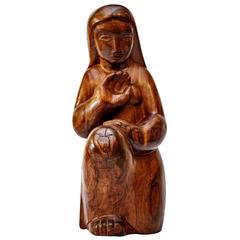
Cocobolo Sculptures

to
1
2
2
1
1
74
18,400
10,676
9,826
8,477
1
1
1
1
Height
to
Width
to
2
2
2
1
Material: Cocobolo
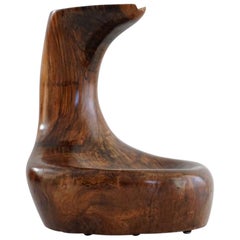
Rare Cocobolo Don Shoemaker Fountain, Organic Mexican Mid-Century Modern, 1960s
Located in San Diego, CA
Exceptional one of a kind organic midcentury Mexican modernist fountain designed by Don Shoemaker. Don Shoemaker fountain is made of Cocobolo woo...
Category

Mid-20th Century Mexican Mid-Century Modern Cocobolo Sculptures

Materials

Cocobolo

Unique Sculpture
Located in Limhamn, Skåne län
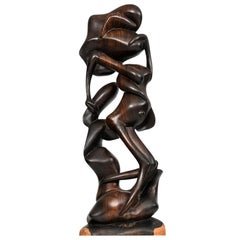
Unique sculpture by unknown artist.
Category

20th Century American Craftsman Cocobolo Sculptures

Materials

Cocobolo

Related Items
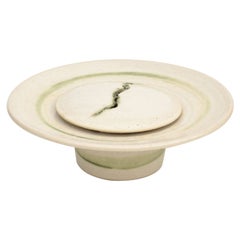
Architectural Studio Pottery Fountain by Piet Knepper
Located in London, GB
Fountain with two different tops by Piet Knepper for Mobach white glaze with copper oxide details and cracked surface, hand turned studio ceramic . This is an example of Modern Scho...
Category

1980s European Vintage Cocobolo Sculptures

Materials

Ceramic

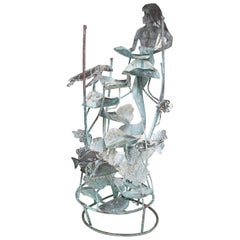
Copper Mermaid Fountain by Glen Mayo
Located in West Palm Beach, FL
Whimsical fountain sculpture, of copper, by metal artist Glen Mayo; its mermaid focal point holding a leaf which cascades water down the fountain, among turtles, angel fish, other se...
Category

1990s North American Cocobolo Sculptures

Materials

Copper

Copper Mermaid Fountain by Glen Mayo
$4,850
H 82.5 in Dm 42 in
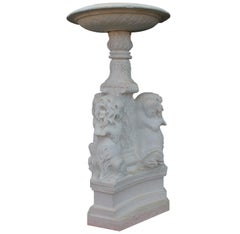
Whimsical English 19th-20th Century White Marble Figural Outdoor Dog Fountain
Located in Los Angeles, CA
A Whimsical English 19th-20th century white marble figural fountain with dogs fountain. The Baroque Revival six-sided tripod marble base surmounted with three upright seated Yorkshire Terriers resting on a leaf and acanthus center stem, topped with a semi-circular scalloped carved basin...
Category

Early 1900s English Baroque Revival Antique Cocobolo Sculptures

Materials

Marble

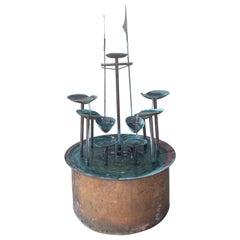
Wonderful Modernist Kenetic Motion Copper Fountain / Water Feature, Hand Made
Located in Buffalo, NY
Ingenious copper fountain / water feature, solid copper construction, Modernist design Artisan made, hand executed. Sculpture in motion, great for garden, or indoor space.
Category

1970s American Mid-Century Modern Vintage Cocobolo Sculptures

Materials

Copper

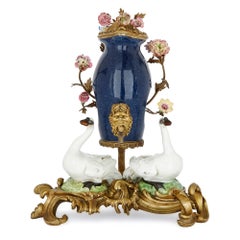
Meissen style porcelain and gilt bronze table fountain by Samson
Located in London, GB
This colourful porcelain table fountain, fashioned in the German Meissen style, was crafted in the 19th Century by the French porcelain company Samson et Cie. The table fountain co...
Category

19th Century German Louis XV Antique Cocobolo Sculptures

Materials

Ormolu

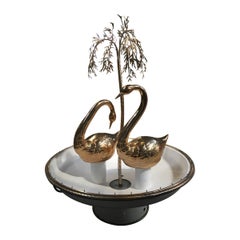
Mid-Century Modern Italian Fountain with Gilt Brass Swans and Weeping Willow
Located in Prato, IT
Mid-Century Modern Italian fountain with gilt brass swans and weeping willow, 1970s This beautiful object can be used either to embellish a garden, or to enrich a spacious living ro...
Category

1970s Italian Mid-Century Modern Vintage Cocobolo Sculptures

Materials

Metal, Brass

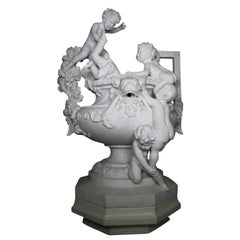
A French 19th Century Carved Marble Whimsical Figural Urn Fountain with Children
By Joseph Reynés I Gurgui
Located in Los Angeles, CA
A very fine large, rare and charming, French, 19th century. Belle Époque carved white marble whimsical figural urn fountain depicting children climbing on an urn with flowers and garlands, influenced in the Louis XV style, by Joseph Reynés I Gurgui (Barcelona, 1850-1926). Signed: Reynes. Barcelona, circa 1890. An almost identical Carrara marble fountain also by Josep Reynés carved in 1893 currently at the Parc de la Ciutadella in Barcelona, Spain. Measures: Overall height: 55 inches (140 cm) Marble height: 49 inches (124.5 cm) width: 37 inches (94 cm) depth: 30 inches (76.3 cm) Joseph Reynes Gurguí (Barcelona, 1850 - 1926) is a Catalan sculptor, also known as Reynesy-Gurgui, Spanish school. He studied at the Ecole de la Llotja, studied for a time in Paris, in the workshops of the great French sculptors Jean-Baptiste Carpeaux (1827-1875) and Carrier-Belleuse (1824-1887). He devoted himself mainly to interior decoration. His works were profoundly marked by a French influence. He exhibited in Paris in 1895 where he received an honorable mention. In 1890 he obtained the first medal in Madrid for "The Violinist". Literature: E. Benezit Dictionaire des Peintres, Sculpteurs, Dessinateurs et Graveurs by Grund - Nouvelle Edition, 1976 - Volume 8, Page 714. Cristina Mensoza, Ramon Casas...
Category

19th Century Spanish Louis XV Antique Cocobolo Sculptures

Materials

Marble

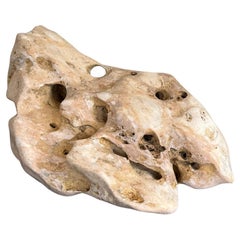
Unique Natural Stone Sculpture
Located in Nijlen, BE
A unique big sculpture, created from the water. Originated in Malta. Velvet soft in feeling. The natural glow creates a beautiful wabi-sabi feel, a sense of imperfection. Beautifull...
Category

19th Century Maltese Primitive Antique Cocobolo Sculptures

Materials

Stone

Unique Natural Stone Sculpture
$1,063
H 10.63 in W 16.54 in D 12.6 in
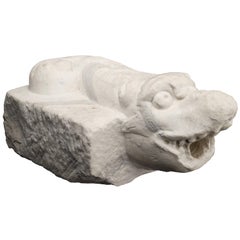
Italian Ancient Marble Sculpture Fountain, Late 16th Century
Located in Milano, IT
Sea monster Carrara marble mouth fountain Italy, late 16th century It measures 13.8 x 31.5 x 18.9 in (35 x 80 x 48 cm) State of conservation: some small evident gaps and widespread signs of wear due to outdoor exposure. The gray marks crossing it do not come from restoration, but are rather the natural veins of the marble. This work has some morphological characteristics typically associated with the iconography of the sea monster: an elongated muzzle, sharp teeth, protruding eyes, elongated ears, and a coiled serpent's tail. An in-depth series of studies on artistic depictions of the sea monster attempted to verify how this symbol evolved in antiquity in the European and Mediterranean contexts and how it gradually changed its image and function over time. The iconography itself is mutable and imaginative and its history is rich with cultural and artistic exchange, as well as the overlapping of ideas. This occurred so much that it is difficult to accurately pinpoint the "types" that satisfactorily represent its various developments. However, we can try to summarize the main figures, starting from the biblical Leviathan and the marine creature that swallowed Jonah (in the Christian version, this figure was to become a whale or a "big fish", the “ketos mega”, translation of the Hebrew “dag gadol”). Other specimens ranged from the dragons mentioned in the Iliad (which were winged and had legs) to "ketos” (also from Greek mythology), the terrifying being from whose Latinized name (“cetus”) derives the word "cetacean". See J. Boardman, “Very Like a Whale” - Classical Sea Monsters, in Monsters and Demons in the Ancient and Medieval Worlds, in Papers presented in Honor of Edith Porada, Mainz am Rhein 1987, pp. 73-84). In Italy the monster underwent yet further variations: it can be found in Etruscan art on the front of some sarcophagi representing the companion of souls, while among the Romans we find the “Pistrice” (cited by Plinio in Naturalis Historia PLIN., Nat., II 9, 8 and by Virgilio in Eneide: VERG., Aen., III, 427), which appeared in the shape of a stylized hippocampus or a very large monstrous cetacean and evolved into a hideous being with a dragon's head and long webbed fins. During the Middle Ages, the sea monster was the object of new transformations: at this time, it is often winged, the head is stretched like a crocodile, the front legs are often very sharp fins - sometimes real paws - until the image merges with dragons, the typical figures of medieval visionary spirituality widely found throughout Europe (on this topic and much more, see: Baltrušaitis, J., Il Medioevo fantastico. Antichità ed esotismi nell’arte gotica, Gli Adelphi 1997). In Italy during the 15th and 16th centuries, the revival of classicism - representative of the humanistic and Renaissance periods - led to a different reading of these "creatures". Indeed, the sea monster was also to find widespread use as an isolated decorative motif, especially in numerous fountains and sculptures where dolphins or sea monsters were used as a characterizing element linked to water (on this theme see: Chet Van Duzer, Sea Monsters on Medieval and Renaissance Maps, London, The British library, 2013). From the morphological point of view, the "sea monsters" of this period are mostly depicted as hybrid figures, in which the body of a mythological or real being (a hippocampus, a sea snake, a dolphin), is joined to a head with a rather indistinct appearance. It was usually characterized by large upright ears, an elongated snout, sharp teeth and globular, protruding eyes; a complex and indefinite figure, both from the symbolic point of view and from that of its genesis. The work we are examining is placed as a cross between the medieval sea serpent and the Renaissance dolphin, with stylistic features which recall the snake as often used in heraldry (such as the "snake" depicted in the coat of arms of the Visconti - the lords and then dukes of Milan between 1277 and 1447 - and which, for some, may be derived from the representations of the “Pistrice” that swallowed Jonah). In the search for sources, Renaissance cartography and in particular woodcuts should not be neglected. See for example the monsters of Olaus Magnus, from the editions of the “Historia de gentibus septentrionalibus” (“History of the peoples of the north”) and the natural histories of Conrad Gesner, Ulisse...
Category

16th Century Italian Renaissance Antique Cocobolo Sculptures

Materials

Carrara Marble

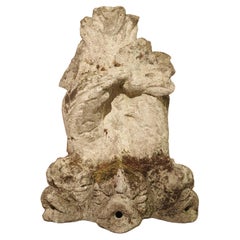
Antique French Stone Fountain Piece with Triple Dolphin Spouts, Circa 1900
Located in Dallas, TX
This charming French fountain piece with triple dolphin spouts was made circa 1900. The dolphins are made from reconstituted stone, which is natural lim...
Category

Early 1900s French Antique Cocobolo Sculptures

Materials

Stone

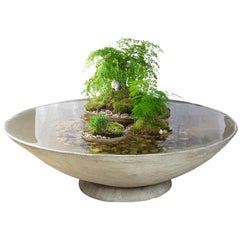
Ukiyo Saucer, Concrete Fountain/Fishpond by OPIARY (D50")
Located in Brooklyn, NY
Opiary is a Brooklyn-based biophilic design and production studio. We integrate nature in each of our designs, incorporating live greenery and organic shapes into bespoke furniture, planters, and sculpture. Through the ethos of biophilia, our work reflects the shifting, yet timeless relationship between humans and nature. This modern, minimalist fountain is a tasteful way to incorporate aquatic life into any indoor or outdoor space. The Ukiyo Saucer...
Category

21st Century and Contemporary Modern Cocobolo Sculptures

Materials

Cement

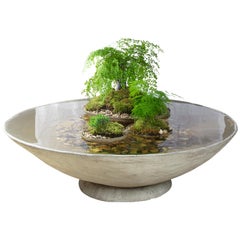
Ukiyo Saucer, Concrete Fountain/Fishpond by OPIARY (D62")
Located in Brooklyn, NY
Opiary is a Brooklyn-based biophilic design and production studio. We integrate nature in each of our designs, incorporating live greenery and organic shapes into bespoke furniture, planters, and sculpture. Through the ethos of biophilia, our work reflects the shifting, yet timeless relationship between humans and nature. This modern, minimalist fountain is a tasteful way to incorporate aquatic life into any indoor or outdoor space. The Ukiyo watersaucer can house multiple floating islands...
Category

21st Century and Contemporary Modern Cocobolo Sculptures

Materials

Cement

Previously Available Items
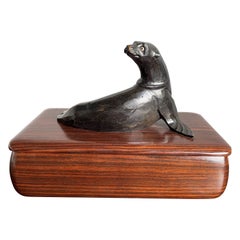
Striking Coromandel Wood Box with a Hand Carved Ebonized Sea Lion Sculpture 1920
Located in Lisse, NL
All handcrafted, one of a kind and truly beautiful Art Deco box. If you are looking for a truly beautiful box for yourself or maybe as a gift for that special someone in your life then this rare and all handcrafted gem could be perfect. We love everything about this Art Deco era box and we have never seen another one like it anywhere in the world. The beautifully rounded geometrical design of the striking coromandel box...
Category

Early 20th Century European Art Deco Cocobolo Sculptures

Materials

Cocobolo, Wood, Glass

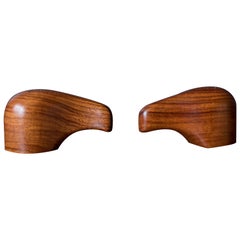
Vintage Cocobolo Salt and Pepper Shaker Set by Don Shoemaker
Located in San Jose, CA
Mid-Century Modern abstract salt and pepper shakers designed by Don Shoemaker for Señal, S.A. Mexico. This set is handmade in an exotic cocobolo wood displaying rich smooth grains fo...
Category

1960s Mexican Mid-Century Modern Vintage Cocobolo Sculptures

Materials

Cocobolo

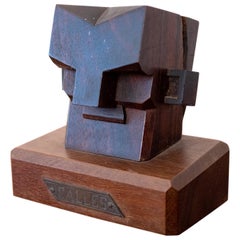
Mexican Modernist Art Deco Sculpture of Plutarco Elías Calles
Located in San Diego, CA
Art Deco sculpture of Mexican President, Plutarco Elías Calles. Constructed out of cocobolo, with a brass Calles plaque. Elected in 1924, Calles called for land redistribution and promised equal...
Category

1920s Mexican Art Deco Vintage Cocobolo Sculptures

Materials

Cocobolo

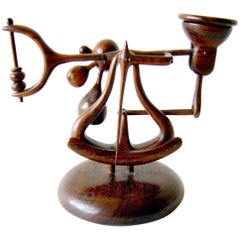
Bill Chappelow Cocobolo Wood with Gold Accents Balance Scale
By William Chappelow
Located in Palm Springs, CA
Cocobolo wood scale with 14 karat gold dots as scale markers in grams, created by William (Bill) Chappelow of Gautay, California. Scale measures 7" high by 9" wide by 5" deep. Signed...
Category

1980s American Organic Modern Vintage Cocobolo Sculptures

Materials

Cocobolo

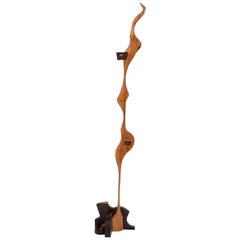
Randy Bader Organic Sculpture in Mixed Wood
By Randy Bader
Located in Phoenix, AZ
Randy Bader is a Laguna Beach master craftsman. This example some 25 years old, mixes cocobolo walnut and other exotic woods to create a free-form floor sculpture with two hand-carve...
Category

1990s American Mid-Century Modern Cocobolo Sculptures

Materials

Walnut, Cocobolo

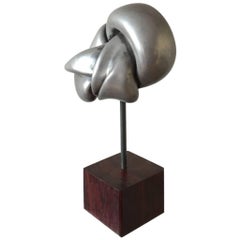
1960 Pewter Abstract Small Sculpture
Located in London, GB
A pewter abstract small sculpture, depicting a knot, on a solid cocobolo square base, English, circa 1960. Measures: 22 cm high.
Category

Mid-20th Century English Cocobolo Sculptures

Materials

Pewter

1960 Pewter Abstract Small Sculpture
H 8.67 in W 4.34 in D 2.76 in
Carved Sculpture
Located in Rochester, NY
Modernist carved cocobolo wood sculpture figure of a woman, Mid-century circa 1950. Student work from Cranbrook Academy of Art.  The Cranbrook Academy of Art, one of the nation's ...
Category

Mid-20th Century American Mid-Century Modern Cocobolo Sculptures

Materials

Cocobolo, Wood

Carved Sculpture
Carved Sculpture
H 18 in W 8 in D 8 in

Read More

He Wrote ‘Oedipus Rex,’ but Do You Know What He Looked Like?

The Greek tragedian is said to have been handsome in his day.

These Soft Sculptures Are Childhood Imaginary Friends Come to Life

Miami artist and designer Gabriela Noelle’s fantastical creations appeal to the Peter Pan in all of us.

Salvatori Commissioned Several Famous Architects to Create Miniature Homes in Stone

Gabriele Salvatori explains how the COVID lockdowns inspired his design company's latest collection, the Village.

Christopher Norman Is Turning the Cast-Off Urban Trees of Los Angeles into Art

With a World War II–era milling machine, the California artist crafts poetic, sculptural furniture pieces.

These Human-Size Ceramic Hares Evoke Serious Emotions

Swedish artist Margit Brundin's large anthropomorphic animal sculptures are on view for the first time in the United States at Dienst + Dotter Antikviteter, in New York.

Tour the Wabi-Sabi New York Apartment of Andrianna Shamaris

As her sun-filled home reveals, the furniture maker and dealer puts a contemporary spin on antiques from around the globe.

Vicente Wolf’s Tips for Finding — and Living with — Eastern Treasures

The A-list designer shares his expertise on choosing authentic objects and displaying them with style.

Rodrigo Rivero Lake’s Mexico City Showroom Is a Museum-Worthy Trove of Spanish Colonial and Asian Antiques

The dealer and curator has spent the past 50 years amassing a collection of exceptional art, furniture and architectural elements that trace the cultural influence of the Spanish empire from Europe to the Americas and beyond.

Still Thinking About These?

All Recently Viewed