Renaissance Decorative Objects

RENAISSANCE STYLE

Spanning an era of cultural rebirth in Europe that harkened back to antiquity, the Renaissance was a time of change in design. From the late 1400s to the early 1600s, Rome, Venice and Florence emerged as artistic centers through the expansion of global trade and a humanist belief in the arts being central to society. Antique Renaissance furniture was ornately carved from sturdy woods like walnut, its details standing out against the tapestries and stained glass adorning the walls.

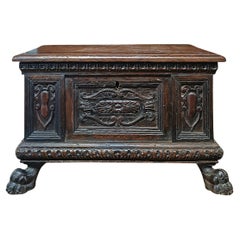
Renaissance chests, which were frequently commissioned for marriages, were often decorated with gilding or painted elements. Those that were known as cassoni were crafted in shapes based on classical sarcophagi. As opposed to the medieval era, when furniture was pared down to the necessities, a wide range of Renaissance chairs, tables and cabinets were created for the home, and the designs regularly referenced ancient Rome.

Large torchères of the Renaissance era that were used as floor lamps were inspired by classical candelabras, while marble surfaces evoked frescoes. The inlaid boxes being imported from the Middle East informed the intarsia technique, which involved varying hues of wood in mosaic-like patterns, such as those by architect Giuliano da Maiano in the Florence Cathedral.

Tapestry-woven cushion covers accented the variety of Renaissance seating — from conversation to study chairs — while bookcases for secular use reflected the migration of culture and knowledge from the church into the home. The aesthetics of the Italian Renaissance later spread to France through the publishing of work by renowned designers, including Hugues Sambin and Jacques Androuet du Cerceau. Centuries later, the 19th-century Renaissance Revival would see a return to this influential style.

Find a collection of antique Renaissance case pieces, decorative objects and other furniture on 1stDibs.

to
37
171
169
104
36
38
15
24
6
3
3
3
3
6
5
5
604
424
359
204
181
127
54
36
23
15
14
13
11
7
3
1
1
93
61
31
28
18
116
52
164
83
22
15
11
Height
to
Width
to
171
171
171
1
1
Period: 18th Century and Earlier
Style: Renaissance
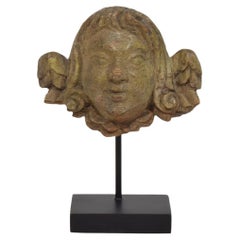
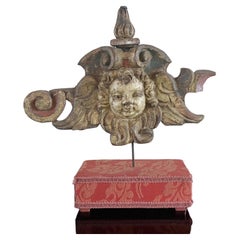
French 16th/ 17th Century Weathered Oak Renaissance Angel Fragment
Located in Buisson, FR
Beautiful weathered oak winged angel head Renaissance ornament. France, 16/ 17th century. Weathered Measurements include the wooden pedestal.
Category

16th Century French Antique Renaissance Decorative Objects

Materials

Oak

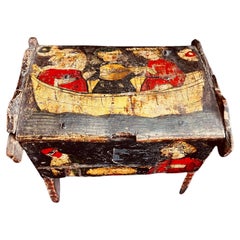
Antique Rare 15th Century Venetian Casket Former Dr. Albert Figdor Collection
Located in Doha, QA
This exceptional 15th-century Venetian painted casket is a rare example of early decorative art from the late Medieval to early Renaissance period in the Republic of Venice, Italy. H...
Category

15th Century and Earlier Italian Antique Renaissance Decorative Objects

Materials

Wood, Paint

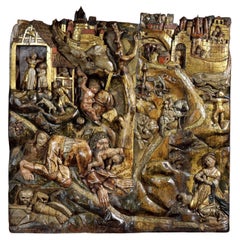
Wood Low-Relief Depicting a Werewolf and Saint George
Located in Saint-Ouen, FR
Exceptional polychrome wood low-relief depicting a werewolf and saint george after a woodcut by lucas cranach (“DER WERWOLF” 1512) Provenance : collection Brimo de Laroussihle colle...
Category

16th Century German Antique Renaissance Decorative Objects

Materials

Wood

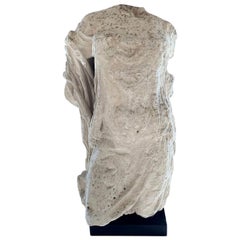
16th Century Stone Classical Roman Style Torso
Located in Vosselaar, BE
A wonderful 16th century draped female torso in classical style. Made in France under Italian Renaissance influence this female torso is finely sculpted with great detail to the stol...
Category

16th Century French Antique Renaissance Decorative Objects

Materials

Sandstone

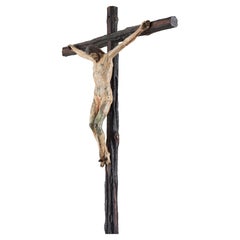
Rare and important painted bronze Crucifix after a model by Michelangelo
By Michelangelo Buonarroti
Located in Leesburg, VA
A rare and very fine bronze corpus of Christ after a model by Michelangelo, cast ca. 1597-1600 by Juan Bautista Franconio and painted in 1600 by Francisco Pacheco in Seville, Spain. The present corpus reproduces a model attributed to Michelangelo. The best known example, lesser in quality, is one on display at the Metropolitan Museum of Art (MET). The association of this corpus with Michelangelo was first brought to light by Manuel Gomez-Moreno (1930-33) who studied the wider circulated casts identified throughout Spain. The attribution to Michelangelo was subsequently followed by John Goldsmith-Phillips (1937) of the MET and again by Michelangelo expert, Charles de Tolnay (1960). While Michelangelo is best known for his monumental works, there are four documented crucifixes he made. The best known example is the large-scale wooden crucifix for the Church of Santa Maria del Santo Spirito in Florence, made in 1492 as a gift for the Prior, Giovanni di Lap Bicchiellini, for allowing him to study the anatomy of corpses at the hospital there. In 1562, Michelangelo wrote two letters to his nephew, Lionardo, indicating his intention to carve a wooden crucifix for him. In 1563 a letter between Lionardo and the Italian sculptor Tiberio Calcagni, mentions this same crucifix (a sketch of a corpus on the verso of a sheet depicting Michelangelo’s designs for St. Peter’s Basillica [Palais des Beaux-Arts in Lille] may reproduce this). That Michelangelo was working on small corpora in the last years of his life is further evidenced by the small (26.5 cm) unfinished wooden crucifix located at the Casa Buonarroti, considered his last known sculptural undertaking. Michelangelo’s contemporary biographer, Giorgio Vasari additionally cites that Michelangelo, in his later years, made a small crucifix for his friend, Menighella, as a gift. Surviving sketches also indicate Michelangelo’s study of this subject throughout his career, most notably during the end of his life but also during the 1530s-40s as he deepened his spiritual roots. The occasional cameo of crucified Christ’s throughout his sketched oeuvre have made it challenging for scholars to link such sketches to any documented commissions of importance. All the while, in consideration that such objects were made as gifts, it is unlikely they should be linked with commissions. Nonetheless, a number of theories concerning Michelangelo’s sketches of Christ crucified have been proposed and some may regard the origin of the present sculpture. It has been suggested that the corpus could have its impetus with Michelangelo’s work on the Medici Chapel, whose exclusive design was given to the master. It is sensible smaller details, like an altar cross, could have fallen under his responsibility (see for example British Museum, Inv. 1859,0625.552). Others have noted the possibility of an unrealized large marble Crucifixion group which never came to fruition but whose marble blocks had been measured according to a sheet at the Casa Buonarroti. A unique suggestion is that Michelangelo could have made the crucifix for Vittoria Colonna, of whom he was exceedingly fond and with whom he exchanged gifts along with mutual spiritual proclivities. In particular, Vittoria had an interest in the life of St. Bridget, whose vision of Christ closely resembles our sculpture, most notably with Christ’s proper-left leg and foot crossed over his right, an iconography that is incredibly scarce for crucifixes. The suggestion could add sense to Benedetto Varchi’s comment that Michelangelo made a sculpted “nude Christ…he gave to the most divine Marchesa of Pescara (Vittoria Colonna).” Of that same period, two sketches can be visually linked to our sculpture. Tolnay relates it to a sketch of a Crucified Christ at the Teylers Museum (Inv. A034) of which Paul Joannides comments on its quality as suggestive of preparations for a sculptural work. Joannides also calls attention to a related drawing attributed to Raffaello da Montelupo copying what is believed to be a lost sketch by Michelangelo. Its relationship with our sculpture is apparent. Montelupo, a pupil of Michelangelo’s, returned to Rome to serve him in 1541, assisting with the continued work on the tomb of Pope Julius II, suggesting again an origin for the corpus ca. 1540. The earliest firm date that can be given to the present corpus is 1574 where it appears as a rather crudely conceived Crucifixion panel, flanked by two mourners in low-relief and integrally cast for use as the bronze tabernacle door to a ciborium now located at the Church of San Lorenzo in Padula. Etched in wax residue on the back of the door is the date, 27 January 1574, indicating the corpus would have at least been available as a model by late 1573. The Padula tabernacle was completed by Michelangelo’s assistant, Jacopo del Duca and likely has its origins with Michelangelo’s uncompleted tabernacle for the Basilica of St. Mary of the Angels in Rome. The impetus for the Padula tabernacle’s Crucifixion panel begins with a series of late Crucifixion sketches by Michelangelo, depicting a scene of Christ crucified and flanked by two mourners (see British Museum Inv. 1895.0915.510; Ashmolean Museum Inv. 1846.89, KP II 343 recto; Windsor Castle RCIN 912761 recto; and Louvre Inv. 700). A faintly traced block possibly intended for sculpting the sketch of the crucified Christ on its recto was discovered by Tolnay on a version of the composition at Windsor Castle. The Windsor sketch and those related to it appear to have served as preparatory designs for what was probably intended to become the Basilica of St. Mary’s tabernacle door. Vasari documents that the project was to be designed by Michelangelo and cast by his assistant, Jacopo del Duca. Michelangelo died before the commission was complete, though on 15 March 1565, Jacopo writes to Michelangelo’s nephew stating, “I have started making the bronze tabernacle, depending on the model of his that was in Rome, already almost half complete.” Various circumstances interrupted the completion of the tabernacle, though its concept is later revitalized by Jacopo during preparations to sell a tabernacle, after Michelangelo’s designs, to Spain for Madrid’s El Escorial almost a decade later. The El Escorial tabernacle likewise encountered problems and was aborted but Jacopo successfully sold it shortly thereafter to the Carthusians of Padula. An etched date, 30 May 1572, along the base of the Padula tabernacle indicates its framework was already cast by then. A 1573 summary of the tabernacle also describes the original format for the door and relief panels, intended to be square in dimension. However, a last minute decision to heighten them was abruptly made during Jacopo’s negotiations to sell the tabernacle to King Phillip II of Spain. Shortly thereafter the commission was aborted. Philippe Malgouyres notes that the Padula tabernacle’s final state is a mixed product of the original design intended for Spain’s El Escorial, recycling various parts that had already been cast and adding new quickly finished elements for its sale to Padula, explaining its unusually discordant quality, particularly as concerns the crudeness of the door and relief panels which were clearly made later (by January 1574). Apart from his own admission in letters to Spain, it is apparent, however, that Jacopo relied upon his deceased master’s designs while hastily realizing the Padula panels. If Michelangelo had already earlier conceived a crucifix model, and Jacopo had access to that model, its logical he could have hastily employed it for incorporation on the door panel to the tabernacle. It is worth noting some modifications he made to the model, extending Christ’s arms further up in order to fit them into the scale of the panel and further lowering his chin to his chest in order to instill physiognomic congruence. A crude panel of the Deposition also follows after Michelangelo’s late sketches and is likewise known by examples thought to be modifications by Jacopo based upon Michelangelo’s initial sculptural conception (see Malgouyres: La Deposition du Christ de Jacopo del Duca, chef-d’oeuvre posthume de Michel-Ange). Jacopo’s appropriation of an original model by Michelangelo for more than one relief on the Padula tabernacle adds further indication that the crucifix was not an object unique to Jacopo’s hand, as few scholars have posited, but rather belongs to Michelangelo’s original...
Category

16th Century Antique Renaissance Decorative Objects

Materials

Bronze

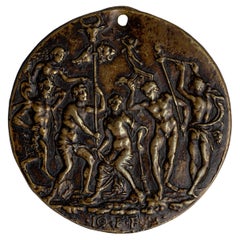
15th Century Italian Renaissance Bronze Medallion
Located in Fort Lauderdale, FL
Renaissance bronze medallion made by Master IOFF in the mid 15th century, showing the mythological scene of Ariadne on Naxos. Made in the mid-15th ...
Category

15th Century and Earlier Italian Antique Renaissance Decorative Objects

Materials

Bronze

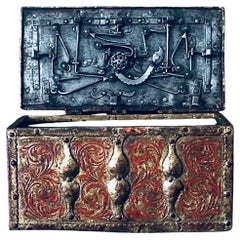
Antique 16th century Venetian Painted Gold Gilt Iron Strongbox with Original Key
Located in Doha, QA
An extraordinarily rare and visually striking 16th-century Venetian iron treasure coffer, showcasing the height of Renaissance artistry and engineering. Crafted in the early to mid-1...
Category

16th Century Italian Antique Renaissance Decorative Objects

Materials

Gold, Iron

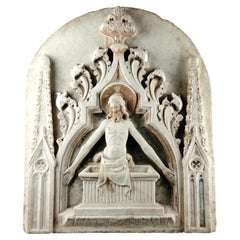
A Very Rare and Important Marble Relief of the ‘Resurrection of Christ’
Located in London, GB
A Very Rare and Important Marble Relief of the ‘Resurrection of Christ’ Attributed to the Master of the Mascoli Altar Marble Venice, Italy Second half of the 15th Century SIZE: ...
Category

15th Century and Earlier Italian Antique Renaissance Decorative Objects

Materials

Marble

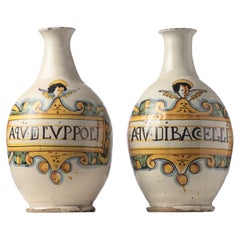
Pair of 18th c. Italian Pharmacy Jars
Located in Wichita, KS
A rare pair of tin-glazed (lead glaze with a bit of tin oxide added) earthenware pharmacy jars from Italy hand-painted. Beautiful color and elegant shape. Circa 1720.
Category

18th Century Italian Antique Renaissance Decorative Objects

Materials

Terracotta

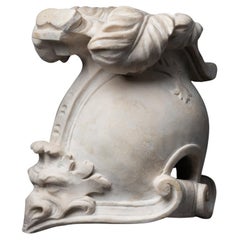
Marble Helmet - France, 17th century
Located in Bruxelles, BE
Marble Helmet
 France, 17th century
 Marble
 25 × 27 × 18 cm This finely carved marble helmet, adorned with a grotesque mask, exemplifies the 17th-century fascination with antique-i...
Category

17th Century French Antique Renaissance Decorative Objects

Materials

Marble

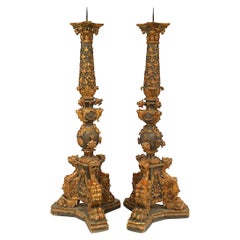
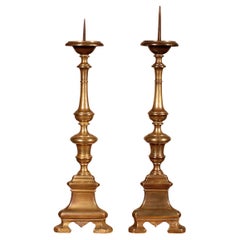
Pair of Italian Renaissance Altar Candlesticks
Located in Queens, NY
PAIR of Italian Renaissance-style (17th Century) dark green painted large floor standing altar style candlesticks with gilt carved floral and vine trim supported on base with 3 griff...
Category

17th Century Antique Renaissance Decorative Objects

Materials

Wood

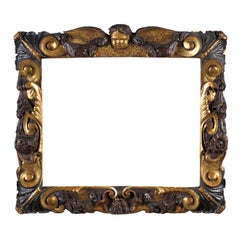
16th Century Partly Gilt Carved Wood Frame
Located in Saint-Ouen, FR
This rare Venetian frame entirely carved in high-relief shows a rich decor of scrolls, garlands, daisy flowers and thistles. At the four corners of the frame are depicted large acant...
Category

16th Century Italian Antique Renaissance Decorative Objects

Materials

Wood

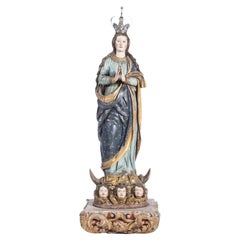
Indo-Portuguese sculpture "Lady Conception" 17th century, H 147cm
Located in Madrid, ES
Indo-Portuguese sculpture "Lady Conception" 17th century, H 147cm. Our Lady Conception Indo-Portuguese teak wood carving from the 17th century. Upholstered and polychrome . T he ...
Category

17th Century Portuguese Antique Renaissance Decorative Objects

Materials

Wood

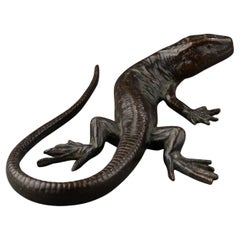
Bronze salamander - 17th century
Located in Bruxelles, BE
Bronze salamander Italy, 17th century Patinated bronze 4 x 17 x 10 cm This finely cast bronze salamander exemplifies the 17th-century fascination with naturalistic forms and animal ...
Category

17th Century Italian Antique Renaissance Decorative Objects

Materials

Bronze

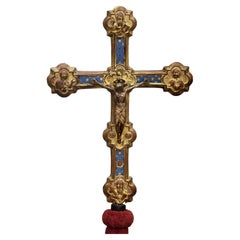
Paolo di Giovanni Sogliani - Processional Cross Florence, around 1515
Located in Bruxelles, BE
Paolo di Giovanni Sogliani (Florence 1455-1522) Processional Cross Florence, around 1515 Enameled, chiseled, engraved, stippled, and gilded copper; wooden core ; Inscription: "OPA...
Category

16th Century Italian Antique Renaissance Decorative Objects

Materials

Copper, Enamel

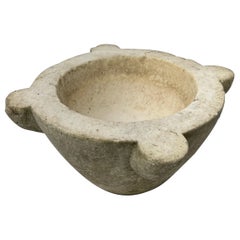
Large 18th Century, Italian or French White Marble Mortar Phenomenal Patina
Located in Atlanta, GA
Likely Italian or French, 18th century. An impressive and large mortar carved from a single block of white marble. Showing phenomenal antique patina - this piece was heavily used du...
Category

18th Century French Antique Renaissance Decorative Objects

Materials

Marble

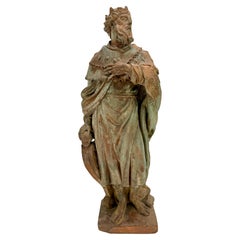
Highly Important Jacques Bergé (Flemish, 1693 - 1756) King David Sculpture 1736
Located in Atlanta, GA
Jacques Bergé "King David" - Terracotta or Fired Clay with Polychrome Remnants Dated 1736 14.5" h x 5.5" w x 4.5" d A rare and exceptionally refined terracotta sculpture of *King ...
Category

Early 18th Century Belgian Antique Renaissance Decorative Objects

Materials

Clay, Terracotta

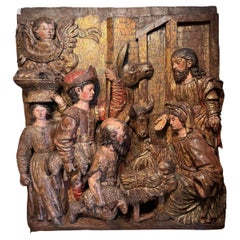
Adoration of the shepherds - Large high-relief, Northern Italy Circa 1500
Located in PARIS, FR
Large high relief in carved and gilt wood, with many traces of polychromy, representing the Adoration of the Shepherds. The evangelist Luke first mentions that the scene takes place at night. A sudden light, which frightens the shepherds, signals the arrival of an angel who announces "great joy". He gives them a sign: they will find "a newborn baby wrapped...
Category

16th Century Italian Antique Renaissance Decorative Objects

Materials

Wood

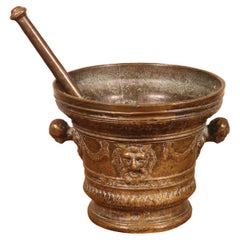
Bronze Pharmacy Mortar Italy-17° Century
Located in Brussels, Brussels
Elegant bronze mortar from the 17 century from Italy dated 1630. Really rare mortar due to his big size. In very good condition and beautiful patina.
Category

17th Century Italian Antique Renaissance Decorative Objects

Materials

Bronze

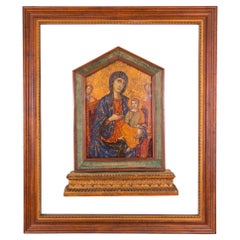
Madonna Enthroned with the Child Christ, 17th Century, Gold Gilded on Wood Panel
Located in North Miami, FL
17th Century Italian polychromed and gold gilded on wood panel Sienese style painting of the Madonna Enthroned with the child and two adoring angels behind them. The halos are beautifully adorned with punch work. She is framed by a hand-carved gold gilded and velvet lined frame and sitting on a hand-carved matching base. The piece is mounted on a Lucite panel and framed with a contemporary hand-finished wood molding.
Category

Early 17th Century Italian Antique Renaissance Decorative Objects

Materials

Gold Leaf

Embriachi workshop marquetry casket - Northern Italy, 15th century
Located in Bruxelles, BE
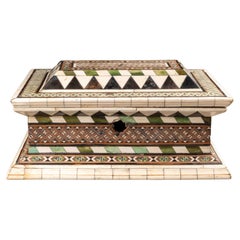
Embriachi workshop marquetry casket Northern Italy, 15th century Alla certosina inlays (bone, stained bone, pewter and wood) H 28.2 x W 18 x D 14 cm This beautiful casket of rectangular form is richly decorated with the characteristic geometric patterns of the Embriachi style. The intricate geometric patterns are fashioned by juxtaposing lighter and darker pieces of wood, (colored) bone, horn and pewter. The lid and base are framed by a broad band of horn. When ivory became scarce in Europe due to disrupted trade routes, bone was substituted. The attention to Symmetry and balance created an harmonious visual effect Enhancing the overall aesthetic appeal of the casket. The application of geometrical motifs is in Italy known as marquetry ‘alla Certosina’, named after the Certosina Church in Pavia with its famous altarpiece decorated in this way. This is ‘intarsia technique’, a term derived from the Arabic 'tarsi', which means ‘incrustation' recalling ancient mosaics made from various materials. These geometric elements not only enhance the aesthetic appeal of the caskets but also demonstrate the versatility and skill of the artisans in creating multifaceted works of art. ‘Alla Certosina’ became famous through the Northern Italian Embriachi family who achieved a particularly high standard in working in this technique. Venice in particular was known for the production of these luxurious boxes. The caskets, hexagonal or rectangular, surmounted by a lid decorated in several registers constitute the secular, albeit equally renowned component of the workshop’s production, in addition to mirror frames and various everyday objects. The method of fabrication of those objects was based on two concepts that underlay pre-industrial production: standardization and modularity, thanks to a distribution of skills according to the different phases of fabrication. even the realization of the marquetry motifs (in the form of ingots from which portions of the desired size were cut) were therefore entrusted to various specialized craftsmen, as were the assembly phase. Today better known thanks to the extensive research work recently carried out by Michele Tomasi, this workshop owes its name to its founder and owner, the Florentine Baldassare Ubriachi (or degli Embriachi), a merchant and banker established in the Tuscan capital before he settled in Venice in 1395. Together with sculptor Giovanni di Jacopo, who directed the workshop, from the last years of the fourteenth century, Baldassare oversaw a production that was truly original, and still easily recognizable today, comprising monumental altarpieces and various objects, primarily triptychs and caskets. The precise location of the workshop is unknown, except that it originated in Florence and in ca. 1431 there was apparently a workshop in Venice, in the area of S Luca. They employed local workers specializing in 'certosina' (inlay of stained woods, bone and horn), and the workshop produced items carved in bone (usually horse or ox) with wood and bone marquetry. The geometric decoration of Embriachi caskets reflects the artistic complexity and attention to detail that characterized their work. this inlaid casket is a testament to the skill and artistry of the Embriachi family and serves as a stunning example of the decorative arts of the late Middle Ages. Related Literature : E. Berger, Prunk-Kassetten: Europäischen Meisterwerke aus acht Jahrhunderten / Ornamental Caskets...
Category

15th Century and Earlier Italian Antique Renaissance Decorative Objects

Materials

Pewter

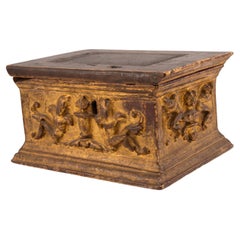
LATE 16th CENTURY SMALL WALNUT BOX
Located in Firenze, FI
Elegant solid walnut small box, entirely hand-carved. The rectangular chest features an opening top, ideal for storing objects. The front, back, and sides are decorated with geometri...
Category

16th Century Italian Antique Renaissance Decorative Objects

Materials

Nutwood

Italian Renaissance Carved Wooden Angel Head
Located in Los Angeles, CA
Italian renaissance hand carved wooden "putto" angel head, circa 15th Century Width 14 inches / height 14 inches / depth 4 inches 1 available in stock in Italy Order reference #: FAB...
Category

15th Century and Earlier Italian Antique Renaissance Decorative Objects

Materials

Wood

Polychrome Papier-mâché Madonna and Child
Located in Queens, NY
Polychrome and gilt papier-mâché Religious Madonna and child depicting the Nuestra Señora de la Candelaria. Figures stand on a gilt rectangular base with painted description by the a...
Category

17th Century Mexican Antique Renaissance Decorative Objects

Materials

Chrome

18th Century Italian Maiolica Blue and White Alborello Pharmacy Jar #1
Located in Bradenton, FL
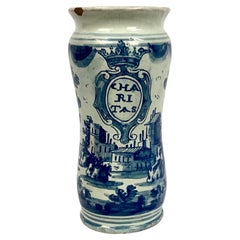
18th Century Italian Majolica Albarello Pharmacy Jar. Jar is in a cylindrical shape with flared rim and foot. Jar features blue and white pattern with the word "Charitas" in an oval ...
Category

18th Century Italian Antique Renaissance Decorative Objects

Materials

Maiolica

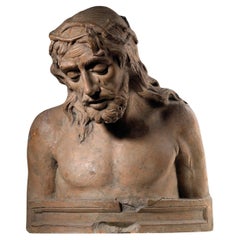
Ecce Homo - Florence, 15th century
Located in Bruxelles, BE
A terracotta bust "Ecce Homo" Florence, 15th century 53 x 44 x 31 cm
Category

15th Century and Earlier Italian Antique Renaissance Decorative Objects

Materials

Terracotta

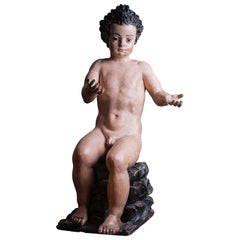
Cercle of Juan Martinez Montañés 1568-1649 , Infant St John the Baptist
Located in Bruxelles, BE
Cercle of Juan Martinez Montañés (1568-1649) Infant St John the Baptist Spanish, 17th century H 74 cm Saint John the Baptist is here represented naked, sitting on a rock, with...
Category

17th Century Spanish Antique Renaissance Decorative Objects

Materials

Wood

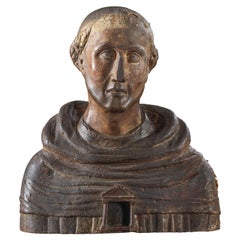
16th Century Polychrome Reliquary of a Monk
Located in Saint-Ouen, FR
The monk is depicted with an oval face, marked with high and strong cheekbones, sunken cheeks, strong jawbones and a cleft chin. His almond shaped eyes are opened under very strong a...
Category

16th Century Italian Antique Renaissance Decorative Objects

Materials

Wood

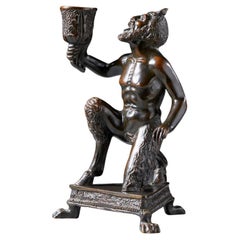
Calzetta Da Ravenna Severo Candlestick Depicting a Kneeling Satyr
By Severo Calzetta da Ravenna
Located in Milano, IT
Calzetta Da Ravenna (Attivo Tra IL 1496 E IL 1543 circa) Severo. Circle of. Candlestick depicting a kneeling satyr. The model of the present bronze is the ""kneeling satyr"" attributed to Severo Calzetta da Ravenna, one of the main Paduan bronze sculptors of the first half of the 16th century, whose figure was rediscovered by Planiscig in 1935 (L. Planiscig, ""Severo da Ravenna...
Category

16th Century Italian Antique Renaissance Decorative Objects

Materials

Bronze

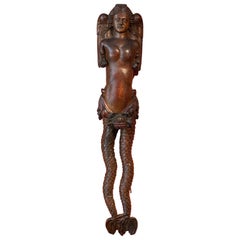
16th Century Southern Germany Carved Wood Bracket Depicting a Mermaid
Located in Saint-Ouen, FR
In Medieval Europe and even more during the early 16th century fantastic beasts could be found in Bestiaries, a literary genre close to poetry. A bestiary used the characteristics of...
Category

16th Century German Antique Renaissance Decorative Objects

Materials

Wood

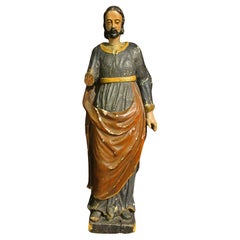
18th Century Wood Sculpture of a Saint
Located in Chapel Hill, NC
An 18th Century carved polychromed Saint, various old repairs losses, but truly great original surface! 42 1/2"h. We are a family business that has been a major source f...
Category

18th Century Italian Antique Renaissance Decorative Objects

Materials

Wood

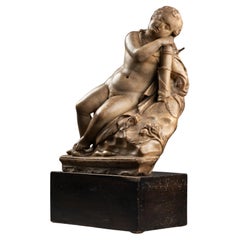
Sleeping Eros - Rome, 16th century
Located in Bruxelles, BE
Sleeping Eros Rome, 16th century
 Carrara marble, on a wooden base
 of an ancient collection 31 × 44 x 17 cm Carved from a fine block of Carrara marble, this sculpture depicts Eros ...
Category

16th Century Italian Antique Renaissance Decorative Objects

Materials

Carrara Marble

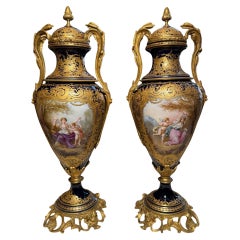
Sevres Style Pair Of Gilt Cobalt Blue Urns
Located in Guaynabo, PR
This is a Pair of Gilt Cobalt Blue Urns. Both Urns depict a cobalt blue background that is decorated in the center with a hand painted country side landscape ...
Category

18th Century Unknown Antique Renaissance Decorative Objects

Materials

Porcelain

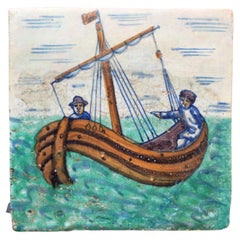
Extremely Rare Rotterdammer Tile with Two Men in a Boat, Early 17th Century
Located in AMSTERDAM, NH
An extremely rare, so-called, Rotterdammer tile, with the decoration of a sailboat. Country: The Netherlands Place: Rotterdam Date: circa 1615 - 1620 Workshop: Claes Wijtmans This tile comes from one of the most rare and sought after tile series...
Category

Early 17th Century Dutch Antique Renaissance Decorative Objects

Materials

Ceramic, Majolica

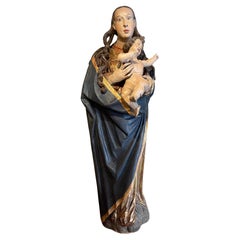
Large Virgin and Child, Tyrol, 16th century
Located in PARIS, FR
Large wooden Madonna and Child, painted and carved in hollow at the back. The theme of the Virgin and Child is the most represented in all Christian art, whereas the infancy of Jesus...
Category

16th Century German Antique Renaissance Decorative Objects

Materials

Wood, Pine

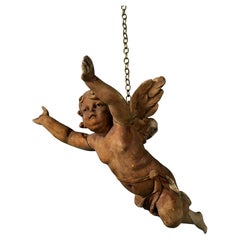
Antique 17th Century Carved Boxwood Cherub Wall Hanging
Located in Wormelow, Herefordshire
An antique carved boxwood cherub decorative wall hanging dating to circa 1650. Crafted in boxwood, this renaissance style sculpture depicts a detailed handcarved cherub or putti bea...
Category

Mid-17th Century English Antique Renaissance Decorative Objects

Materials

Wood, Boxwood

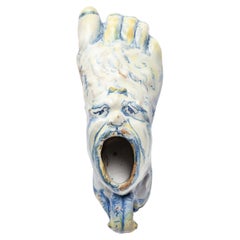
Renaissance Inkwell Calamelli workshop, Italy, Faenza, second half of the 16th
By Virgiliotto Calamelli
Located in Milano, IT
Inkwell Calamelli workshop (attr.). Faenza, second half of the 16th century Height 4.33 in; length 8.07 in; depth 2.95 in (11 cm; 20.5 cm; 7.5 cm) Weight: 0.800 lb (363 g) State of conservation: some chipping to the top of the mask around the mouth. Handle glued, without any restorations; minor chips in some raised areas. This object has the shape of a foot wearing Greek-style footwear, as can be seen in some raised areas. The foot is anatomically modeled with bare toes, while the ankle is partially covered by the footwear. On the heel, there is a small circular handle to support the object. The mouth of the container is shaped like a mask. The interior, completely enameled, suggests that the piece was intended to be used as an inkwell or to contain some other liquid. The base, however, is not enamelled. The painted decoration, scant and brief, consists of rapid cobalt blue shading between the toes of the foot, with more precise emphasis on the nails. It is accompanied by yellow citrine accents to enhance the forms. The mask is painted with the tip of the brush, to accentuate the tense nature of the eyes and to accentuate their outline. Thin strokes of yellow-orange line the interior of the mouth. Since the Renaissance, this decoration has been referred to as "compendiaria" and it characterizes the period of production extending from the mid-16th century to approximately the middle of the following century. It significantly influenced tastes at the time. It evolved from the polychrome style "istoriato" and transformed into a new style that "summarized" (compendia), or condensed, the ornamentation of the works into a few colors, placing greater prominence on the shapes. It was often inspired by metal specimens. Since the Renaissance, this decoration has been referred to as "compendiaria" and it characterizes the period of production extending from the mid-16th century to approximately the middle of the following century. It significantly influenced tastes at the time. It evolved from the polychrome style "istoriato" and transformed into a new style that "summarized" (compendia), or condensed, the ornamentation of the works into a few colors, placing greater prominence on the shapes. It was often inspired by metal specimens. This artwork finds parallels in similar objects all characterized by this refined style and produced in the city of Faenza and other Italian centers starting from the mid-16th century. The closest comparable example in majolica is a foot acquired by the British Museum in 2011 (inv. 2011, 8008.1). This was previously published by Carmen Ravanelli Guidotti in 1996 and later by Dora Thornton in 2016 during the conference on Renaissance ceramics...
Category

16th Century Italian Antique Renaissance Decorative Objects

Materials

Maiolica

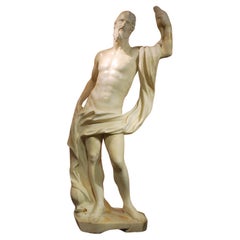
A 16th century carved marble sculpture of poseidon
Located in London, GB
This fine and imposing sculpture is an excellent example of 16th century Italian craftsmanship. The figure is stood on a raised, shaped rectangular base with a carved "dolphin" at th...
Category

16th Century Italian Antique Renaissance Decorative Objects

Materials

Marble

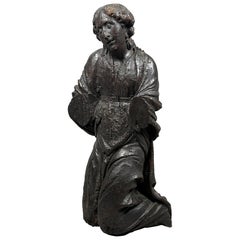
A large 16th century wood carving of an Angel
Located in Sleepy Hollow, NY
A large 16th-century hand-carved wooden fragment depicting a kneeling angel in adoration, arms extended and wearing a gentle, serene expression. Likely of Northern European origin, t...
Category

16th Century European Antique Renaissance Decorative Objects

Materials

Fruitwood

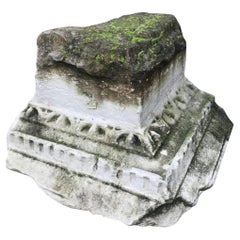
16th C. Hand Carved Capital Stone Base Architectural Element Sculpture Pedestal
Located in West Hollywood, CA
16th C. Hand Carved Capital Stone Base Architectural Element Sculpture Pedestal. Very rare 16th Century Renaissance corner Capital . Hand carved limestone Chapiteau Capital from a Cloister in France . From an ornamental point of view , it is the coronation , the upper part of a post or a column or pilaster pillar . A beautiful Architectural element garden ornament . It can used as a Base for a coffee glass table , or as a side table for drinks or to mount books. A stunning Fragments to be used as stand for a sculpture . Use it as a pedestal or as a mounted decorative object. In an entryway a bathroom a living room , in an office , it will create an incredible focal point . It can make a beautiful base for a floor lamp by a leather reading chair...
Category

16th Century French Antique Renaissance Decorative Objects

Materials

Stone, Limestone

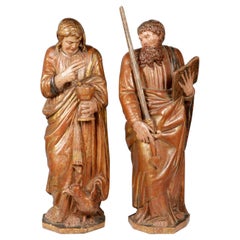
Saints Apostles John and Paul, Wood, Castillian School, 16th Century
Located in Madrid, ES
Pair of polychrome wood sculptures. "San Juan and San Pablo". Castilian school, 16th century. Both male figures have been represented standing, with their main iconographic attrib...
Category

16th Century Spanish Antique Renaissance Decorative Objects

Materials

Other

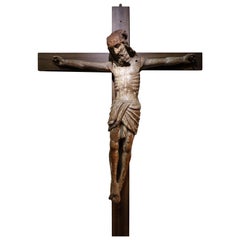
A Burgundy Christ, 15th century
Located in PARIS, FR
A huge Burgundy 15th century Christ on its cross. Oak wood . Cross is modern. Damages, some parts missing. 98x83 cm without the cross.
Category

15th Century and Earlier French Antique Renaissance Decorative Objects

Materials

Wood

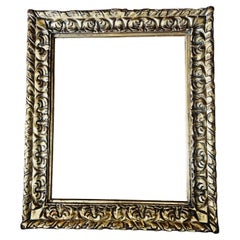
Antique Rare Italian Gold Gilded Hand-Carved Frame Early 17th Century
Located in Doha, QA
A truly magnificent Italian Renaissance gold gilded hand carved frame. Amazing craftsmanship and a very good condition for its age. Painting which fits inside (painting opening), di...
Category

Early 17th Century Italian Antique Renaissance Decorative Objects

Materials

Giltwood

Italian Corpus Christi
Located in S-HERTOGENBOSCH, NL
Hand-carved Italian Corpus Christi with traces of polychromy. This sculpture reflects the transition from Gothic to Renaissance style.
Category

16th Century Italian Antique Renaissance Decorative Objects

Materials

Wood

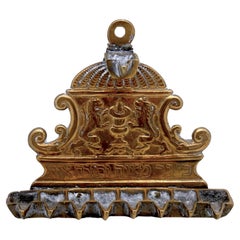
An Italian Brass Hanukkah Lamp, 18th Century
Located in New York, NY
An Italian Brass cast bench Hanukkah lamp made in the Renaissance era of the 18th century. A pair of rampant lions leaning on a goblet-shaped burning incense alter is reminiscent of...
Category

18th Century Italian Antique Renaissance Decorative Objects

Materials

Brass

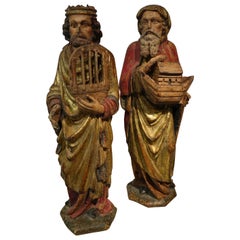
Pair of rare statues , Noah and King David, Flanders, early 16th century
Located in PARIS, FR
Noah and King David, Flanders, early 16th century Rare wood carvings in the round of Noah holding the Ark and King David holding his lyre. Noah, a biblical figure, is the tenth and l...
Category

16th Century Belgian Antique Renaissance Decorative Objects

Materials

Wood

renaissance wooden candelabrum and painted cross - Umbria, 16th century
Located in Bruxelles, BE
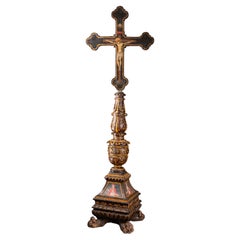
Base of a carved wooden candelabrum, polychrome and gilded; cross painted on both sides. Umbria or Tuscany, 16th century 136 x 43,5 x 30 cm (The cross and the base of the candelabrum were later assembled) The base of the candelabrum is intricately carved and adorned with polychrome and gilded finishes. The shafts take on the shape of balusters reminiscent of ancient columns, feature ornate foliage decorations, garlands and winged cherub faces. The feet are crafted in the likeness of lion paws. The base is further embellished with depictions of four saint martyrs, among them Saint Barbara and Saint Catherine of Alexandria. The plasticity of the figures, outlined with strong contour lines, the clear and vibrant colors, are stylistic elements linked to the Umbrian tradition of the sixteenth century.The precisely defined and elegant drawing, along with the clear color palette applied with refined chiaroscuro modulations, became the signature of a style that would leave a lasting mark on the era to come. This is exemplified by a preference for vibrant, multicolored images, accentuated in this case by the use of red and pink in the saint's attire. A notable addition, introduced later, is a polylobed cross painted on both sides. On one side, the Crucifixion is vividly portrayed:The treatment of the corpus itself is in line with High Medieval practice, emphasizing pathos by showing Jesus dead, his arms sagging from the weight of the body. The upper section displaying a pelican pecks at her breast to feed her young with her own blood; a symbol of the sacrifice of Christ on the cross whose body and blood similarly nourishes the celebrant during Mass. The lower part depicts Golgotha. On the reverse side, the Resurrection is artistically presented in a Renaissance iconography, reminiscent of the renowned composition painted by Piero della Francesca, now housed in the Civic Museum of Sansepolcro. In terms of composition, with the frontal depiction of Christ holding the banner, this motif became particularly widespread in central Italy, spanning from Tuscany to Umbria throughout the 16th century.. The double-sided construction suggests that it may also have been carried in liturgical processions. In Umbria from the 14th century, the use of portable crosses painted on both sides had become a widespread practice, aimed at satisfying the monastic clientele that had significantly increased following the establishment of new religious communities. The earliest surviving Tuscan painted crucifix represent Christ as Christus Triumphans, or the “Triumphant Christ” with his head up and eyes open. This form was supplanted in the 13th century with the Christus Patiens, or “Suffering Christ” type who is shown often with his head fallen on his shoulder and his eyes closed, as In our cross. The iconography of the suffering Christ appears to have developed out of a new interest in Christ’s human nature, the development of the feast of Corpus Christi and with increased importance given to the Eucharist. The process of humanizing the figure of Christ reaches its peak with the abandonment of all the previous expressive conventions in favor of more realistic details we can observe in this Crucifix, such as the swollen belly, the arms stretched to the limit of muscle tearing, the body falling heavily forward, the abundant blood on the wounds, and the cross firmly embedded in the rock of Calvary. It's worth noting that Renaissance candelabra...
Category

16th Century Italian Antique Renaissance Decorative Objects

Materials

Wood, Giltwood

Oak Sculpture of Saint Anne, 16th Century.
Located in Saint-Ouen, FR
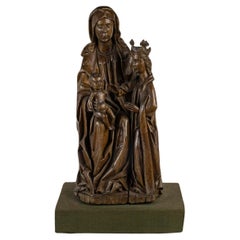
Oak sculpture of Saint Anne, 16th century. Large oak sculpture of Saint Anne. Work from the Upper Rhine, Basel region. First third of the 16th century. An arm is missing from the i...
Category

16th Century French Antique Renaissance Decorative Objects

Materials

Oak

Judith with the Head of Holofernes, Plaquette After Riccio, Italian 17th Century
By Andrea Briosco (Riccio)
Located in Miami Beach, FL
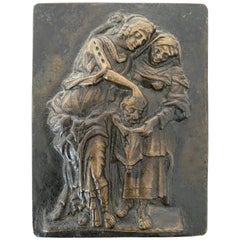
Judith with the head of Holofernes, unsigned rectangular cast bronze plaquette, by Andrea Briosco, called Riccio (1470-1532), Judith...
Category

17th Century Italian Antique Renaissance Decorative Objects

Materials

Bronze

Italian Antique 17th Century Hand carved wood Candelabra on a Renaissance base.
Located in Encinitas, CA
An Italian Antique 17th Century "Mecca" gilding Wood Hand carved Bear "Orso" Candelabra on Renaissance base. The base and the bear are gilded with Mecca, a silver gilt technique that...
Category

Late 17th Century Italian Antique Renaissance Decorative Objects

Materials

Giltwood

Italian Ancient Marble Sculpture Fountain, Late 16th Century
Located in Milano, IT
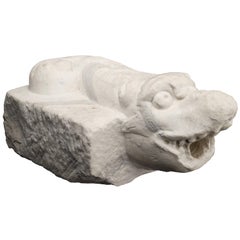
Sea monster Carrara marble mouth fountain Italy, late 16th century It measures 13.8 x 31.5 x 18.9 in (35 x 80 x 48 cm) State of conservation: some small evident gaps and widespread signs of wear due to outdoor exposure. The gray marks crossing it do not come from restoration, but are rather the natural veins of the marble. This work has some morphological characteristics typically associated with the iconography of the sea monster: an elongated muzzle, sharp teeth, protruding eyes, elongated ears, and a coiled serpent's tail. An in-depth series of studies on artistic depictions of the sea monster attempted to verify how this symbol evolved in antiquity in the European and Mediterranean contexts and how it gradually changed its image and function over time. The iconography itself is mutable and imaginative and its history is rich with cultural and artistic exchange, as well as the overlapping of ideas. This occurred so much that it is difficult to accurately pinpoint the "types" that satisfactorily represent its various developments. However, we can try to summarize the main figures, starting from the biblical Leviathan and the marine creature that swallowed Jonah (in the Christian version, this figure was to become a whale or a "big fish", the “ketos mega”, translation of the Hebrew “dag gadol”). Other specimens ranged from the dragons mentioned in the Iliad (which were winged and had legs) to "ketos” (also from Greek mythology), the terrifying being from whose Latinized name (“cetus”) derives the word "cetacean". See J. Boardman, “Very Like a Whale” - Classical Sea Monsters, in Monsters and Demons in the Ancient and Medieval Worlds, in Papers presented in Honor of Edith Porada, Mainz am Rhein 1987, pp. 73-84). In Italy the monster underwent yet further variations: it can be found in Etruscan art on the front of some sarcophagi representing the companion of souls, while among the Romans we find the “Pistrice” (cited by Plinio in Naturalis Historia PLIN., Nat., II 9, 8 and by Virgilio in Eneide: VERG., Aen., III, 427), which appeared in the shape of a stylized hippocampus or a very large monstrous cetacean and evolved into a hideous being with a dragon's head and long webbed fins. During the Middle Ages, the sea monster was the object of new transformations: at this time, it is often winged, the head is stretched like a crocodile, the front legs are often very sharp fins - sometimes real paws - until the image merges with dragons, the typical figures of medieval visionary spirituality widely found throughout Europe (on this topic and much more, see: Baltrušaitis, J., Il Medioevo fantastico. Antichità ed esotismi nell’arte gotica, Gli Adelphi 1997). In Italy during the 15th and 16th centuries, the revival of classicism - representative of the humanistic and Renaissance periods - led to a different reading of these "creatures". Indeed, the sea monster was also to find widespread use as an isolated decorative motif, especially in numerous fountains and sculptures where dolphins or sea monsters were used as a characterizing element linked to water (on this theme see: Chet Van Duzer, Sea Monsters on Medieval and Renaissance Maps, London, The British library, 2013). From the morphological point of view, the "sea monsters" of this period are mostly depicted as hybrid figures, in which the body of a mythological or real being (a hippocampus, a sea snake, a dolphin), is joined to a head with a rather indistinct appearance. It was usually characterized by large upright ears, an elongated snout, sharp teeth and globular, protruding eyes; a complex and indefinite figure, both from the symbolic point of view and from that of its genesis. The work we are examining is placed as a cross between the medieval sea serpent and the Renaissance dolphin, with stylistic features which recall the snake as often used in heraldry (such as the "snake" depicted in the coat of arms of the Visconti - the lords and then dukes of Milan between 1277 and 1447 - and which, for some, may be derived from the representations of the “Pistrice” that swallowed Jonah). In the search for sources, Renaissance cartography and in particular woodcuts should not be neglected. See for example the monsters of Olaus Magnus, from the editions of the “Historia de gentibus septentrionalibus” (“History of the peoples of the north”) and the natural histories of Conrad Gesner, Ulisse...
Category

16th Century Italian Antique Renaissance Decorative Objects

Materials

Carrara Marble

Chest. Carved wood, metal. Spanish school, 16th century.
Located in Madrid, ES
Chest. Carved wood, metal. Spanish school, 16th century. Rectangular casket with a flat lid decorated on the outside with a series of figurative reliefs in a symmetrical arrangemen...
Category

16th Century Spanish Antique Renaissance Decorative Objects

Materials

Metal, Other

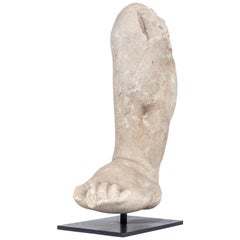
Renaissance Era, Marble Fragment of a Leg
Located in Los Angeles, CA
Chic, 15th Century, Roman marble fragment of a left foot and calf mounted on a custom iron stand.
Category

15th Century and Earlier Italian Antique Renaissance Decorative Objects

Materials

Carrara Marble

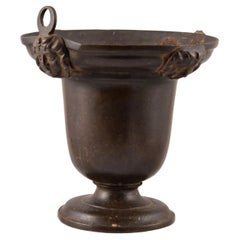
Bronze Situla, 16th Century
Located in Madrid, ES
Acetre. Bronze. Century XVI. Bronze piece that has a circular foot, and a circular body, with an outwardly hollowed mouth at the top, and a decoration in relief in this last area o...
Category

16th Century European Antique Renaissance Decorative Objects

Materials

Bronze

Sculpture of John The Baptist, 16th Century
Located in North Miami, FL
Early 16th Century Spanish gold gilded and polychromed carved wood sculpture of John The Baptist.
Category

16th Century Spanish Antique Renaissance Decorative Objects

Materials

Gold Leaf

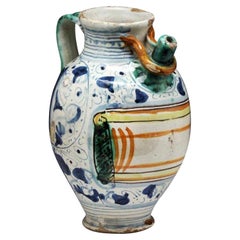
Italian 18th C. Majolica Wet Drug or Syrup Jar
Located in Bradenton, FL
A beautifully decorated 18th century Italian Majolica faience ‘wet’ or syrup albarello/drug jar. Blue and white having a front reserve, blue and white scrolls to body. Beautifully de...
Category

18th Century Italian Antique Renaissance Decorative Objects

Materials

Pottery

Pair Of Late 17th Century Italian Bronze Candlesticks
Located in Brussels, Brussels
Elegant pair of bronze candle sticks from the end of the 17th century from Italy Beautiful appearance and good quality with small traces of wear which make their charm Very beautif...
Category

17th Century Italian Antique Renaissance Decorative Objects

Materials

Bronze

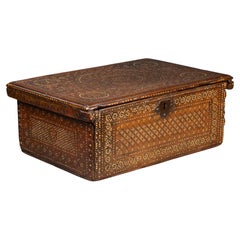
Hispano-Moresque Mudéjar Bone-Inlaid Walnut Chest
 - Spain, 16th century
Located in Bruxelles, BE
Hispano-Moresque Mudéjar Bone-Inlaid Walnut Chest
 Spain, 16th–17th century 
Walnut, bone inlay, iron fittings
 44.5 × 30.5 × 18 cm This rectangular walnut chest, richly ornamented ...
Category

16th Century Spanish Antique Renaissance Decorative Objects

Materials

Bone, Walnut

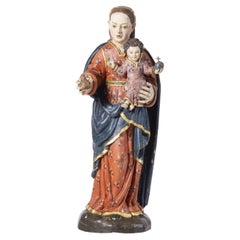
Our Lady with Child Jesus Savior of the World 17th Century
Located in Madrid, ES
Our lady with child Jesus savior of the world 17th century Portuguese sculpture in polychrome and gilded wood. Repaints. Height: 71 cm very g...
Category

Early 17th Century Portuguese Antique Renaissance Decorative Objects

Materials

Wood

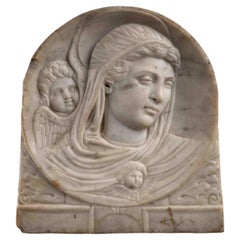
Renaissance Marble Relief - Emilia Romagna, 1470-80
Located in Bruxelles, BE
Renaissance Marble Relief Emilia Romagna, Faenza ? 1470-80 H 30,2 x L 33 x P 3,5 cm The carved marble relief depicts the Virgin accompanied by a winge...
Category

15th Century and Earlier Italian Antique Renaissance Decorative Objects

Materials

Marble

Renaissance decorative objects for sale on 1stDibs.

Find a broad range of unique Renaissance decorative objects for sale on 1stDibs. Many of these items were first offered in the 21st Century and Contemporary, but contemporary artisans have continued to produce works inspired by this style. If you’re looking to add vintage decorative objects created in this style to your space, the works available on 1stDibs include decorative objects, more furniture and collectibles, serveware, ceramics, silver and glass and other home furnishings, frequently crafted with metal, wood and other materials. If you’re shopping for used Renaissance decorative objects made in a specific country, there are Europe, Italy, and France pieces for sale on 1stDibs. While there are many designers and brands associated with original decorative objects, popular names associated with this style include Europa Antiques, Ferdinand Barbedienne, deBlona, and Andrea Salvatori. It’s true that these talented designers have at times inspired knockoffs, but our experienced specialists have partnered with only top vetted sellers to offer authentic pieces that come with a buyer protection guarantee. Prices for decorative objects differ depending upon multiple factors, including designer, materials, construction methods, condition and provenance. On 1stDibs, the price for these items starts at $100 and tops out at $348,500 while the average work can sell for $4,296.

Still Thinking About These?

All Recently Viewed