16th Century Urns
to
1
2
94
1,131
952
284
268
296
172
34
18
31
37
35
40
41
26
28
10
2
1
1
1
1
1
1
1
1
Height
to
Width
to
2
2
2
Period: 16th Century
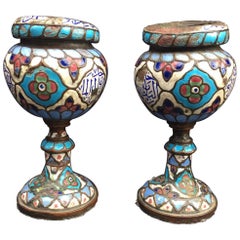
Pair of Islamic Enameled Vessels, Ancient Urns
Located in Vero Beach, FL
This is an exceptional and historic pair of Damascus enameled metalwork vessels or urns. These art objects show signs of rough use and handling through the centuries. Although it is ...
Category
West Asian Islamic Antique 16th Century Urns
Materials
Enamel

$4,240 Sale Price
20% Off
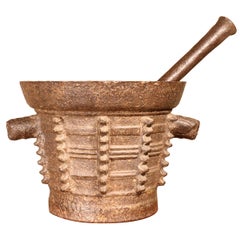
Mortar and Pilar End 15th Century Gothic Period
Located in Brussels, Brussels
Iron mortar with its original pestle end 15th beginning 16th century Gothic period, France
Beautiful original object with a beautiful patina and in good condition
Category
French Gothic Antique 16th Century Urns
Materials
Iron
Related Items
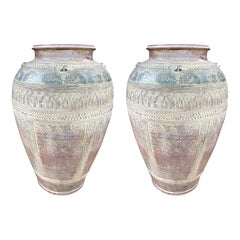
Pair Of Moroccan Urns
Located in Houston, TX
Pair Of Moroccan Urns.
Offered is a large matching pair of vintage Moroccan incised terracotta urns.
These Moorish urns have a subtle color tone that will work in a variety of interi...
Category
Moroccan Moorish 16th Century Urns
Materials
Terracotta
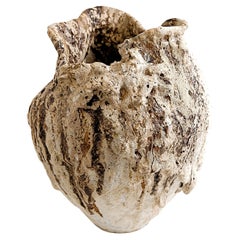
Ancient Vessel- handmade Lava Vase III
Located in Van Nuys, CA
Found like an ancient relic.. created from found clay slabs throughout the studio.
Glazed and finished in old world bronze and mocha mix of color and texture
on dark chocolate clay....
Category
American Organic Modern 16th Century Urns
Materials
Ceramic, Stoneware
Japanese antique Bizen ware vase / 15th-16th century / Wabi-sabi vase/Tsubo
Located in Sammu-shi, Chiba
This Bizen ware jar was fired in the Bizen region of Okayama Prefecture. Bizen ware is one of Japan's Six Ancient Kilns and is known as one of the oldest pottery styles in Japan. Its...
Category
Japanese Other Antique 16th Century Urns
Materials
Pottery
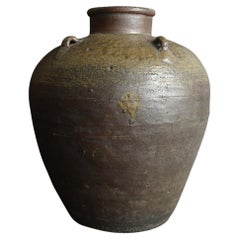
$1,300
H 15.95 in Dm 13.47 in
Korean antique black glaze pottery/Joseon period/15th-16th century/small vase
Located in Sammu-shi, Chiba
This is a small black-glazed jar made in Korea between the 15th and 16th centuries.
White porcelain is famous in Korea, but this was a type of porcelain that was only allowed to be u...
Category
South Korean Other Antique 16th Century Urns
Materials
Pottery
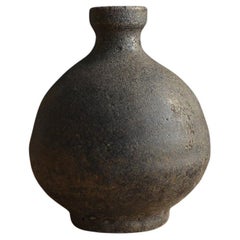
$900
H 5.16 in Dm 4.34 in
Japanese Antique Pottery Jar 15th-16th Century/ Wabi-Sabi Jar/Tokoname Vase
Located in Sammu-shi, Chiba
It is a very old jar in Japan.
This is a pottery called Tokoname ware.
Tokoname is a kiln located in Aichi prefecture, Japan.
It is said to have originated around the 12th century.
A...
Category
Japanese Other Antique 16th Century Urns
Materials
Pottery
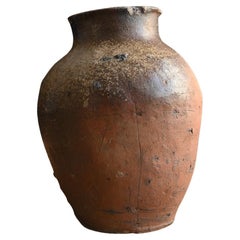
$1,000
H 12.13 in Dm 9.77 in
Japanese antique "Shigaraki ware" large vase / late 15th century / Wabi-sabi
Located in Sammu-shi, Chiba
This is a piece of Shigaraki ware pottery fired in Shiga Prefecture. Shigaraki ware is said to have originated in the Shigaraki region of Shiga Prefecture around the 8th century and ...
Category
Japanese Other Antique 16th Century Urns
Materials
Pottery
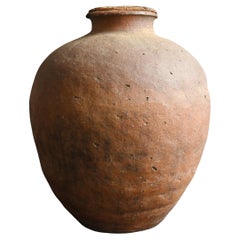
$1,100
H 18.47 in Dm 15.56 in
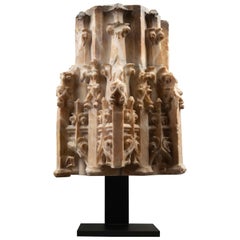
Gothic Canopy, France, 15th Century
Located in Bruxelles, BE
Gothic canopy
France, 15th century
Alabaster, some traces of polychromy
33 x 23 x 20 cm
Provenance:
- Private collection Genève, Switzerland
...
Category
French Gothic Antique 16th Century Urns
Materials
Alabaster
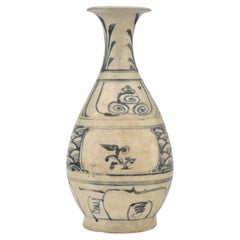
Annamese stoneware with cobalt underglaze blue, Hoi An Hoard, late 15th century.
Located in seoul, KR
The vase features a slender neck adorned with gracefully drawn, elongated leaves that blend seamlessly with its natural curves, adding a refined elegance. At the center, a meticulously rendered geometric pattern of repeating wave-like motifs creates a sense of depth and movement, framed by curved lines for balance. Simple plant motifs are scattered throughout, complementing the design with minimal strokes. The base is grounded by repeated geometric symbols, ensuring stability and cohesion. Overall, the vase masterfully combines simplicity and sophistication, resulting in a harmonious and elegant work of art.
Dates : 15th century Le Dynasty
Region : North Annam, Vietnam
Type : Yuhuchun Vase
Found/Acquired : Southeast Asia , South China Sea, Hoi An Ship
Reference :
1) Art Gallery of Greater Victoria - A vase from the wreck of the Hoi An
2) Butterfield Treasures Hoi An Hoard Auction Catalogs / San Francisco Butterfields 2000
* Vietnamese trade ceramics
Around the mid-14th century, Vietnam developed its ceramics production technology by producing blue and white porcelain, and began to export it overseas. During this period, China Ming Dynasty implemented a policy of lifting the ban from 1371 to 1657 and restricted foreign trade. This served as a good opportunity in the trade history of Vietnamese ceramics, and ceramic exports...
Category
Vietnamese Antique 16th Century Urns
Materials
Stoneware
$2,990
H 9.45 in Dm 5.12 in
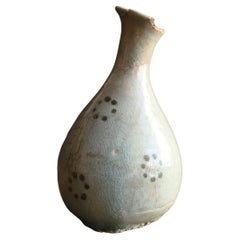
Korean antique pottery vase/rare design pottery/Joseon Dynasty/15th century
Located in Sammu-shi, Chiba
I would like to introduce Korean antique pottery with a very rare design.
This is a vase-shaped container made in the early Joseon Dynasty of Ko...
Category
South Korean Other Antique 16th Century Urns
Materials
Pottery
$1,000
H 6.82 in Dm 3.75 in
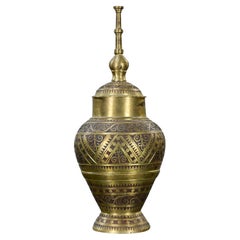
20Th Century Asian Islamic Wedding Vessel Gador or Mindanao Marana Brass Urn
Located in Topeka, KS
20th Century Asian Islamic Philippine Wedding Vessel or Gador or Mindanao Maranao cast brass urn. Beautiful condition, keeping in mind that this is vintage and not new so will have s...
Category
Islamic 16th Century Urns
Materials
Brass
$995
H 18.25 in Dm 7.25 in
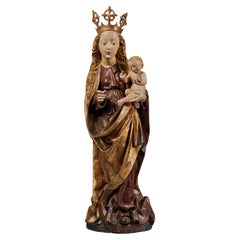
Polychrome carved wood Virgin and Child from the 15th Century
Located in Saint-Ouen, FR
POLYCHROME CARVED WOOD VIRGIN AND CHILD FROM THE 15TH CENTURY
ORIGIN: SOUTH GERMANY, SWABIA, NUREMBERG REGION
PERIOD: 15th CENTURY
Height: 94,6cm
Width : 28 cm
Depth : 18 cm
Lime wood
Original Polychromy
Good state of conservation
From 1430 onwards, sculpture underwent a profound stylistic renewal which continued until 1530, the so-called late Gothic period. In the Germanic countries, original sculptures flourished in an expressive and sensitive vein.
This renewal was inspired by the art of Nicholas of Leiden, who was active in Strasbourg in the 1460's. His style broke with the refined and delicate art of the international Gothic style in force throughout Europe around 1400. The figures became more authentic and realistic. The bodies became denser. Clothes are animated by deep, broken folds, the fabrics are heavy and have a great decorative value. In addition, the polychromy is intended to be illusionistic. The painting makes it possible to restore the texture of the materials, the richness of the textiles and the natural skin tone of the characters.
The dissemination of images through engraving and the great mobility of the artists led to the success of this style, which conquered the Upper Rhine, Swabian, Tyrolean and Franconian regions, contributing to the formation of a common stylistic identity in these regions. The economic boom in the flourishing German cities was conducive to the development of original production. Attracted by this prosperity, numerous workshops were set up in order to meet the orders of religious communities, the Church and the laity, including a clientele of middle-class rockers.
This precious Virgin and Child is depicted standing on a crescent moon, her head encircled by a crown of tall flowers. Her long wavy hair spreads over her shoulders, framing her beautiful oval face. Under fine eyebrows drawn with a brushstroke, her almond-shaped, slightly drooping eyes look at the Child with infinite softness. She is dressed in a long red dress with a rounded neckline, belted under the chest. The heavy fabric of her dress spreads out in broken folds at her feet. On her shoulders she wears a golden cloak. The drapery has deep folds. She holds out her right hand while she holds the Christ Child with her left.
Christ, with his well-defined hair, is naked. His cheeks are highlighted with red, he holds an apple in his left hand and with the other hand makes a sign of blessing towards the faithful.
Virgins with Child on a crescent moon were very popular in the second half of the 15th century, especially as the central subject of altarpieces in southern Germany and Austria. The crescent moon on which Mary is standing is reminiscent of the Woman of the Apocalypse. Often equated with the Virgin Mary.
This episode is taken from the Book of Revelation (12:1-6)
1 Then a great sign appeared in heaven: a woman clothed with the sun, with the moon under her feet and a crown of twelve stars on her head. ; 2 She was pregnant, and she cried out because she was in labor, in pain from giving birth. ; 3 Then another sign appeared in heaven: it was a great fiery red dragon, with seven heads and ten horns, and seven royal crowns on his heads. ; 4 His tail swept down a third of heaven's stars and threw them to the earth. The dragon stood in front of the woman who was about to give birth so that when she gave birth, he might devour her child. ; 5 She gave birth to a son, a male child who is to rule all the nations with an iron rod. Her child was snatched up to God and his throne. ; 6 Then the woman fled into the desert, where God has prepared a place for her. There she will be taken care of for one thousand two hundred sixty days.
Some theologians see in this woman a reference to the Virgin Mary and in the child, Jesus.
This remarkable work is a very fine example of sculpture from Swabian workshops in the last decades of the 15th century. It presents all the characteristic stylistic elements: a highly girdled silhouette, an abundant drapery with angular folds, but also a great physical presence accentuated by the polychromy that restores the anatomical details. This group is made of a wooden log. The deep folds of the drapery highlight the movement of the Virgin holding the child.
Bibliography :
Sophie Guillot de Suduiraut, Dévotion et Séduction, Sculptures souabes des musées de France, vers 1460-1530, Paris musée du Louvre-Éditions somogy, 2015
“Revelation 12 - Common English Bible...
Category
German Gothic Antique 16th Century Urns
Materials
Wood
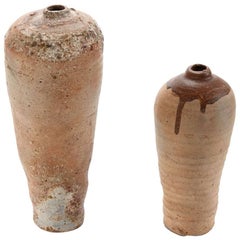
Pair of 15th (or earlier) Century Encrusted Cizhou pottery / vessels from Fujian
Located in Wainscott, NY
Pair of 15th Century (or earlier) Encrusted ceramic vessels from Fujian encrusted by the Sea air. SOLD SEPARATELY
Period of Southern Song to Yuan Dynas...
Category
Chinese Antique 16th Century Urns
Materials
Pottery
$1,280 Sale Price / item
20% Off
H 10.25 in W 3.75 in D 3.75 in
Previously Available Items
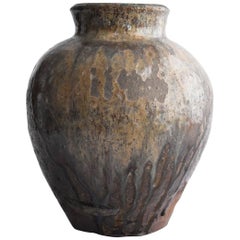
Japanese Antique "Shigaraki Ware" Jar / Muromachi Period 1450-1573 / Old Vase
Located in Sammu-shi, Chiba
We have an aesthetic sense peculiar to Japanese people.
And we introduce the unique items that only we can do, the route of purchasing in Japan, the experience value so far, and the way that no one can imitate.
It is "Shigaraki ware...
Category
Japanese Arts and Crafts Antique 16th Century Urns
Materials
Pottery
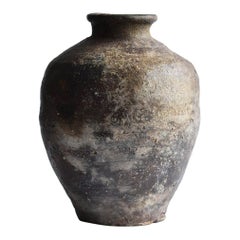
Japanese Tokoname Pot 14th-16th Century Muromachi Period / Tsubo / Old Pottery
Located in Sammu-shi, Chiba
We Japanese introduce unique items with unique aesthetics, purchasing routes, and ways that no one can imitate.
Tokoname is an area in Aichi prefecture, Japan.
It was a pottery producing area with a very old history (from around the 12th century) in Japan.
This is a jar that was burned during the Muromachi period...
Category
Japanese Arts and Crafts Antique 16th Century Urns
Materials
Pottery
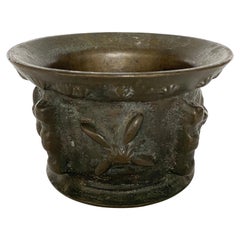
16th Century Spanish Cast Bronze Apothecary Mortar
Located in Miami Beach, FL
This rare example of a Renaissance bronze mortar is decorated with starbursts all along the everted rim and features 4 large starbursts on the sides between the ribbed handles. The c...
Category
Italian Renaissance Antique 16th Century Urns
Materials
Bronze
Still Thinking About These?
All Recently ViewedMore Ways To Browse
Sevres Urns Signed
Wedgwood England Urn
19th Qing Urn
Blue John Urns
Bronze Urn With Lid
Derbyshire Spar
Gold And White Urn Ram Head
Turned Wood Urns
Basalt Urns
Bird And Flower Urn
Black Basalt Urn
Capodimonte Urn
Carl Thieme Potschappel
Chinese Incense Urn
Chinese Temple Urn
Cobalt Bronze Urns
Jade Urn
Large Majolica Urn