Want more images or videos?
Request additional images or videos from the seller
1 of 19
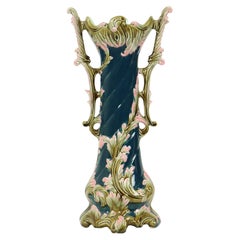
French Art Nouveau Majolica Earthenware Vases ca. 1900
$828.40List Priceper set
About the Item
- Dimensions:Height: 12.6 in (32 cm)Width: 7.09 in (18 cm)Depth: 6.3 in (16 cm)
- Sold As:Set of 2
- Style:Art Nouveau (Of the Period)
- Materials and Techniques:
- Place of Origin:
- Period:
- Date of Manufacture:ca. 1900
- Condition:Refinished. Wear consistent with age and use. There is a chip from the rim of the opening of one vase, an old attempt at repair with a thick type of glue.
- Seller Location:Poperinge, BE
- Reference Number:1stDibs: LU10184247638042
About the Seller
5.0
Platinum Seller
Premium sellers with a 4.7+ rating and 24-hour response times
1stDibs seller since 2024
64 sales on 1stDibs
Typical response time: 1 hour
Authenticity Guarantee
In the unlikely event there’s an issue with an item’s authenticity, contact us within 1 year for a full refund. DetailsMoney-Back Guarantee
If your item is not as described, is damaged in transit, or does not arrive, contact us within 7 days for a full refund. Details24-Hour Cancellation
You have a 24-hour grace period in which to reconsider your purchase, with no questions asked.Vetted Professional Sellers
Our world-class sellers must adhere to strict standards for service and quality, maintaining the integrity of our listings.Price-Match Guarantee
If you find that a seller listed the same item for a lower price elsewhere, we’ll match it.Trusted Global Delivery
Our best-in-class carrier network provides specialized shipping options worldwide, including custom delivery.You May Also Like
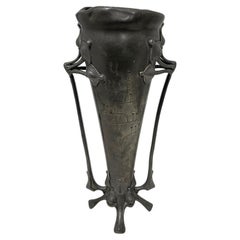
French Art Nouveau pewter vase, ca 1900
Located in Delft, NL
French Art Nouveau pewter vase, ca 1900
A French Art Nouveau vase, made of pewter in beautiful Art Nouveau scene of flowers, raised on 4 legs. A tapered, but rounded model with two ...
Category
Early 20th Century French Art Nouveau Vases
Materials
Pewter
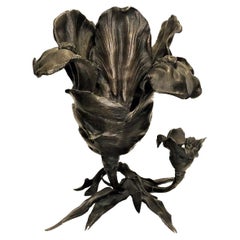
French Art Nouveau Patinated Bronze Sculptural Iris Vase, ca. 1900
Located in New York, NY
ABOUT IRIS
The iris is a special and mysterious flower. Not only because of its striking appearance, but also from an artistic and historical point of view. It is also like a work of art, as though created by Mother Nature. The unique leaves of this plant not only create wonderful shadow casts, but also look as if they were painted by hand. It's no wonder that iris acts as the muse for countless artists, and can be seen in many famous works of art.
The iris was first spotted in the time of Pharaoh Thutmose, in 1504 BC. He had the iris inscribed into the wall reliefs of a temple as a sign of his power, as well as decorating his sceptre with motifs of the flower. Since then, the iris has been a symbol of victory in Egypt. But the symbolism of the iris goes further than that. In Japan, the flower represents courage and is the symbol of the boys' festival. In Islamic cultures, the iris is a symbol of prosperity. In Europe, the flower was a popular weapon symbol in the Middle Ages and stood for chivalry. And in Christianity, the iris was seen as a symbol of the trinity because of its three-part flowers. With more than 300 varieties, the iris is now the most popular flower among growers and gardeners following the rose.
Countless artists use the iris in their works and the flower is present in all eras. You can see the flower on furniture, vases, jewelry, fabrics, sculptures, coats of arms and much more. Did you know that the iris is also called the sword lily? It's not a coincidence that it used to symbolize physical and emotional pain and suffering caused by a weapon. We also see the flower in religious art, where it's often associated with Mary and Jesus. The iris is also associated with the Greek goddess Iris, where the flower symbolizes reconciliation and divine messages. This is also reflected in many paintings.
Finally, the iris is also visible in Dutch and Flemish still-life paintings. This can be in a religious form, incorporated into an object or as a decorative flower.
In the Art Nouveau art movement, the iris (along with other plants, such as the birch) was often used as an expression of feminine beauty. With its almost otherworldly appearance, the iris is perfectly suited to the Art Nouveau aesthetic and is featured in many well-known works of art. The poet of that era, Hermann Hesse...
Category
Antique Early 1900s French Art Nouveau Planters, Cachepots and Jardinières
Materials
Bronze
$1,600
H 10.75 in W 8.5 in D 8.5 in
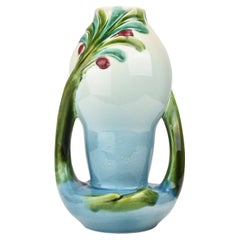
Art Nouveau Majolica Vase by Sarreguemines, France
By Sarreguemines
Located in Bad Säckingen, DE
This antique Art Nouveau double-handled majolica ceramic vase features a beautifully embossed floral motif and was made by the famous French manu...
Category
Antique Early 1900s French Art Nouveau Vases
Materials
Ceramic
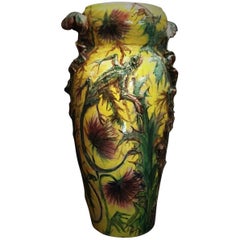
French Art Nouveau Majolica Vase with Thistles and Lizards, circa 1900
Located in New York, NY
This beautifully designed and highly decorative Art Nouveau ceramic vase is outstanding by all measures. It is very impressive and fabulously rendered in a most unusual technique, co...
Category
Antique Early 1900s French Art Nouveau Vases
Materials
Majolica
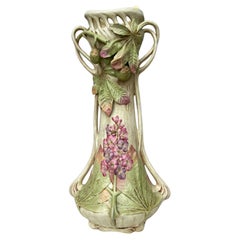
Monumental Majolica Vase Art Nouveau Royal Dux Circa 1900
By Royal Dux
Located in Austin, TX
Large Faience Vase Art Nouveau Royal Dux Circa 1900.
Chesnut bogues and leaves.
Pink flowers.
Height / 21.7 inches.
Category
Antique Early 1900s Czech Art Nouveau Vases
Materials
Faience
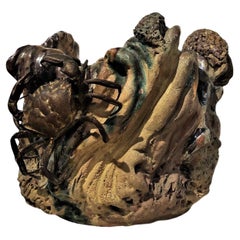
French Art Nouveau Iridescent Stoneware
Bronze Vase or Cachepot, ca. 1900s
Located in New York, NY
French Art Nouveau
Ocean Life Theme
Vase Cachepot
Iridescent Stoneware & Patinated Bronze Crab Appliqué
ca. 1900s
ABOUT
We present here a most unusual and utterly decorative Fren...
Category
Antique Early 1900s French Art Nouveau Vases
Materials
Stoneware
$4,400
H 14 in W 9.75 in D 12.5 in
Émile Gallé small Cameo vase, Art Nouveau, ca 1900
By Émile Gallé
Located in Delft, NL
Émile Gallé small Cameo vase, Art Nouveau, ca 1900
Émile Gallé (Nancy, 1846 –1904) was a French glassmaker and furniture designer
Émile Gallé 20 cm hig...
Category
Early 20th Century French Art Nouveau Vases
Materials
Glass
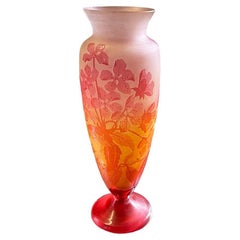
Émile Gallé Miniature Cameo Vase, Art Nouveau, Ca 1900
By Émile Gallé
Located in Delft, NL
Émile Gallé miniature Cameo vase, Art Nouveau, ca 1900
Émile Gallé (Nancy, 1846 –1904) was a French glassmaker and furniture designer
Émile Gallé 7...
Category
Early 20th Century French Art Nouveau Vases
Materials
Glass
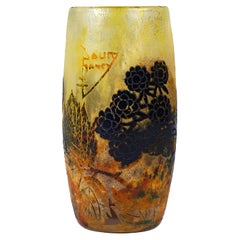
Art Nouveau Cameo Vase
Mûres Sauvages
, Daum Nancy, France, Ca. 1900/1905
By Daum
Located in Vienna, AT
Cylindrical vase, colourless glass with flaky white, yellow-green and burgundy powder inclusions, yellow-orange, green and deep blue enamel melts, highly etched decoration with wild ...
Category
Antique Early 1900s French Art Nouveau Glass
Materials
Glass
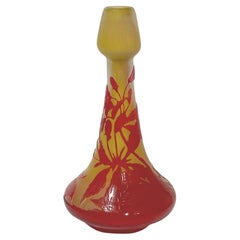
Émile Gallé Art Nouveau Cameo Single Vase
Vigne
, Nancy, France Ca. 1900
By Émile Gallé
Located in Vienna, AT
Exquisite solitary vase in baluster form on a broad round foot, conically widening wall, strong shoulders around a short neck with a slightly flared rim, colourless glass with milky ...
Category
Antique Early 1900s French Art Nouveau Glass
Materials
Glass

More From This Seller
View AllFrench Art Nouveau Vase Majolica Gustave De Bruyn 29cm
By Gustave De Bruyn
Located in Poperinge, BE
Beautiful French Art Nouveau vase made of polychrome crackle majolica earthenware, decorated with peonies and floral motifs, numbered and marked on the bottom.
Gustave De Bruyn (Leu...
Category
Antique Early 1900s French Art Nouveau Vases
Materials
Majolica
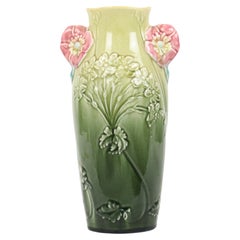
Art Nouveau Barbotine Majolica Vases Jardinière Set of 3
Located in Poperinge, BE
Rare set of three Art Nouveau objects consisting of two identical vases and a matching jardinière, made of barbotine or majolica earthenware, numbered 2054 on the bottom, France, cir...
Category
Antique Early 1900s French Art Nouveau Vases
Materials
Majolica, Earthenware
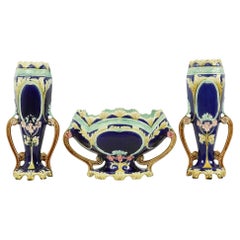
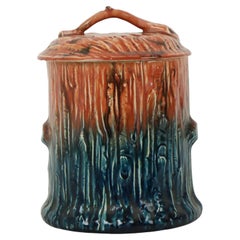
Antique Barbotine Majolica Pot with Lid Organic Art Nouveau
Located in Poperinge, BE
Beautiful antique pot with lid, barbotine or majolica pottery, the pot has the shape of a tree trunk and the handle of a branch, typical of the organic shapes and colours that are ty...
Category
Antique Early 19th Century French Art Nouveau Jars
Materials
Majolica
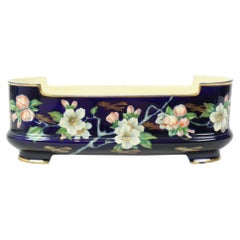
Villeroy
Boch Florale Art Nouveau Flower Pot Taiping Circa 1900
By Villeroy
Boch
Located in Poperinge, BE
A very rare ceramic flowerpot, a jardinière, in the then-popular chinoiserie style from the "Taiping" series by Villeroy & Boch, Mettlach, Germany, circa 1900. Marked on the bottom w...
Category
Antique Early 1900s German Art Nouveau Planters, Cachepots and Jardinières
Materials
Ceramic
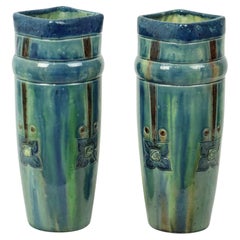
Pair of Blue Art Nouveau Vases Flemish Pottery Antiques
Located in Poperinge, BE
A pair of antique Art Nouveau vases made of blue and green glazed majolica earthenware, better known as Flemish earthenware, marked "Made in Belgiu...
Category
Antique Early 1900s Belgian Art Nouveau Vases
Materials
Earthenware, Majolica
Antique Blue Art Nouveau Vase Rococo Style 38cm
By Gustave De Bruyn
Located in Poperinge, BE
Ceramic vase made of majolica earthenware, elaborately decorated with a typical Art Nouveau design, featuring leaves, stems, and curves inspired by the rocaille or rococo style, circ...
Category
Antique Early 1900s French Art Nouveau Vases
Materials
Majolica