Want more images or videos?
Request additional images or videos from the seller
1 of 7
Japanese Gilt Bronze Mounted Imari Porcelain Vases
$5,200List Priceper set
About the Item
- Dimensions:Height: 16 in (40.64 cm)Diameter: 6 in (15.24 cm)
- Sold As:Set of 2
- Style:Anglo-Japanese (Of the Period)
- Materials and Techniques:
- Place of Origin:
- Period:
- Date of Manufacture:Unknown
- Condition:Wear consistent with age and use.
- Seller Location:Queens, NY
- Reference Number:Seller: 0621811stDibs: LU977916866632
About the Seller
4.9
Recognized Seller
These prestigious sellers are industry leaders and represent the highest echelon for item quality and design.
Platinum Seller
Premium sellers with a 4.7+ rating and 24-hour response times
Established in 1939
1stDibs seller since 2013
1,064 sales on 1stDibs
Authenticity Guarantee
In the unlikely event there’s an issue with an item’s authenticity, contact us within 1 year for a full refund. DetailsMoney-Back Guarantee
If your item is not as described, is damaged in transit, or does not arrive, contact us within 7 days for a full refund. Details24-Hour Cancellation
You have a 24-hour grace period in which to reconsider your purchase, with no questions asked.Vetted Professional Sellers
Our world-class sellers must adhere to strict standards for service and quality, maintaining the integrity of our listings.Price-Match Guarantee
If you find that a seller listed the same item for a lower price elsewhere, we’ll match it.Trusted Global Delivery
Our best-in-class carrier network provides specialized shipping options worldwide, including custom delivery.You May Also Like
19th Century Pair / Gilt Bronze Mounted Imari Porcelain Vases
Located in Tarry Town, NY
Early 19th century pair of gilt bronze mounted imari porcelain decorative vases or urns. Each urn is in good antique condition with minor wear consistent...
Category
Antique Early 19th Century European Urns
Materials
Bronze
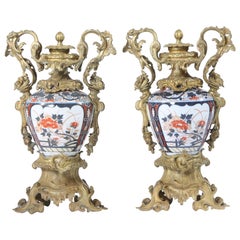
Japanese Imari Porcelain and Gilt Bronze Clock Set
Located in London, GB
This clock set contains three pieces: namely, a mantel clock and a pair of flanking candelabra. The mantel clock is designed about a Japanese porcelain vase, known as Imari ware. This white ground vase, painted in reds and blues and ornamented with foliate forms, functions as the clock case, the dial centrally mounted and encompassed by Rococo style gilt bronze motifs. This vase is supported by a gilt bronze base, which is profusely ornamented with gilt bronze acanthus leaves, garlands, and, most distinctly, a pair of putti. The vase is mounted with lion head handles to each side, also of gilt bronze, while the lid of the vase is topped by a gilt bronze finial in the form of a putto.
The candelabra are similarly decorated and of similar construction, each one being built about a smaller Imari...
Category
Antique Mid-19th Century French Louis XV Garniture
Materials
Ormolu, Bronze
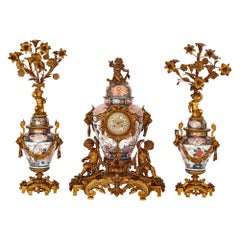
A Pair of Imari Porcelain Vases with Gilt Bronze Mounts, 19th Century.
Located in Saint-Ouen, FR
A pair of 19th century Napoleon III period Imari porcelain vases with gilt bronze mounts.
H: 25.5cm, D: 11cm
Please contact us before ordering to confirm availability.
Category
Antique 19th Century French Napoleon III Vases
Materials
Bronze
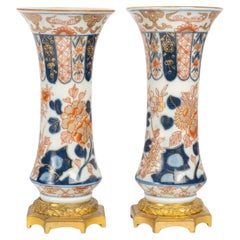
$2,847 / set
H 10.04 in Dm 4.34 in
Palatial 19th Century Japanese Imari Vases with French Gilt Bronze Mounts, Pair
Located in Vancouver, British Columbia
An impressive pair of late 19th century Japanese Imari porcelain vases decorated with colourful peacocks, other birds, flowers, chrysanthemums, manufactured for export to France wher...
Category
Antique Late 19th Century Japanese Other Planters, Cachepots and Jardini...
Materials
Porcelain
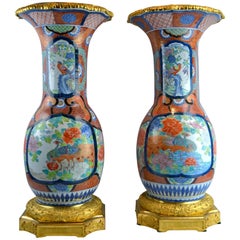
$12,000
H 29 in Dm 13.5 in
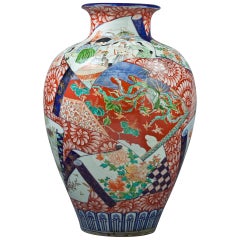
Japanese Porcelain Imari Vase, circa 1870
Located in New York, NY
Japanese porcelain Imari vase, circa 1870.
Category
Antique 1870s Japanese Vases
Materials
Porcelain
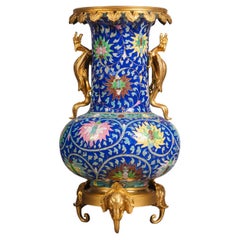
A Gilt-Bronze Mounted Chinese-Style Porcelain Vase
By Ferdinand Barbedienne
Located in Brighton, West Sussex
A Gilt-Bronze Mounted Chinese-Style Porcelain Vase With Dragon Handles and Elephant Head Feet, In the Manner of Ferdinand Barbedienne.
French, Circa 1860.
Category
Antique 19th Century French Vases
Materials
Bronze
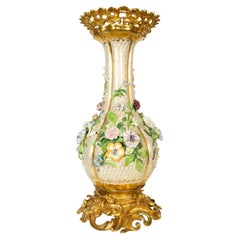
Large French Gilt Bronze Mounted Porcelain Vase
Located in Atlanta, GA
A very impressive French Porcelain vase ornated with applied polychromed flower clusters, with ormolu base and rim. 19th Century
Measures: Height 26" x width 12" x depth 12".
CW5127
Category
Antique 1880s French Louis XV Vases
Materials
Bronze
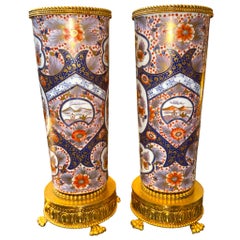
Pair of Roller Vases in Imari Porcelain with Gilt Bronze Mounts, 19th century
Located in NICE, FR
This pair of roller vases is crafted in Imari-style porcelain of French manufacture, attributed to Bayeux, and enriched with finely worked gilt bronze mounts. The cylindrical porcela...
Category
Antique Late 19th Century French Napoleon III Vases
Materials
Bronze
$1,779 / set
H 13.98 in Dm 6.5 in
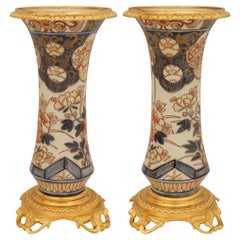
Japanese Imari Porcelain and French Louis XV st. Ormolu mounted vases
Located in West Palm Beach, FL
An elegant and most decorative pair of Japanese 19th century Imari Porcelain and French Louis XV st. Ormolu mounted vases. Each colorful vase is raised by a pierced Ormolu base with ...
Category
Antique 19th Century French Louis XV Vases
Materials
Ormolu
$7,260
H 10.25 in W 5.5 in D 5.5 in
Pair 19th Century Japanese Imari Porcelain
Gilt-Bronze Torchere Candelabra
By Imari Porcelain
Located in Los Angeles, CA
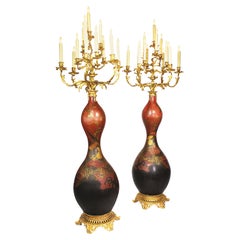
A fine Pair of 19th century Japanese Imari Porcelain and French Gilt-Bronze Mounted Thirteen-Light Celadon Torchere Candelabra. The bottle-shaped Japonisme vases with a Royal red background, decorated with parcel-gilt and black soaring eagles in the hunt within a forestall scene. Each Vase fitted and surmounted with a French 19th century Louis XV Style 13-Light scrolled candelabrum and all raised on a circular pierced gilt-bronze plinth. circa: 1880.
Imari Porcelain (????) is the name for Japanese porcelain wares made in the town of Arita, in the former Hizen Province, northwestern Kyushu. They were exported to Europe extensively from the port of Imari, Saga, between the second half of the 17th century and the first half of the 18th century. The Japanese as well as Europeans called them Imari. In Japanese, these porcelains are also known as Arita-yaki (???). Imari or Arita porcelain has been continously produced up through the present day.
Characteristics
Though there are many types of Imari, Westerners' conception of Imari in the popular sense is associated only with a type of Imari produced and exported in large quantity in mid-17th century. This type is called Kinrande. Kinrande Imari is colored porcelain with cobalt blue underglaze and red and gold overglaze. The color combination was not seen in China at that time. Traditional Ming dynasty color porcelain used dominantly red and green, probably due to scarcity of gold in China, whereas gold was abundant in Japan in those days. The subject matter of Imari is diverse, ranging from foliage and flowers to people, scenery and abstractions. Some Imari design structures such as kraak style were adopted from China, but most designs were uniquely Japanese owing to the rich Japanese tradition of paintings and costume design. The porcelain has a gritty texture on the bases, where it is not covered by glaze. There is also blue and white Imari. Kakiemon style Imari is another type of Imari, but it tends to be categorized separately in Europe.
History
"Imari" was simply the trans-shipment port for Arita wares. It was the kilns at Arita which formed the heart of the Japanese porcelain industry.
Arita's kilns were set up in the 17th century, when kaolin was discovered in 1616 by the immigrant Korean potter, Yi Sam-pyeong (1579–1655). (He may also be known by the name, "Kanage Sambei".) Yi Sam-Pyeong, along with his extended family of 180 persons, left Korea on the offer of a privileged position in Japan. This decision was made after the occurrence of certain Japanese invasions of Korea. After Yi Sam-Pyeong's discovery, his kilns began to produce revised Korean-style blue and white porcelains, known as "Shoki-Imari".
In the mid-17th century there were also a lot of Chinese refugees in Northern Kyushu due to the turmoil on Chinese continent, and it is said one of them brought coloring technique to Arita. Thus Shoki-Imari developed into Ko-KutaniImari. Ko-Kutani was produced around 1650 for both export and domestic market. Blue and white porcelain continued to be produced and they are called Ai-Kutani. Ko-Kutani Imari for the export market usually adopted Chinese design structure such as kraak style, whereas Ai-Kutani for the domestic market were highly unique in design and are accordingly valued very much among collectors.
Ko-Kutani style evolved into Kakiemon style Imari, which was produced for about 50 years around 1700. Imari achieved its technical and aesthetic peak in Kakiemon style, and it dominated European market. Blue and white Kakiemon is called Ai-Kakiemon. Kakiemon style transformed into Kinrande in the 18th century. Kinrande used blue underglaze and red and gold overglaze, and later some other colors.
Imari began to be exported to Europe because the Chinese kilns at Ching-te-Chen were damaged in the political chaos and the new Qing dynasty government stopped trade in 1656–1684. Exports to Europe were made through the Dutch East India Company, but the designation "Imari Porcelain" in Europe connotes Arita wares of mostly Kinrande Imari.
Export of Imari to Europe stopped in mid-18th century when China began export to Europe again, since Imari was not able to compete against China due to high labor cost. By that time, however, both Imari and Kakiemon style were already so popular among Europeans, Chinese export porcelain copied both Imari and Kakiemon style, which is called Chinese Imari. At the same time, European kilns, such as Meisen also tried to copy Imari and Kakiemon.
Export of Imari surged again in late 19th century (Meiji era) when Japonism flourished in Europe. Thus in western world today, two kinds of Imari can...
Category
Antique 19th Century Japanese Japonisme Floor Lamps
Materials
Bronze, Ormolu
$18,950 Sale Price / set
61% Off
H 72.25 in Dm 24.25 in
More From This Seller
View AllPair of Japanese Imari Rose Porcelain Covered Vases
Located in Queens, NY
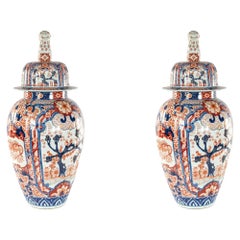
PAIR of Asian Japanese large imari rose porcelain covered baluster-shaped vases (temple jars) with lids having foo dog finials (19/20th Century)
Category
Antique 19th Century Japanese Anglo-Japanese Vases
Materials
Luster
$14,500 / set
Pair of Japanese Imari Rose Porcelain Covered Vases
Located in Queens, NY
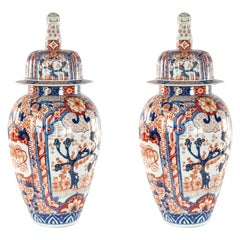
Pair of Asian Japanese large imari rose porcelain covered baluster-shaped vases (temple jars) with lids having foo dog finials (19/20th Century).
Category
20th Century Japanese Anglo-Japanese Vases
Materials
Porcelain
$14,500 / set
Pair of 19th Century Japanese Imari Porcelain Vases
Located in Queens, NY
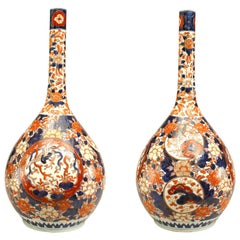
Pair of 19th century Japanese Imari Porcelain vases with slender necks depicting floral and bird motifs in shade of red and cobalt.
Category
Antique 19th Century Asian Japonisme Vases
Materials
Porcelain
19th Century Octagonal Imari Porcelain Lidded Vase Mounted on a Bronze Dore Base
Located in Queens, NY
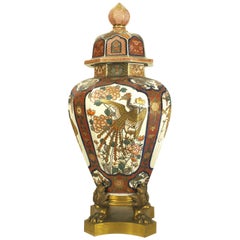
Large octagonal Imari porcelain vase with finial cover and 4 bronze doré claw feet on base (19th century).
Category
Antique 19th Century Chinoiserie Vases
Materials
Bronze
Pair of Chinese Imari Porcelain Vases
Located in Queens, NY
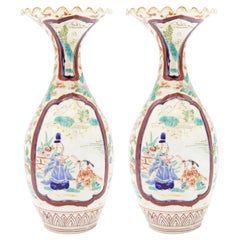
Pair of Asian Chinese Imari (18th cent) porcelain small vases with a scalloped top and scenes of figures and flowers. (small chip to 1 top) (priced as pa...
Category
Antique 18th Century Chinese Chinese Export Vases
Materials
Porcelain
$3,350 / set
Pair of Chinese Monumental Imari-Style Monumental Orange Porcelain Vases
Located in Queens, NY
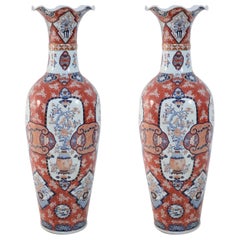
PAIR of Chinese monumental porcelain floor vases celebrating Japanese Imari ware in both palette and design, featuring white, blue, orange and gold floral motifs on rust-colored grou...
Category
20th Century Chinese Chinese Export Vases
Materials
Porcelain
Still Thinking About These?
All Recently ViewedMore Ways To Browse
Charmaine Haines
Frances Senska Pottery
Mccoy Pedestal
Jerry Brown Pottery
Jiaqing Vase
Kare Berven Fjeldsaa
Lalique Dragon
Lalique Esterel
Limoges Au Vase Etrusque Paris
Lobi Vessel
Lotton Art Glass
Lyngby Porcelaen
M Z Austria
Moorcroft Anemone
Moorcroft Jug
Nilo Vase
Ostrich Vases
Pair Of Art Vases Deco Sarreguemine