Want more images or videos?
Request additional images or videos from the seller
1 of 10

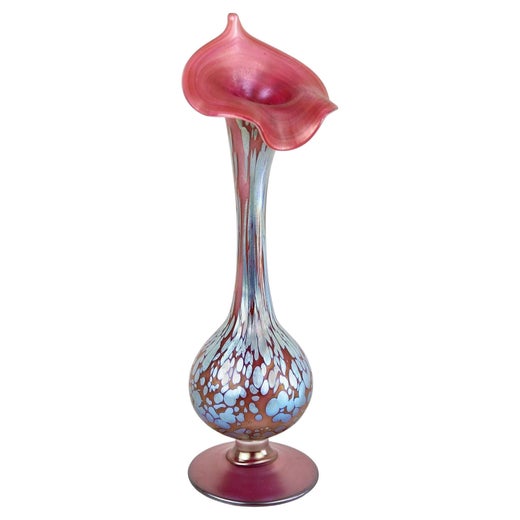
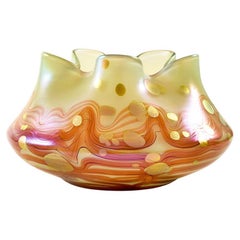
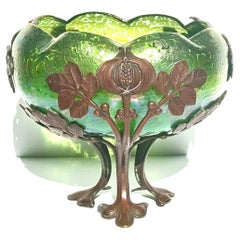
Loetz Austrian Jugendstil Iridescent Art Glass Bowl Bronzed Metal Stand, 1900

$2,900List Price

You May Also Like

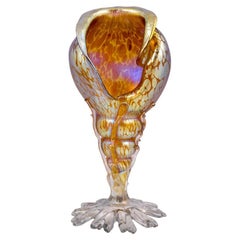
Conch Shell Glass Vase Iridescent Handmade Loetz Austria Jugendstil, circa, 1900
By Loetz Glass
Located in Klosterneuburg, AT
Conch shell glass vase handmade by Johann Loetz Witwe Austria/Bohemia Jugendstil circa 1902 "Candia Papillon" Decoration. The extravagant Candia Papillon decor lends a special brilliance to the shell shape of this collectible. The iridescent quality of this decoration not only encompasses the outside of the intricately applied silver crumbled dots, but extends into the interior of the glass shell. A characteristic of this scroll vase...
Category

Antique Early 1900s Austrian Jugendstil Vases

Materials

Art Glass, Blown Glass

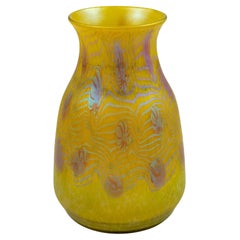
Austrian Jugendstil Glass Vase Yellow Iridescent circa 1903 Loetz
By Loetz Glass
Located in Klosterneuburg, AT
Austrian Jugendstil glass vase lemon yellow circa 1903 Johann Loetz Witwe decor Phenomen Genre 3/430 Zitronengelb Our vase bears the decor called Phenomen Genre 3/430, which was des...
Category

Antique Early 1900s Austrian Jugendstil Vases

Materials

Blown Glass

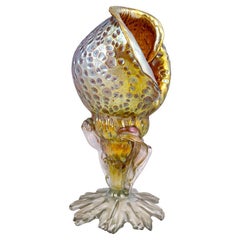
Conch Shell Glass Vase Iridescent Handmade Loetz Austria Jugendstil circa 1902
By Loetz Glass
Located in Klosterneuburg, AT
Conch Shell Glass Vase Handmade by Johann Loetz Witwe Austria/Bohemia Jugendstil circa 1902 "Diaspora" Decoration The naturalistically depicted shell and snail vases...
Category

Antique Early 1900s Austrian Jugendstil Vases

Materials

Art Glass, Blown Glass

Austrian Jugendstil Floral Glass Bowl Loetz Red Gold circa 1902
By Loetz Glass
Located in Klosterneuburg, AT
Austrian Jugendstil floral glass bowl Johann Loetz Witwe red gold circa 1902 "Cytisus Maigruen" decoration The "Cytisus" decoration, also known as "golden rain", is one of the mos...
Category

Antique Early 1900s Austrian Jugendstil Decorative Bowls

Materials

Glass

Loetz Art Nouveau Jugendstil Art Glass Bowl
By Loetz Glass
Located in Miami, FL
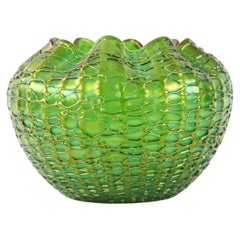
A stunning Loetz art glass green bowl decorated with gold inclusions. The glass manufacturer Loetz after their big success at the Paris World Exhibition in 1900. While creating decoration variants, the owner of the glass workshop, Max Ritter von Spaun, was presumably inspired by works of Louis C. Tiffany. The applied applications by Loetz are positioned more prominently and have their own ornament in the form of pulled iridescent threads. This glass work of art known as Loetz Jugendstil...
Category

Early 20th Century Austrian Art Nouveau Vases

Materials

Glass, Art Glass

Loetz Austria 1900 Art Nouveau Miniature Cabinet Vase Blue Iridescent Art Glass
By Loetz Glass
Located in Miami, FL
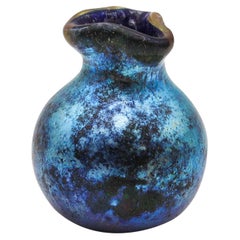
Miniature glass vase designed by Loetz. Gorgeous and very beautiful antique miniature cabinet glass vase, created by Loetz. Made in Bohemia, Aust...
Category

Antique Early 1900s Austrian Art Nouveau Vases

Materials

Art Glass

Antique Art Nouveau Jugendstil vase Loetz Bohemian Red Glass 1900
By Loetz Glass
Located in Amsterdam, Noord Holland
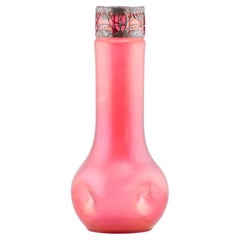
Step into the elegance of the Art Nouveau era with this exquisite natural shape Despite its age, this vase remains in remarkable condition With its interesting size and captivating...
Category

Early 20th Century Austrian Jugendstil Planters, Cachepots and Jardinières

Materials

Art Glass

Antique Art Nouveau Jugendstil vase Loetz Bohemian Red Glass 1900
$1,184 Sale Price
20% Off
H 11.62 in Dm 5.12 in
Loetz Papillon Iridescent Glass And Metal Mounted Bowl
By Loetz Glass
Located in Dallas, TX
Loetz Iridescent Glass And Metal Mounted Bowl Czech Republic Circa. 1900 Unmarked Height. 7.25 Inches, Diameter 8.5 inches. Condition: Excellent AVANTIQUES is dedicated to providin...
Category

Antique Early 1900s Czech Art Nouveau Planters, Cachepots and Jardinières

Materials

Art Glass

LOETZ Formosa iridescent blown glass vase. Austria, 1900s
By Loetz Glass
Located in Torino, IT
Vase made of glass blown iridescent LOETZ Formosa. ORIGIN Klostermühle PERIOD 1902 MARK LOETZ one of the most celebrated art glass factories in history, famous for its Art Nouveau...
Category

Early 20th Century Austrian Vases

Materials

Glass, Art Glass, Blown Glass

Loetz Art Nouveau Jugendstil Art Glass Bowl
By Johann Lötz Witwe
Located in Bochum, NRW
A vase, Johann Lötz Witwe, Klostermühle, c. 1900 Decoration: Crete chiné (1896/97); green underlaid glass; pre-blown into a multi-piece ribbed mold; ...
Category

Antique Early 1900s Austrian Jugendstil Vases

Materials

Glass

More From This Seller

View All
French Art Nouveau Iridescent Stoneware Bronze Vase or Cachepot, ca. 1900s
Located in New York, NY
French Art Nouveau Ocean Life Theme Vase Cachepot Iridescent Stoneware & Patinated Bronze Crab Appliqué ca. 1900s ABOUT We present here a most unusual and utterly decorative Fren...
Category

Antique Early 1900s French Art Nouveau Vases

Materials

Stoneware

Franz Xavier Bergmann, Sculptural Bud Vase, Vienna Bronze, circa 1900
By Franz Bergmann
Located in New York, NY
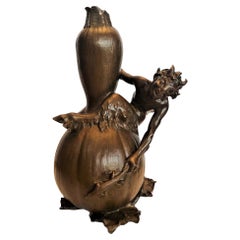
Dimensions Height: 7.25 inches Width: 5.25 inches Depth: 4.5 inches. Markings Fully marked on the bottom with a "B" in an urn-shaped cartouche (for “Bergmann”), and “GESHUTZED” (German: “PROTECTED). ABOUT What distinguishes this unique bud vase from others is a perfect synthesis of a utilitarian object and a Fine sculpture. It is not only the amazing subtlety and taste of the author’s artist skills, but an extraordinary design and an absolutely outstanding original plot. Designed for a single flower only, it is nonetheless a very complex and multifaceted composition filled with warm humor and fantasy. Sitting on a vessel shaped as a gourd, clasping its goat legs with hooves and holding on to the neck with one hand in order not to fall of it; a playful and mischievous faun holds by the tail a fleeing lizard with the other hand. FRANZ XAVIER BERGMANN (Austrian, 1861–1936) was the owner of a Viennese foundry who produced numerous patinated and cold-painted bronze oriental, erotic and animal figures, the latter often humanized or whimsical, humorous objects d'art. Cold painted bronze refers to pieces cast in Vienna and then decorated in several layers with so-called dust paint; the expertise for the mix of this kind of paint has been lost. The color was not fired hence "cold painted". Mainly women working...
Category

Antique Early 1900s Austrian Jugendstil Vases

Materials

Bronze

French Art Nouveau Patinated Bronze Sculptural Iris Vase, ca. 1900
Located in New York, NY
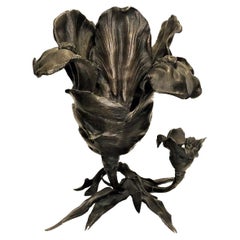
ABOUT IRIS The iris is a special and mysterious flower. Not only because of its striking appearance, but also from an artistic and historical point of view. It is also like a work of art, as though created by Mother Nature. The unique leaves of this plant not only create wonderful shadow casts, but also look as if they were painted by hand. It's no wonder that iris acts as the muse for countless artists, and can be seen in many famous works of art. The iris was first spotted in the time of Pharaoh Thutmose, in 1504 BC. He had the iris inscribed into the wall reliefs of a temple as a sign of his power, as well as decorating his sceptre with motifs of the flower. Since then, the iris has been a symbol of victory in Egypt. But the symbolism of the iris goes further than that. In Japan, the flower represents courage and is the symbol of the boys' festival. In Islamic cultures, the iris is a symbol of prosperity. In Europe, the flower was a popular weapon symbol in the Middle Ages and stood for chivalry. And in Christianity, the iris was seen as a symbol of the trinity because of its three-part flowers. With more than 300 varieties, the iris is now the most popular flower among growers and gardeners following the rose. Countless artists use the iris in their works and the flower is present in all eras. You can see the flower on furniture, vases, jewelry, fabrics, sculptures, coats of arms and much more. Did you know that the iris is also called the sword lily? It's not a coincidence that it used to symbolize physical and emotional pain and suffering caused by a weapon. We also see the flower in religious art, where it's often associated with Mary and Jesus. The iris is also associated with the Greek goddess Iris, where the flower symbolizes reconciliation and divine messages. This is also reflected in many paintings. Finally, the iris is also visible in Dutch and Flemish still-life paintings. This can be in a religious form, incorporated into an object or as a decorative flower. In the Art Nouveau art movement, the iris (along with other plants, such as the birch) was often used as an expression of feminine beauty. With its almost otherworldly appearance, the iris is perfectly suited to the Art Nouveau aesthetic and is featured in many well-known works of art. The poet of that era, Hermann Hesse...
Category

Antique Early 1900s French Art Nouveau Planters, Cachepots and Jardinières

Materials

Bronze

Japanese Art Nouveau Meiji Period Patinated Bronze Vase, circa 1900
Located in New York, NY
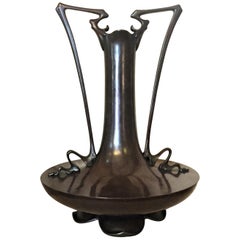
Although unmarked, this rare and important, grand but at the same exquisite patinated bronze vase has just a very few little details, defying the shape of the handles, as well as the...
Category

Antique Early 1900s Japanese Art Nouveau Vases

Materials

Bronze

Charles Vital-Cornu, French Art Nouveau Bronze Sculptural Floral Vase, 1900s
By Charles Vital-Cornu
Located in New York, NY
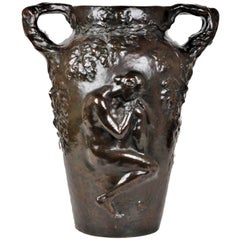
Charles Vital-Cornu (French, 1851 - 1927), Jouffroy’s and Pils’ pupil, he acquired a skillfulness mastery in carving marbles and producing bronzes. He used several patinas in his production. Indeed, if his pieces' embodiments are often golden-brown colored, the hollow part are darker. His figures, hands, faces, and bodies are of a great quality. Charles Vital-Cornu had participated in numerous annual ‘‘Salons’’ organized in Paris by ‘‘la Société des Artistes Français’’ where he got several awards, such as a mention of Honor in 1880 and 1881, a third class medal in 1882, a travelling grant in 1883, a second class medal in 1886, a bronze medal at the 1889 World Fair and, finally, a silver medal at the 1900 World Fair at the Grand palace...
Category

Antique Early 1900s French Art Nouveau Vases

Materials

Bronze

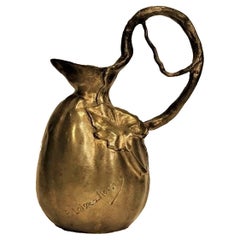
Paul Loiseau-Rousseau, French Art Nouveau Gilt Bronze Jug, Ca. 1900
By Paul Loiseau-Rousseau 1
Located in New York, NY
Paul Louis Emile Loiseau-Rousseau (French, 1861-1927) was a famous French sculptor. In his youth, he planned to devote himself to etching, was a student of Antoine-Louis Barye at the...
Category

Antique Early 1900s French Art Nouveau Vases

Materials

Bronze

Still Thinking About These?

All Recently Viewed