1 of 3

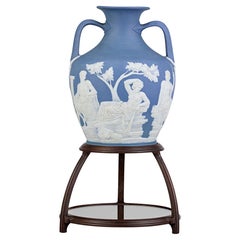
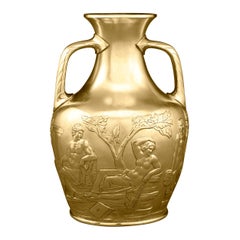
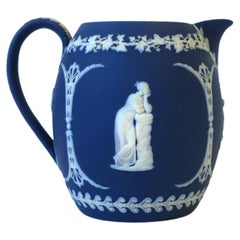
Portland Vase by Wedgwood, England 1880

Price:$2,300
$3,400List Price

You May Also Like

Wedgwood First Edition Portland Vase
By Josiah Wedgwood
Located in New Orleans, LA
This extraordinary First Edition Wedgwood rendering of the legendary Portland Vase is one of the rarest masterpieces of Josiah Wedgwood, the most important ceramics manufacturer of the 18th century. A tour de force of ceramic art, the Portland Vase First Editions are regarded as one of the greatest ceramic accomplishments of the 18th century, and they are a testament to the superior skill of Josiah Wedgwood, his extraordinary ambition and his tireless dedication to perfection. One of the very few First Editions still in private hands, this exceptional Wedgwood Portland Vase is one of the most important works of ceramics on the market. The story of Wedgwood and the Portland Vase is legendary. The original Portland Vase is the ancient world's most famous decorative arts masterpiece—a cameo glass vase dating to circa 25 CE with a frieze representing the myth of Peleus and Thetis, initially thought to be carved from stone. When it was first rediscovered around 1582, it captivated the world with its opaque white cameo figures over its rich blue background. After the vase was excavated it was owned by Cardinal Barberini, whose family later sold it to the Duke of Hamilton who eventually sold it to the Duchess of Portland, from whom the famed vase now takes its name. The famed British sculptor John Flaxman was likely the first to have brought the vase to Wedgwood’s attention. In a letter dated February 5, 1784, he wrote: “I wish you may soon come to town to see William Hamilton’s vase, it is the finest production of Art that has been brought to England and seems to be the very apex of perfection to which you are endeavouring to bring your bisque and jasper…” Indeed, the Portland Vase is a masterpiece of cameo-cutting, with a stunning frieze of opaque white cameo glass over its translucent deep blue form. Its beauty and translucence would inspire Wedgwood to undertake his years-long endeavor to precisely replicate the original in porcelain. Upon closer examination, Wedgwood realized the vase was not made of stone or earthenware, but of cameo glass—a technique so advanced it remains the masterpiece of cameo-cutting. Today, the vase is housed in the British Museum, where it is the second most viewed antiquity, only after the Rosetta Stone. It then took Wedgwood several painstaking years to craft his unparalleled copy of the vase, during which he perfected the jasperware technique that would become his crowning achievement. To this day, the renowned porcelain firm regards the vase as its most momentous triumph, so much so that the vessel’s silhouette is incorporated into the Wedgwood logo. The four years it took Wedgwood to complete his vase were not without tribulations. From the start, Wedgwood encountered numerous problems with his copies, from cracking and blistering to the difficulty of replicating the translucent effects of the original. The first acceptable copy was produced in October 1789 and sent to Wedgwood’s physician and friend Erasmus Darwin, the grandfather of Charles Darwin. Wedgwood presented another copy to Queen Charlotte in May 1790 and afterward organized a private exhibition of the vase at the Portland House in London. The viewing proved so popular that Wedgwood was forced to restrict the show to 1,900 visitors. Much of London wished to see Wedgwood’s greatest major achievement. Perhaps the highest praise of Wedgwood’s copy came from the famed artist Sir Joshua Reynolds, the founder of the British Royal Academy: “I can venture to declare it a correct and faithful imitation, both in regard to the general effect, and the most minute detail of the part.” Over the next few years, Wedgwood's oven records listed 43 First Edition copies of the Portland Vase produced between 1791 and 1796, 11 of which were broken during the firing process. In all, it is believed around 30 First Edition vases were completed, though an unknown number of these were somewhat damaged—one of these imperfect examples is currently held by the Victoria & Albert Museum in London. The perfect examples such as ours have found their way into the most important museum collections in the world. The British Museum (London), Art Institute of Chicago, Birmingham Museum of Art, Museum of Fine Arts (Boston) and the Fitzwilliam Museum (Cambridge, UK), among others, all hold one of these highly coveted vases in their collections. In terms of technical achievement, the First Edition Portland Vases...
Category

Antique 18th Century English Classical Roman Vases

Materials

Porcelain

Wedgwood First Edition Portland Vase
$168,500
H 16 in W 8.25 in D 9 in
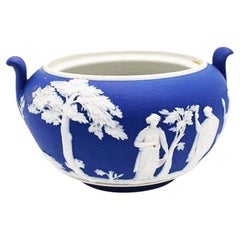
Antique Portland Blue Jasperware Bowl with White Overlay by Wedgwood England
By Wedgwood
Located in Oklahoma City, OK
A stunning Neoclassical Wedgwood Portland blue bowl with a white overlay. This piece is believed to have been a small sugar bowl, however we think it...
Category

20th Century English Neoclassical Vases

Materials

Ceramic

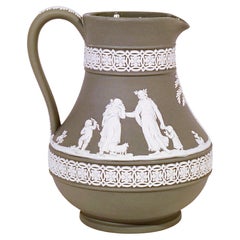
Wedgwood. Neoclassical Revival style ceramic vase, England, 1960s
By Wedgwood
Located in SANT ADRIÀ DE BESÒS, ES
Wedgwood ceramic jug, England, 60s. English ceramic piece in olive green tone and white embossed details representing mythological scenes. Perfect condition. Marked and stamped on th...
Category

Vintage 1960s English Neoclassical Revival Vases

Materials

Ceramic

Silver Gilt Portland Vase by Elkington Co.
By Elkington Co.
Located in New Orleans, LA
This magnificent silver-gilt Portland vase was crafted by the pioneering silversmithing firm of Elkington & Co. The iconic classical scenes are chased up...
Category

Antique 19th Century English Neoclassical Sterling Silver

Materials

Sterling Silver, Silver

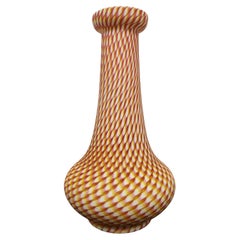
Antique Victorian Satin Glass Vase by Stevens and Williams, England 1880s
By Stevens Williams
Located in Beograd, RS
In this listing you will find a captivating Antique Victorian vase by Stevens and Williams. The vase is executed in mustard, pink and white glass with a diagonal zipper pattern on a ...
Category

Antique 1880s English Victorian Vases

Materials

Glass

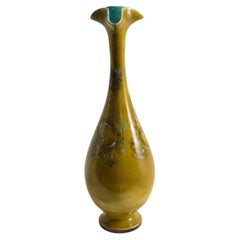
Chinoiserie Ochre Yellow Dragon Vase by Lambeth Doulton Faience, England 1880s
By Doulton Lambeth
Located in Grythyttan, SE
Elegantly adorned with intricate chinoiserie dragon detailing, this ceramic ochre yellow vase from Lambeth Doulton Faience exudes timeless charm and ex...
Category

Antique Late 19th Century English Aesthetic Movement Vases

Materials

Faience

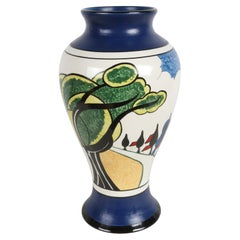
Clarice Cliff "Bizarre" Summer House Vase for Wedgwood - Hand-Painted England
By Clarice Cliff, Wedgwood
Located in St. Louis, MO
Clarice Cliff "Bizarre" collection for Wedgwood 1931 "SummerHouse" 120 shape vase hand-painted England with artist initials on bottom. This vase is based off the original and under l...
Category

Early 2000s English Art Deco Vases

Materials

Ceramic

Clarice Cliff "Bizarre" May Avenue Vase for Wedgwood - Hand-Painted England
By Clarice Cliff, Wedgwood
Located in St. Louis, MO
Clarice Cliff "Bizarre" collection for Wedgwood May Avenue Meiping Vase 120 shape vase hand-painted England with artist initials on bottom. This vase is bas...
Category

Early 2000s English Art Deco Vases

Materials

Ceramic

Wedgwood Jasperware Blue and White Pitcher or Vase Neoclassical, England 19th C
By Wedgwood
Located in New York, NY
A beautiful antique English Wedgwood Jasperware blue and white pitcher, in the Neoclassical style, circa late 19th century, England. A beautifu...
Category

Antique Late 19th Century English Neoclassical Vases

Materials

Stoneware

Wedgwood Lustre Vase by Daisy Makeig-Jones
Located in Toronto, CA
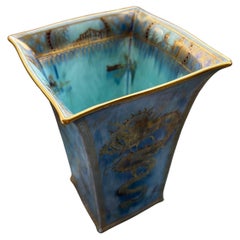
This is a stunning Wedgwood lustre vase, circa 1914, designed by Daisy Makeig-Jones. The flared form vase has an iridescent overglaze on a pale blue ground, and is decorated with intricately detailed, swirling dragons in gold on all four sides. The inside of the vase has a gilded border featuring Oriental scenes of pagodas and gardens, below which are four mythical birds which seem to float in magical suspension over the pale green glaze of the interior. Daisy Mekeig-Jones apprenticed at Wedgwood in 1909 and only two years later, by 1911, she had started to create her own designs at the factory. In 1913 she started designing the Oriental dragon patterns seen here, and by 1915 she had begun the Fairyland lustre ware for which she would become famous. These designs became incredibly popular and helped boost the company's success after the first world war. This beautiful vase, particularly with its fanciful bird-like creatures floating whimsically on the inside, feels like a true precursor to the Fairyland lustreware...
Category

Early 20th Century Vases

Materials

Porcelain

Wedgwood Lustre Vase by Daisy Makeig-Jones
$770
H 7.75 in W 5.5 in D 5.5 in

Still Thinking About These?

All Recently Viewed