Video Loading
Want more images or videos?
Request additional images or videos from the seller
1 of 14

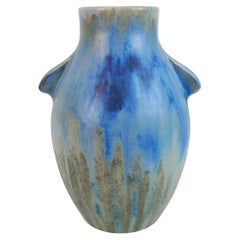
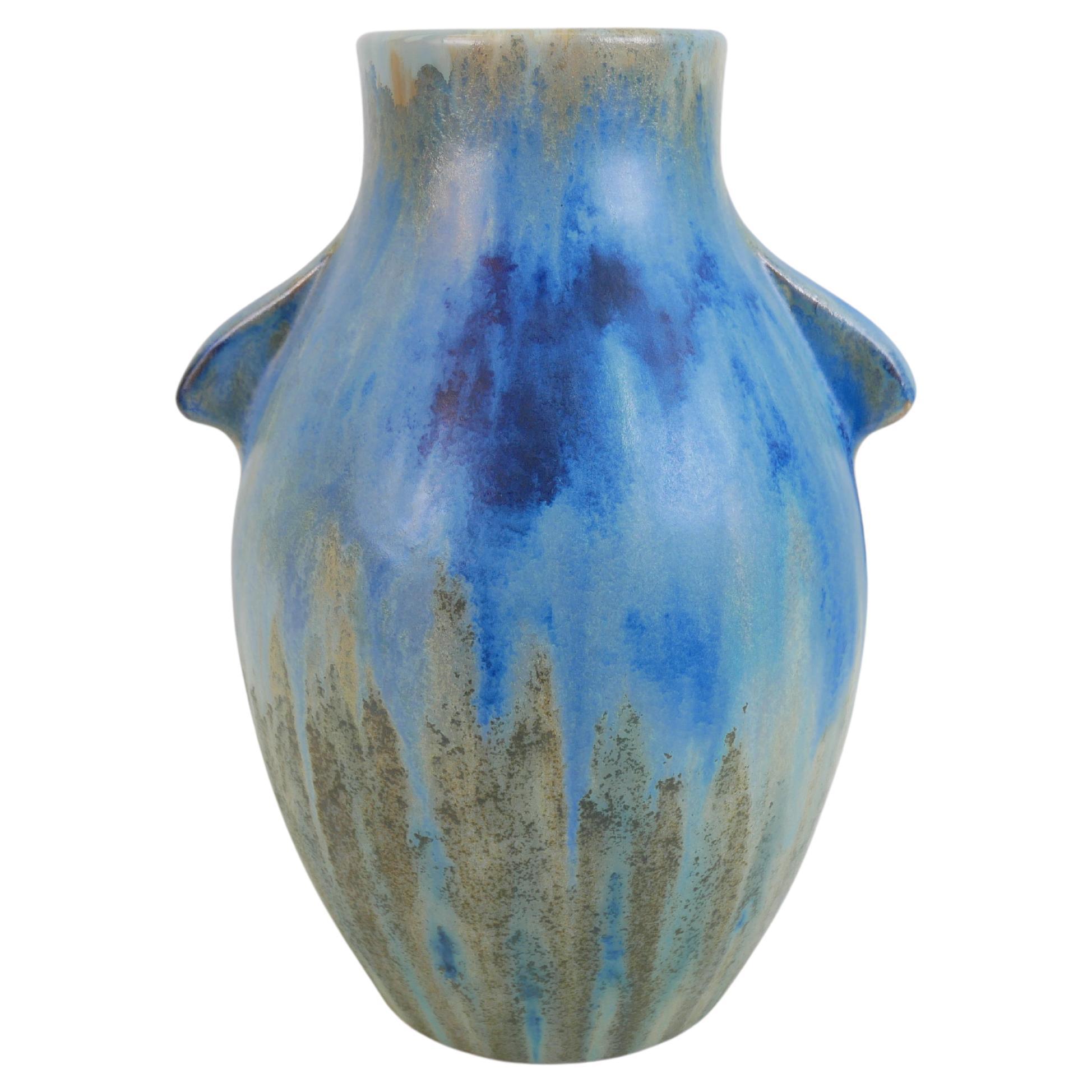
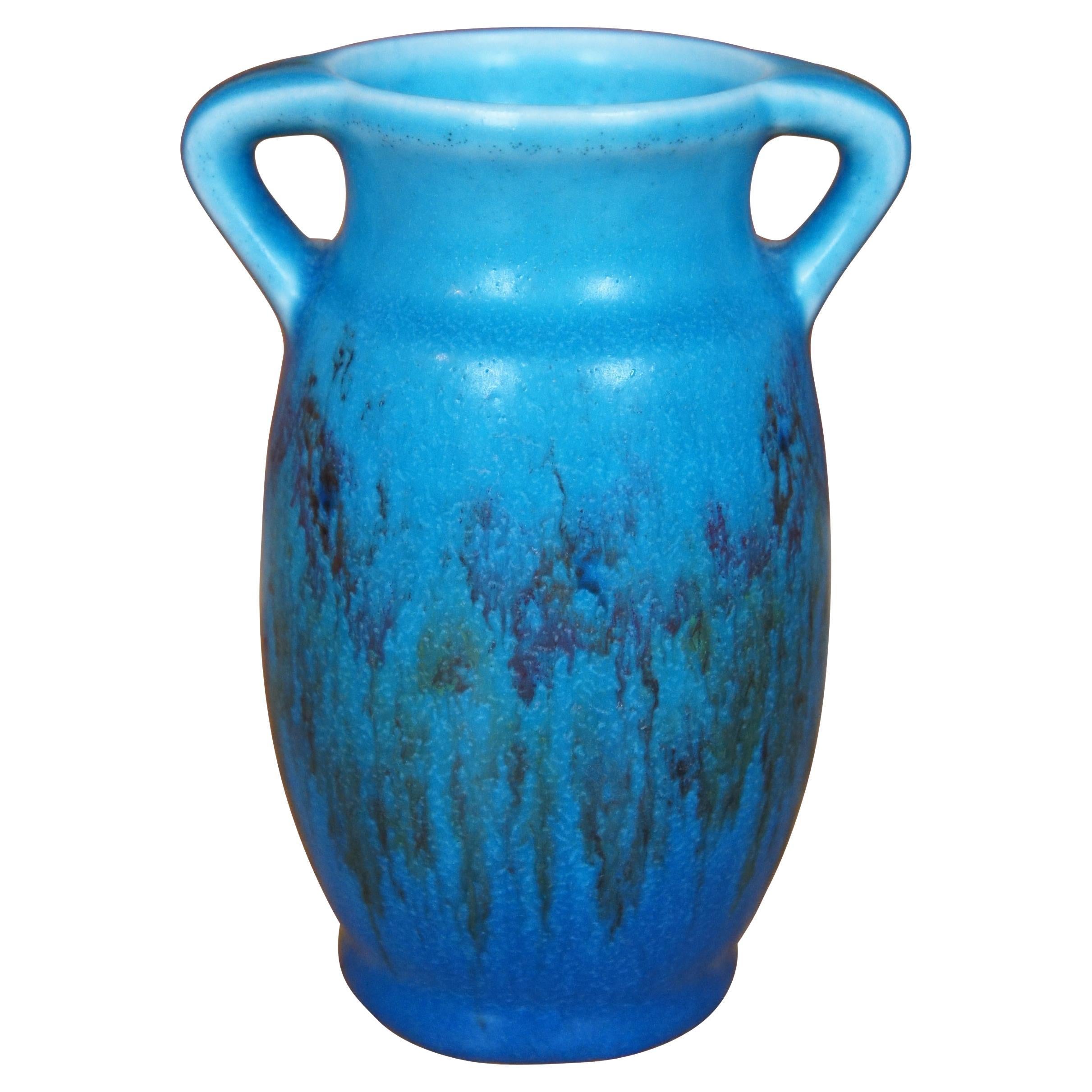
Roseville Pottery Earlam Tourmaline Blue Vase, Frank Ferrel 1930s

$560
£426.73
€492.14
CA$795.37
A$854.58
CHF 458.48
MX$10,067.91

About the Item

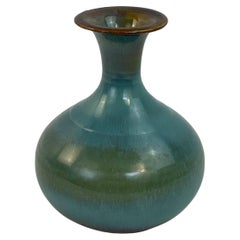
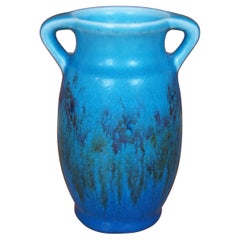
The vintage vase features a blended blue matte glaze with dripping creamy yellow semi-glossy glaze effect around the rim on both inner and outer surfaces and on handles. The vase has an Art Deco form with twin handles; the soft, curved form was used in both Earlam and Tourmaline lines (517 and A517 respectively), and the complex, but subtle and understated glaze shows a strong Arts and Crafts influence. Both Earlam and Tourmaline were designed by Frank Ferrel; both lines were marked with paper stickers that often get lost, leaving the pieces unmarked. Earlam was introduced in 1930, and it is most often found decorated in soft colors, with predominating brown and green and mottled matte glazes. Tourmaline was released in 1933, featuring matte green and pink and semigloss yellow and blue glazes, with blue being less common colorway; Tourmaline revived a few older forms from Carnelian, Futura, and Earlam lines. The factory numbering system inserts "A" before the shape numbers borrowed from the earlier lines, but the model number would be marked in red crayon, less likely to survive for almost 100 years. The vase stands 5.5" tall; the Earlam model is listed at 5.5", and Tourmaline - at 6". The vase lost its paper stiker, and there is no crayon markings left, if it had any; it has an initial impressed into the base, which was at times common for more experimental pieces. The glaze is reminiscent of the blue Tourmaline pieces, but it's more matte and less mottled that the examples that we saw catalogued both in print and in online resources; it has less bright contrasting glaze at the transition area than many Earlam pieces. While green and yellow gold are the most common colors for Earlan, there are blue and brown pieces found in this line that appear to be less common and less often referenced. Striking vase with elegant form, high quality craftsmanship, and statement piece presence will make a perfect addition to a wide range of interiors, from Traditional to Modern, Transitional, Modern Country, Organic Modern, Art Deco, Arts and Crafts, Collected, or Contemporary. We are offering a table lamp and a bowl from another line designed by Frank Ferrel in 1930s, the Orian, introduced in 1935, in separate listings. Provenance: the vase came from the estate of a prominent ceramics and studio art pottery collector in Western New York. Frank Ferrell (1878- 1961) was a renown American ceramic designer, based in Zanesville, Ohio, area. He began working at Weller Pottery in 1894 at age of 16, performing under-slip decoration of pottery for the Louwelsa line. He left Weller in 1905 to work at J.B.Owens Company, and by 1908 he opened his first studio in Zanesville, Ferock Pottery, where he experimented with sculpting pottery rather than just decorating established shapes. His unique designs caught the attention of Peters and Reed, an established commercial venture, and in 1912 he began designing for Peters and Reed, where he created his first commercial art line, Moss Aztec. The Moss Aztec line was very successful, and produced until 1926. By 1918 Frank had moved on to Roseville Pottery, where he would remain as art director for the rest of his career. Sylvan line was his first line for Roseville, and until 1952 every piece of Roseville pottery was designed by Frank Ferrell. Art Deco Futura line, created in 1928, and the highest selling line from any American pottery, the Pinecone line, created in 1935 during the great depression, as well as Baneda, Volpato, Ferrella, Sunflower and Wisteria, are some of his most well-known designs of that period. Frank Ferrell legacy of pottery forms is in the many thousands; he inspired whole generations of potters, and he had been responsible for over 100 different lines of pottery for four major companies, greatly influencing the industry.
  • Creator:
    Roseville Pottery (Manufacturer)
  • Dimensions:
    Height: 5.5 in (13.97 cm)Width: 6.38 in (16.21 cm)Depth: 5.38 in (13.67 cm)
  • Style:
    Art Deco (Of the Period)
  • Materials and Techniques:
  • Place of Origin:
  • Period:
  • Date of Manufacture:
    1930
  • Condition:
    Wear consistent with age and use.
  • Seller Location:
    Clifton Springs, NY
  • Reference Number:
    1stDibs: LU4421146143752

More From This Seller

View All
Kent Follette Crystalline Vase, American Studio Art Pottery
Located in Clifton Springs, NY
Striking studio pottery vase features crystalline glaze in bright, but harmonious teal, grey, and beige tones on the top part of the vase and burnt orange and espresso brown drip gl...
Category

Late 20th Century American Organic Modern Vases

Materials

Ceramic, Pottery

Art Nouveau Faience Handled Vase with Drip Glaze, Belgium
By Wasmuel Majolica, Denbac, Thulin
Located in Clifton Springs, NY
Striking large ceramic vase features the organic, rounded shape with 3 curved, free-flowing decorative handles. It is decorated in characteristic Belgian Art Nouveau style with the u...
Category

Early 20th Century Belgian Art Nouveau Vases

Materials

Ceramic, Faience, Majolica, Pottery

Leslie Ehrlich Crystalline Glaze Bud Vase Signed Art Pottery
Located in Clifton Springs, NY
Vintage art studio pottery ceramic vase is decorated with crystalline glaze in organic, delicate olive and sky-blue palette. The vase was hand thro...
Category

1990s American Vases

Materials

Ceramic

Jon Price Large Blue Crystalline Glaze Vase, California Art Pottery
Located in Clifton Springs, NY
Rare, sculptural vase was made of pure, high-fire porcelain and glazed both on the inside and the outside. Blue and pink highly detailed crystals on crackled blue background were gr...
Category

Late 20th Century American Post-Modern Vases

Materials

Ceramic

Linn Phelan Vase, Early American Studio Pottery 1932
By Linn Lovejoy Phelan
Located in Clifton Springs, NY
Sculptural vintage vase features a bulbous body with pronounced wide rim; it is decorated in complex drip glaze in blue, teal, and green palette with beige pink accents. Parts of the vase near the bottom are intentionally left unglazed to accentuate the unpredictable nature of the drip glazes. The inner surfaces are decorated with the glazes in the same palette, and the inner part of the rim is done with the same drip glaze pattern as the outer surfaces, creating a continuous composition and guiding the eyes of the viewers along the lines of the piece. The vase is signed and dated by the artist on the bottom, "Linn L. Phelan 1932", circling the base, and marked with that appears to be either model or glaze numbers in the center. The date corresponds with Phelan's training under Arthur Baggs; the vase is an important example of Phelan's early work and of early American studio pottery movement. While the form of the vase shows Art Deco style influence, the striking glaze on the piece points towards the distinctive works Phelan created later in his career. We are offering a large ceramic decorative bowl, created by Phelan in 1950s-1960s, in a separate listing. Linn Lovejoy Phelan (1906-1992) was a renowned American ceramic artist, who operated famous Rowantrees and Linwood Pottery in Maine. He studied art in Bevier School of Art of the Rochester Athenaeum and Mechanics Institute (now Rochester Institute of Technology) in Rochester, New York, in 1928, and received his BFA in Ceramic Art in Ohio State University, Columbus, Ohio, in 1932. While attending Ohio State University, Phelan took "Ceramic Art: Survey of the Field" class, taught by Arthur Baggs. After Phelan left the school, he corresponded with Baggs, and in late 1930s Phelan wrote to Baggs of his experiences in helping to start up what becomes Rowantrees Pottery of Blue Hill, Maine. Arthur E. Baggs (1886-1947) studied at Alfred University in 1903-1905 and 1910-1911 with Dr. Charles F. Binns, who was considered "the father of American ceramic art"; Baggs worked at Marblehead Pottery and Cowan Pottery Studio, and became the head of the Ceramic Art Division of the Fine Arts Department at Ohio State University in 1928. Examples of Baggs work are in the collections of The Metropolitan Museum of Art in New York; Museum of Fine Arts, Boston; Everson Museum of Art in Syracuse, NY; and Columbus Museum of Art in Ohio. Baggs was an extremely influential figure in early American ceramics; he was given the Binns medal for outstanding achievement, made a Fellow of the American Ceramic Society and a member of Keramos. Through Baggs Phelan was exposed to the foundations of technical creativity and advancements in ceramic art in Alfred University, as well as the early 1900s studio pottery movement in America, linking the Arts and Crafts phase of studio pottery to Modernist movement. In 1940s Phelan started teaching ceramics at School of American Craftsman (SAC), founded by Aileen Osborn Webb at Darthmouth College in 1944; SAC moved to Alfred University in Alfred, New York, in 1946, and to Rochester Institute of Technology (RIT) in 1950s. In 1940s SAC faculty included Edwin Blanchard Brown, Ernest Frank Brace, Laurits Eichner, Philip Morton, Charles Reese, Ethel Mitchell, Robert Savage, Thomas Mclure, along with Linn Phelan and another renowned ceramist, Herbert...
Category

Vintage 1930s American Vases

Materials

Ceramic, Pottery

Royal Haeger Vase Crackle Teal and Lava Glaze Mid Century Modern
By Royal Haeger
Located in Clifton Springs, NY
Vintage long neck vase was made by Royal Haeger in 1950s. It is decorated in glossy, complex blue teal crackle glaze with lighter, highly textured lava glaze accents, streaming in b...
Category

Mid-20th Century American Mid-Century Modern Vases

Materials

Ceramic, Pottery

You May Also Like

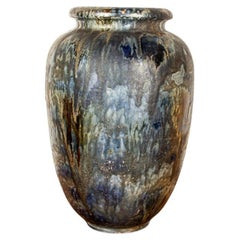
Impressive blue sandstone Art Deco vase by Pierrefonds Manufacture circa 1930
By Pierrefonds Pottery
Located in NICE, FR
This striking stoneware vase from the renowned Pierrefonds manufactory showcases the brand’s signature mastery of flambé and crystalline glazes. Its rounded, organic form is punctuat...
Category

Vintage 1930s French Art Deco Vases

Materials

Sandstone

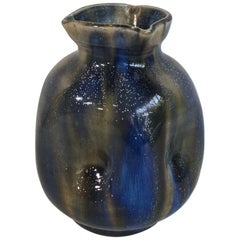
Large Art Deco vase, in glazed and iridescent blue stoneware, Roger Guérin, 1930
By Roger Guerin
Located in JOINVILLE-LE-PONT, FR
Large, highly decorative Art Deco vase. Roger Guérin (1896-1954) was a Belgian ceramist of the Art Deco period. He studied under Willem Delsaux and founded the cooperative company Po...
Category

Vintage 1930s Belgian Art Deco Vases

Materials

Ceramic

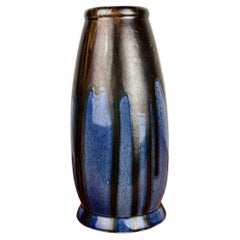
Large Art Deco vase in blue glazed ceramic by Léon Pointu, Grès de Puisaye, 1920
By Leon Pointu
Located in JOINVILLE-LE-PONT, FR
Superb large, highly decorative Art Deco vase. Léon Pointu (1879-1942) was a French ceramicist active in the early 20th century, known for his stoneware and earthenware pieces in the...
Category

Vintage 1920s French Art Deco Vases

Materials

Ceramic

Art Deco Pottery Vase Charles Greber, circa 1930
By Charles Greber
Located in Austin, TX
Art Deco pottery vase Charles Greber, circa 1930.  
Category

Vintage 1930s French Art Deco Vases

Materials

Pottery

Lovely Blue glazed ceramic vase attributed at Guy-Roland Marcy
By Guy-Roland Marcy
Located in NICE, FR
Certainly! Here is a description of the vase in 140 words in English: This is a small, elegant vase with a timeless design, attributed to the ceramic artist Guy-Roland Marcy...
Category

Vintage 1960s French Mid-Century Modern Vases

Materials

Ceramic

Rookwood Antique Art Deco Elizabeth Barrett 1924 XXIV 2557 Bud Vase 5"
By Rookwood Pottery Co.
Located in Dayton, OH
Antique Rookwood bud vase by Elizabeth Barrett. It features Art Deco styling with wide opening, high handles and blue glaze. Circa 1924 XXIV. Shape 2557. Marked with Elizabeth Ba...
Category

Vintage 1920s Art Deco Vases

Materials

Pottery