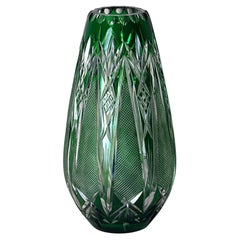
Want more images or videos?
Request additional images or videos from the seller
1 of 20
Swedish Crystal Tulip Vase With Square Base
$694.16List Price
About the Item
- Dimensions:Height: 13.78 in (35 cm)Diameter: 9.06 in (23 cm)
- Style:Scandinavian Modern (Of the Period)
- Materials and Techniques:
- Place of Origin:
- Period:
- Date of Manufacture:1980-1985
- Condition:Wear consistent with age and use. The vase is in good condition, only one corner at the base was chipped and it was chamfered slightly (see photo).
- Seller Location:Prato, IT
- Reference Number:Seller: 141311stDibs: LU4632238220692
About the Seller
5.0
Platinum Seller
Premium sellers with a 4.7+ rating and 24-hour response times
Established in 1977
1stDibs seller since 2019
301 sales on 1stDibs
Authenticity Guarantee
In the unlikely event there’s an issue with an item’s authenticity, contact us within 1 year for a full refund. DetailsMoney-Back Guarantee
If your item is not as described, is damaged in transit, or does not arrive, contact us within 7 days for a full refund. Details24-Hour Cancellation
You have a 24-hour grace period in which to reconsider your purchase, with no questions asked.Vetted Professional Sellers
Our world-class sellers must adhere to strict standards for service and quality, maintaining the integrity of our listings.Price-Match Guarantee
If you find that a seller listed the same item for a lower price elsewhere, we’ll match it.Trusted Global Delivery
Our best-in-class carrier network provides specialized shipping options worldwide, including custom delivery.You May Also Like
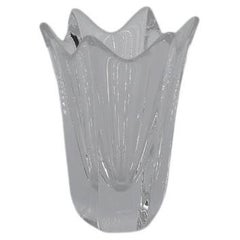
Vintage Mid-century Modern Swedish Scandinavian Transparent Crystal Tulip Vase
By Jan Johansson, Orrefors
Located in Warszawa, Mazowieckie
This Tulip crystal vase was designed by Jan Johansson for the Swedish glassworks Orrefors during the 1970s. Transparent vase made of lead art crystal glass. It is shaped like a tulip...
Category
Vintage 1970s Swedish Scandinavian Modern Vases
Materials
Crystal
$570 Sale Price
26% Off
Free Shipping
H 5.91 in W 4.34 in D 4.34 in
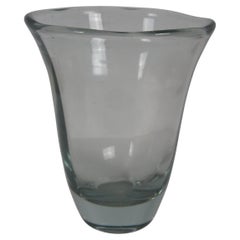
Swedish Strombergshyttan Crystal Large Wave Edge Flower Tulip Vase 10"
By Strombergshyttan
Located in Dayton, OH
Large vintage Swedish Strombergshyttan crystal flower / tulip vase with flared mouth and waving edge. Polished pontil.
Dimensions:
8.25" x 10" (Diameter x Height)
Category
Late 20th Century Vases
Materials
Crystal
$350
H 10 in W 8.25 in D 8.25 in
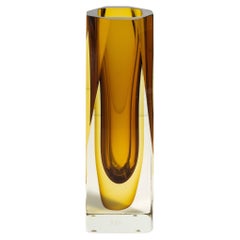
Hand Blown Murano Vase with Square Base in Amber
Located in West Hollywood, CA
This striking rectangular vase showcases a captivating combination of amber hues and crystal-clear glass, evoking a sense of timeless elegance and sophistication. The seamless blend ...
Category
21st Century and Contemporary Italian Modern Vases
Materials
Murano Glass
Nils Landberg, "Tulip Glass" Vase, Blown Glass, Sweden, 1950s
By Orrefors, Nils Landberg
Located in High Point, NC
A colored blown glass "Tulip Glass" Vase designed by Nils Landberg and produced by Orrefors, Sweden, 1950s.
From the "Expo" production series.
Category
Vintage 1950s Swedish Scandinavian Modern Vases
Materials
Blown Glass
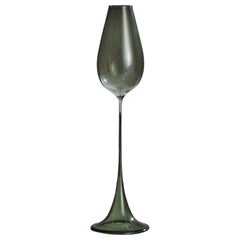
Small Swedish Crystal Vase by Strombergshyttan
By Strombergshyttan, Asta Stromberg
Located in Fort Lauderdale, FL
Vintage handcrafted oval shaped aqua blue crystal vase by Strombergshyttan. Signed on bottom.
Artist: Asta Stromberg
Manufacturer: Strombergshyttan
Origin: Sweden
Year: ...
Category
Mid-20th Century Swedish Scandinavian Modern Vases
Materials
Crystal
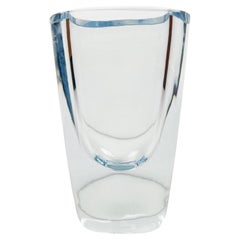
Crystal Square Flower Vase TIZO
Located in Chula Vista, CA
For your consideration, a crystal square flower vase by Tizo.
Dimensions: 4.25" H x 3.75" W x 2" D. Opening 1.5" in diameter.
Please visit take a look at our listings, we have an a...
Category
Vintage 1980s Unknown Modern Vases
Materials
Crystal
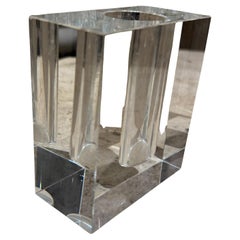
Crystal Square Architectural Bud Vase
Located in Los Angeles, CA
A simple, yet purely elegant and Architectural bud vase of solid crystal with a hole bore offset to hold a bud.
The form is the look here and the simple lines make this a hit with o...
Category
20th Century Modern Vases
Materials
Crystal
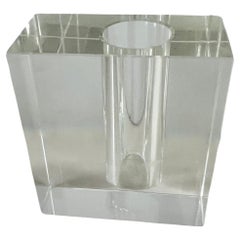
Scandinavian Modern Swedish Modern Crystal Strombergshytt Glass Vase with Lion
By Strombergshyttan
Located in New York, NY
A beautiful and substantial Scandinavian Modern Swedish Modern Strombergshyttan crystal glass vase with regal Lion design, circa mid-20th century, Sweden. Beautiful detail in etched ...
Category
Mid-20th Century Swedish Scandinavian Modern Vases
Materials
Crystal
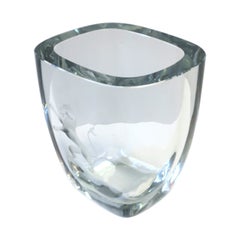
$925
H 5.19 in W 4.82 in D 4.13 in
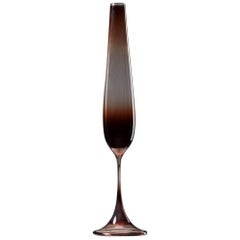
Vase, Tulip Designed by Nils Landberg for Orrefors, Sweden, 1957
By Nils Landberg
Located in Stockholm, SE
Vase, tulip designed by Nils Landberg for Orrefors,
Sweden, 1957.
Glass.
Measurements
H: 44.5 cm/ 1' 6".
Category
Vintage 1950s Swedish Scandinavian Modern Vases
Materials
Glass
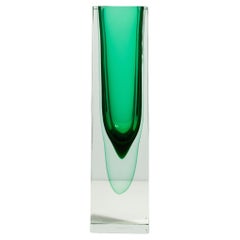
Hand Blown Murano Vase with Square Base in Emerald Green
Located in West Hollywood, CA
An ode to modern sophistication, this exquisite emerald hue vase exudes a timeless elegance that can transform any space into a sanctuary of style. Handcrafted in Murano, Italy, this...
Category
21st Century and Contemporary Italian Modern Vases
Materials
Murano Glass
More From This Seller
View AllNeoclassical Style Italian Crystal Vase With Festoon Engravings
Located in Prato, Tuscany
Before describing the object under consideration we must make an important clarification; the artifact, one of many that we will publish over time, is part of the museum collection of a historic Florentine crystal grinder that unfortunately closed recently. It is the Marcello Galgani & Son company, whose completely manual and artisanal work has not withstood the disproportionate advance of mass-produced mechanical processes! Marcello Galgani began his craft as a grinder and restorer in 1960; as the years went by, Marcello mastered and became familiar with particular techniques and shapes, resulting in the production of objects that manage to retain the freshness of grinding and engraving, the warmth and softness of light, and the inimitable flavor of unique artifacts. After several years, his son Lorenzo, who grew up among crystals, also entered the business and immediately became passionate about this ancient craft with skill and ability. Stimulated by the aesthetic sense of the past, father and son, set up a workshop in which the shapes they researched and created themselves are mouth-blown by traditional Tuscan glassmakers in Empoli, then ground and engraved using ancient sixteenth-century techniques, with motifs born of the Galgani's inexhaustible imagination or culturally inspired by designs of objects seen and studied in Florentine museums (Uffizi, Galleria Palatina, Museo degli Argenti, etc.). Marcello and Lorenzo Galgani were also Masters in the difficult art of restoration, bringing rare and precious objects back to life. As mentioned the company recently closed and disposed of all its last production, only Marcello's old private museum collection remained, which includes unique and special objects created over time, a collection that the craftsman made available to us for a planned sale. All of the objects were made entirely by hand with old grinding wheels, but there were mainly two tools that allowed the creation of masterpieces: the right hand and the left hand of the master craftsman. Ancient glassmaking techniques were used for all the ground and engraved products: first the object was ground with an emery wheel fed continuously by a jet of abrasive sand and water, then re-polished with a very fine-grained sandstone wheel also fed with water; the engravings were done freehand using as many as 10-15 small stone wheels for each design (flowers, branches, animals, etc. ); then the object was polished and shined; we must make, at this point, an important clarification on these last two operations: towards the end of the 1960s acid crystal polishing was devised, the object was immersed and rotated in a solution of sulfuric acid, fluoridic acid and water and in a short time all the defects left by the previous processes were eliminated, it was a fast, industrial operation that allowed to lower costs considerably, with discrete but not excellent results. But for Galgani's products polishing is done with a cork bark wheel wet with water and pumice, to make the surfaces more transparent. Finally, polishing was achieved with a felt wheel wet with a paste of water, iron oxide, and cerium oxide. This series of processes takes an average of two days of work( sometimes much longer) for each object, each engraving or grinding is the result of the creative inventiveness of the two craftsmen, inventiveness that transforms crystal into a material reality of the highest aesthetic value and inestimable value. All objects in the entire collection have never been used; they were part of the exhibition. Large oval crystal vase...
Category
Late 20th Century Italian Neoclassical Vases
Materials
Crystal
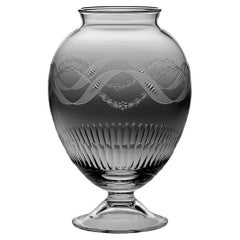
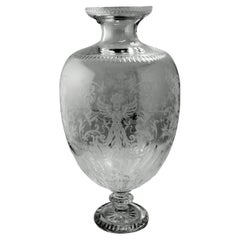
Baroque Style Large Italian Crystal Vase With Grotesque Engravings
Located in Prato, Tuscany
Before describing the object under consideration, we must make an important clarification; the artifact, one of many that we will publish over time, is part of the museum collection of a historic Florentine crystal grinder that unfortunately closed recently. It is the Marcello Galgani & Son company, whose completely manual and artisanal work has not withstood the disproportionate advance of mass-produced mechanical processes! Marcello Galgani began his craft as a grinder and restorer in 1960; as the years went by, Marcello mastered and became familiar with particular techniques and shapes, resulting in the production of objects that manage to retain the freshness of grinding and engraving, the warmth and softness of light, and the inimitable flavor of unique artifacts. After several years, his son Lorenzo, who grew up among crystals, also entered the business and immediately became passionate about this ancient craft with skill and ability. Stimulated by the aesthetic sense of the past, father and son, set up a workshop in which the shapes they researched and created themselves are mouth-blown by traditional Tuscan glassmakers in Empoli, then ground and engraved using ancient sixteenth-century techniques, with motifs born from the Galgani's inexhaustible imagination or culturally inspired by designs of objects seen and studied in Florentine museums (Uffizi, Galleria Palatina, Museo degli Argenti, etc.). Marcello and Lorenzo Galgani were also Masters in the difficult art of restoration, bringing rare and precious objects back to life. As mentioned the company recently closed and disposed of all its last production, and only Marcello's old private museum collection remained, which includes unique and special objects created over time, a collection that the craftsman made available to us for a planned sale. All of the objects were made entirely by hand with old grinding wheels, but there were mainly two tools that allowed the creation of masterpieces: the right hand and the left hand of the master craftsman. Ancient glassmaking techniques were used for all the ground and engraved products: first, the object was ground with an emery wheel fed continuously by a jet of abrasive sand and water, then re-polished with a very fine-grained sandstone wheel also fed with water; the engravings were done freehand using as many as 10-15 small stone wheels for each design (flowers, branches, animals, etc. ); then the object was polished and shined; we must make, at this point, an important clarification on these last two operations: towards the end of the 1960s acid crystal polishing was devised, the object was immersed and rotated in a solution of sulfuric acid, fluoridic acid and water and in a short time all the defects left by the previous processes were eliminated, it was a fast, industrial operation that allowed to lower costs considerably, with discrete but not excellent results. But for Galgani's products polishing is done with a cork bark wheel wet with water and pumice, to make the surfaces more transparent, and finally polishing was achieved with a felt wheel wet with a paste of water, iron oxide, and cerium oxide. This series of processes takes an average of two days of work( sometimes much longer) for each object, each engraving or grinding is the result of the creative inventiveness of the two artisans, inventiveness that transforms crystal into reality material of the highest aesthetic value and inestimable value. All the items in the entire collection have never been used; they were part of the exhibition. Large crystal vase; the decorations, in baroque style represent a series of "grotesques" The object is "a unique piece" signed by the Master, it was created in Marcello Galgani's workshop in 1983 and made with the techniques (grinding, engraving and polishing) that we explained in the description; for the shape, the Master was inspired by a vase present in a painting, preserved in the Uffizi Gallery in Florence by the sixteenth-century painter Jacopo Ligozzi...
Category
Late 20th Century Italian Baroque Vases
Materials
Crystal
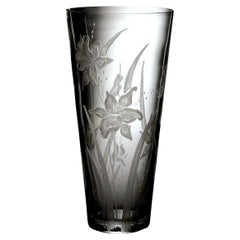
Italian Cut And Ground Crystal Vase With Flower Decoration
Located in Prato, Tuscany
Before describing the object under consideration we must make an important clarification; the artifact, one of many that we will publish over time, is part of the museum collection o...
Category
Late 20th Century Italian Mid-Century Modern Vases
Materials
Crystal
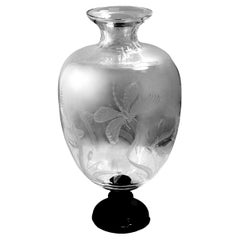
Art Noveau Style Large Crystal Vase Engraved With Butterflies And Dragonflies
Located in Prato, Tuscany
Before describing the object under consideration, we must make an important clarification; the artifact, one of many that we will publish over time, is part of the museum collection of a historic Florentine crystal grinder that unfortunately closed recently. It is the Marcello Galgani & Sons company, whose completely manual and artisanal work has not withstood the disproportionate advance of mass-produced mechanical processes! Marcello Galgani began his craft as a grinder and restorer in 1960; as the years went by, Marcello mastered and became familiar with particular techniques and shapes, resulting in the production of objects that manage to retain the freshness of grinding and engraving, the warmth and softness of light, and the inimitable flavor of unique artifacts. After several years, his son Lorenzo, who grew up among crystals, also entered the business and immediately became passionate about this ancient craft with skill and ability. Stimulated by the aesthetic sense of the past, father and son, set up a workshop in which the shapes they researched and created themselves are mouth-blown by traditional Tuscan glassmakers in Empoli, then ground and engraved using ancient sixteenth-century techniques, with motifs born from the Galgani's inexhaustible imagination or culturally inspired by designs of objects seen and studied in Florentine museums (Uffizi, Galleria Palatina, Museo degli Argenti, etc.). Marcello and Lorenzo Galgani were also Masters in the difficult art of restoration, bringing rare and precious objects back to life. As mentioned the company recently closed and disposed of all its last production, and only Marcello's old private museum collection remained, which includes unique and special objects created over time, a collection that the craftsman made available to us for a planned sale. All of the objects were made entirely by hand with old grinding wheels, but there were mainly two tools that allowed the creation of masterpieces: the right hand and the left hand of the master craftsman. Ancient glassmaking techniques were used for all the ground and engraved products: first, the object was ground with an emery wheel fed continuously by a jet of abrasive sand and water, then re-polished with a very fine-grained sandstone wheel also fed with water; the engravings were done freehand using as many as 10-15 small stone wheels for each design (flowers, branches, animals, etc. ); then the object was polished and shined; we must make, at this point, an important clarification on these last two operations: towards the end of the 1960s acid crystal polishing was devised, the object was immersed and rotated in a solution of sulfuric acid, fluoridic acid and water and in a short time all the defects left by the previous processes were eliminated, it was a fast, industrial operation that allowed to lower costs considerably, with discrete but not excellent results. But for Galgani's products polishing is done with a cork bark wheel wet with water and pumice, to make the surfaces more transparent, and finally polishing was achieved with a felt wheel wet with a paste of water, iron oxide, and cerium oxide. This series of processes takes an average of two days of work( sometimes much longer) for each object, each engraving or grinding is the result of the creative inventiveness of the two artisans, inventiveness that transforms crystal into reality material of the highest aesthetic value and inestimable value. All the items in the entire collection have never been used; they were part of the exhibition. Large crystal vase with a black base; the decorations, purely Art Noveau, represent graceful butterflies and dragonflies in a peaceful lake landscape. The object is "one-of-a-kind" signed by the Master; it was created in Marcello Galgani's workshop in 1982 and made with the techniques (grinding, engraving, and polishing) we explained in the description; for the shape, the Master was inspired by a vase found in a painting, preserved in the Uffizi Gallery in Florence by the 16th-century painter Jacopo Ligozzi...
Category
Late 20th Century Italian Art Nouveau Vases
Materials
Crystal
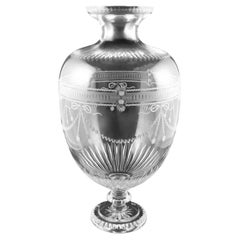
Neoclassical Style Large Italian Crystal Vase with 18th Century Engravings
Located in Prato, Tuscany
Before describing the object under consideration, we must make an important clarification; the artifact, one of many that we will publish over time, is part of the museum collection of a historic Florentine crystal grinder that unfortunately closed recently. It is the Marcello Galgani & Son company, whose completely manual and artisanal work has not withstood the disproportionate advance of mass-produced mechanical processes! Marcello Galgani began his craft as a grinder and restorer in 1960; as the years went by, Marcello mastered and became familiar with particular techniques and shapes, resulting in the production of objects that manage to retain the freshness of grinding and engraving, the warmth and softness of light, and the inimitable flavor of unique artifacts. After several years, his son Lorenzo, who grew up among crystals, also entered the business and immediately became passionate about this ancient craft with skill and ability. Stimulated by the aesthetic sense of the past, father and son, set up a workshop in which the shapes they researched and created themselves are mouth-blown by traditional Tuscan glassmakers in Empoli, then ground and engraved using ancient sixteenth-century techniques, with motifs born from the Galgani's inexhaustible imagination or culturally inspired by designs of objects seen and studied in Florentine museums (Uffizi, Galleria Palatina, Museo degli Argenti, etc.). Marcello and Lorenzo Galgani were also Masters in the difficult art of restoration, bringing rare and precious objects back to life. As mentioned the company recently closed and disposed of all its last production, and only Marcello's old private museum collection remained, which includes unique and special objects created over time, a collection that the craftsman made available to us for a planned sale. All of the objects were made entirely by hand with old grinding wheels, but there were mainly two tools that allowed the creation of masterpieces: the right hand and the left hand of the master craftsman. Ancient glassmaking techniques were used for all the ground and engraved products: first, the object was ground with an emery wheel fed continuously by a jet of abrasive sand and water, then re-polished with a very fine-grained sandstone wheel also fed with water; the engravings were done freehand using as many as 10-15 small stone wheels for each design (flowers, branches, animals, etc. ); then the object was polished and shined; we must make, at this point, an important clarification on these last two operations: towards the end of the 1960s acid crystal polishing was devised, the object was immersed and rotated in a solution of sulfuric acid, fluoridic acid and water and in a short time all the defects left by the previous processes were eliminated, it was a fast, industrial operation that allowed to lower costs considerably, with discrete but not excellent results. But for Galgani's products polishing is done with a cork bark wheel wet with water and pumice, to make the surfaces more transparent, and finally polishing was achieved with a felt wheel wet with a paste of water, iron oxide, and cerium oxide. This series of processes takes an average of two days of work( sometimes much longer) for each object, each engraving or grinding is the result of the creative inventiveness of the two artisans, inventiveness that transforms crystal into reality material of the highest aesthetic value and inestimable value. All the items in the entire collection have never been used; they were part of the exhibition. Large crystal vase with base; the decorations, graceful and delicate, are in Neoclassical style. The object is "one-of-a-kind" signed by the Master; it was created in Marcello Galgani's workshop in 1981 and made with the techniques (grinding, engraving, and polishing) we explained in the description; for the shape, the Master was inspired by a vase found in a painting, preserved in the Uffizi Gallery in Florence by the 16th-century painter Jacopo Ligozzi...
Category
Late 20th Century Italian Neoclassical Vases
Materials
Crystal
Bohemian Biedermeier Style Cut And Polished Green Crystal Vase
Located in Prato, Tuscany
Elegant and substantial green crystal vase, produced between 1950 and 1955 in Northern Bohemia, in the Jablonec nad Nisou area—a historically renowned region celebrated for its excel...
Category
Mid-20th Century Biedermeier Vases
Materials
Crystal