Piero Fornasetti Ceramic 'Bill of Sale' Tray, Weikel
Smith Spice Company, Philadelphia
I. Introduction
The Object in Focus: A Nexus of Art, Commerce, and History
This report provides an exhaustive analysis of a remarkable object: a Piero Fornasetti ceramic tray depicting a bill of sale from the Weikel
Smith Spice Company of Philadelphia. The piece is a quintessential example of Fornasetti's mid-century modern aesthetic, which deliberately sought to elevate everyday ephemera and commercial documents into the realm of high design. This inquiry necessitates a multi-faceted approach, moving beyond a simple physical description to dissect the object's intrinsic attributes, its conceptual place within Fornasetti's broader artistic themes, the historical context of the American company it depicts, and its contemporary standing in the global decorative arts market. The analysis synthesizes information from disparate domains—art history, commercial records, and auction data—to produce a comprehensive and authoritative document befitting its subject.
II. Catalogue Raisonné
Gallery Description
A. Title
Provenance
Title: Piero Fornasetti "Bill of Sale" Ceramic Tray, Weikel
Smith Spice Company, Philadelphia
Artist/Designer: Piero Fornasetti (Italian, 1913–1988)
Date of Creation: Circa 1950s–1960s [1]
Materials: Glazed porcelain with lithographic transfer-printed decoration and gilt details
Provenance: This object exists within an active secondary market for the designer's work, with similar examples appearing in sales at major auction houses as well as on various online platforms. Examples have been documented as shipping from locations such as Pennsylvania, suggesting a circulation within the United States market
B. Detailed Physical Description
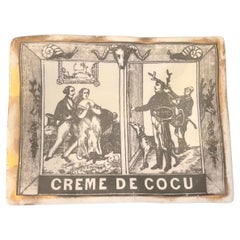
The object is a rectangular, low-relief tray or ashtray, meticulously crafted from fine Italian porcelain [2]. Its design is a masterful exercise in trompe-l'oeil, or "deceive the eye," a technique that creates the optical illusion of three-dimensional space and texture on a two-dimensional surface. In this instance, the surface of the ceramic is decorated with a transfer-printed motif that flawlessly mimics a weathered, creased, and aged piece of paper. The entire composition is an intricately rendered facsimile of a historical bill of sale.
The central design is a receipt from the "Weikel
Smith Spice Company," with the business's name prominently displayed at the top. The document is marked with an invoice number and the specific date of "September 7th," though the year is intentionally omitted [1]. A list of purchased spices, a core element of the document's commercial purpose, is elegantly detailed in flowing, gold-colored script. The itemized list includes "Cloves," "Nutmegs," "Cinnamon," "Allspice," "Pepper," and "Mustard" . The use of gilt details not only highlights the commercial nature of the document but also elevates these otherwise mundane elements into a decorative and luxurious pattern.
The tray measures approximately 8 1/2 inches in width by 5 1/4 inches in depth, with a height of 1 inch [1, 3]. The reverse side of the piece is stamped with the recognizable maker's marks that authenticate the object's origin. These include "Fornasetti Milano" and "Made in Italy," sometimes accompanied by the Fornasetti "hand with paintbrush" motif [3, 4]. These marks are definitive indicators of the tray's Italian manufacture and its status as an original design from the Fornasetti atelier.
III. The Fornasetti Oeuvre: Context and Design Philosophy
A. Piero Fornasetti (1913–1988): A Magician of Design
Piero Fornasetti was a prolific and multi-disciplinary Italian artist, engraver, and interior decorator. His body of work, comprising over 13,000 different objects, is celebrated for its wit, whimsy, and intellectual depth. Fornasetti's artistic philosophy centered on the idea of democratizing art by producing objects in series rather than as unique, one-of-a-kind pieces [6]. He believed that beautiful and imaginative design should be accessible, and this conviction led him to apply his distinctive motifs to a vast array of everyday functional objects, including furniture, fashion, and ceramics.
Fornasetti’s work is characterized by a unique fusion of classicism, surrealism, and metaphysical art [5, 6]. His collaboration with the esteemed Italian architect Gio Ponti was particularly pivotal during the economic boom of the 1950s. Together, they promoted a holistic approach to home interiors, advocating for a style that was both functional and aesthetically unified through intricate design [6]. Fornasetti's technical innovation was critical to this process, particularly his pioneering use of lithographic transfer-printing to apply his fantastical designs to a diverse variety of surfaces [5]. This technique allowed him to produce his iconic series of decorated objects and cemented his influence in the world of mid-century design.
B. The Document as a Recurring Motif
The "Bill of Sale" tray is not an isolated or singular design but rather an exemplary piece within a distinct, yet less documented, thematic series in Fornasetti's oeuvre. This series, which could be informally termed "Documenti" or "Ephemera," runs parallel to his more famous "Tema e Variazioni" collection. While the latter explored the endless variations on the face of the opera singer Lina Cavalieri, this series focuses on the reproduction of historical documents, receipts, and other printed matter.
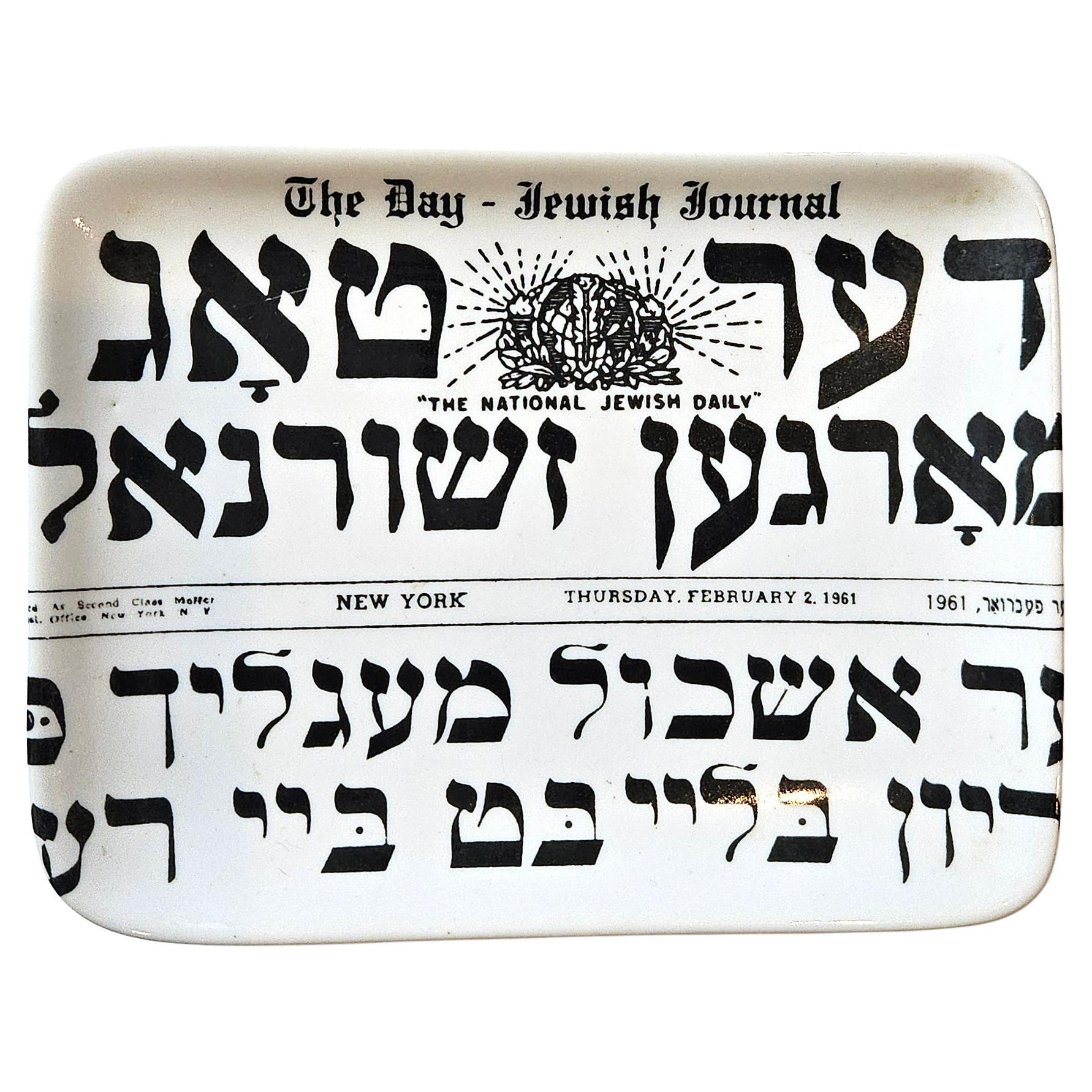
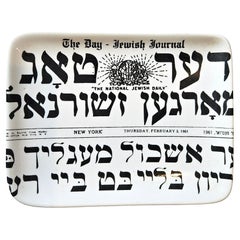
The "Bill of Sale" tray functions on an analogous conceptual level. It is a "found" piece of historical ephemera—a commercial invoice—that Fornasetti has chosen to lift from its mundane context and elevate to the status of a decorative object. This artistic methodology is further supported by other known works, such as the ceramic tray depicting a playbill for Giuseppe Verdi’s opera Othello [10]. In both cases, Fornasetti's artistic genius lay not in the invention of the primary image, but in the sophisticated and intelligent act of selecting a culturally or historically resonant piece of paper and transforming it through his signature technical and stylistic approach. This demonstrates a profound and consistent artistic methodology that transcends his most famous series, proving that his fascination extended to any piece of printed material that held a cultural or narrative significance. By doing so, he stripped the document of its specific temporal function and remade it as a timeless, whimsical symbol.
C. The Trompe-L'oeil and Humorous Element
A central tenet of Fornasetti's artistic identity is the use of humor and irony to subvert traditional expectations of form and function. The "Bill of Sale" tray is a prime example of this intellectual playfulness. The piece's trompe-l'oeil effect, which so convincingly renders a fragile, paper-like surface on a solid and durable ceramic body, creates a delightful contradiction [5]. The observer is presented with a visual paradox: a disposable commercial receipt, meant to be forgotten and discarded, has been immortalized as a permanent, functional object for the home.
The humor is further amplified by the choice of subject matter. The act of placing a mundane symbol of transaction and consumption—a bill for spices—on a decorative object for a home is a direct commentary on the intersection of art and commerce. Fornasetti's work consistently blurred the lines between high art and functional design, and this piece embodies that spirit completely. It is not merely an ashtray or a tray; it is a witty and thoughtful commentary on the nature of objects, their purpose, and their capacity to tell a story. This creative subversion is a hallmark of Fornasetti's style and contributes to the enduring appeal of his designs.
IV. Historical
Cultural Context: The Weikel
Smith Connection
A. The History of a Philadelphia Institution
The bill of sale depicted on the Fornasetti tray is from the Weikel
Smith Spice Company, a real historical entity with roots in 19th-century Philadelphia. The company's history can be traced to its founding in 1850 as Hummel, Bohler
Co. [11]. It was later reorganized as a stock company under the name Weikel
Smith Spice Co. in 1867 . While the company's precise lifespan into the 20th century is not fully detailed in the provided materials, historical records show that it was active in the late 19th and early 20th centuries, documented through the existence of various advertisements and trade cards . These promotional materials were common at the time and often listed the various spices and products manufactured by the company, a detail that aligns perfectly with the itemized list on the Fornasetti tray.
B. The Creative Anachronism: An American Document in Italian Design
The selection of a Philadelphia-based spice company for a mid-20th-century Italian design is a deliberate and fascinating act of creative anachronism. It speaks directly to Fornasetti's eclectic and global sources of inspiration, demonstrating that he was a cultural scavenger who pulled images from a vast, international archive of historical documents. The most probable explanation for this choice is that Fornasetti, who was known to source images from 19th-century publications and ephemera for his work [8], likely came across a vintage Weikel
Smith trade card, advertisement, or an actual bill of sale.
This object is not a simple reproduction; it is a creative recontextualization. The absence of a specific year on the "September 7th" date [1] is a crucial detail that deliberately de-contextualizes the document, stripping it of its specific historical purpose and transforming it into a timeless symbol. This decision aligns with Fornasetti's broader aesthetic goal of creating art from reproducible, everyday items. The tray therefore functions as a sophisticated commentary on the intersection of post-war Italian design, historical American commerce, and the universal nature of trade. It is a material manifestation of a cross-cultural and temporal dialogue, a testament to Fornasetti's ability to see and interpret the poetic potential in the most mundane of subjects.
(Ref: NY9814-nin)