1 of 8
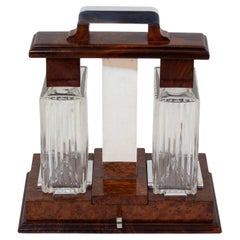
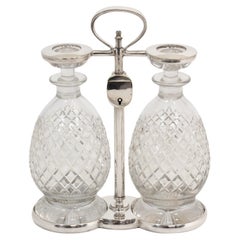
Art Deco Tantalus Decanter Set in Crystal, Wood and Chrome
$3,200List Price
About the Item
- Dimensions:Height: 12 in (30.48 cm)Width: 19 in (48.26 cm)Depth: 5.5 in (13.97 cm)
- Style:Art Deco (Of the Period)
- Materials and Techniques:
- Place of Origin:
- Period:
- Date of Manufacture:1940
- Condition:Minor losses.
- Seller Location:Oakland, CA
- Reference Number:Seller: 27581stDibs: LU871417685041
Authenticity Guarantee
In the unlikely event there’s an issue with an item’s authenticity, contact us within 1 year for a full refund. DetailsMoney-Back Guarantee
If your item is not as described, is damaged in transit, or does not arrive, contact us within 7 days for a full refund. Details24-Hour Cancellation
You have a 24-hour grace period in which to reconsider your purchase, with no questions asked.Vetted Professional Sellers
Our world-class sellers must adhere to strict standards for service and quality, maintaining the integrity of our listings.Price-Match Guarantee
If you find that a seller listed the same item for a lower price elsewhere, we’ll match it.Trusted Global Delivery
Our best-in-class carrier network provides specialized shipping options worldwide, including custom delivery.You May Also Like
English Art Deco Tantalus in Rare Thuya Wood
Located in Northampton, GB
FREE WORLDWIDE SHIPPING
Art Deco Period Tantalus
From our Decanters & Tantalus collection, we are pleased to offer this unusual Tantalus veneered in Thuya wood from the Art Deco p...
Category
Early 20th Century English Art Deco Barware
Materials
Silver Plate
Midcentury Cubic Chromed Steel, Wood and Glass Dry Bar, Italy 1970s
By Willy Rizzo
Located in Roma, IT
Unique midcentury cubic dry bar in lacquered ash wood, mirrored steel and glass dry bar with hidden wheels. This gorgeous Willy Rizzo style dry bar was produced in Italy during the 1970s.
The wheeled bar cart's four sides are in mirrored chromed steel, while the top is in dark smoked glass. It moves thanks to four hidden wheels, and the structure is veneered black lacquered oak.
A design masterpiece that will become a cult furniture element in a midcentury bar or living room.
Italian designer and photographer Willy Rizzo (1928-2013) first came to prominence in the 1960s as both a chronicler of and participant in La Dolce Vita, the glamorous, jet set lifestyle enjoyed by many international celebrities and socialites in the postwar era. While photography was Rizzo's first love, in the 1970s he developed a passion for interiors and launched a second successful career as a luxury furniture designer.
Rizzo was born in Naples in 1928 but moved to France early. After expressing an interest in photography at the age of 12, Rizzo's mother gifted him an Agfa Box camera; soon he was shooting portraits of his classmates at Paris's Istituto Statale Italiano Leonardo Da Vinci.
In the 1940s, Rizzo began his career as a photojournalist, working for several French publications, including Ciné Mondial, Point de Vue, and Image du Monde. In the aftermath of the Second World War, Rizzo notably covered the Nuremberg Trials and travelled to Tunisia for Point de Vue to photograph the conflict in North Africa, later published in Life Magazine. As his reputation grew, he was hired by France Dimanche to take portraits of the rich and famous at flashy events like the Cannes Film Festival. Rizzo's charm won the trust of royalty, dignitaries, and movie stars, allowing him to capture these public figures in unusually candid moments.
Hoping to advance his career further, Rizzo travelled to New York with Black Star Agency in 1947 to photograph American starlets. When he returned to Paris two years later, he was invited to join Jean Prouvost’s newest publication in colour, Paris Match, as head photographer—a position that he held for 20 years and, along the way, sparked a new culture of celebrity photographers who were as intriguing and fashionable as their subjects.
In 1959, he became the artistic director of Marie Claire and collaborated with other fashion magazines, such as Vogue.
Throughout his career, Rizzo photographed dozens of stars, including Brigitte Bardot, Maria Callas, Salvador Dalí, Marlene Dietrich, Jane Fonda, Gene Kelly, and Gregory Peck, as well as striking up close friendships with famous personalities like Coco Chanel, Christian Dior, and Jack Nicholson. In 1962, Rizzo famously captured some of the last moments of Marilyn Monroe’s life on film before tragically committing suicide a few weeks later.
In 1968, Rizzo married Italian actress Elsa Martinelli, and the pair relocated to Rome. It was here that Rizzo began his work in furniture design, starting with his newly-leased, run-down Roman apartment. Just for personal use (at first), Rizzo created a series one-of-a-kind pieces inspired by modernist icons, such as Mies van der Rohe and Le Corbusier. But as his glitterati friends—Rodolfo Parisi, Gigli Rizzi, Franco Rapetti, Salvador Dalí, Brigitte Bardot, and the like—became admirers of his work, Rizzo was flooded with design commissions.
Rizzo went on to furnish apartments for Italian aristocracy in the Palazzo Borghese and Palazzo Ruspoli that same year and quickly earned an international reputation as a designer to the rich and famous. In response to ever-growing demand, he launched his own Tivoli-based company dedicated to contemporary furniture design handmade in lux materials such as wood, marble, stainless steel, brass, and wild boar. Over time, his team of eight grew to 150, and he was able to open shops in France and throughout Europe, as well as in New York, Miami, and Los Angeles.
With an emphasis on clean lines and geometric forms, Rizzo's tables, chairs, and accessories combined contemporary shapes with traditional materials—in contrast to many of his contemporaries, like Ettore Sottsass and Vico Magistretti, who were popularizing plastic, foam, and other synthetics in furniture production. Rizzo's most successful designs are many low, box-like tables in granite, metal, glass, or burled wood, often embellished with brass or chrome accents or built-in liquor cabinets or trays. Two examples of his most celebrated designs include the Alveo Coffee Table (1970s) for Mario Sabot and the circular Yin Yang Coffee Table...
Category
Vintage 1970s Italian Mid-Century Modern Barware
Materials
Steel, Metal, Chrome

$1,420
H 16.34 in W 15.56 in D 15.56 in
Scherk Art Deco Crystal and Silver Decanter
By Cartier
Located in Sharon, CT
Marked Scherk.
Category
Vintage 1920s French Art Deco Barware
Materials
Glass
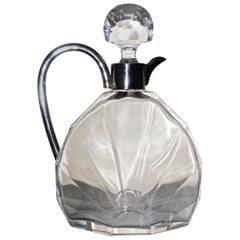
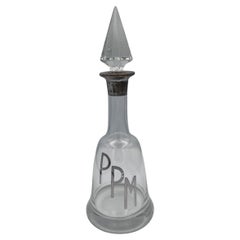
Elegant Art Deco Crystal Decanter
Located in Red Lion, PA
This elegant Art Deco 1930s crystal decanter features a graceful curved bell shape and a silver monogram reading "PPM." The pointed diamond-shaped crystal stopper contrasts with the ...
Category
Vintage 1930s American Art Deco Barware
Materials
Silver
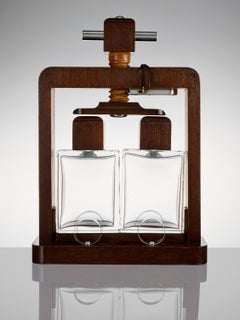
Art Deco Pair of Mounted Decanters in Tantalus France Circa 1930
Located in London, GB
Presenting a rare and impressive Art Deco pair of mounted decanters in a tantalus from France, dating back to circa 1930.
This unique drinks tantalus features a pair of decanters el...
Category
Vintage 1920s French Mid-Century Modern Barware
Materials
Chrome
Art Deco Strombergshyttan Decanter in Crystal
Silver, 1930s
By Strombergshyttan
Located in Esbjerg, DK
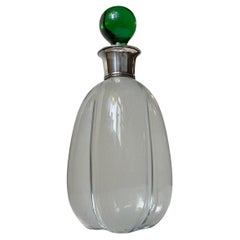
Organically shaped pumpkin decanter in crystal. It is set with a bottle neck in 830/1000 silver designed and made by Carl F. Christensen in Copenhagen Denm...
Category
Vintage 1930s Scandinavian Art Deco Barware
Materials
Crystal, Silver
$565 Sale Price
45% Off
H 9.85 in W 4.34 in D 4.34 in
Victorian Oak and Silver Metal Tantalus with Crystal Decanters
Located in Hamilton, Ontario
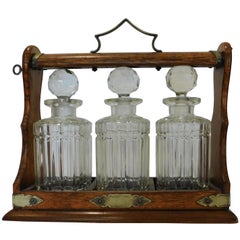
Original antique Victorian oak and silver metal tantalus with three crystal decanters. Comes with key to lock in the liquor or wine decanters.
Category
Antique 19th Century English Victorian Crystal Serveware
Materials
Silver
$1,800 Sale Price
20% Off
H 12.5 in W 13.5 in D 5.25 in
Iconic Art Deco Inlaid New York Bar Cabinet, Adolfo Baldizzi
Located in Riverdale, NY
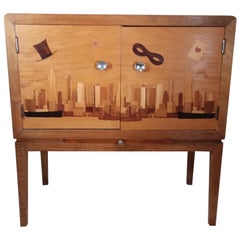
Amazing Art Deco New York dry bar cabinet inlaid with exotic woods with a skyline view of NY from the New Jersey side. Exotic woods in different tones are used to depict the booming skyline as well as a pair of black steamer ships coming into port and a barge centered in the middle of the doors.
Floating above are symbols of a party time New York filled with renewed promise, a top hat, cocktail glass, masquerade ball mask...
Category
Vintage 1930s North American Art Deco Dry Bars
Materials
Wood
Art Deco Walnut Cocktail Cabinet, Dry Bar, English, circa 1930
Located in Devon, England
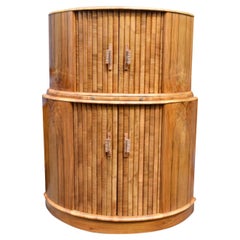
Gorgeous and original 1930s Art Deco cocktail cabinet in figured walnut. This cabinet really is stunning, featuring a storage area for bottles at the bottom and glasses etc. at the top. The top part of the cocktail cabinet has an all mirrored interior and internal light for that extra 'glam' look. Both the doors to the top and base "roll" in to close and shut, rather than the conventional opening and closing. There is also a pull out mirror...
Category
Mid-20th Century English Art Deco Dry Bars
Materials
Walnut, Glass, Mirror, Bakelite
$3,208
H 57.09 in W 47.25 in D 13.78 in
Art Deco Hukin and Heath Tantalus
By Hukin
Heath
Located in Northampton, GB
Art Deco Circa 1920
From our Tantalus collection, we are delighted to offer this Art Deco Silver Plate Tantalus by Hukin and Heath. The Tantalus modelled with two quilt-cut pineapple shaped decanters...
Category
Early 20th Century English Art Deco Barware
Materials
Metal, Silver Plate
Still Thinking About These?
All Recently ViewedMore Ways To Browse
Vintage Seymour Mann Owl Ice Bucket
Dresser Claret Jug
Elektra Coffee
Josephine Baker African Dancer Barware
Kingsway Plate
Sekai Ichi
Silver Anthony Nelme
Vintage Blue Seltzer Bottles
Vintage Chanel Tray
Waterford Marquis Vintage Wine Glasses
Waterford Old Fashion
Continental German Glass Decanter
Wine Dispenser
Richard Rohac Cat
Soda King
Epns Cup
French Wine Bottle Opener
German Hanau Decanter