Items Similar to Ancient Maiolica Plates Pasquale Rubati, Milan Circa 1770-1780

Video Loading
Want more images or videos?
Request additional images or videos from the seller
1 of 22
Ancient Maiolica Plates Pasquale Rubati, Milan Circa 1770-1780
$7,211.40per set
£5,341.72per set
€6,000per set
CA$9,864.95per set
A$10,752.29per set
CHF 5,684.64per set
MX$129,437.14per set
NOK 72,152.25per set
SEK 66,148.86per set
DKK 45,716.69per set
About the Item
Five oval maiolica dishes with pierced edge
Manufacture of Pasquale Rubati
Milan, 1770-1780
Three small oval dishes 10.23 in x 7.67 in (26 cm x 19.5 cm)
Two large oval dishes 10.82 in x 8.85 in (27.5 x 22.5 cm)
lb 3.5 (kg 1.8)
State of conservation: intact
The five dishes of different sizes have an oval shape, a mixtilinear edge and a molded polylobed shape with a surface enriched with a relief weave motif extending to the brim and forming a perforated basket-shaped ornamentation.
The decoration painted in the characteristic tones of the oriental Imari typology, red, blue with touches of gold, shows an idealized oriental landscape that develops around a perforated rock. From this stone, boughs branch off following arched courses and are adorned with peonies or with long lanceolate leaves. A fence completes the composition. The hem is decorated with a motif of a dense chain of eggs.
The Imari decoration, clearly inspired by the East, derives from Japanese productions that, by way of Chinese culture, came to the West where the taste for chinoiserie became widespread during the 18th century. At the Milanese factories the decoration took on various ornamental declinations, often distinguished solely by elements of morphological enrichment or distinguishable only by signed works.
In Milan in the 18th century, two majolica factories were active. The first was that of Felice Clerici, from 1745, and the second was opened by Pasquale Rubati in 1756, in competition with Felice, for whom he had been a worker. Upon Rubati's death, in 1796, the enterprise was continued for a few years under his son Carlo.
This type of decoration was produced by both Milanese factories, but its quality, the originality of the mold and the meticulousness in the realization of the motifs, lead us to confidently attribute the works to Pasquale Rubati's manufacture - to which we owe the most complex specimens - and date them to the 1770s, its most prosperous period (Ausenda R., by the Museums and Galleries of Milan. Museum of Applied Arts. The ceramics. Second tome. Milan 2001, pp. 318- 322, No. 315).
- Creator:Pasquale Rubati (Maker)
- Dimensions:Height: 1.38 in (3.5 cm)Width: 8.86 in (22.5 cm)Depth: 10.83 in (27.5 cm)
- Sold As:Set of 5
- Style:Rococo (Of the Period)
- Materials and Techniques:Maiolica,Glazed
- Place of Origin:
- Period:1770-1779
- Date of Manufacture:circa 1770
- Condition:Minor fading. Intact.
- Seller Location:Milano, IT
- Reference Number:1stDibs: LU4352216298671
About the Seller
4.3
Vetted Professional Seller
Every seller passes strict standards for authenticity and reliability
Established in 1860
1stDibs seller since 2018
22 sales on 1stDibs
Typical response time: 3 hours
Associations
International Confederation of Art and Antique Dealers
Associations
- ShippingRetrieving quote...Shipping from: Milano, Italy
- Return Policy
More From This Seller
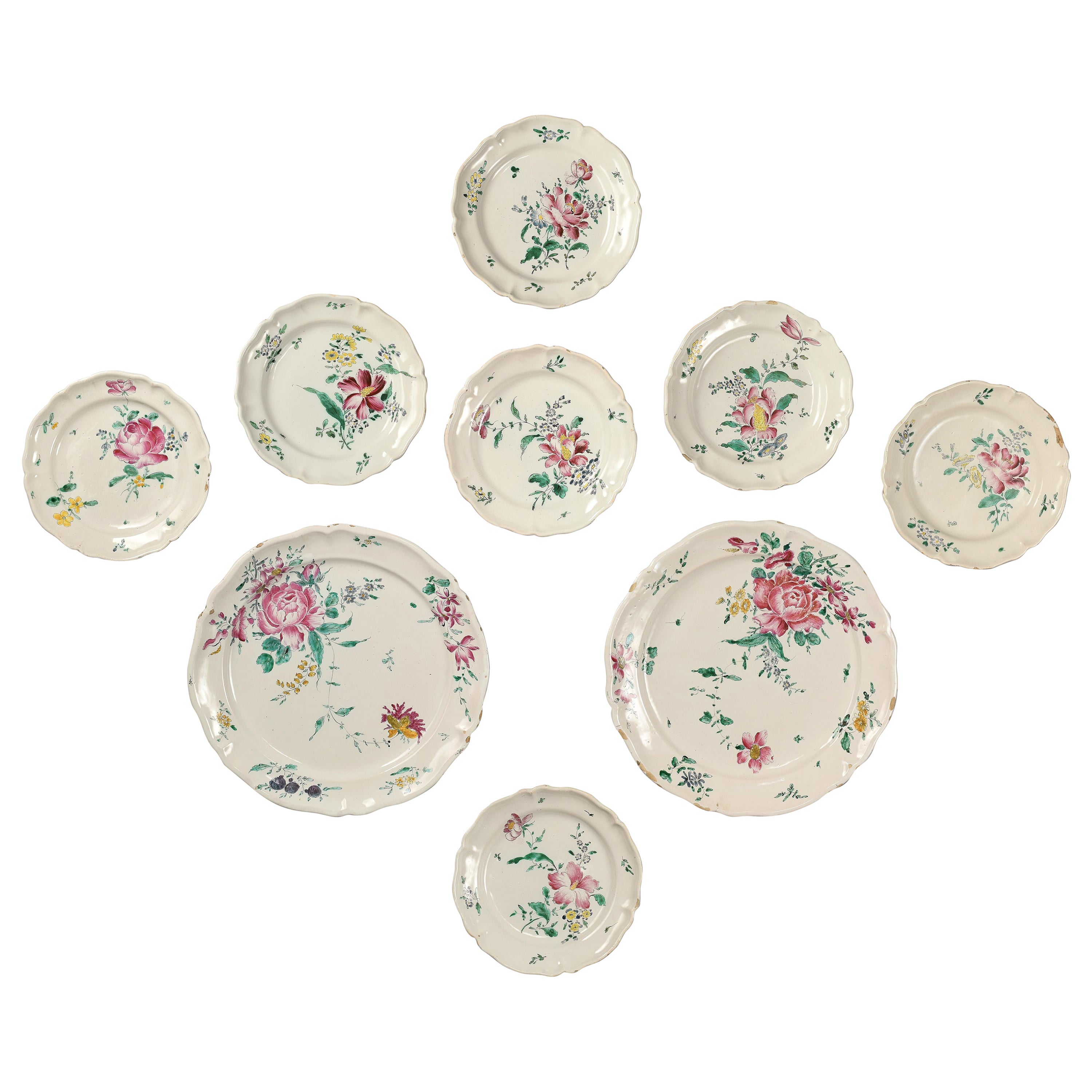
View AllAncient Maiolica Dishes with flowers, Lombard Manufacture, 1770-1780 Circa
Located in Milano, IT
Assortment of dishes
Lombard manufacture
1770 – 1780 Circa
Maiolica polychrome decorated “a piccolo fuoco” (third fire).
Two large dishes: diameter 14.76 in (37.5 cm); weight 4.5...
Category
Antique 1770s Italian Rococo Ceramics
Materials
Maiolica
18th Century Italian Maiolica Centerpiece Bassano Venice, circa 1750
Located in Milano, IT
Maiolica centerpiece
Pasquale Antonibon factory
Nove di Bassano, Venice, 1740-1770.
Measures: 1.85 in x 19.21 in x 15.27 in
4.7 cm X 48.8 cm X 38.8 cm.
lb 5.29 (kg 2.4)
State of conservation: thin passing fêlure with covered chipping and a glued foot
The Antonibon were an important family of Venetian...
Category
Antique 1750s Italian Baroque Ceramics
Materials
Maiolica
Three Dishes, Antonio Maria Coppellotti Factory, Lodi, Italy, Circa 1745
By Antonio Maria Coppellotti
Located in Milano, IT
Pair of round dishes and a small oval tray
Antonio Maria Coppellotti factory
Lodi, circa 1745
High fire polychrome majolica
Dishes size: diameter 9.44 in, height 0.78 in (24 cm, 2 c...
Category
Antique 1740s Italian Rococo Delft and Faience
Materials
Maiolica
Four Italian Ancient Dishes, Antonio Ferretti, Lodi, circa 1770-1780
By Antonio Ferretti
Located in Milano, IT
Assortment of 4 dishes with braided rim
Antonio Ferretti Manufacture
Lodi, circa 1770-1780
Maiolica polychrome decorated “a piccolo fuoco” (third fire).
Measures: 14 x 10 in (35.5 x 25.5 cm);
12.2 x 8.39 in (31 x 21.3 cm);
10.4 x 9.65 in (26.5 x 24.5 cm);
10.8 x 9.61 in (27.5 x 24.4 cm).
Weight: 4.4 lb (1.998 kg)
State of conservation: some chips due to use on the edges and on the parts in relief.
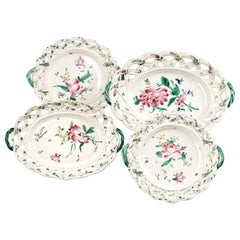
The four different dishes have a foot with a low lip from which extends a wide, flat, slanted rim resembling a basket weave. The small handles are painted green: they resemble wickerwork in the two oval dishes and take the form of a sinuous branch in the round ones.
The third fire decoration is inspired by the naturalistic floral botanical patterns on the ceramics produced by the Hannong family in Strasbourg. Here the pattern is defined by the rapidity and subtlety of the brushstrokes and the result is particularly tasteful, characterized by compositional intelligence and pictorial expertise.
A main corolla, either a wild or garden rose, is set slightly off center in each well. From this extends a thin stem holding a small secondary bud and there are small field florets dotting the composition to lend volume to the delicate bunch of flowers.
On the brim, small polychrome flowers add color to the weave, accompanied by lanceolate leaves of a very intense green.
There exist few and very rare examples for comparison with this morphology: a round plate - entirely consistent with those in question - has been dated to around 1775 (S. Levy, Maioliche settecentesche lombarde e venete, Milano 1962, tav. 200). Two other dishes with a basket rim, but with parallel striped brim decoration, were exhibited in the 1995 exhibition on Lodi ceramics; the attribution to the Lombard town near Milan is therefore almost exclusively derived from the decoration called "alla rosa contornata" or "alla vecchia Lodi" and constitutes one of the most popular decorations during the eighteenth century. (M. L. Gelmini, in Maioliche lodigiane del '700 (cat. mostra Lodi), Milano 1995, pp. 31 p. 162-163 nn. 181-182).
This decorative choice represented a strong point of the Lodi factory, which established itself thanks to the vivid nature of the colors made possible by the introduction of a new technique perfected by Paul Hannong in Strasbourg and which Antonio Ferretti introduced in Italy. This production process, called “piccolo fuoco” (third fire), allowed the use of a greater number of colors than in the past; in particular, the purple of Cassius, a red made from gold chloride, was introduced. Its use allowed for many more tones and shades, from pink to purple.
The Ferretti family had started their Maiolica manufacturing business in Lodi in 1725.
The forefather Simpliciano had started the business by purchasing an ancient furnace in 1725 and, indeed, we have evidence of the full activity of the furnaces from April of the same year (Novasconi-Ferrari-Corvi, 1964, p. 26 n. 4). Simpliciano had started a production of excellence also thanks to the ownership of clay quarries in Stradella, not far from Pavia. The production was so successful that in 1726 a decree of the Turin Chamber came to prohibit the importation of foreign ceramics, especially from Lodi, to protect internal production (G. Lise, La ceramica a Lodi, Lodi 1981, p. 59).
In its initial stages, the manufacture produced maolicas painted with the “a gran fuoco” (double fire) technique, often in turquoise monochrome, with ornamentation derived from compositional modules in vogue in Rouen in France. This was also thanks to the collaboration of painters like Giorgio Giacinto Rossetti, who placed his name on the best specimens next to the initials of the factory.
In 1748 Simpliciano made his will (Gelmini, 1995, p. 30) appointing his son Giuseppe Antonio (known as Antonio) as universal heir. After 1750, when Simpliciano passed away, Antonio was directly involved in the Maiolica factory, increasing its fortunes and achieving a reputation on a European level. Particularly important was the aforementioned introduction in 1760 of the innovative “a piccolo fuoco” (third fire) processing, which, expanding the ornamental repertoire with Saxon-inspired floral themes, could commercially compete with the German porcelains that had one of its most renowned offerings in the naturalistic Deutsche Blumen. Antonio Ferretti understood and promoted this technique and this decoration, proposing it in a fresher and more corrective version, less linked to botanical tables...
Category
Antique 1770s Italian Neoclassical Ceramics
Materials
Maiolica
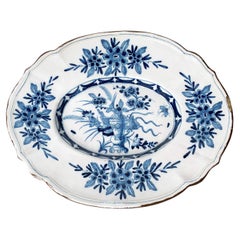
Maiolica Oval Tray, Felice Clerici Manufactory, Milan, Circa 1770-1780
By Felice Clerici
Located in Milano, IT
Small oval tray
Felice Clerici Manufactory 1745-1780
Milan, Circa 1770-1780
Maiolica polychrome.
Dimensions: 10.82 x 8.66 in (27.5 x 22 cm); weight 0.4...
Category
Antique 1770s Italian Rococo Ceramics
Materials
Maiolica
Ancient Maiolica Tiles, Ambrogette, Rampini Manufactory, Pavia, 1693-1704
By Siro Antonio Africa
Located in Milano, IT
Six maiolica “ambrogette” (tiles)
Rampini manufactory, painter probably Siro Antonio Africa
Pavia, 1693-1704
a) 6.88 x 5.51 in (17.5 x 14 cm); 0.55 lb (252 g)
b) 7.08 x 5.70 in (18 x 14.5 cm); 0.51 lb (233 g)
c) 6.88 x 5.70 in (17.5 x 14.5 cm); 0.54 lb (245 g)
d) 6.81 x 5.51 in (17.3 x 14 cm); 0.50 lb (230 g)
e) 6.88 x 5.51 in (17.5 x 14 cm); 0.50 lb (229 g)
f) 7.08 x 5.70 in (18 x 14.5 cm); 0.51 lb (233 g)
State of conservation: intact.
These six ”maiolica fina” small “ambrogette” belong to a family of ceramic works considered among the finest produced between the 17th and 18th centuries. For a long time, this type of maiolica was attributed to the Venetian village of Angarano, but later it was definitively attributed to the pottery factories in Pavia. A fundamental study ascribed this production specifically to Pavia through an analysis of Lombard collections and a comparison with archaeological remains found near the two main manufacturing sites in the city. (E. Pelizzoni - M. Forni - S. Nepoti, La maiolica di Pavia tra Seicento e Settecento, Milano 1997).
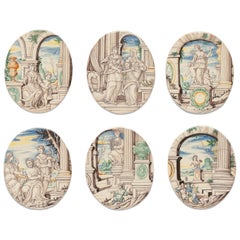
The six small oval tiles have rounded edges and are decorated with a historiated motif. They were created using high-fired polychrome technique, with a predominance of cool tones and a dominance of gray and blue, interspersed with manganese, citrine yellow, orange-yellow, and green. The six small “ambrogette” are characterized by the same stylistic features, with a similar decorative design.
The first tile (a) depicts a female figure, holding a stiletto and sitting near a pedestal supporting a relief-decorated baluster vase. Behind her, a child is holding a chalice, while through the arches of a portico, a glimpse of a mountainous landscape can be seen in the background. The female figure could possibly be Lucretia, an example of virtue in ancient Roman culture.
In the second “ambrogetta” b), the Biblical episode of Judith and Holofernes is depicted through canonical iconography: the decapitated body of Holofernes lies on the bed in the background, while the protagonist, Judith, is seen placing his head into a sack held by a maidservant. Through an archway a shining slice of the moon gives the perception of nighttime. Surprisingly, within the narrative, there is the presence of a basin in the shape of a large shell, closely resembling the products of Pavia's factories.
The third small plaque (c) depicts a female figure standing on a plinth and framed by an architectural arch with a vast mountainous landscape in the background. The woman, with her breasts exposed, is accompanied by two children: one approaching her as if wanting to be picked up, and the other seated with an apple in his hand. The protagonist lends herself to different interpretations: perhaps she represents Rea Silvia with the two twin founders of Rome, or perhaps she is an allegory for the Pietà, a common theme depicted on maiolica.
In the fourth tile (d), three characters are depicted near a column. The main figure is an old man with a sad expression, holding a cup, while a woman, wearing a turban on her head, also holds a cup in her right hand and a pitcher in her left. A second woman with her hair bound holds another pitcher behind the old man: at his feet a traveller's bag can be seen, along with some apples and a slice of cheese on a rectangular base. It is likely the sad Biblical episode of Lot and his daughters...
Category
Antique Early 1700s Italian Baroque Ceramics
Materials
Maiolica
You May Also Like
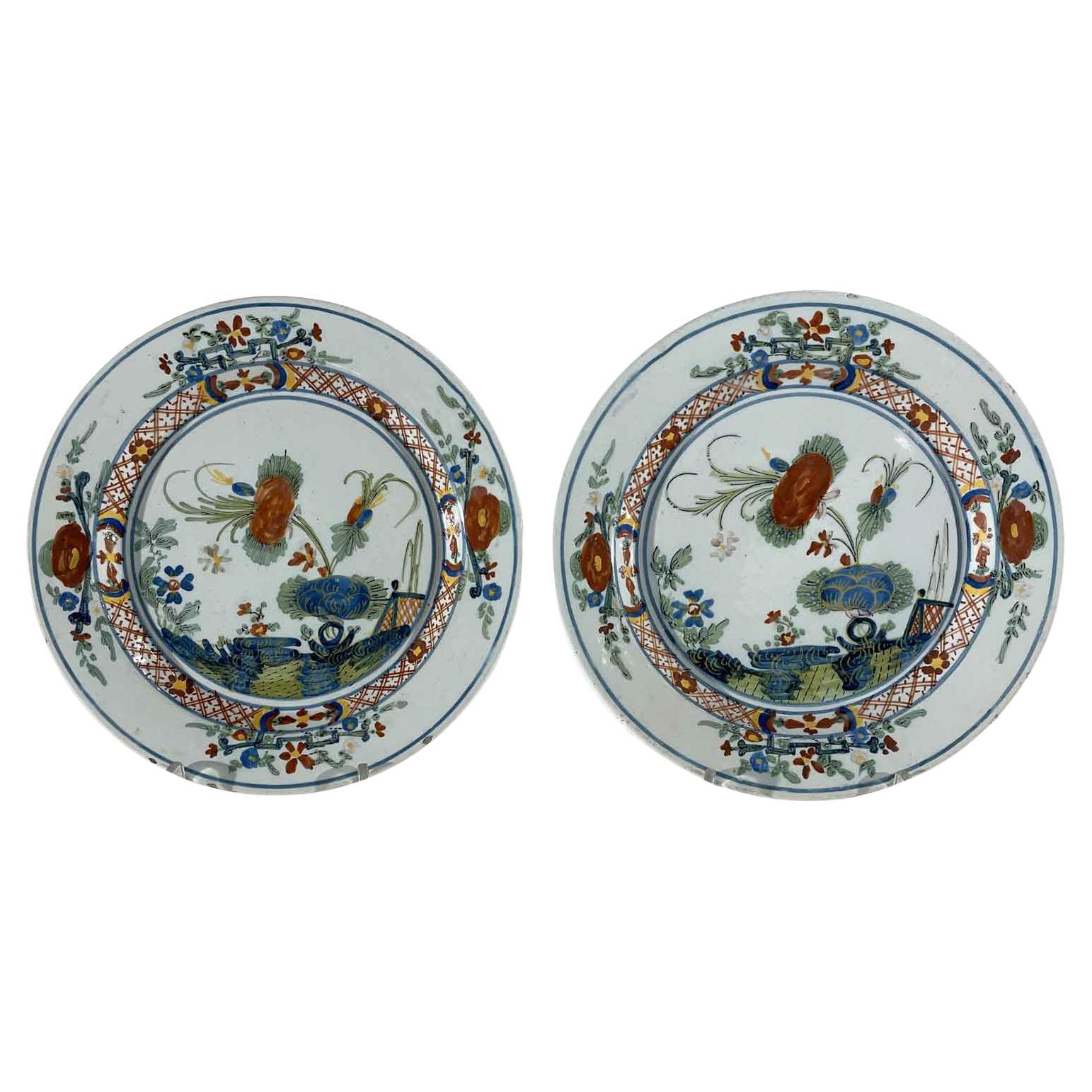
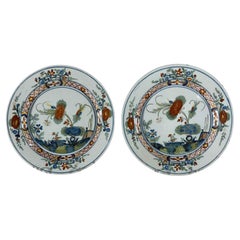
Piatti di Maiolica Italiana 1770 Decoro Al Garofano Manifattura Ferniani Faenza
By Ferniani Factory
Located in Milano, MI
Coppia Di Piatti In Maiolica italiana XVIII secolo Con Decoro Al Garofano Manifattura Ferniani Faenza dipinti in policromia, nei toni del blu, bruno, giallo, rosso, arancio e verde.
...
Category
Antique 1770s Italian Baroque Delft and Faience
Materials
Maiolica
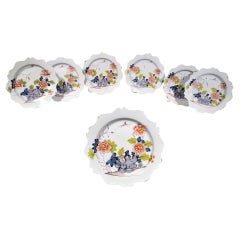
Bristol Delftware Set of Six Polychrome Chinoiserie Scalloped Plates, 1760
Located in Downingtown, PA
Wonderful set of six Bristol delftware polychrome Chinoiserie scalloped plates,
Redbank Back Factory,
Circa 1760
The plates have a most appealing, br...
Category
Antique Mid-18th Century English Rococo Dinner Plates
Materials
Delft
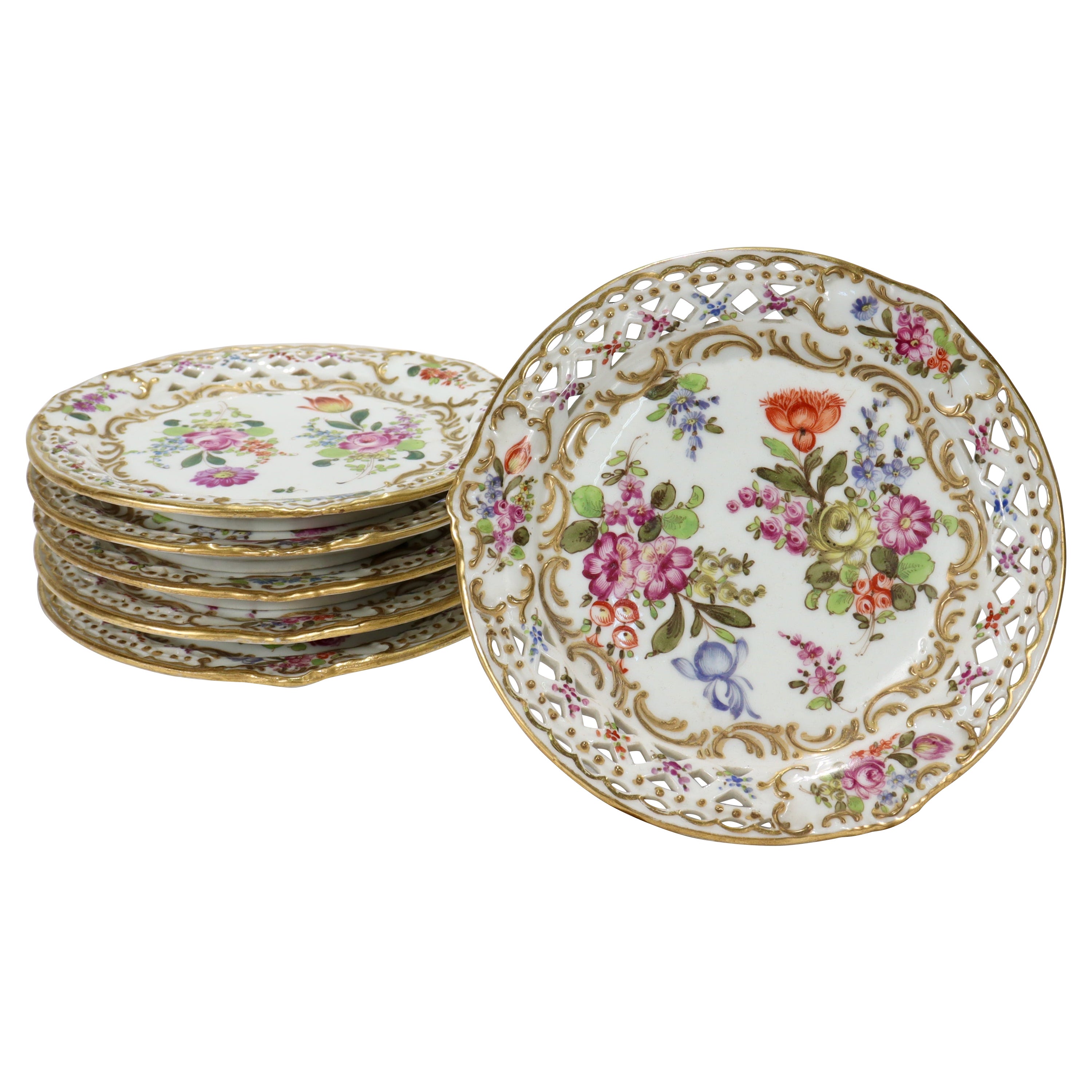
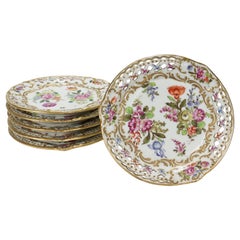
6 Antique French Bloch
Bourdois Reticulated Dresden Style Porcelain Plates
By Bloch
Bourdois
Located in Philadelphia, PA
A set of 6 fine French reticulated porcelain plates.
By Bloch & Bourdois.
Decorated throughout with floral sprays, raised gold, gilt highlights, and a reticulated rim.
Simpl...
Category
Antique Late 19th Century French Rococo Porcelain
Materials
Porcelain
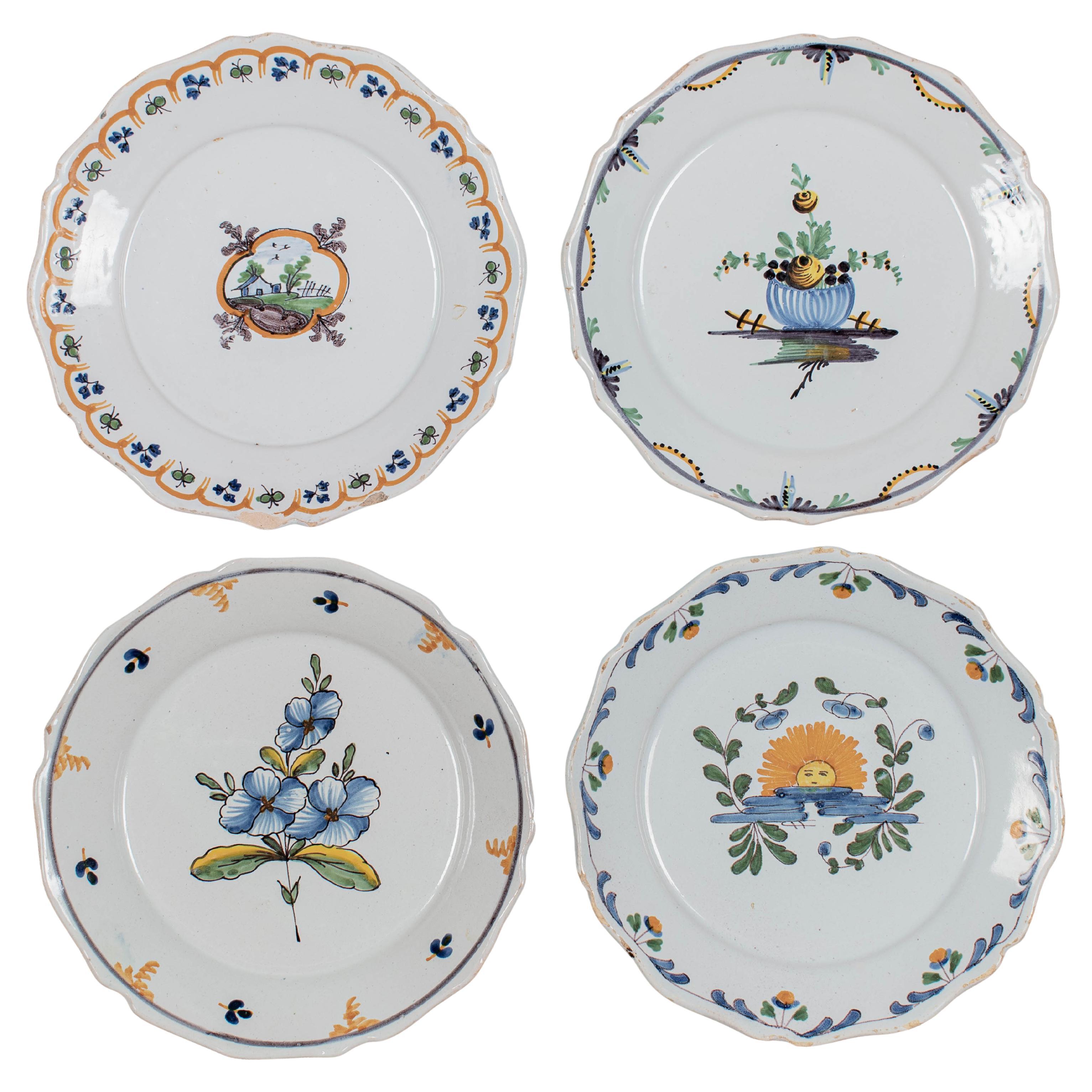
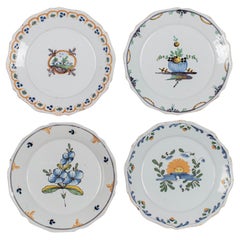
18th Century French Faience Plates Set of 4
Located in Winter Park, FL
A set of four 18th century French faience plates with primitive hand painted decoration each by different artists. In varying condition, with chips and glaze losses on edges of scall...
Category
Antique Late 18th Century French Provincial Delft and Faience
Materials
Faience
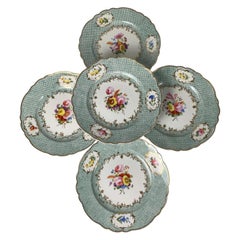
Set of Five Antique Porcelain Dinner Dishes Hand-Painted, England, Ca. 1830
By Coalport Porcelain
Located in Katonah, NY
This set of five Coalport Porcelain dinner dishes was made in England circa 1830.
In the center of each one is a bouquet of exquisite hand-painted flowers.
The close-up images show...
Category
Antique 1830s English Early Victorian Dinner Plates
Materials
Porcelain
18th Century French Faience Plates Set of 4
Located in Winter Park, FL
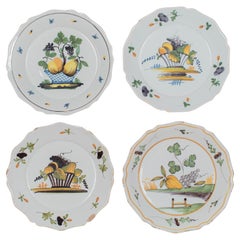
A set of four 18th century French faience plates with primitive hand painted decoration of fruit baskets and grapes, each by different artists. In varying condition, with chips and g...
Category
Antique Late 18th Century French Provincial Delft and Faience
Materials
Faience
More Ways To Browse
Ancient Plate
18th Century Majolica
Red Imari
Large Chinese Charger
Hand Painted Pheasant
Large Ceramic Chargers
Chinese Mandarin Porcelain
Hand Painted Ceramic Bowls
Trompe L Oeil Ceramics
Antique Glass Rooster
Majolica Lid
Rimini Blue Pottery
Antique Blue Canton China
Canton Famille Rose Chinese Export Porcelain
Italian Ceramic Cups
Roth Ceramic
Small Chinese Ceramics
Spanish Majolica