Want more images or videos?
Request additional images or videos from the seller
1 of 8

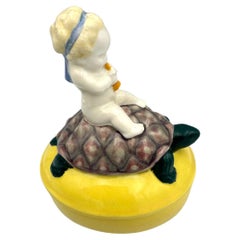
Donauweibchen , Danube Mermaid Box, Michael Powolny, Vienna Ceramics, 1910-1912

$3,816.12
£2,841.20
€3,200
CA$5,274.35
A$5,607.72
CHF 3,032.49
MX$66,705.57
NOK 37,986.21
SEK 34,692.71
DKK 24,383.20

About the Item

Oval, straight-sided lidded box on four ball feet, with a slightly domed lid featuring a fully sculpted group of figures: the naked 'Danube Maiden', the legendary Danube mermaid, embracing the kneeling 'Iron Man' in knight's armour on a stylised, relief-carved flower meadow. Glazed white body, lid painted in colour, knight's armour and ball feet gilded. Relief inscription on the side edge of the lid: 'DONAUWEIBCHEN UND EISERNER MANN ZUR ERINNERUNG AN DIE KAISERSTADT WIEN' (Danube Maiden and Iron Man in memory of the Imperial City of Vienna). In Viennese mythology, the Danube Maiden is the daughter of the powerful Prince of the Danube, who lives in a glass palace at the bottom of the river. On a cold winter's night, the Danube Maiden – a beautiful girl in a shimmering white robe with water lilies in her hair – appears to two fishermen, a father and son, in their hut. She warns the men of an approaching thaw and a violent flood. The fishermen trust the apparition, even though her hand is as cold as ice, and leave the village in time. The prediction comes true: the ice breaks and the houses are destroyed by the floodwaters. While the father is grateful, the young fisherman (often called Andres) falls under the spell of the mermaid. He cannot forget her lovely voice and one night follows her beguiling song. He disappears into the floods of the Danube and is never seen again. Today, the Danube woman is considered a symbol of the ambivalence of the Danube: on the one hand, a saving helper who warns of dangers, on the other hand, a dangerous seductress who draws people into the depths. The Iron Man or Vienna City Hall Man stands enthroned as a standard bearer at the top of the central city hall tower, 98 metres above the ground. A faithful replica now stands in Rathauspark. It was created in 1882 by the artist blacksmith Alexander Nehr, who used a suit of armour belonging to Emperor Maximilian I from 1480 as a historical model for his armour. The figure is 3.4 metres tall and has a shoe size of 63. The Rathausmann is considered a symbol of the freedom and independence of the city of Vienna. By Michael Powolny (1871 - 1954) Nowadays, art experts attest Michael Powolny’s work as the work of one of the most important ceramic artists and designers of Austrian Art Nouveau. Powolny's companions and successors were significantly influenced by him, since he had left behind a work that was extremely important for Viennese ceramic art. Powolny's putti - many of them made on behalf of Wiener Keramik (WK) - are sought after by knowledgeable Art Nouveau collectors, both because of their modeling quality and because of the endearing and distinctive appearance. Manufactured by Vienna Ceramics ('Wiener Keramik') ceramic, bright earthenware, glossy finish, multicolored hand-painting,gold plating Designed ca. 1907, made 1910-1912 Marks: WK with grapes - Wiener Keramik / = Vienna Ceramics MP - signet Michael Powolny Model number 52 Dimensions: Height: 17,5 cm / 6.88 in Width: 17,0 cm / 6.69 in Bibliography: - Thomas Arlt / Arthur Weilinger, WIENER KERAMIK / VIENNA CERAMICS Bertold Löffler, Michael Powolny, Werkverzeichnis / Catalog of works, 2018, Wien / Vienna; Page 66ff, Page 226, Number 52 - Waltraud Neuwirth, Markenlexikon für Kunstgewerbe (3), Wiener Keramik, Modelle 1906-13 / (= Encyclopedia of Marks of Applied Arts / Viennese Ceramics - models 1906-13); Page 46, Number 52 - Elisabeth Frottier, Michael Powolny, Keramik und Glas aus Wien 1900 bis 1950 (= Ceramic and glass from Vienna 1900 to 1950); Catalog of works from Page 193, WV 26, Page 273 Company brands and artist's signatures. Condition: Very good - age related light abrasion to the gilding
  • Creator:
    Michael Powolny (Sculptor)
  • Dimensions:
    Height: 6.89 in (17.5 cm)Width: 6.7 in (17 cm)Depth: 4.34 in (11 cm)
  • Style:
    Art Nouveau (Of the Period)
  • Materials and Techniques:
  • Place of Origin:
  • Period:
    1910-1919
  • Date of Manufacture:
    1910-1912
  • Condition:
    Wear consistent with age and use.
  • Seller Location:
    Vienna, AT
  • Reference Number:
    1stDibs: LU1014448246542

More From This Seller

View All
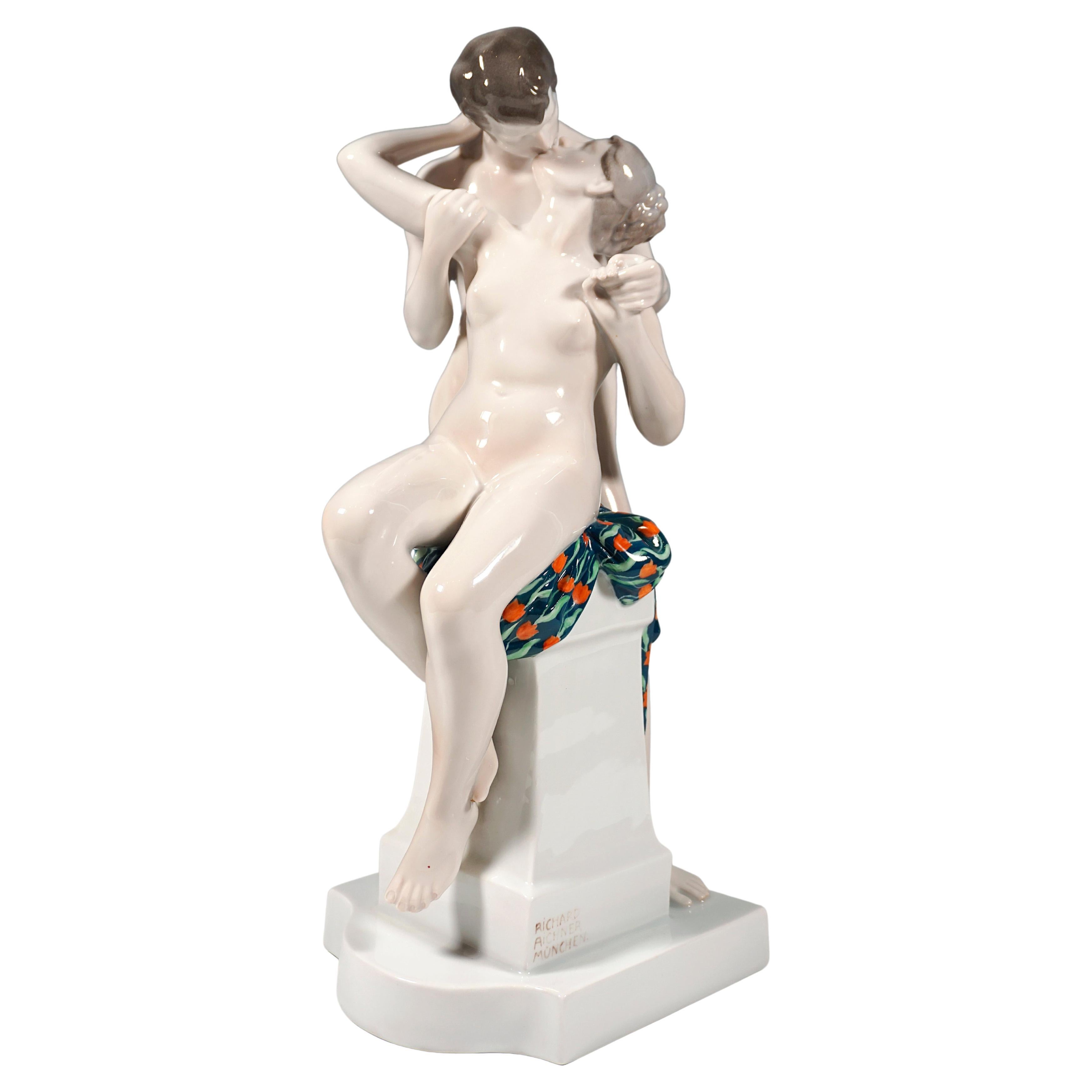
Large Porcelain Group Spring of Love by R. Aigner Rosenthal Selb Germany, 1916
By Rosenthal, Richard Aigner
Located in Vienna, AT
Excellent Large Art Nouveau Group: Monumental depiction of a pair of lovers in intimate embrace: Unclothed young lady sitting on a pedestal and kissing the naked young man standing ...
Category

Vintage 1910s German Art Nouveau Porcelain

Materials

Porcelain

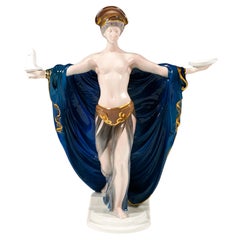
Large Goldscheider Art Deco Odalisque Aida by Josef Lorenzl, Around 1925
By Goldscheider Manufactory of Vienna, Josef Lorenzl
Located in Vienna, AT
Very exceptional decorated Goldscheider Art Deco ceramic figure of the 1920's: Depiction of a standing lady proudly looking to the side in oriental garb, wrapped in a large blue-gree...
Category

Vintage 1920s Austrian Art Deco Ceramics

Materials

Ceramic

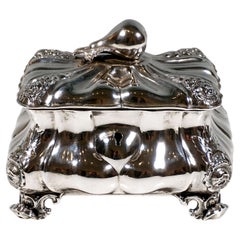
Art Nouveau Silver Sugar Box, by Joaef B. Gedlitzka s Sons, Vienna Circa 1900
By Viennese Manufactory
Located in Vienna, AT
Art Nouveau sugar bowl of oval, rounded form, standing on four rocaille feet, rocaille decoration in relief on the wall and hinged lid, sculpted...
Category

Antique Early 1900s Austrian Art Nouveau Sterling Silver

Materials

Silver

Antique Vienna Biedermeier Silver Sugar Box With Pear Knob, by Thomas Dub, 1863
By Viennese Manufactory
Located in Vienna, AT
Biedermeier silver sugar bowl in rectangular basic form on four rocaille feet, the walls of the container drawn in towards the top and provided with folds, which run straight on the ...
Category

Antique 1860s Austrian Biedermeier Sterling Silver

Materials

Silver

Porcelain Figurine Temple Dedication by Liebermann Rosenthal Selb Germany 1916
By Ferdinand Liebermann
Located in Vienna, AT
Very rare Rosenthal figurine, only 200 versions in existence: A scantily clad Art Nouveau beauty, a belt around her hips with a long, softly falling shawl draping around her legs, a ...
Category

Vintage 1910s German Art Nouveau Porcelain

Materials

Porcelain

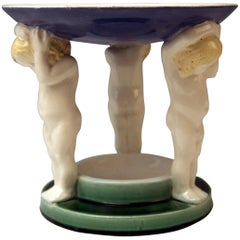
Michael Powolny Art Nouveau Vienna Centrepiece with Three Cherubs, circa 1912
By Michael Powolny
Located in Vienna, AT
Michael Powolny Art Nouveau centrepiece with three cherubs - most lovely ceramics item! Modelled by Michael Powolny (1871 - 1954), circa 1907. Hallmarked: Manufactured by Wiener Keramik (Vienna Ceramics) (WK / hallmarked). Material is ceramics (multicolored painted / glossy finish). Model 113 (model number is impressed / bottom glazed) Monogram of "Michael Powolny (MP)" is impressed, too. Made 1912. ________________________________________________________________________________ Subject: Most lovely three naked male cherub's figurines holding a round plate attached to their heads / the mentioned plate is blue painted at bottom side / the surface of tiered round socle is partially moss green shaded. ________________________________________________________________________________ Height: 21.0 cm (= 8.66 inches) Diameter of platter: 24.5 cm (= 9.64 inches) ________________________________________________________________________________ Bibliography: Waltraud Neuwirth, Markenlexikon für Kunstgewerbe (3), Wiener Keramik / Modelle 1906-13; pages 100-101 Elisabeth Frottier, "Michael Powolny, Keramik und Glas aus Wien 1900-1950", Vienna 1990, page 200, List of Work (= Werkverzeichnis) number W 113 (WV 61), Model 113 ________________________________________________________________________________ Experts of Fine Arts assess Michael Powolny's work nowadays as result of activity of one the most important ceramics sculptors / designers of Austrian Art Nouveau. Most of Powolny's successors were strongly under his sway since Powolny had left 'large steps' in Viennese Art of Ceramics. Excellent condition. ____________________________________________________________________________________ About Michael Powolny (Sculptor). As both a designer and a teacher, the Austrian ceramicist and glassware designer Michael Powolny was an important figure in the development of modernist aesthetics in Vienna at the turn of the 20th century. His romantic sculptural pottery figures embrace the lush, dynamic stylings of Gustav Klimt and other progressive artists, while his functional pieces — such as glass bowls and vases — employ the simple linear and geometric ornamentation that marked the work of Josef Hoffmann and other members of the Wiener Werkstätte Community of designers and craftsmen. Powolny received classical training in ceramics from his father, a potter, and at the Vienna School of Applied Arts, but later joined in the modernizing movement in the Austrian arts at the close of the 19th century. In 1897, Klimt, Hoffman, Koloman Moser and other artists and architects founded the Vienna Secession, a group that fought for freedom of expression against the city’s tradition-bound arts establishment. Powolny’s work reflects the changing times. He used classical figures in his ceramics — female nudes, cherubs — yet would dress them in modern ornament such as garlands of abstract, geometric flowers. Pieces from Powolny’s ceramics company were sold through the Wiener Werkstätte (Viennese Workshops) founded by Hoffmann and Moser, and Hoffman later hired Powolny to create ceramic ornamentation for his architectural masterpiece, the Palais Stoclet in Brussels. Powolny would go on to design glassware that combines elegant, tapering forms with precise linear decoration. His most influential work may have come as a professor at the School of Applied Arts, where he taught both Lucie Rie, the great Austrian-British modernist ceramicist, and the American potter Viktor Schreckengost, creator of the “Jazz Bowl...
Category

Vintage 1910s Austrian Art Nouveau Ceramics

Materials

Ceramic

You May Also Like

Porcelain Box by Ida Weiss Moricz, Vienna
Located in Brussels, BE
Porcelain Box by Ida Weiss Moricz, Vienna
Category

Vintage 1920s Austrian Art Deco Porcelain

Materials

Porcelain

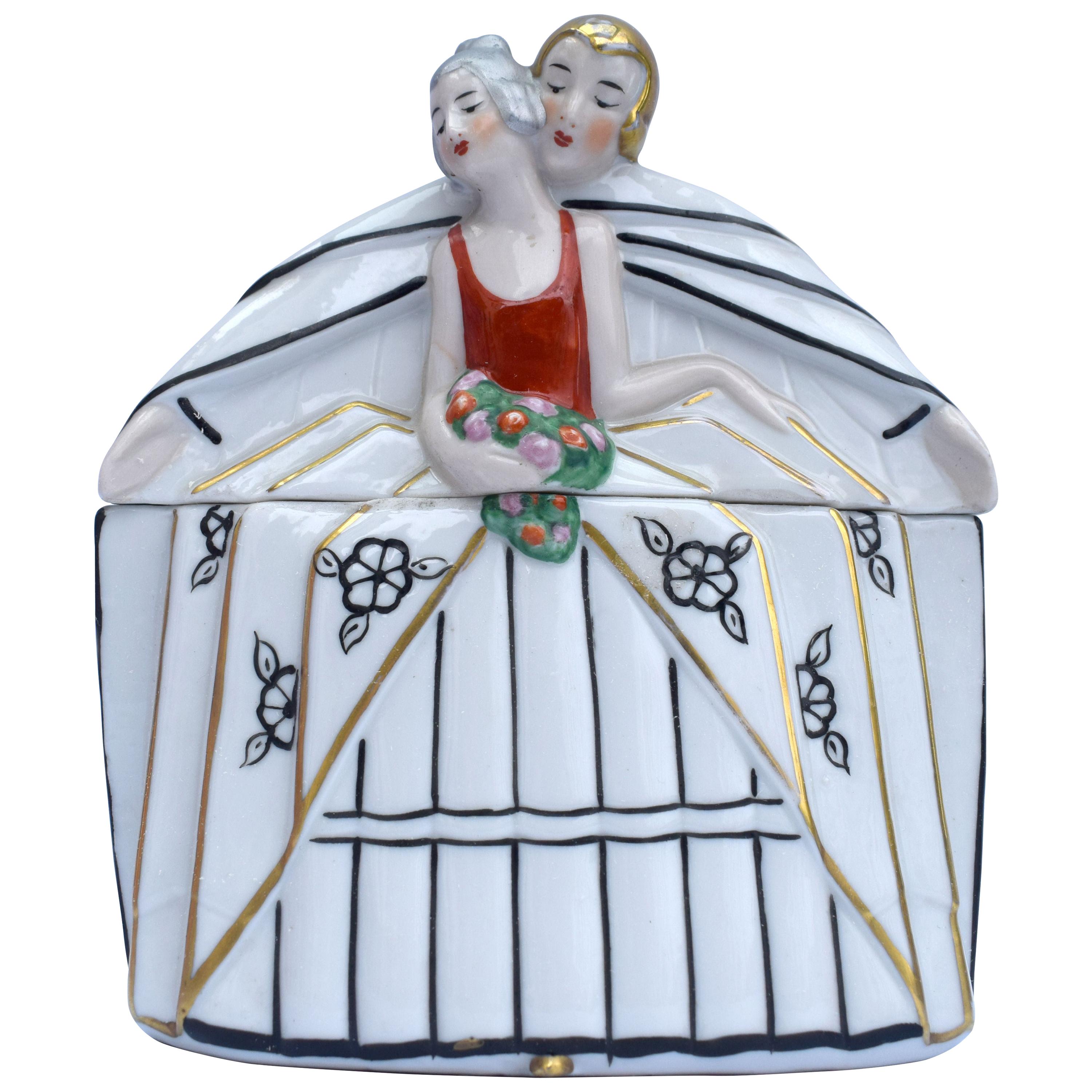
Art Deco Porcelain Powder Box, German, circa 1930
Located in Devon, England
An exceptional Art Deco powder jar very desirable and would enhance any collection. The representation of a couple in love has been expertly hand painted, from the lightly blushed ch...
Category

Mid-20th Century German Art Deco Decorative Boxes

Materials

Porcelain

Art Deco Porcelain Box by Édouard Marcel Sandoz for Theodore Haviland
By Edouard-Marcel Sandoz
Located in Autonomous City Buenos Aires, CABA
Art Deco Porcelain Box by Édouard Marcel Sandoz for Theodore Haviland This exquisite sculptural box showcases the unmistakable zoomorphic aesthetic of Sandoz, one of the great master...
Category

20th Century French Art Deco Decorative Boxes

Materials

Porcelain

Art Deco Madame Pompadour Powder Box Porcelain, 1929
By Schumann Arzberg 1
Located in Lisbon, PT
This Art Deco porcelain powder box, known as “Madame Pompadour,” was produced in 1929 by Schumann Arzberg in Bavaria, Germany, for Golden Cro...
Category

20th Century German Art Deco Decorative Boxes

Materials

Porcelain

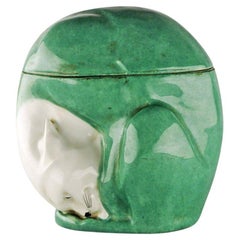
Viennese Secession Ceramic Box
Located in Buenos Aires, Argentina
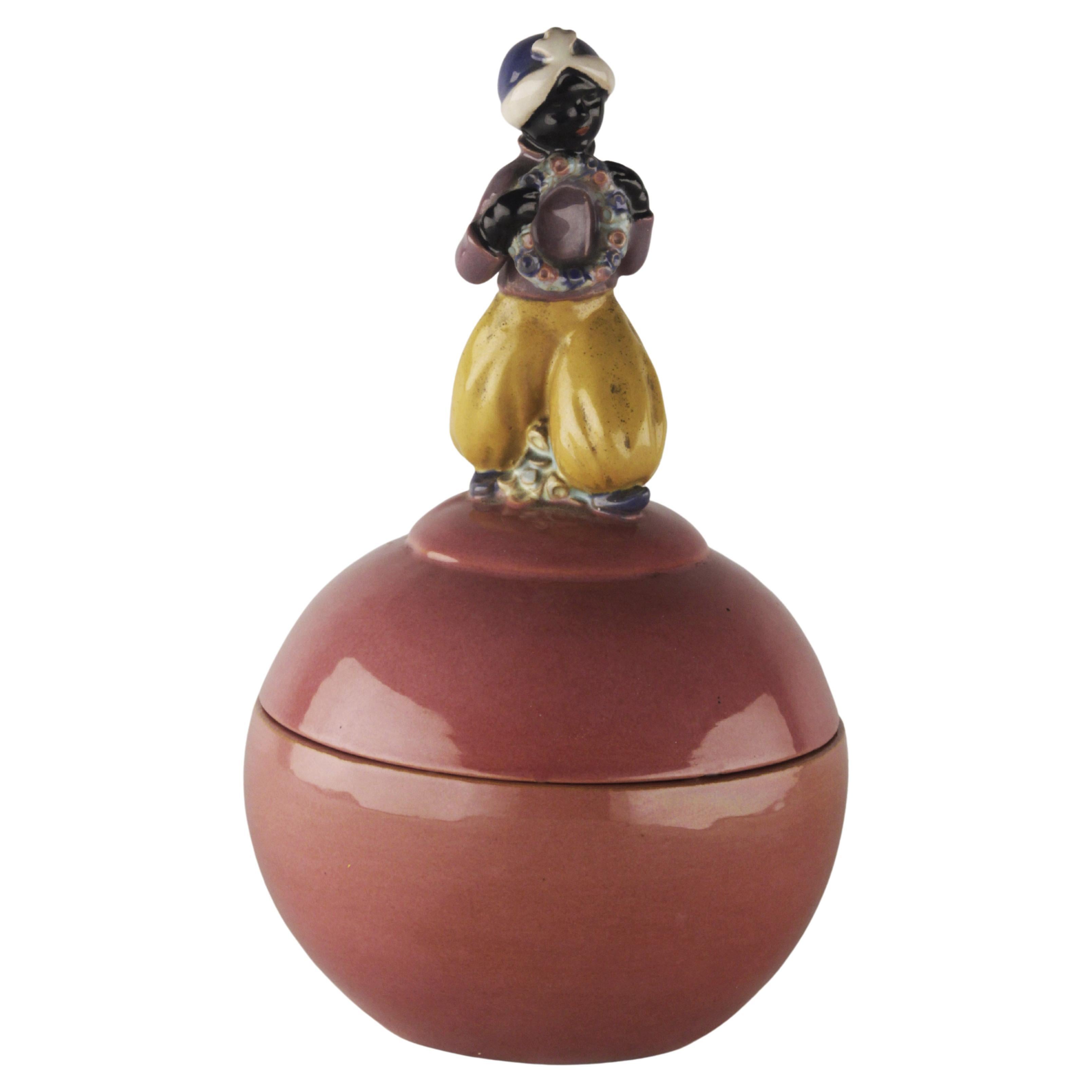
Viennese seseion ceramic box Ceramic Origin Austria circa 1900 Very good condition and no restorations Sealed at its base Some chips on the lid ring due to wear and tear. Pink, black and yellow color with orientalist character on its cover. We are Saint John, a company dedicated to the trade...
Category

Antique Early 1900s Austrian Vienna Secession Decorative Boxes

Materials

Ceramic

Sandoz Art Deco Porcelain Box
By Edouard-Marcel Sandoz
Located in Buenos Aires, Argentina
Sandoz Art Deco Porcelain Box Origin: France, Circa 1920 Porcelain box Fox or cat sculpture Green and white Created and hand-painted by Marcel Sandoz M...
Category

Vintage 1920s French Art Deco Decorative Boxes

Materials

Enamel