Want more images or videos?
Request additional images or videos from the seller
1 of 10
George 111 Spode Porcelain Coffee Can Doll
s House Pattern 488, English Ca 1805
Price:$185
$245.45List Price
About the Item
- Attributed to:Spode (Manufacturer)
- Dimensions:Height: 2.5 in (6.35 cm)Width: 3.25 in (8.26 cm)Depth: 2.57 in (6.53 cm)
- Style:George III (Of the Period)
- Materials and Techniques:
- Place of Origin:
- Period:
- Date of Manufacture:circa 1805
- Condition:Wear consistent with age and use.
- Seller Location:Lincoln, GB
- Reference Number:Seller: P 4741stDibs: LU99039477223
About the Seller
5.0
Platinum Seller
Premium sellers with a 4.7+ rating and 24-hour response times
Established in 1993
1stDibs seller since 2013
1,428 sales on 1stDibs
Associations
LAPADA - The Association of Arts
Antiques Dealers
Authenticity Guarantee
In the unlikely event there’s an issue with an item’s authenticity, contact us within 1 year for a full refund. DetailsMoney-Back Guarantee
If your item is not as described, is damaged in transit, or does not arrive, contact us within 7 days for a full refund. Details24-Hour Cancellation
You have a 24-hour grace period in which to reconsider your purchase, with no questions asked.Vetted Professional Sellers
Our world-class sellers must adhere to strict standards for service and quality, maintaining the integrity of our listings.Price-Match Guarantee
If you find that a seller listed the same item for a lower price elsewhere, we’ll match it.Trusted Global Delivery
Our best-in-class carrier network provides specialized shipping options worldwide, including custom delivery.You May Also Like
Spode, Rare Antique Gilt Porcelain Low Scent Jar, Pattern No. 671, circa 1805
By Spode
Located in Chatham, ON
Antique - SPODE - Georgian period - exceptional and rare - twin handled gilded porcelain large 'Low Scent Jar' - decorated with pattern number 671 - unsigned - illustrated on page 28...
Category
Antique Early 19th Century British Georgian Porcelain
Materials
Porcelain
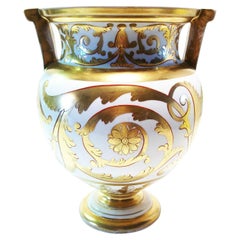
$6,500
H 8.13 in Dm 6.75 in
Antique 19th Century Spode English Porcelain Pink Ducks Pattern Desert Plate
By Spode
Located in Philadelphia, PA
A fine antique English porcelain desert plate.
By Spode.
In the "Pink Ducks" pattern.
Depicting a chinoiserie scene of two mandarin d...
Category
Antique 19th Century English George III Porcelain
Materials
Porcelain
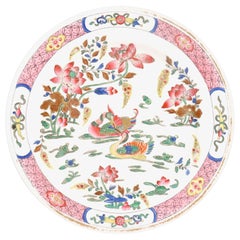
$595
H 1 in W 8.38 in D 8.38 in
A very fine Spode porcelain punch bowl in pattern 944 c.1805-1810
By Spode
Located in Exeter, GB
A very fine Spode porcelain punch bowl c.1805-1810. Finely decorated and gilded in a rich pattern number 944.
Condition: Excellent
Category
Antique 19th Century British Porcelain
Materials
Porcelain
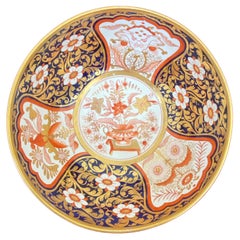
$1,799 Sale Price
20% Off
H 5.12 in Dm 11.23 in
Spode Three Georgian Imari Pattern 967 Decorated Porcelain Plates
By Spode
Located in Bishop
s Stortford, Hertfordshire
A very fine set of three Georgian Imari pattern decorated porcelain cabinet plates by Spode and dating from around 1810. The small side plates are of...
Category
Antique 1810s English George III Porcelain
Materials
Porcelain
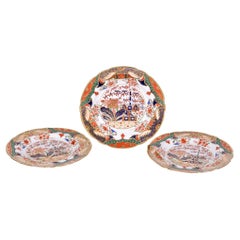
$449 / set
Free Shipping
H 0.69 in Dm 6.11 in
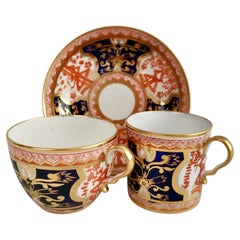
Spode Porcelain Teacup Trio, Red Imari Dollar Pattern, Regency, ca 1810
By Spode
Located in London, GB
This is a beautiful orphaned teacup made by Spode in about 1810. It bears a lavish Japanese-inspired Imari pattern.
Spode was the great pioneer among the Georgian potters in England. Around the year 1800 he perfected the bone china recipe that has been used by British potters ever since, and he was also the leading potter behind the technique of transferware, making it possible for English potters to replace the Chinese export china, which had come to an end around that time, with their own designs. This was fundamental to a thriving industry that would last for about 150 years and provide half the world with their tableware. Spode porcelain is regarded as one of the highest quality porcelains around; for a soft-paste porcelain it is surprisingly hard and fine, and has a wonderful bright white colour.
The pattern on this can is called "Dollar" pattern, a very famous pattern that was used by English potters in the 18th and early 19th Century. It is obvious why it is called “dollar” - but its origin is less obvious! It is thought that this pattern was derived from a very old Chinese pattern depicting a tree with elaborate foliage that hides a Chinese character representing longevity or happiness. Traditionally, this went with a an image called “Taotie”, which was used on very ancient bronze vases...
Category
Antique Early 1800s English Regency Porcelain
Materials
Porcelain
$545 / set
Free Shipping
H 1 in W 1 in D 1 in
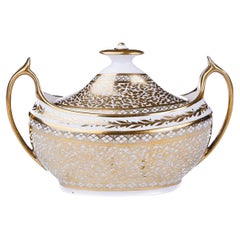
Spode Double Handled Sugar Bowl and Cover
Located in Long Island City, NY
Spode double handled sugar bowl and cover. Oval-shaped porcelain body, gilt with diamond and vine motifs, the base impressed with an “S” and numbered “6...
Category
Antique Early 1800s English George III Porcelain
Materials
Porcelain
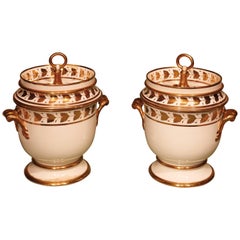
Pair of 19th Century Spode Porcelain Ice-Pails
By Spode
Located in London, GB
An early 19th century pair of porcelain ice-pails with gilt leaf decorated borders, part of a dessert service, comprising 20 plates, 3 shell dishes, 3 circul...
Category
Antique Early 19th Century English George III Porcelain
Materials
Porcelain
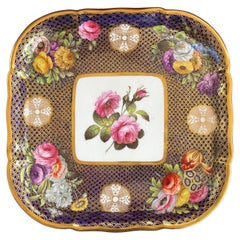
A large
rare Spode Porcelain Tray decorated in pattern 1166 c.1820
By Spode
Located in Exeter, GB
A large & rare Spode Porcelain Square Tray from a Cabaret Set decorated in pattern 1166 c.1820. One of the most sumptuous designs produced by Spode. Pattern 1166 was first recorded ...
Category
Antique 19th Century British Porcelain
Materials
Porcelain
$4,908 Sale Price
20% Off
H 0.79 in W 11.42 in D 11.42 in
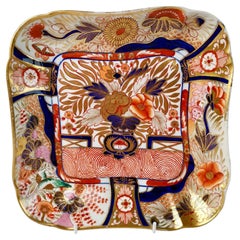
Chamberlains Worcester Porcelain Dish, Nelson or Fine Old Japan pattern, ca 1805
By Chamberlains Worcester
Located in London, GB
This is a striking square serving dish made by Chamberlains in Worcester around 1805. The dish bears the Fine Old Japan pattern, often called the Nelson pattern.
Robert Chamberlai...
Category
Antique Early 1800s English Georgian Serving Bowls
Materials
Porcelain
$875
Free Shipping
H 1.5 in W 8.75 in D 8.58 in
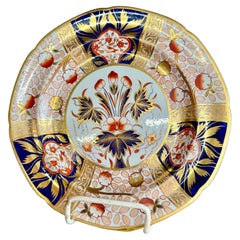
Extraordinary Antique English Spode Ironstone Highly Gilt Imari Cabinet Plate
By Spode
Located in CHARLESTON, SC
A magnificent Antique English early 19th Century Spode Ironstone "Imari" decor dinner-sized Cabinet Plate, richly gilt and in superb, age-appropriate condition (no damages whatsoever...
Category
Antique Early 19th Century English George III Ceramics
Materials
Ceramic, Ironstone
$595
H 0.75 in Dm 9.75 in
More From This Seller
View AllGeorge 111 Minton Porcelain Coffee Can Hand Painted in Pattern 791, Ca 1805
By Minton
Located in Lincoln, Lincolnshire
This is a finely painted porcelain coffee can made by the Minton factory, England, in the reign of George 111 in the early 19th century, circa 1805
Straight sided coffee cans wer...
Category
Antique Early 19th Century English George III Ceramics
Materials
Porcelain
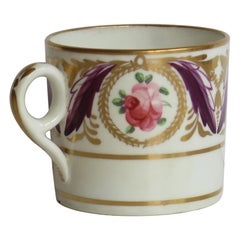
Georgian Spode Coffee Can Porcelain Floral Leaf Gilded Pattern, circa 1810
By Spode
Located in Lincoln, Lincolnshire
This is a good quality porcelain coffee can that we attribute to Spode of Staffordshire, England, made during the very early 19th century, George 111rd period, circa 1810.
The coffee can is nominally parallel, with a loop handle having one lower kink, characteristic of the Spode handle. It has a fairly deep foot recess with obtuse corners and is unmarked to the base.
The pattern is one of Spode's transfer printed floral leaf designs in a burnt orange colour around the upper border, all between gold gilt rings with a further gold gilt ring just above the base and hand gilding to the outer handle.
We date this piece to the late George third...
Category
Antique Early 19th Century English George III Ceramics
Materials
Porcelain
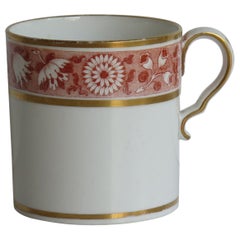
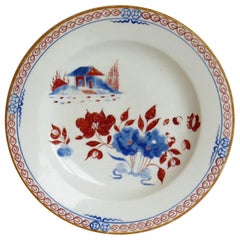
Georgian Spode Desert Plate or Dish Porcelain in Dolls House Prn 488, Ca 1807
By Spode
Located in Lincoln, Lincolnshire
This is a good early English Spode porcelain plate or dish hand painted in the Doll's House pattern, Number 488 and dating to the George 111rd period, very early in the 19th century, circa 1805 to 1810.
The plate is well potted and raised on a low foot. It is well hand painted in burnt orange and cobalt blue enamels in the Doll's House Pattern, No. 488, recorded in 1804. The plate also has a continuous hand painted border pattern to the rim.
This pattern is illustrated on a Spode meat dish...
Category
Antique Early 19th Century English George III Porcelain
Materials
Porcelain
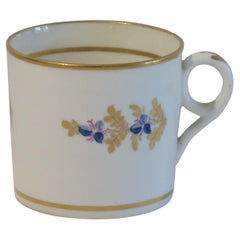
George 111 Early Minton Porcelain Coffee Can Hand Painted Pattern 76, Ca 1805
By Minton
Located in Lincoln, Lincolnshire
This is a finely painted porcelain coffee can made by the Minton factory, England, in the reign of George 111 in the early 19th century, circa 1805
Straight sided coffee cans were only originally made for about the first 20 years of the 19th century and are very collectable.
The porcelain can is well potted with a ring handle.
It is finely hand decorated in Minton's recorded Pattern Number 76, having three sets of horizontally painted...
Category
Antique Early 19th Century English George III Porcelain
Materials
Porcelain
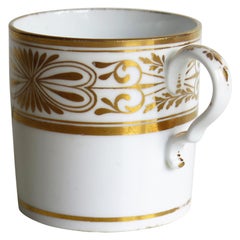
Early 19th Century Spode Porcelain Coffee Can Hand Gilded Pattern 1099, Ca 1810
By Spode
Located in Lincoln, Lincolnshire
This is a fine example of an English George III period, porcelain, coffee can (cup), made by Spode in the early 19th century, circa 1810.
The can is nominally straight sided and h...
Category
Antique Early 19th Century English Regency Ceramics
Materials
Porcelain
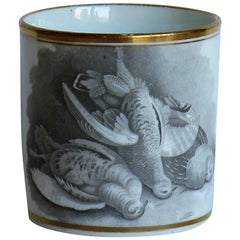
Georgian Spode Porcelain Coffee Can Bat Printed Game Birds Pattern, circa 1810
By Spode
Located in Lincoln, Lincolnshire
This is a very good example of an English George III period, porcelain, coffee can, made by Spode, England in the early 19th century, circa 1810.
The can is nominally straight sided and has the Spode loop handle with a pronounced kick or kink to the lower part, with a lower attachment that curves out slightly from the cup. Spode is the only factory with a handle of this exact shape.
The can is decorated with one of their grey "bat printed" designs, showing game birds collected after the shoot. It also has hand painted gilded detail to both rims and the handle.
Similar Spode bat printed...
Category
Antique Early 19th Century English Georgian Ceramics
Materials
Porcelain
Still Thinking About These?
All Recently ViewedMore Ways To Browse
Antique Porcelain Coffee Cans
English Porcelain Cups
Antique English Porcelain Spode
George 111 Silver
Antique English Dolls House
Tobacco Pattern Plate
Venice Maiolica
Vintage Blue Glass Canister Set
Vintage Drip Coffee Maker
Vintage Hot Chocolate Pitcher
Wedgewood Greek
Wedgewood Majolica
Wedgwood Japan
White Salt Glazed Pitcher
William Wyman
Zachariah Boyle
Zsolnay Jug
16th Century English Silver