Want more images or videos?
Request additional images or videos from the seller
1 of 7
Gli Etruschi, Ivo De Santis Pair of Green/Ochre Horses, Italy, circa 1960
Price:$698
$775List Price
About the Item
- Creator:Gli Etruschi (Manufacturer),Ivo de Santis, Gli Etruschi (Designer)
- Dimensions:Height: 7.88 in (20 cm)Width: 5.12 in (13 cm)Depth: 8.67 in (22 cm)
- Style:Mid-Century Modern (Of the Period)
- Materials and Techniques:
- Place of Origin:
- Period:
- Date of Manufacture:circa 1960
- Condition:Wear consistent with age and use.
- Seller Location:Pymble, AU
- Reference Number:Seller: 46011stDibs: LU1265213951702
About the Seller
5.0
Vetted Professional Seller
Every seller passes strict standards for authenticity and reliability
Established in 2004
1stDibs seller since 2015
184 sales on 1stDibs
Typical response time: 1 hour
Authenticity Guarantee
In the unlikely event there’s an issue with an item’s authenticity, contact us within 1 year for a full refund. DetailsMoney-Back Guarantee
If your item is not as described, is damaged in transit, or does not arrive, contact us within 7 days for a full refund. Details24-Hour Cancellation
You have a 24-hour grace period in which to reconsider your purchase, with no questions asked.Vetted Professional Sellers
Our world-class sellers must adhere to strict standards for service and quality, maintaining the integrity of our listings.Price-Match Guarantee
If you find that a seller listed the same item for a lower price elsewhere, we’ll match it.Trusted Global Delivery
Our best-in-class carrier network provides specialized shipping options worldwide, including custom delivery.You May Also Like
Cobridge Stoneware Vase Sea Horses Blue Green Ochre Contemporary
Located in BUNGAY, SUFFOLK
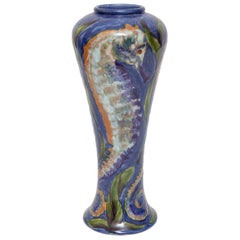
A Cobridge stoneware vase, decorated with a repeat pattern of sea horses and foliage. Rare trial piece dated 8.8.2000,
Cobridge impressed stamp on the underside which is marked trial with the initials PAS & ML and the date 8.8.2000.
Measures: Height 29.5cm
Diameter max 13cm
Diameter (base of vase) 10.3cm
A Cobridge stoneware cylindrical Cathedral pattern vase, designed by Samantha Johnson, copyright 2000
Cobridge Stoneware was a short-lived pottery company born out of the fascination of the head of one of the leading potteries for a process that died with its inventor early in the twentieth century. Cobridge Stoneware was in business 1998–2005. It was an Associate company of Moorcroft Pottery. The consequence of the business closing in down 2005. Is that the vases are now becoming very rare and demanding premium prices on the secondary market.
Hugh Edwards, owner of Moorcroft, was keen to develop the ideas of William Howson Taylor, the man behind the closely guarded secrets of Ruskin Pottery. A new company and name was needed for the new range, Moorcroft is known and recognized universally by its distinctive appearance. Cobridge, an area of The Potteries, was featured in the Industrial Landscapes that were planned to furnish some of the designs for the new range. Its skyline was dominated in earlier years by bottle kilns, now mainly demolished, and Cobridge was chosen as the new name.
The Cobridge Pottery was set up in a new imposing building a couple of hundred yards from the Moorcroft pottery and the official opening was in September 1998. The building was designed with future needs in mind. Only the outer walls are load-bearing, and the inner walls are built from blocks which can, if the need arises, be knocked down and re-built in another place. All the pieces were produced and hand painted here.
The designs for Cobridge Stoneware Pottery vases were designed by well known ceramic designers. Many were also designing for Moorcroft Pottery. These designers include Philip Gibson, Kerry Goodwin, Nicola Slaney and Angela Davenport. Also Anita Harris...
Category
Early 2000s English Post-Modern Vases
Materials
Stoneware
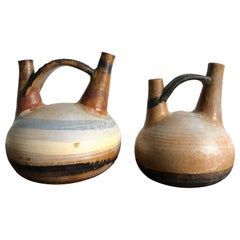
Ivo Sassi Italian Mid-Century Modern Design Ceramic Vases Set, 1950s
By Ivo Sassi
Located in Reggio Emilia, IT
Italian Mid-Century Modern design ceramic vases set series “Gli Etruschi” designed by italian artist Ivo Sassi, 1950s
Dimensions from left:
Height 21 cm, width 20 cm, depth 20 cm...
Category
Vintage 1950s Italian Mid-Century Modern Ceramics
Materials
Ceramic
$1,921 / set
H 8.27 in W 14.18 in D 6.3 in
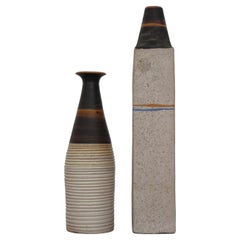
Ivo Sassi Mid-Century Modern Design Italian Ceramic Vases Bottles Set, 1950s
By Ivo Sassi
Located in Reggio Emilia, IT
Italian Mid-Century Modern design ceramic vases or bottles set serie “Gli Etruschi” designed by Italian artist Ivo Sassi, 1950s
Dimensions from left:
Height 22 cm, diameter 6.5 cm
H...
Category
Vintage 1950s Italian Mid-Century Modern Bottles
Materials
Ceramic
$1,116 / set
H 12.6 in W 4.73 in D 2.76 in
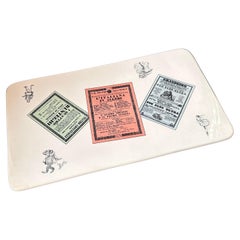
1950s Mid-Century Modern Albisola Ceramic Italian Vide-Poche by Ivos Pacetti
By Ivos Pacetti
Located in Aci Castello, IT
1950s Mid-Century Modern Albisola Ceramic Vide-Poche by Ivos Pacetti
A charming and rare piece of Italian mid-century design, this ceramic vide-poche (catchall tray) was crafted in A...
Category
Mid-20th Century Italian Mid-Century Modern Ceramics
Materials
Ceramic
$480
H 6.7 in W 11.42 in D 0.79 in
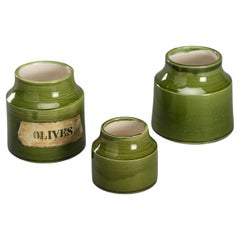
Green ceramic pots by Mado Jolain, circa 1960
By Mado Jolain
Located in VILLEURBANNE, FR
We hear that green is fashion! We've always loved it, especially the beautiful glaze by Mado Jolain, a great French ceramicist whose pots have been very successful with the Benoit Gu...
Category
Vintage 1960s French Mid-Century Modern Ceramics
Materials
Ceramic
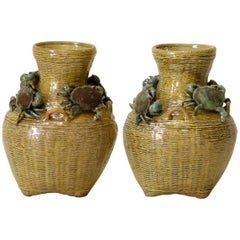
Pair of "Paniers de Crabes" Majolica Vases, France, circa 1900
Located in Isle Sur La Sorgue, Vaucluse
Enchanting and amusing pair of pleasingly rotund Barbotine vases, representing crabs forming a ring around woven baskets. The inspiration is taken from the French expression...
Category
Early 20th Century French Vases
Materials
Majolica
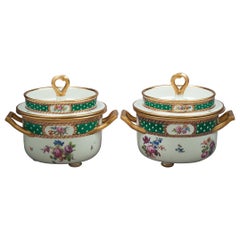
Pair of Vienna Green Ground Ice Pails, circa 1780
Located in New York, NY
With covers and liners. Marked with under glaze blue shield mark.
Category
Antique 1780s Austrian Serving Bowls
Materials
Porcelain
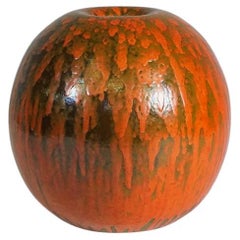
Vase "Pumpkin" from Albisola, Italy, circa 1960
By Ceramiche di Albisola
Located in Berlin, DE
Vase "Pumpkin" from Albisola, Italy, circa 1955.
With artist signature.
Category
Vintage 1950s Italian Mid-Century Modern Ceramics
Materials
Ceramic
Ceramic Vase by Mancioli, Italy, circa 1960s
By Mancioli Pottery
Located in St.Petersburg, FL
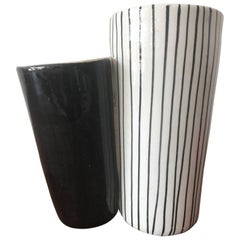
An unusual black and white ceramic vase, hand-painted by Mancioli, Italy, circa 1960s.
Category
Vintage 1960s Italian Mid-Century Modern Ceramics
Two Pairs of Italian Maiolica Baskets, circa 1780
By Antonio Ferretti
Located in Milano, IT
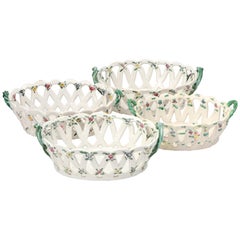
Two pairs of maiolica baskets
Antonio Ferretti Manufacture
Lodi, circa 1770-1790
Maiolica polychrome decorated “a piccolo fuoco” (third fire).
Measures: A) Height 3.54 x 6.69 x 9.84 in (9 x 17 x 25 cm);
B) Height 3.93 x 7.48 x 11.02 in (10 x 19 x 28 cm).
Total weight 4.85 lb (2.200 kg)
State of conservation:
A) One of the smaller baskets has some areas of restoration, the other slight chipping from use;
B) One of the larger baskets is intact and the other shows a clearly glued break.
The mold with which the baskets were forged simulates a wicker weave.
The two larger works have high, vertical walls, with branch-shaped handles penetrating the weave. The painted decorations, small polychrome flowers applied only externally, highlight the points where the weaves intersect.
The decision to leave the center of the basket devoid of decoration is highly unusual, but given the size and complexity of the shape, as well as the quality of the enamel, it is possible to hypothesize that it represents a precise choice in manufacturing or for a particular client.
The two smaller baskets have small, twisted handles and, on the outside, reproduce more decisively the characteristic wicker weave, obtained through thin molded lines. The interior exhibits a rich, typical decoration of naturalistic flowers: a bunch centered around a main flower and secondary stems accompanied by small “semis”. The exterior of these works is also adorned with small little flowers where the weaves intersect.
The size and morphological characteristics of the baskets confirm their attribution to the Lodi factory of Antonio Ferretti between 1770 and 1790, during its most successful period; by this point his original reworking of the "Strasbourg" decoration, known as "old Lodi", had achieved great fame even outside Italy.
This decorative choice represented a strong point of the Lodi factory, which established itself thanks to the vivid nature of the colors made possible by the introduction of a new technique perfected by Paul Hannong in Strasbourg and which Antonio Ferretti introduced in Italy. This production process, called “piccolo fuoco” (third fire), allowed the use of a greater number of colors than in the past; in particular, the purple of Cassius, a red made from gold chloride, was introduced. Its use allowed for many more tones and shades, from pink to purple.
The Ferretti family had started their maiolica manufacturing business in Lodi in 1725.
The forefather Simpliciano had started the business by purchasing an ancient furnace in 1725 and, indeed, we have evidence of the full activity of the furnaces from April of the same year (Novasconi-Ferrari-Corvi, 1964, p. 26 n. 4). Simpliciano had started a production of excellence also thanks to the ownership of clay quarries in Stradella, not far from Pavia. The production was so successful that in 1726 a decree of the Turin Chamber came to prohibit the importation of foreign ceramics, especially from Lodi, to protect internal production (G. Lise, La ceramica a Lodi, Lodi 1981, p. 59).
In its initial stages, the manufacture produced maolicas painted with the “a gran fuoco” (double fire) technique, often in turquoise monochrome, with ornamentation derived from compositional modules in vogue in Rouen in France. This was also thanks to the collaboration of painters like Giorgio Giacinto Rossetti, who placed his name on the best specimens next to the initials of the factory.
In 1748 Simpliciano made his will (Gelmini, 1995, p. 30) appointing his son Giuseppe Antonio (known as Antonio) as universal heir. After 1750, when Simpliciano passed away, Antonio was directly involved in the maiolica factory, increasing its fortunes and achieving a reputation on a European level. Particularly important was the aforementioned introduction in 1760 of the innovative “a piccolo fuoco” (third fire) processing, which, expanding the ornamental repertoire with Saxon-inspired floral themes, could commercially compete with the German porcelains that had one of its most renowned offerings in the naturalistic Deutsche Blumen. Antonio Ferretti understood and promoted this technique and this decoration, proposing it in a fresher and more corrective version, less linked to botanical tables...
Category
Antique 1770s Italian Neoclassical Ceramics
Materials
Maiolica
More From This Seller
View AllPesaro, Renato Giavoli Italy, circa 1960 Crocodile
By Pesaro
Located in Pymble, NSW
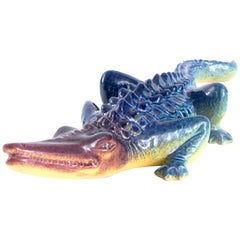
An impressive crocodile by Renato Giavoli made in the early 1950s at his factory in Pesaro Italy. He was a maestro of Italian ceramics and this is being...
Category
Vintage 1950s Italian Mid-Century Modern Ceramics
Materials
Pottery
Italian African Dancer Vase, circa 1960 Unknown Maker
Located in Pymble, NSW
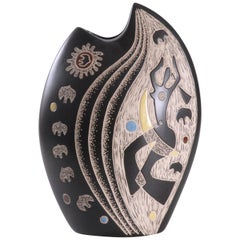
A double sided decorated Italian vase with stylized African female dancer with heavy sgraffito decoration into a satin brown glaze.
Category
Vintage 1960s Italian Mid-Century Modern Ceramics
Materials
Pottery
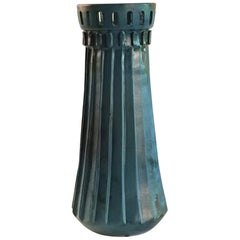
Alvino Bagni Italy Sea Garden Vase, circa 1960
By Alvino Bagni, Bagni Ceramiche
Located in Pymble, NSW
A large Alvino Bagni designed sea-green glazed vase with pierced top and wedge shaped fluting to the sides. Painted mark to the base.
Category
Vintage 1960s Italian Mid-Century Modern Ceramics
Materials
Pottery
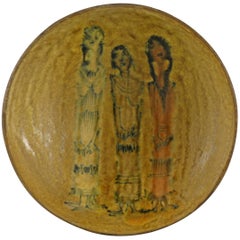
Bitossi Aldo Londi Female Figure Bowl, Italy, circa 1960
By Aldo Londi, Bitossi
Located in Pymble, NSW
A large deep bowl decorated in matt glazes of yellows and ochres with three clothed female figures, in excellent condition. A rare early piece with a Danish shop's label to the base.
Category
Vintage 1950s Italian Mid-Century Modern Ceramics
Materials
Pottery
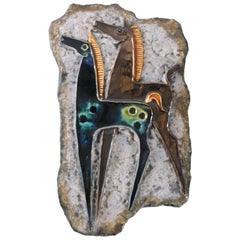
Helmut Schaffenacker, Germany 1960 Pottery Wall Plaque Horses
By Helmut Friedrich Schäffenacker
Located in Pymble, NSW
Helmut Schaffenacker executed pottery wall plaque of two colorful hoses in profile with and irregular rock finish edge, impressed mark on the back...
Category
Vintage 1960s German Mid-Century Modern Ceramics
Materials
Pottery
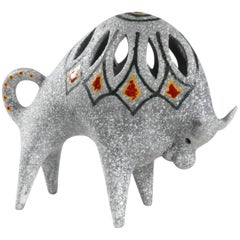
Roberto Rigon Italy Bull, circa 1970
By Roberto Rigon
Located in Pymble, NSW
An exceptional Roberto Rigon bull in 'Smalto Sasso' [glazed stone] with yellow, red and green lines. Base is marked RR. Pieces with painted or tube-lined geometric patterns are rare.
Category
Vintage 1970s Italian Mid-Century Modern Ceramics
Materials
Pottery
Still Thinking About These?
All Recently ViewedMore Ways To Browse
Italian Pottery Green
Italian Ceramics Horse
Italian Pottery Horses
Gli Etruschi Ivo De Santis
Green Glass Horse
Gli Etruschi Pottery
Mason Ironstone Plates
Antique Spanish Tile
Italian Majolica Plates
Silver Bowl Spain
Swedish Ceramics Green
Owl Ceramics
Sugar Bowl Mid Century
19th Century Mug
Japanese Blue Porcelain Plates
Leopard Silver
Orange And Blue Chinese Plates
Roth Germany