Items Similar to Italian Cantagalli Maiolica Large Plate with family noble emblem, Late 19th C.
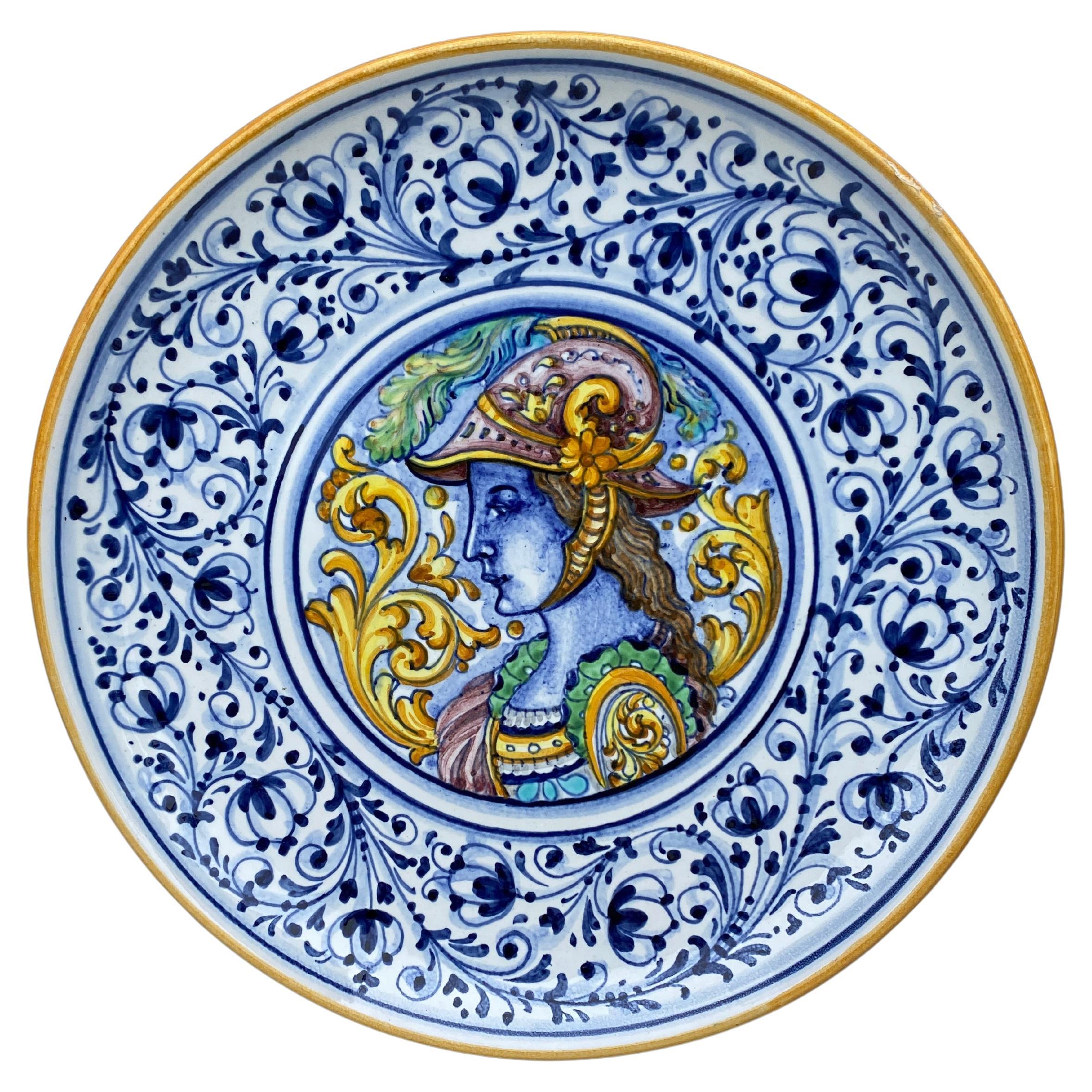
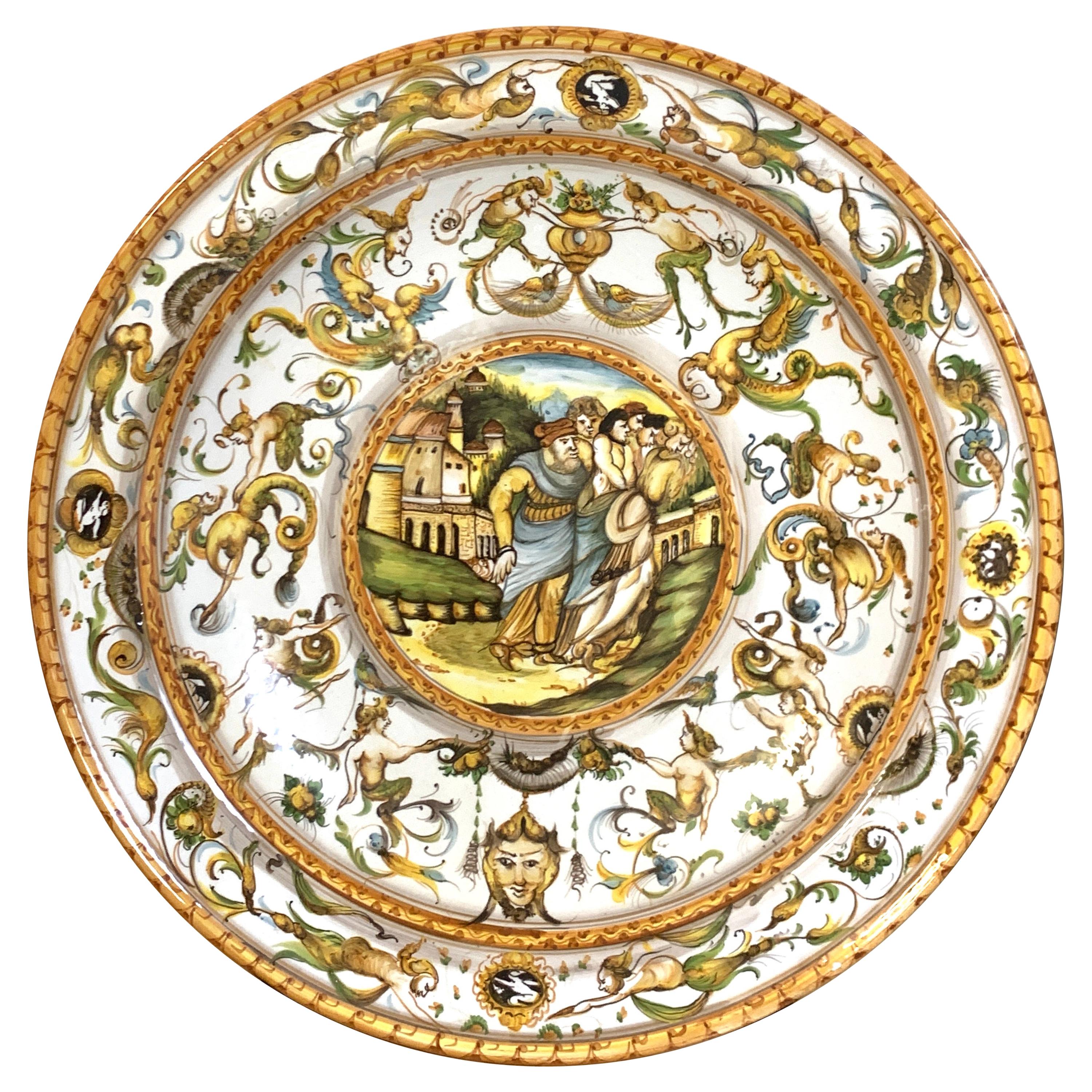
Want more images or videos?
Request additional images or videos from the seller
1 of 15
Italian Cantagalli Maiolica Large Plate with family noble emblem, Late 19th C.
$2,150
£1,623.82
€1,875.77
CA$3,029.04
A$3,244.11
CHF 1,744.01
MX$39,401.58
NOK 22,036.41
SEK 20,175.97
DKK 14,015.43
About the Item
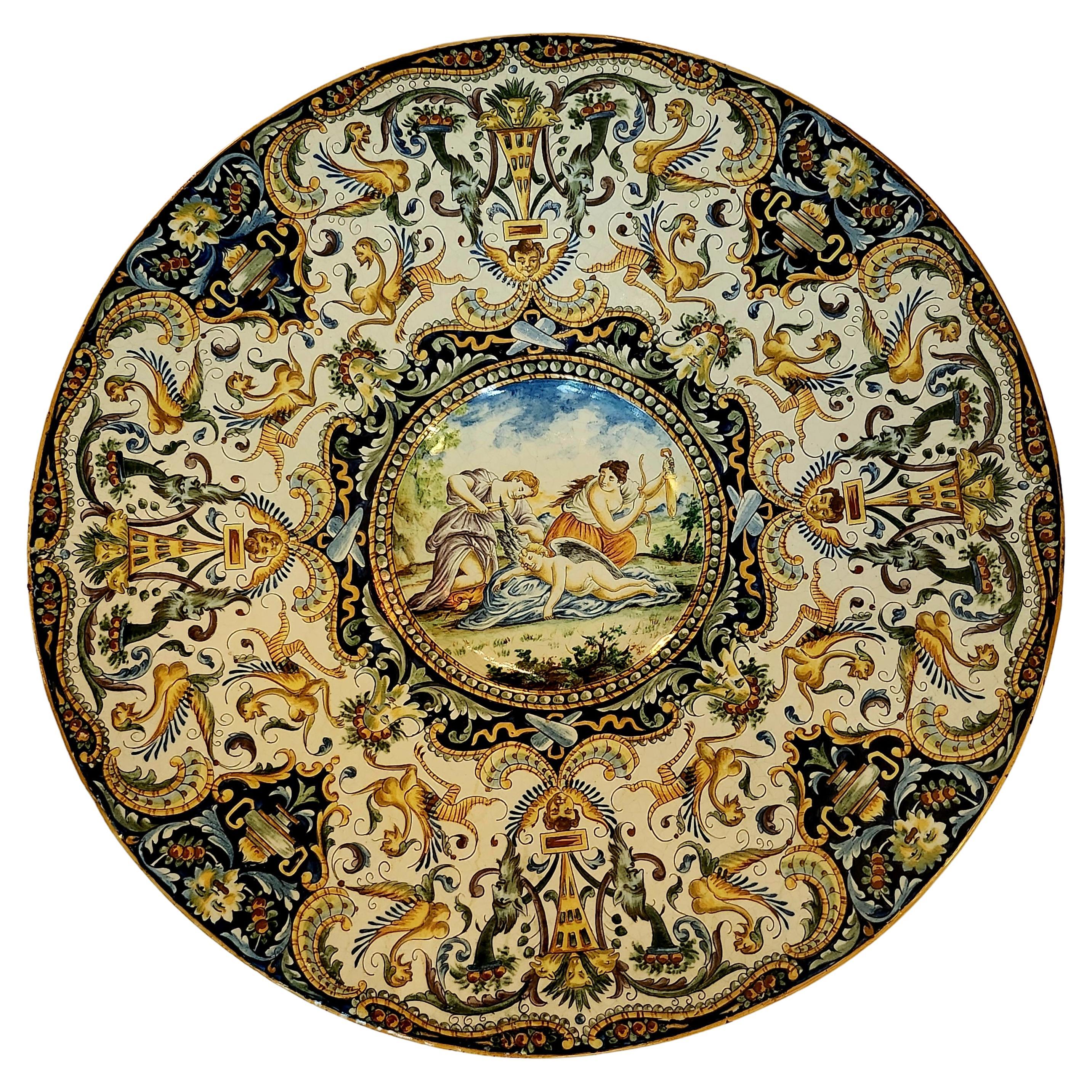
Cantagalli Maiolica Plate with Heraldic Emblem
Cantagalli Factory, Florence, Late 19th Century
Tin-glazed earthenware (maiolica); polychrome decoration
This large maiolica plate was produced in the late nineteenth century by the Cantagalli ceramics manufactory, a leading center of Renaissance-Revival maiolica in Florence. The reverse bears the distinctive rooster (gallo) mark, identifying it as an authentic work of the Cantagalli workshop.
The central roundel is painted with a heraldic device closely resembling the emblem associated with the family of Frederick Stibbert (1838–1906), the Anglo-Italian collector whose Florentine villa and museum housed an extensive assemblage of historic arms, armor, and ceramics. Surrounding the heraldic shield, the inner border is ornamented with Raffaellesque motifs rendered on a white ground, echoing sixteenth-century istoriato and ornament traditions. The wide outer rim is enriched with fantastical Grotesque decoration on a cobalt-blue field, executed in the refined historicist style characteristic of Cantagalli’s late nineteenth-century production.
The plate exemplifies the factory’s commitment to recreating Renaissance techniques and aesthetics using traditional tin-glazed earthenware methods, while also serving the era’s taste for scholarly revival and aristocratic lineage.
- Creator:Cantagalli (Maker)
- Dimensions:Height: 1.5 in (3.81 cm)Diameter: 18.9 in (48.01 cm)
- Style:Renaissance Revival (Of the Period)
- Materials and Techniques:
- Place of Origin:
- Period:
- Date of Manufacture:1880
- Condition:Wear consistent with age and use.
- Seller Location:CH
- Reference Number:1stDibs: LU977836105822
About the Seller
5.0
Recognized Seller
These prestigious sellers are industry leaders and represent the highest echelon for item quality and design.
1stDibs seller since 2013
45 sales on 1stDibs
Typical response time: 2 hours
- ShippingRetrieving quote...Shipping from: Bissone, Switzerland
- Return Policy
More From This Seller
View AllItalian Paris Porcelain Painted Plate, Naples Circa 1825
Located in CH
Italian Paris Porcelain Painted Plate
Naples, circa 1825
An elegant Italian Paris porcelain painted plate, produced in Naples circa 1825, decorated with a finely executed scene of p...
Category
Antique Early 19th Century Italian Restauration Porcelain
Materials
Porcelain
Italian Castelli Majolica Bases, circa 1800
By Castelli
Located in CH
Pair of Italian Castelli Majolica Bases
Circa 1800
A fine pair of Italian Castelli majolica bases for large vases, dating to around 1800, exemplifyi...
Category
Antique 19th Century Italian Rococo Pottery
Materials
Ceramic
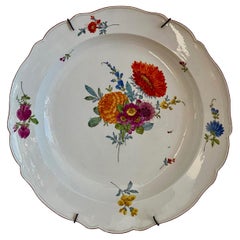
Meissen Charger with Decoration a Flower Bunches, Marcolini Period Ca. 1800
By Meissen Porcelain
Located in CH
Meissen Charger with Floral Bouquet Decoration
Marcolini Period, circa 1800
A large Meissen porcelain charger decorated with stylized bouquets of flow...
Category
Antique 1790s German Neoclassical Porcelain
Materials
Porcelain
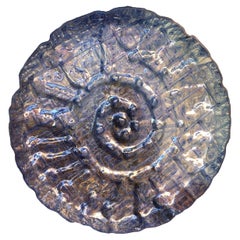
Italian Venetian Murano Renaissance Revival Very Large Glass Charger, circa 1910
Located in CH
Italian Venetian Murano Renaissance Revival Glass Charger
Circa 1910
An impressive and exceptionally crafted Venetian Murano glass charger, dating to around 1910, produced during th...
Category
20th Century Italian Renaissance Revival Glass
Materials
Art Glass, Blown Glass
Meissen Porcelain, Pair of "Neu-Ozier" Molded Plates, 19th Century
By Meissen Porcelain
Located in CH
Meissen Porcelain, Pair of “Neu-Ozier” Molded Plates
19th Century
A fine pair of Meissen porcelain plates in the “Neu-Ozier” molded style, dating to the 19th century. Each plate fea...
Category
Antique 19th Century German Rococo Porcelain
Materials
Porcelain

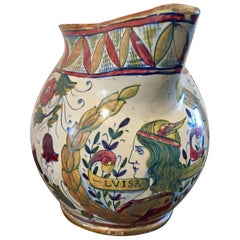
Italian Maiolica La Bella Water Jug, 19th Century
Located in CH
IItalian Maiolica “La Bella” Istoriato Lustered Red Water Jug
19th Century
A finely decorated Italian maiolica water jug, richly painted in the “La Bella...
Category
Antique Late 19th Century Italian Renaissance Ceramics
Materials
Ceramic
You May Also Like
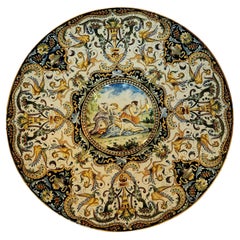
A Large Italian Maiolica Charger, 19th Century
Located in CABA, AR
Maiolica chargers are large, decorative ceramic plates that are part of the broader tradition of Maiolica pottery, a type of tin-glazed earthenware produced in Italy since the Renais...
Category
Antique 19th Century Italian Renaissance Revival Ceramics
Materials
Ceramic
$4,800 Sale Price
20% Off
Italian Renaissance Plate, Patanazzi Workshop Urbino, End of 16th Century
By Patanazzi Workshop
Located in Milano, IT
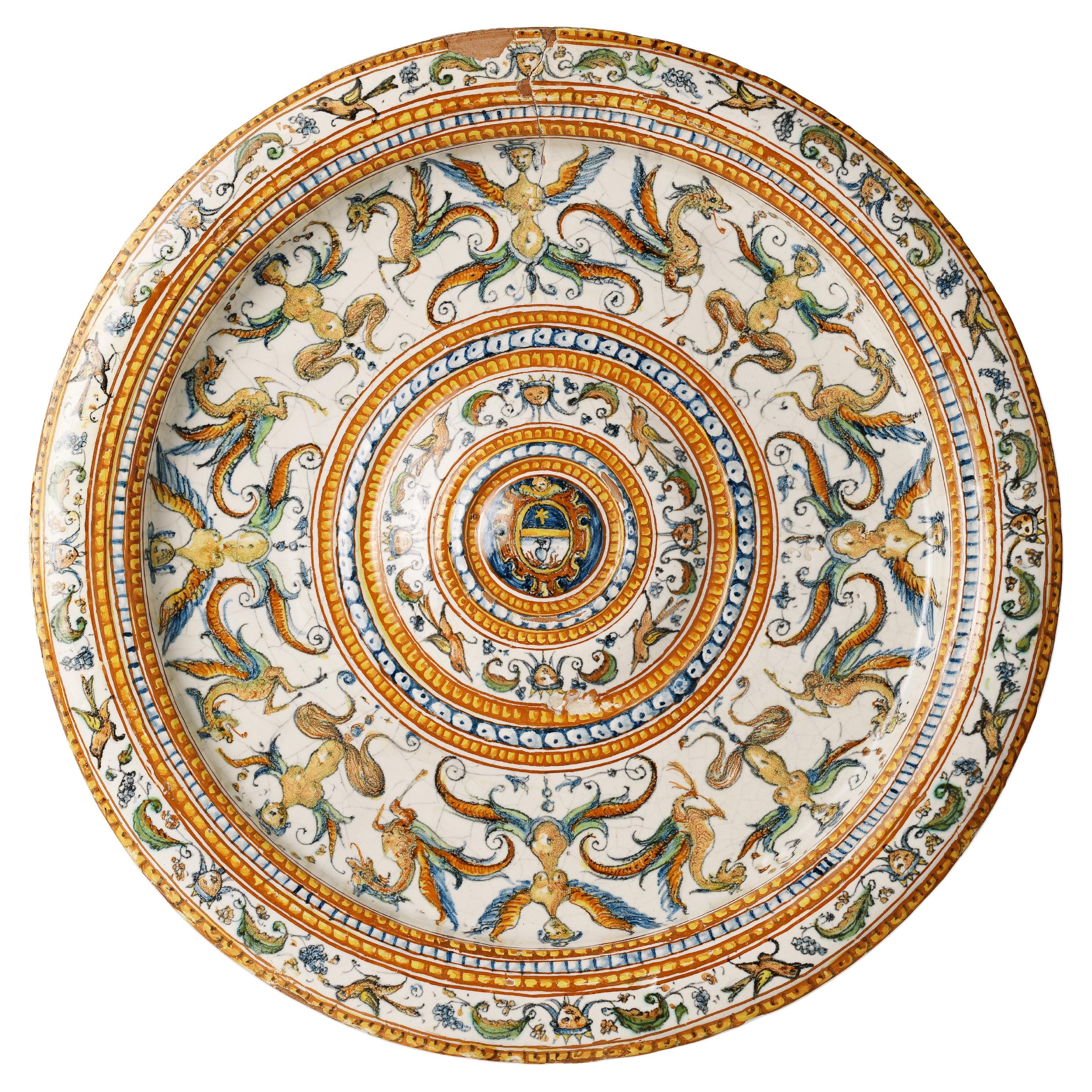
Acquareccia plate
Patanazzi workshop
Urbino, last quarter of the 16th century
It measures diameter 17.12 in; foot diameter 11.53 in; height 1.88 in (43.5 cm; 29.3 cm; 4.8 cm).
Weight
State of conservation: wear and a few small minimal detachments of enamel, chipping on the raised areas, peeling of enamel at the brim on the back.
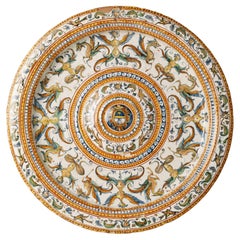
This large, shallow basin is equipped with a wide and convex well. It is umbonate with a contoured center. The brim, short and flat, is enclosed in a double rounded and barely raised edge. The basin has a flat base without rims; it has a slightly concave center in correspondence to the well.
The shape takes inspiration from the basins associated with the metal forged amphora pourers that traditionally adorned the credenza. These were used from the Middle Ages to wash hands during banquets. Two or three people washed their hands in the same basin and it was considered an honor to wash one’s hands with an illustrious person.
The decoration is arranged in concentric bands with, in the center of the umbo, an unidentified shield on a blue background: an oval banded in gold with a blue head, a gold star and a field with a burning pitcher.
Rings of faux pods separate the center from a series of grotesque motifs of small birds and masks. These go around the basin and are, in fact, faithfully repeated on the brim. The main decoration develops inside the flounce of the basin, which sees alternating symmetrical figures of winged harpies and chimeras. The ornamentation, outlined in orange, green and blue, stands out against the white enamel background.
This decorative style, defined since the Renaissance as “grottesche” or “raffaellesche”, refers to the decorations introduced after the discovery of the paintings of the Domus Aurea towards the end of the fifteenth century. The discovery of Nero's palace, buried inside Colle Oppio by damnatio memoriae, occurred by chance when a young Roman, in 1480, fell into a large crack which had opened in the ground on the hill, thus finding himself in a cave with walls covered with painted figures.
The great artists present in the papal city, including Pinturicchio, Ghirlandaio, Raffaello, immediately visited these caves. The decorations found there soon became a decorative subject of immense success: the term grotesque , with the meaning of “unusual,” “caricatured,” or “monstrous,” was later commented by Vasari in 1550 as “una spezie di pittura licenziose e ridicole molto”( “a very licentious and ridiculous kind of painting”).
The decorations “a grottesche” also widely circulated in ceramic factories, through the use of engravings, variously interpreted according to the creativity of the artists or the requests of the client.
Our basin is reflected in similar artifacts produced at the end of the sixteenth century by the factories of the Urbino district. See the series of basins preserved in the main French museums, among which the closest in morphology is that of the Campana collection of the Louvre (Inv. OA1496); this however has a more complex figure decoration, while the decoration of our specimen is sober and with a watercolor style.
The style, sure in its execution, approaches decorative results still close to the works produced around the middle of the sixteenth century by the Fontana workshop. The decoration is closely linked to their taste, which later finds its natural outlet, through the work of Antonio, also in the Patanazzi workshop. Studies show the contiguity between the two workshops due to the kinship and collaboration between the masters Orazio Fontana and Antonio Patanazzi, both trained in the workshop of Guido Fontana il Durantino. It is therefore almost natural that their works, often created according to similar typologies and under the aegis of the same commissions, are not always easily distinguishable, so much so that the presence of historiated or “grottesche” works by Orazio is documented and preserved in Antonio Patanazzi's workshop. Given that the studies have always emphasized the collaboration between several hands in the context of the shops, it is known that the most ancient “grottesche” works thus far known, can be dated from 1560, when the Fontana shop created the so-called Servizio Spagnolo (Spanish Service) and how, from that moment on, this ornamentation became one of the most requested by high-ranking clients. We remember the works created for the Granduchi di Toscana, when Flaminio Fontana along with his uncle Orazio supplied ceramics to Florence, and, later, other commissions of considerable importance: those for the service of the Duchi d’Este or for the Messina Farmacia of Roccavaldina, associated with the Patanazzi workshop when, now after 1580, Antonio Patanazzi began to sign his own work.
Thus, in our basin, the presence of masks hanging from garlands, a theme of more ancient memory, is associated in the work with more advanced stylistic motifs, such as the hatching of the chimeras and harpies. These are found here on the front with the wings painted in two ornate ways. In addition, the theme of the birds on the edge completes the decoration along the thin brim and can be seen as representing an early style typical of the Urbino district during a period of activity and collaboration between the two workshops. Later, a more “doll-like” decorative choice, typical of the end of the century and the beginning of the seventeenth century, characterized the period of the Patanazzi workshop under the direction of Francesco.
Bibliography:
Philippe Morel, Il funzionamento simbolico e la critica delle grottesche nella seconda metà del Cinquecento, in: Marcello Fagiolo, (a cura di), Roma e...
Category
Antique 16th Century Italian Renaissance Ceramics
Materials
Maiolica
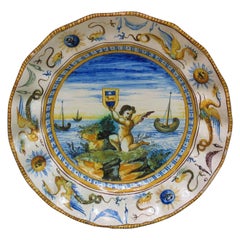
Deruta Maiolica Moulded Plate Probably 19th Century
Located in Ottawa, Ontario
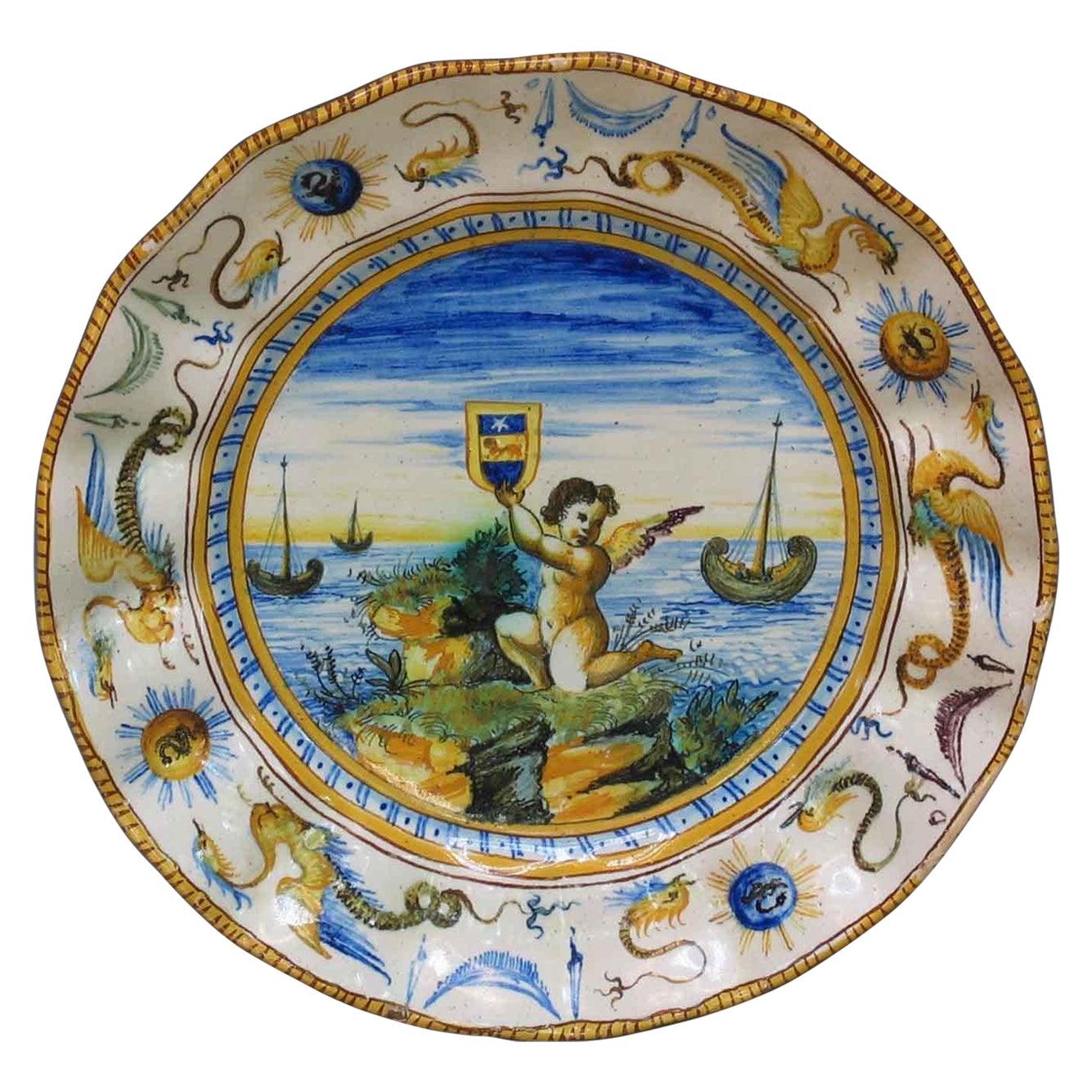
A DERUTA MAIOLICA MOULDED PLATE
Probably 19th Century.
Painted with kneeling Cupid on a rock holding a heraldic shield surrounded by a seascape with...
Category
Antique Late 19th Century Italian Renaissance Contemporary Art
Materials
Tin
Small Maiolica Plate, Urbino District, 1533-1555
Located in Milano, IT
Maiolica plate (tondino)
Urbino district, Casteldurante or Pesaro, 1533-1555
It measures: diam. 7.48 in (19 cm), foot diam. 2.75 in (7 cm), height 1.0...
Category
Antique 16th Century Italian Renaissance Ceramics
Materials
Maiolica
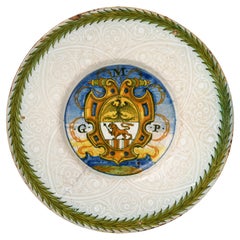
Large Neo-Renaissance Italian Faience Platter Circa 1930
Located in Austin, TX
Large Neo-Renaissance Italian Faience Platter Circa 1930.
Category
Vintage 1930s English Renaissance Revival Platters and Serveware
Materials
Ceramic, Faience
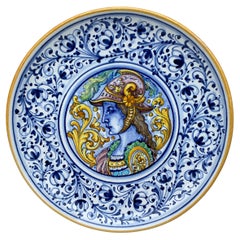
Massive Italian Majolica Allegorical Charger by A. Deruta
By Deruta
Located in West Palm Beach, FL
Massive Italian Majolica allegorical charger by A. Deruta
Gorgeous continuous Italian Renaissance style decoration
Ready to hang.
Category
20th Century Italian Renaissance Ceramics
Materials
Majolica

$2,200 Sale Price
20% Off
More Ways To Browse
Italian Renaissance Plates
Antique Cantagalli
Antique Furniture Emblems
Cloutier Ceramics
Dame Lucie Rie
Gatti Faenza
German Vintage Guitars
Gilbert Valentin Les Archanges
Goose Bowl
Green Majolica Tureen
Grisaille Chinese
Gunnar Nylund Fish
Italian Ceramic Donkey
Japanese Sugar Bowl
Jelly Mold
Lettuce Leaf
Lindberg Horse
Longchamp Barbotine