Want more images or videos?
Request additional images or videos from the seller
1 of 8
A Midcentury Ceramic Black Panther by Royal Haeger
$525List Price
About the Item
- Creator:Royal Haeger (Maker)
- Dimensions:Height: 4.5 in (11.43 cm)Width: 25 in (63.5 cm)Depth: 6 in (15.24 cm)
- Style:Art Deco (In the Style Of)
- Materials and Techniques:Ceramic,Glazed
- Place of Origin:
- Period:
- Date of Manufacture:circa 1950 s
- Condition:Wear consistent with age and use.
- Seller Location:Astoria, NY
- Reference Number:Seller: R314TB - 7151stDibs: 15061088935530
About the Seller
4.9
Vetted Professional Seller
Every seller passes strict standards for authenticity and reliability
1stDibs seller since 2010
2,609 sales on 1stDibs
Typical response time: 11 hours
Authenticity Guarantee
In the unlikely event there’s an issue with an item’s authenticity, contact us within 1 year for a full refund. DetailsMoney-Back Guarantee
If your item is not as described, is damaged in transit, or does not arrive, contact us within 7 days for a full refund. Details24-Hour Cancellation
You have a 24-hour grace period in which to reconsider your purchase, with no questions asked.Vetted Professional Sellers
Our world-class sellers must adhere to strict standards for service and quality, maintaining the integrity of our listings.Price-Match Guarantee
If you find that a seller listed the same item for a lower price elsewhere, we’ll match it.Trusted Global Delivery
Our best-in-class carrier network provides specialized shipping options worldwide, including custom delivery.You May Also Like
Small Black Panther Ceramic Sculpture, Italy, 1960s.
Located in 05-080 Hornowek, PL
Italian ceramic, perfect condition, produced in 1960s. We have also medium and large black panthers, check our products.
Category
20th Century Ceramics
Materials
Ceramic
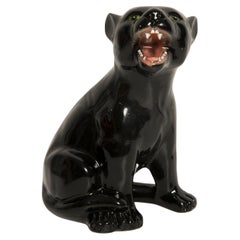
Rare Medium Black Panther Ceramic Sculpture, Italy, 1960s
Located in 05-080 Hornowek, PL
Italian ceramic, perfect condition, produced in 1960s. We have also another big cats for sale, check our products. Only one unique piece available.
Category
20th Century Italian Mid-Century Modern Animal Sculptures
Materials
Ceramic

Midcentury Medium Black Cats Ceramic Sculpture, Portugal, 1960s
Located in 05-080 Hornowek, PL
Portugal ceramic, perfect condition, produced in 1960s.
Category
20th Century Portuguese Mid-Century Modern Animal Sculptures
Materials
Ceramic
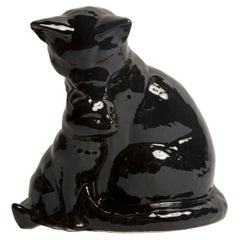
Midcentury Bird Stoneware Ceramic Sculpture Brown Pottery Color by B. Favre
By Benoist Favre
Located in Neuilly-en- sancerre, FR
Benoist Favre
Midcentury bird ceramic sculpture realized, circa 1975.
Brown stoneware pottery colors with effects.
Excellent original conditions...
Category
Late 20th Century French Mid-Century Modern Animal Sculptures
$2,510
H 11.42 in W 11.03 in D 4.34 in
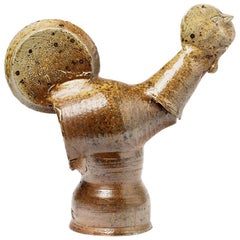
Ceramic Majolica Italian Grey Hound Midcentury
Located in Rochester, NY
Majolica Italian grey hound. Mid-20th century.
Category
Mid-20th Century Italian Mid-Century Modern Ceramics
Materials
Ceramic, Majolica
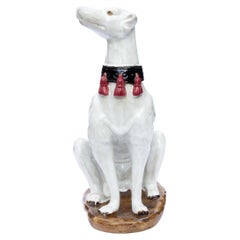
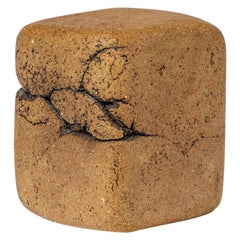
Stoneware Ceramic Brown Asbtract Form by O Giroud La Borne 1977 Midcentury
Located in Neuilly-en- sancerre, FR
Olivier Giroud
Realized in 1977, signed under the base.
Abstract stoneware ceramic sculpture.
Original midcentury design form with brown stonew...
Category
20th Century French Mid-Century Modern Abstract Sculptures
Materials
Ceramic
$1,080
H 3.94 in W 3.15 in D 3.15 in
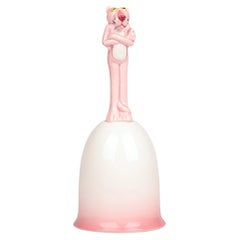
Pink Panther Collection Royal Orleans Ceramic Figural Bell
By United Artists
Located in Bishop
s Stortford, Hertfordshire
A delightful, Japanese licensed Pink Panther Collection handled ceramic bell with a Pink Panther handle distributed by Royal Orleans and dated 1981. The ceramic bell has a round bell...
Category
Vintage 1980s Japanese Modern Ceramics
Materials
Ceramic
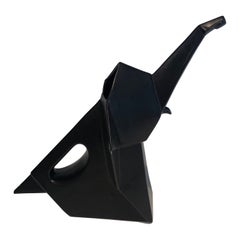
Elephant Black Ceramic Picher
Located in Marcq-en-Barœul, Hauts-de-France
This pitcher which represents an elephant, is made of a black glazed ceramic. This is a French work, circa 1970.
Category
Vintage 1970s French Mid-Century Modern Ceramics
Materials
Ceramic
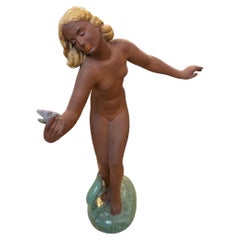
Ceramic Red and Black, Style, Art Deco
Located in Ciudad Autónoma Buenos Aires, C
Ceramic
Sign:
Made in Austria Keramos
2051
19/M
Wiener
Keramos, later Keramos AG or Keramos KG , was a Viennese ceramics manufacturer that made a name for itself especially in the interwar period . In addition to their own designs, designs from the dissolved Wiener Werkstätte were also produced from 1932 onwards. In over 60 years of company history, around 3000 model designs have been produced by around 60 ceramists.
Keramos also carried out commissions from the Wiener Werkstätte, such as vases by Dagobert Peche .
History
The origins of the Keramos company lie in two companies with the same name. The company Keramos – Invalid Society for Viennese Art Ceramics was founded at the end of 1919 on the initiative of the three ceramists Rudolf Wolf, Heinrich Wolf and Ludwig Rys, who had become invalids in World War I. Production started in September 1920. Art-ceramic lamps, figures, vases and boxes were produced.
The company Keramos – Viennese art ceramics and porcelain manufactory was founded in 1920. Josef Hoffmann was a shareholder of Keramos for a long time, as was the sculptor Rudolf Podany, who was engaged from the start and created a large number of designs. From 1921 Anton Klieber was employed, who was also responsible for most of the models.
Around 1924 both companies were merged and converted into an AG, commercial director became Otto Köller, the technical directors were the brothers Rudolf and Heinrich Wolf.
"Some war invalid ceramists founded a workshop with the help of some artists, which was subsequently financed by the state and later enlarged with its participation and converted into a joint-stock company."
The company's headquarters were in the Hofburg , Schwarze-Adler-Stiege, the factory in the 10th district of Vienna, Schleiergasse 17. Artistic collaborators at that time were Eduard Klablena , Otto Prutscher , Karl Perl , Karin Jarl-Sakellarios , IDA Schwetz- Lehmann and Grete Fucik-Fischmeister. On February 23, 1928, the triangular mark was entered in the trademark register. It was now also produced for the Wiener Werkstätte.
Difficulties for the company arose from the Great Depression . Around 1932, 50 people were employed and a large number of models from Eduard Klabena and the dissolved Wiener Werkstätte were taken over. The works created by Keramos were labeled with their company brands until after 1941. From 1939 the economic situation of the company was better managed by taking over the production of ceramic winter welfare organization badges, the so-called WHW badges.
Before 1941 the company is converted into a KG named Keramos, Wiener Kunstkeramik und Porzellanmanufaktur Brüder Wolf KG . Otto Köller was no longer active from this point on.
After the end of World War II, Robert Obsieger recommended Robert Mathis as the new head of Keramos, who took over the management of the ceramics manufactory in 1945. In 1949 Mathis introduced a new company logo, which was used alongside the existing triangle mark, the so-called coat of arms mark.
Anton Klieber and Rudolf Podany continued to work as ceramists, and new artists such as Josef Lorenzl and Stephan Dakon , both of whom had previously worked for Goldscheider , as well as Rudolf Chocholka, Karl Grössl and Ina Eisenbeisser were engaged. New models such as dancers, children's figures, animals and nudes were created, as well as the well-known wall masks, young people and poodles from the mid-1950s, which corresponded to the trend at the time. In addition, however, traditional designs such as Madonna statues and busts, saints and angels were still made.
Utility ceramics such as crockery, vases, lamp bases, candle holders and flower pots also became an important branch of production, and cooperation with the German manufacturer Carstens at the beginning of the 1960s was just as lucrative.
In the course of the 1960s, the sales markets for figurative ceramics became increasingly difficult. So until 1982, production was increasingly shifted to everyday ceramics, since ceramic figures were no longer modern due to changing tastes and the spirit of the times. Ultimately, the economic situation at Keramos became more and more difficult and Klaus Mathis, the son of Robert Mathis and then director, who succeeded his father at the helm of the company at the beginning of the 1970s, initiated the liquidation of the company at the end of 1982 .
Staff
The following artistic collaborators have worked for Keramos over the years: Hans Adametz , Franz Barwig the Elder , Franz Barwig the Younger , Andreas Beck, Hans Bolek, Angelo Bortolotti, Hertha Bucher , Rudolf Chocholka, Stephan Dakon , Ferdinand Doblinger, Eckstein, Franz Eggenberger , Ina Eisenbeisser, English, Stephan Erdös, Alois Feichtinger, Feyslitz, Hans Friedberger, Grete Fucik-Fischmeister, Kurt Goebel, Anton Grath, Karl Grössl, M. Günther, Otto Hafenrichter, Arnold Hartig , Friedrich Herkner, Trude Hillinger, Leopold Hohl, Hostasch, Karl Jamök, Karin Jarl-Sakellarios , Eduard Klablena, Klar, Anton Klieber, Maria Klinger, Josef Kostial, Josef Lorenzl , Wilhelm Otto Lugerth, Viktor Matula, Gusty Mundt-Amman, Novotny, Carl Perl, Rudolf Podany, Friedrich Pollak, Hugo Postl, Adolf Prischl, Otto Prutscher , Max Rieder , Elisabeth Rieger-Hofmann, Walter Ritter , Willibald Russ, Karl Sailer, Schönberg, Schwarz, Ida Schwetz-Lehmann , Sult, Robert Ullmann , Otto Weigand, IDA Weiss-Moricz, Rudolf Wolf.
Exhibitions
• Jubilee exhibition of the Wiener Kunstgewerbeverein, Austrian Museum , Vienna 1924.
• Arts and Crafts Exhibition, Paris, 1925.
• Exhibition of Austrian arts and crafts...
Category
Vintage 1930s Austrian Art Deco Figurative Sculptures
Materials
Ceramic
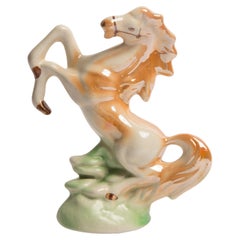
Midcentury Ceramic Porcelain Decorative Horse Sculpture, Europe, 1960s
Located in 05-080 Hornowek, PL
Painted ceramic, very good original vintage condition. No damages or cracks. Beautiful and unique decorative sculpture. Horse sculpture was produced in England. Only one item available.
Category
20th Century English Mid-Century Modern Ceramics
Materials
Ceramic, Porcelain
$133 Sale Price
30% Off
H 8.27 in W 2.37 in D 6.3 in
More From This Seller
View AllLouis Mendez Ceramic Art Pottery Female Figures, 2
By Louis Mendez
Located in Astoria, NY
Louis Mendez (American, 1929-2012) Two Ceramic Art Pottery Female Figures, comprising: figure with metallic copper glaze and a figure as a candlestick, one signed.
Taller: 12" H x ...
Category
20th Century American Post-Modern Figurative Sculptures
Materials
Ceramic, Pottery

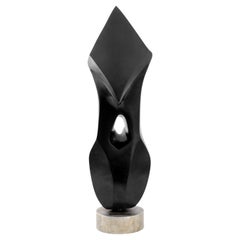
Arthur M. Bernhang "She" Black Marble Sculpture
Located in Astoria, NY
Arthur M. Bernhang (American, XX) "She" Black Marble Sculpture, 1983, upon a circular metal pedestal with plaque. 36.5" H x 10" W x 12" D. Provenance: From a 575 Park Avenue Estate.
Category
Vintage 1980s Abstract Sculptures
Materials
Marble
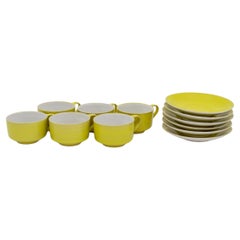
Rupert Spira Yellow Glazed Stoneware Articles, 12
By Rupert Spira
Located in Astoria, NY
Set of 12 Rupert Spira (English, b. 1960) Yellow Glazed Stoneware Table Articles, comprising: (6) coffee cups and (6) saucers, each marked "RS" to underside. Overall: 3.25" H x 6.5" ...
Category
Late 20th Century British Modern Ceramics
Materials
Stoneware
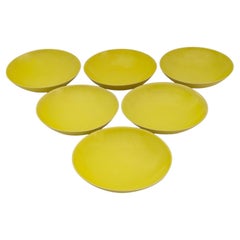
Rupert Spira Yellow Glazed Stoneware Bowls, 6
By Rupert Spira
Located in Astoria, NY
Set of Six Rupert Spira Ceramics (English, b. 1960) Yellow Glazed Stoneware Bowls, marked "RS" to the underside. 2.5" H x 9" Diameter.
Category
Late 20th Century Ceramics
Materials
Stoneware
$1,300 / set
Rupert Spira Yellow Glazed Stoneware Sake Set, 7
By Rupert Spira
Located in Astoria, NY
Rupert Spira (English, b. 1960) Yellow Glazed Stoneware Sake Set, comprising: sake pitcher and six cups, each marked "RS" to the underside. Seven pieces total. Pitcher: 5.75" H x 2.2...
Category
21st Century and Contemporary British Ceramics
Materials
Ceramic
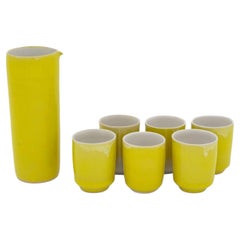
$950 Sale Price / set
34% Off
Studio Art Pottery Tableware Pieces, 10
Located in Astoria, NY
Collection of Ten Studio Art Pottery Tableware Pieces, comprising: two cups, stamped "J.O.", a David Wright oval cup, signed "Wright" to underside, a cup and two saucers, terracotta ...
Category
20th Century American Mid-Century Modern Ceramics
Materials
Ceramic
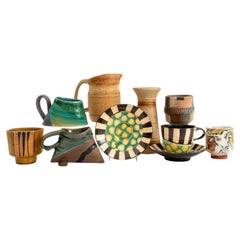
$850 / set
Still Thinking About These?
All Recently ViewedMore Ways To Browse
Haeger Ceramic
Glass Panther
Black Ceramic Panther
Mid Century Panther Ceramic
Haeger Art Deco
Glass Black Panthers
Stalking Panther
Haeger Black Panther
Haeger Ceramic Panther
Haeger Panther
Antique Cheese Dish
Ceramic Eggs
Ceramic Wine Glasses
English Green Majolica
Glass Coffee Mugs
Holdcroft Majolica
Lebrillo Bowl
Majolica Cabbage