1 of 6
Pair of Triton Candlesticks. Palmer C1780.
$7,500List Price
About the Item
- Creator:Palmer (Manufacturer)
- Dimensions:Height: 10 in (25.4 cm)Width: 4 in (10.16 cm)Depth: 4 in (10.16 cm)
- Style:Neoclassical (Of the Period)
- Materials and Techniques:Stoneware,Molded
- Place of Origin:
- Period:
- Date of Manufacture:circa 1780
- Condition:Replacements made: Bases have been replaced with Wedgwood bases.
- Seller Location:Melbourne, AU
- Reference Number:Seller: 40301stDibs: LU3151331724802
Authenticity Guarantee
In the unlikely event there’s an issue with an item’s authenticity, contact us within 1 year for a full refund. DetailsMoney-Back Guarantee
If your item is not as described, is damaged in transit, or does not arrive, contact us within 7 days for a full refund. Details24-Hour Cancellation
You have a 24-hour grace period in which to reconsider your purchase, with no questions asked.Vetted Professional Sellers
Our world-class sellers must adhere to strict standards for service and quality, maintaining the integrity of our listings.Price-Match Guarantee
If you find that a seller listed the same item for a lower price elsewhere, we’ll match it.Trusted Global Delivery
Our best-in-class carrier network provides specialized shipping options worldwide, including custom delivery.You May Also Like
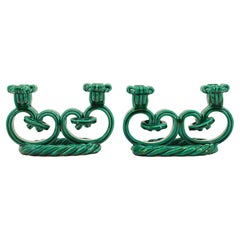
Vallauris Pair of Candlesticks, 1940s
By André Baud
Located in Saint-Amans-des-Cots, FR
Pair of candlesticks made at Vallauris, France, 1940s. Ceramic. Representation of braided candlesticks, Classic design from this period of the 40s. Very close to the work of Jérome M...
Category
Vintage 1940s French Neoclassical Candlesticks
Materials
Ceramic
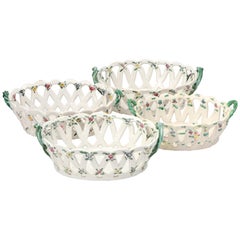
Two Pairs of Italian Maiolica Baskets, circa 1780
By Antonio Ferretti
Located in Milano, IT
Two pairs of maiolica baskets
Antonio Ferretti Manufacture
Lodi, circa 1770-1790
Maiolica polychrome decorated “a piccolo fuoco” (third fire).
Measures: A) Height 3.54 x 6.69 x 9.84 in (9 x 17 x 25 cm);
B) Height 3.93 x 7.48 x 11.02 in (10 x 19 x 28 cm).
Total weight 4.85 lb (2.200 kg)
State of conservation:
A) One of the smaller baskets has some areas of restoration, the other slight chipping from use;
B) One of the larger baskets is intact and the other shows a clearly glued break.
The mold with which the baskets were forged simulates a wicker weave.
The two larger works have high, vertical walls, with branch-shaped handles penetrating the weave. The painted decorations, small polychrome flowers applied only externally, highlight the points where the weaves intersect.
The decision to leave the center of the basket devoid of decoration is highly unusual, but given the size and complexity of the shape, as well as the quality of the enamel, it is possible to hypothesize that it represents a precise choice in manufacturing or for a particular client.
The two smaller baskets have small, twisted handles and, on the outside, reproduce more decisively the characteristic wicker weave, obtained through thin molded lines. The interior exhibits a rich, typical decoration of naturalistic flowers: a bunch centered around a main flower and secondary stems accompanied by small “semis”. The exterior of these works is also adorned with small little flowers where the weaves intersect.
The size and morphological characteristics of the baskets confirm their attribution to the Lodi factory of Antonio Ferretti between 1770 and 1790, during its most successful period; by this point his original reworking of the "Strasbourg" decoration, known as "old Lodi", had achieved great fame even outside Italy.
This decorative choice represented a strong point of the Lodi factory, which established itself thanks to the vivid nature of the colors made possible by the introduction of a new technique perfected by Paul Hannong in Strasbourg and which Antonio Ferretti introduced in Italy. This production process, called “piccolo fuoco” (third fire), allowed the use of a greater number of colors than in the past; in particular, the purple of Cassius, a red made from gold chloride, was introduced. Its use allowed for many more tones and shades, from pink to purple.
The Ferretti family had started their maiolica manufacturing business in Lodi in 1725.
The forefather Simpliciano had started the business by purchasing an ancient furnace in 1725 and, indeed, we have evidence of the full activity of the furnaces from April of the same year (Novasconi-Ferrari-Corvi, 1964, p. 26 n. 4). Simpliciano had started a production of excellence also thanks to the ownership of clay quarries in Stradella, not far from Pavia. The production was so successful that in 1726 a decree of the Turin Chamber came to prohibit the importation of foreign ceramics, especially from Lodi, to protect internal production (G. Lise, La ceramica a Lodi, Lodi 1981, p. 59).
In its initial stages, the manufacture produced maolicas painted with the “a gran fuoco” (double fire) technique, often in turquoise monochrome, with ornamentation derived from compositional modules in vogue in Rouen in France. This was also thanks to the collaboration of painters like Giorgio Giacinto Rossetti, who placed his name on the best specimens next to the initials of the factory.
In 1748 Simpliciano made his will (Gelmini, 1995, p. 30) appointing his son Giuseppe Antonio (known as Antonio) as universal heir. After 1750, when Simpliciano passed away, Antonio was directly involved in the maiolica factory, increasing its fortunes and achieving a reputation on a European level. Particularly important was the aforementioned introduction in 1760 of the innovative “a piccolo fuoco” (third fire) processing, which, expanding the ornamental repertoire with Saxon-inspired floral themes, could commercially compete with the German porcelains that had one of its most renowned offerings in the naturalistic Deutsche Blumen. Antonio Ferretti understood and promoted this technique and this decoration, proposing it in a fresher and more corrective version, less linked to botanical tables...
Category
Antique 1770s Italian Neoclassical Ceramics
Materials
Maiolica
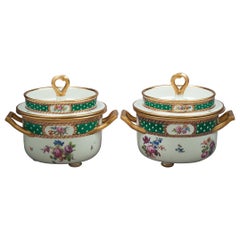
Pair of Vienna Green Ground Ice Pails, circa 1780
Located in New York, NY
With covers and liners. Marked with under glaze blue shield mark.
Category
Antique 1780s Austrian Serving Bowls
Materials
Porcelain
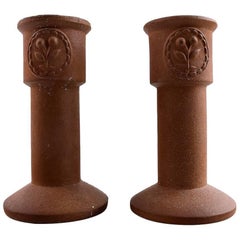
Gustavsberg a Pair of Unglazed Candlesticks, app. 1960s
By Stig Lindberg
Located in København, Copenhagen
Gustavsberg. A pair of unglazed candlesticks in stoneware.
Approximately 1960.
Marked.
Measures 13 cm.
In perfect condition.
Category
Vintage 1960s Swedish Scandinavian Modern Ceramics
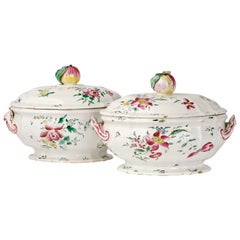
Pair of Italian Maiolica Tureens, Ferretti Manufacture, Lodi Circa 1770 - 1780
By Antonio Ferretti
Located in Milano, IT
Pair of maiolica tureens
Antonio Ferretti Manufacture
Lodi, circa 1770-1780
Maiolica polychrome decorated “a piccolo fuoco” (third fire).
a – 8.66 x 11.02 x 7.48 in (22 x 28 x 19...
Category
Antique 1770s Italian Rococo Ceramics
Materials
Maiolica
$14,201 / set
H 8.86 in W 12.21 in D 7.88 in
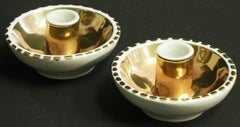
Rare Pair of Gold and White Candlesticks, Waylande Gregory
By Waylande Gregory
Located in Philadelphia, PA
This rare pair of porcelain candlesticks, brilliantly glazed in gold and white, are signed by Waylande Gregory, the pioneering 20th century sculptor and ceramicist. Prodigious and i...
Category
Vintage 1950s American Art Deco Candle Holders
Materials
Porcelain
$880 Sale Price / set
20% Off
H 1.88 in Dm 4 in
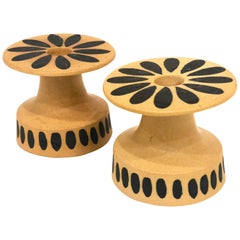
Pair of Midcentury Ceramic Candlestick Holders by Bennington Potters
By Bennington Potters
Located in San Diego, CA
Beautiful and rare pair of ceramic candleholders by Bennington Potters, in beautiful condition nice color and design. In mustard and black design.
Category
20th Century American Mid-Century Modern Ceramics
Materials
Ceramic
$220 Sale Price / set
20% Off
H 3.5 in Dm 4.5 in
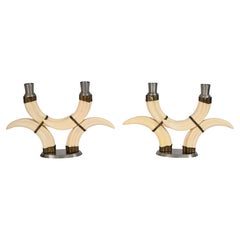
Pair of Beige Faux Horn Candlesticks Mounted in Nickel
Located in Miami, FL
A stunning pair of beige faux horn candlesticks, brass decorations and nickel plated tips, circa 1970.
These stylishly design candlesticks would enhance any table, counter, console...
Category
20th Century French Mid-Century Modern Ceramics
Materials
Brass, Nickel
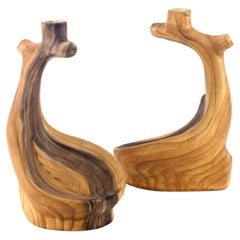
Pair of Faux Bois Ceramic Candlesticks by Grandjean Jourdan Vallauris
By Grandjean Jourdan
Located in NEUVILLE-DE-POITOU, FR
Pair of Candlesticks or lamp bases (that can be electrified) by Grandjean Jourdan in Vallauris.
Decorated in faux wood, enamel matte to satin, typical work of the 50s, 60s.
Category
Vintage 1960s French Mid-Century Modern Candlesticks
Materials
Ceramic
$1,200
H 9.06 in W 5.91 in D 4.73 in
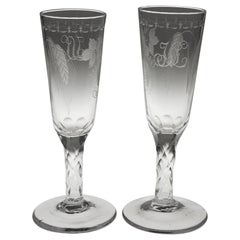
Pair of Georgian Ale Glasses with Facet Cut Stems c1780
Located in Tunbridge Wells, GB
Heading : Pair of engraved Georgian ale glasses with facet cut stems
Period : George III – c1780
Origin : England
Colour : Clear
Bowl : Round funnel engraved with hops and barley an...
Category
Antique 1780s British George III Glass
Materials
Blown Glass
Still Thinking About These?
All Recently ViewedMore Ways To Browse
18th Century Stoneware
Triton Fountain
Red Chinese Plates
Sarreguemines On Sale
Spongeware Bowl
Antique Ceramic Barrels
Antique Rose Punch Bowl
Antique Spongeware Bowl
Ceramic Cake Plate
Ceramic Insects
Cica Gomez
Crown Ducal
English Ironstone Chinoiserie
Italian Creamware
Japanese Tea Ceremony Ceramics
Lebrillos Green
Majolica Corn
Majolica Fern