Items Similar to Small oval tray, Antonio Maria Coppellotti Manufacture, Lodi, Circa 1750
Video Loading
Want more images or videos?
Request additional images or videos from the seller
1 of 12
Small oval tray, Antonio Maria Coppellotti Manufacture, Lodi, Circa 1750
$3,788.36
£2,830.20
€3,200
CA$5,275.11
A$5,667.81
CHF 3,040.77
MX$66,773.30
About the Item
Small oval tray
Antonio Maria Coppellotti Manufacture
Lodi, Circa 1750
High fire polychrome majolica
It measures: 0.79 in height x 9.84 x 8.07 (2 cm x 25 x 20.5)
Weight: 0.58 lb (266 g)
State of conservation: intact, minor chips.
The small tray has an oval shape with a four-lobed mixtilinear rim. It is covered with a poor creamy white enamel which has a few defects. The high fire polychrome decoration abundantly uses "Armenian bolus" red pigment and features an "aerial" island in the center of the well. This contains a still life with small pears, a peach, two small strawberries, and a bunch of black grapes on which a wasp is resting. The rim is symmetrically decorated with a sequence of small flowering branches with four leaves placed at the cardinal points. The hem is lined in coffee color.
The ornamentation was executed with the rapidity and certain naiveté that seem to characterize some works attributed to the Lodi manufactory of Antonio Maria Coppellotti from around the 1750s.
See for comparison a bowl, with a wavy rim shape, that shows similar stylistic features. As do the two juxtaposed plates found in the catalog of the exhibition of maiolica held in Lodi in 1995 (M. L. Gelmini, in Maioliche lodigiane del '700 (exhibition catalog), Milan 1995, p. 124 nn. 122-124).
In terms of morphology, the small tray can be associated with the ovals traditionally attributed to the Coppellotti manufacture, albeit in a shallower version with a flatter brim. It is also similar to works characterized by unusual decorations such as the small tray from the 1995 Lodi exhibition with oriental decoration (M. L. Gelmini, in Maioliche lodigiane del '700 (catalogo della mostra di Lodi), Milan 1995, p. 132 n. 135).
The first mention of the Coppellotti family as potters comes from archival documents which record the official request of an unknown Giovanni Coppellotti to open a maiolica factory in Lodi in 1674.
The factory, located near the church of St. John the Baptist. Philip, seems to have been immediately quite successful. However, it was only in 1679, when the management of the factory passed to Antonio Giovanni Maria Coppellotti - the son or perhaps grandson of the original Giovanni - that the production reached the peak of success and became an example for the main Italian manufactures of the time, especially those in Veneto and Liguria. In 1728 the factory had to move outside the city walls at the behest of the authorities, who feared the possibility of fires.
The activity continued until about 1750, the year of Anton Maria's death and resumed later with his son, Bassano Coppellotti, under the guide of some other directors, among whom we note: first, G. Moroni, followed by Giulio Berinzaghi and in 1771 Pedrinazzi. Finally, in 1787 a new municipal ordinance ordered the definitive closure of the manufactory.
The maiolica produced during the initial period are characterized by the use of a thick, velvety enamel and have ornaments ranging from monochrome turquoise with Italian (ruins, castles, flowers) and French motifs ("rabeschi," ramage), to decorations in the manner of Chinese porcelain and oriental inspiration.
Of particular importance are ornaments of Baroque fruit which show the amazing relief effects produced by using the red tone called "Armenian bolus." This great variety of decorations appeared between 1735 and 1740 by which time, alongside the production of turquoise monochrome, polychromy with high fire technique was firmly established.
Bibliography:
M. L. Gelmini, in Maioliche lodigiane del '700 (catalog of the exhibition in Lodi), Milan 1995
- Attributed to:Antonio Maria Coppellotti (Maker)
- Dimensions:Height: 0.79 in (2 cm)Width: 9.06 in (23 cm)Depth: 8.08 in (20.5 cm)
- Style:Baroque (Of the Period)
- Materials and Techniques:
- Place of Origin:
- Period:1740-1749
- Date of Manufacture:Circa 1750
- Condition:Wear consistent with age and use. Intact, minor chips.
- Seller Location:Milano, IT
- Reference Number:1stDibs: LU4352248335052
About the Seller
4.3
Vetted Professional Seller
Every seller passes strict standards for authenticity and reliability
Established in 1860
1stDibs seller since 2018
23 sales on 1stDibs
Typical response time: 5 hours
Associations
International Confederation of Art and Antique Dealers
Associations
- ShippingRetrieving quote...Shipping from: Milano, Italy
- Return Policy
More From This Seller
View AllMaiolica Oval Tray, Felice Clerici Manufactory, Milan, Circa 1770-1780
By Felice Clerici
Located in Milano, IT
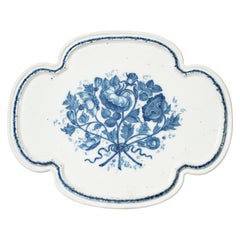
Small oval tray
Felice Clerici Manufactory 1745-1780
Milan, Circa 1770-1780
Maiolica polychrome.
Dimensions: 10.82 x 8.66 in (27.5 x 22 cm); weight 0.4...
Category
Antique 1770s Italian Rococo Ceramics
Materials
Maiolica
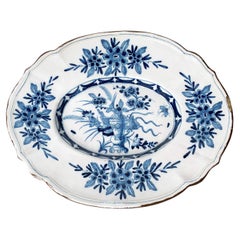
Two Small Italian Dishes Antonio Maria Coppellotti Manufacture, Lodi, Circa 1740
By Antonio Maria Coppellotti
Located in Milano, IT
Two small dishes
Antonio Maria Coppellotti Manufacture
Lodi, Circa 1740
High fire polychrome majolica
They measure: diameter 7.08 in(18 cm)
Weight: 0.37 lb (170 g)
State of conservat...
Category
Antique 1740s Italian Baroque Ceramics
Materials
Maiolica
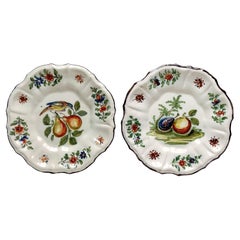
18th Century Italian Maiolica Centerpiece Bassano Venice, circa 1750
Located in Milano, IT
Maiolica centerpiece
Pasquale Antonibon factory
Nove di Bassano, Venice, 1740-1770.
Measures: 1.85 in x 19.21 in x 15.27 in
4.7 cm X 48.8 cm X 38.8 cm.
lb 5.29 (kg 2.4)
State of conservation: thin passing fêlure with covered chipping and a glued foot
The Antonibon were an important family of Venetian...
Category
Antique 1750s Italian Baroque Ceramics
Materials
Maiolica
Three Dishes, Antonio Maria Coppellotti Factory, Lodi, Italy, Circa 1745
By Antonio Maria Coppellotti
Located in Milano, IT
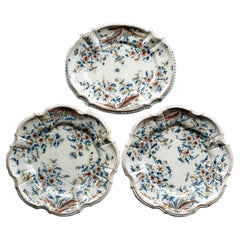
Pair of round dishes and a small oval tray
Antonio Maria Coppellotti factory
Lodi, circa 1745
High fire polychrome majolica
Dishes size: diameter 9.44 in, height 0.78 in (24 cm, 2 c...
Category
Antique 1740s Italian Rococo Delft and Faience
Materials
Maiolica
Ancient Italian Maiolica Faenza, Ferniani Factory, Circa 1700
By Ferniani Factory
Located in Milano, IT
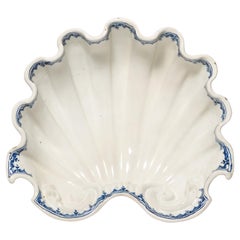
Centerpiece white maiolica shell
Ferniani factory, early period: 1693-1776
Faenza, circa 1700
Measures: 5.6 in x 14.72 in x 13.46 in (14.3 cm x 37.4...
Category
Antique Early 1700s Italian Baroque Ceramics
Materials
Maiolica
Ancient Italian Maiolica Faenza, Ferniani Factory, Circa 1700
By Ferniani Factory
Located in Milano, IT
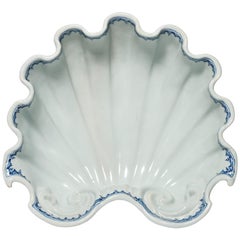
Centerpiece light blue maiolica shell
Ferniani factory, early period: 1693-1776
Faenza, 1700 circa
5.5 in x 14.72 in x 13.77 in (14 cm x 37.4 cm X cm 35)
lb 4.40 (kg 2)
State of con...
Category
Antique Early 1700s Italian Baroque Ceramics
Materials
Maiolica
You May Also Like
Italy Richard Ginori Late 18th Century Porcelain Tray Underplate
By Richard Ginori
Located in Brescia, IT
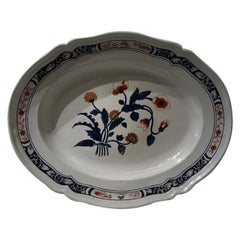
This elegant and glamorous porcelain tray ispainted with one of the most iconic decor of Richard Ginori in red and blue. This kind of decor inspired by Oriental thought is called ...
Category
Antique Late 18th Century Italian Baroque Porcelain
Materials
Porcelain
19th Century Italian Faenza Garofano Serving Platter
Located in Bradenton, FL
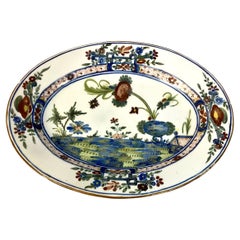
Large 19th Century Italian Ceramic Serving Platter. Platter in Faenza Garofano Blue Carnation pattern features flora in colors of blue, green, brown on a white background. Solid whit...
Category
Antique 18th Century Italian Rococo Platters and Serveware
Materials
Ceramic
18th Century Polychrome Faience Lobed Platter
By Paul Hannong
Located in Cincinnati, OH
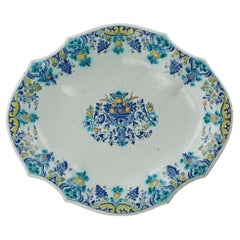
This early 18th century tin glazed earthenware platter was made by the Hannong ceramics factory in Strasbourg, France. Hannong was founded in 1721 by Charles-François Hannong and rem...
Category
Antique 1740s French Rococo Platters and Serveware
Materials
Earthenware
French, 18th Century Glazed Earthenware Rouen Platter
Located in Buisson, FR
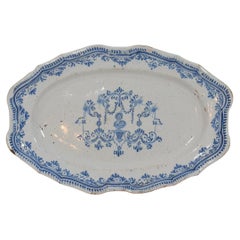
Very rare Rouen plate with beautiful blue decoration. Wonderful decorated with a bust , floral ornaments and guirlandes .France, circa 1750. Good condition
H:3,5cm W:35cm D:23,5cm
Category
Antique 18th Century French French Provincial Platters and Serveware
Materials
Earthenware
$467 Sale Price
50% Off
Antique Cantaloupe Serving Dish, Chinese, Ceramic, Decor, Fruit Bowl, Victorian
Located in Hele, Devon, GB
This is an antique cantaloupe serving dish. A Chinese, ceramic decorative fruit bowl, dating to the late Victorian period, circa 1900.
Graced with superb colour and an attractive ov...
Category
Antique Late 19th Century Chinese Late Victorian Ceramics
Materials
Ceramic
French, 18th Century Glazed Earthenware Rouen Platter
Located in Buisson, FR
very rare Rouen plate with beautiful blue decoration.
France, circa 1750
Good condition.
Category
Antique 18th Century French French Provincial Platters and Serveware
Materials
Earthenware
$467 Sale Price
50% Off