Items Similar to Three Dishes, Antonio Maria Coppellotti Factory, Lodi, Italy, Circa 1745
Video Loading
Want more images or videos?
Request additional images or videos from the seller
1 of 18
Three Dishes, Antonio Maria Coppellotti Factory, Lodi, Italy, Circa 1745
$3,002.24per set
£2,223.61per set
€2,500per set
CA$4,106.92per set
A$4,469.59per set
CHF 2,369.33per set
MX$53,772.57per set
NOK 30,050.65per set
SEK 27,494.24per set
DKK 19,050.43per set
About the Item
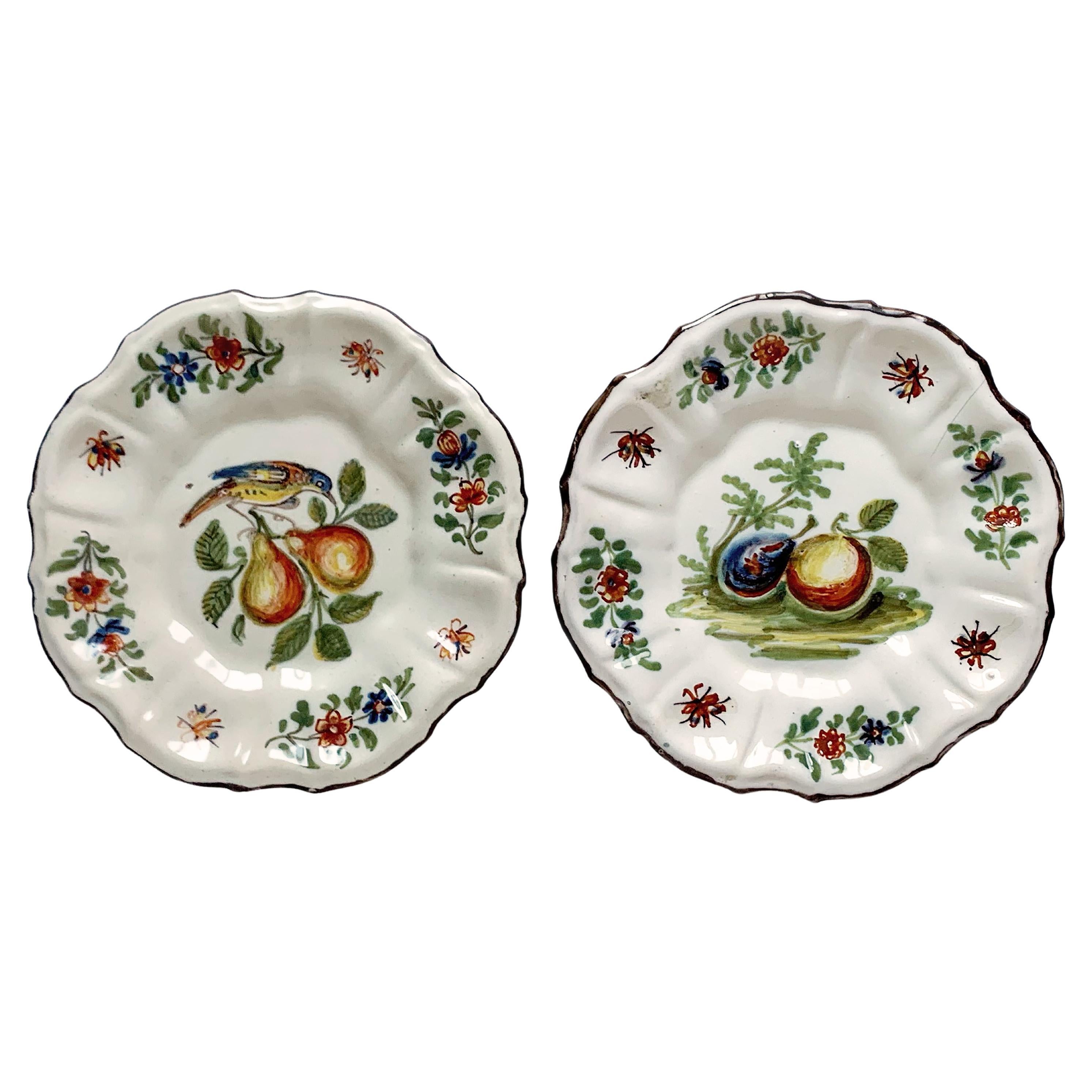
Pair of round dishes and a small oval tray
Antonio Maria Coppellotti factory
Lodi, circa 1745
High fire polychrome majolica
Dishes size: diameter 9.44 in, height 0.78 in (24 cm, 2 cm)
Weight: 0.66 lb each (300 g)
Tray size: 9.44 in x 8.26 in x height 0.78 in (24 x 21 x 2 cm)
Weight: 0.66 lb (300 g)
State of conservation: the two round dishes are intact except for slight flaking in the glaze and wear. The tray shows a clean break restored with antiquarian restoration on the front, but legible on the reverse.
The three dishes have a traditional shape without a support ring, with a short, barely sloping brim and a mixtilinear profile. The rim is wavy, ribbed, and striped with two thin parallel lines of iron-red orange color with an additional thin wavy blue line on the tray.
The decoration is made using a high fire technique and is polychrome with a thick, creamy-white glaze with a few pinpoints.
The decoration of groups of little flowers starts from two broad tufts of lanceolate leaves and spreads in symmetrical fronds reaching the brim and extending to the middle of the well. In the center of the oval plate there is a small asterisk.
A close comparison comes to us from an oval tray which bears, on the verso, the initials AMC. It is now preserved in the collections of the Museo d'Arti Applicate at the Castello Sforzesco in Milan (R. Ausenda, ed., Musei e Gallerie di Milano. Museums and Galleries of Milan. Museum of Applied Arts. Le ceramiche. Tomo secondo, Milan 2000, p. 190, no. 230). The presence of the mark in the comparison specimen confirms the attribution of these elegant creations to high fired "ferrosi" (with iron color) foils that characterize a specific production of works on forms typical of the Lodi production in the first half of the 18th century. Other comparison specimens are published in monographic repertories. These include an unusual coffee pot with a Middle Eastern oriental form which was exhibited at the Poldi Pezzoli Museum in the celebrated 1964 exhibition. Also recognizable from the same exhibition are a tureen and a sugar bowl, all consistent in decorative choice (G. Gregorietti Museo Poldi Pezzoli, Maioliche di Lodi, Milano e Pavia (catal.), Milan 1964, no. 46). More unusual in morphology and ornamentation are a coffee pot and a jug in which the decoration is associated with the depiction of a "castelletto," a theme which was often used in Lombard ceramic production in general (Felice Ferrari, La ceramica di Lodi, Lodi 2003, pp. 118, 119; nn. 33-34, and M. L. Gelmini, Maioliche lodigiane del '700, Milan 1995, pp. 102-103; nn. 83-87).
The three dishes are certainly works of the Lodi manufacture by Antonio Maria Coppellotti, as they adhere to all of its compositional standards.
The painting expertise of the decorators from Lodi, especially in color control, set a standard: the red, sourced from now-depleted Eastern quarries and known as "Armenian bolo," was carefully managed during firing. This was achieved by applying a thin brushstroke of enamel over the sections affected by the chromatic range. This technique helped contain the "boiling" of the color during firing, resulting in remarkable outcomes where the relief and red-orange color characterize the production.
The earliest records of the Coppellotti family as a family of potters come from archival documents which, between 1639 and 1641, testify to the official application, by a certain Giovanni Coppellotti, to the relevant authorities for permission to open a maiolica factory in Lodi.
The factory, located near the church of San Filippo seems to have been immediately quite successful. However, it was only in 1679, when the management of the factory passed to Antonio Giovanni Maria Coppellotti - the son or perhaps grandson of the original Giovanni - that the production reached the peak of success and became an example for the main Italian manufactures of the time, especially those in Veneto and Liguria.
The activity continued under the direction of Anton Maria Junior until about 1750, to resume, after a brief interruption, with Bassano Coppellotti in collaboration with a number of other directors, including G. Moroni, Giulio Berinzaghi and, from 1771, the Pedrinazzi. Finally, in 1787, a new municipal ordinance ordered the definitive closure of the factory due to financial difficulties.
The maiolica produced during the initial period are characterized by the use of a thick, velvety enamel and have ornaments ranging from monochrome turquoise with Italian (ruins, castles, flowers) and French motifs ("rabeschi," ramage), to decorations in the manner of Chinese porcelain and oriental inspiration.
Of particular importance are ornaments of Baroque fruit which show the amazing relief effects produced by using the red tone called "Armenian bolus." This great variety of decorations appeared between 1735 and 1740 by which time, alongside the production of turquoise monochrome, polychromy with high fire technique was firmly established. The brand precisely identifying the majolica of this factory is rare and uses a woven "AMC" monogram. It was sometimes done in different colors and was sometimes accompanied by the names of the painters and modelers of the manufacture.
Bibliography:
C. Baroni, La maiolica antica di Lodi, in "Archivio storico lombardo" LVIII, 1930, pp. 448 f., 455-457;
A. Minghetti, I ceramisti italiani, Rome 1946, p. 129;
S. Levy, Maioliche settecentesche lombarde e venete, Milan 1962, pp. 15-17, tables 121-150;
G. Gregorietti Museo Poldi Pezzoli, Maioliche di Lodi, Milano e Pavia (catal.), Milan 1964, pp. 15 f., with ill;
A. Novasconi - S. Ferrari - S. Corvi, La ceramica lodigiana, Milan 1964, pp. 23, 27, 34-36, 47, ill. pp. 53-121;
O. G. C. Sciolla, Museo civico di Lodi, Bologna 1977, pp. VIII f.; tables pp. 72-76, 78;
M. L. Gelmini, Maioliche lodigiane del '700, Milan 1995, pp. 102-103; nn. 83-87
R. Ausenda, a cura di, Musei e Gallerie di Milano. Museum of Applied Arts. Le ceramiche. Tomo secondo, Milan 2000, p. 190, no. 230;
Felice Ferrari, La ceramica di Lodi, Lodi 2003, pp. 118-127.
- Attributed to:Antonio Maria Coppellotti (Maker)
- Dimensions:Height: 0.79 in (2 cm)Diameter: 9.45 in (24 cm)
- Sold As:Set of 3
- Style:Rococo (Of the Period)
- Materials and Techniques:
- Place of Origin:
- Period:1740-1749
- Date of Manufacture:Circa 1745
- Condition:Repaired: The tray shows a clean break restored with antiquarian restoration on the front, but legible on the reverse. Minor structural damages. The two round dishes are intact except for slight flaking in the glaze and wear. The tray shows a clean break restored with antiquarian restoration on the front, but legible on the reverse.
- Seller Location:Milano, IT
- Reference Number:1stDibs: LU4352245004542
About the Seller
4.3
Vetted Professional Seller
Every seller passes strict standards for authenticity and reliability
Established in 1860
1stDibs seller since 2018
22 sales on 1stDibs
Typical response time: 3 hours
Associations
International Confederation of Art and Antique Dealers
Associations
- ShippingRetrieving quote...Shipping from: Milano, Italy
- Return Policy
More From This Seller
View AllTwo Small Italian Dishes Antonio Maria Coppellotti Manufacture, Lodi, Circa 1740
By Antonio Maria Coppellotti
Located in Milano, IT
Two small dishes
Antonio Maria Coppellotti Manufacture
Lodi, Circa 1740
High fire polychrome majolica
They measure: diameter 7.08 in(18 cm)
Weight: 0.37 lb (170 g)
State of conservat...
Category
Antique 1740s Italian Baroque Ceramics
Materials
Maiolica
Four Italian Ancient Dishes, Antonio Ferretti, Lodi, circa 1770-1780
By Antonio Ferretti
Located in Milano, IT
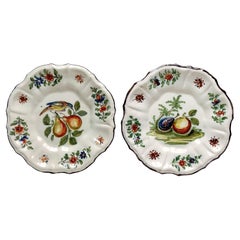
Assortment of 4 dishes with braided rim
Antonio Ferretti Manufacture
Lodi, circa 1770-1780
Maiolica polychrome decorated “a piccolo fuoco” (third fire).
Measures: 14 x 10 in (35.5 x 25.5 cm);
12.2 x 8.39 in (31 x 21.3 cm);
10.4 x 9.65 in (26.5 x 24.5 cm);
10.8 x 9.61 in (27.5 x 24.4 cm).
Weight: 4.4 lb (1.998 kg)
State of conservation: some chips due to use on the edges and on the parts in relief.
The four different dishes have a foot with a low lip from which extends a wide, flat, slanted rim resembling a basket weave. The small handles are painted green: they resemble wickerwork in the two oval dishes and take the form of a sinuous branch in the round ones.
The third fire decoration is inspired by the naturalistic floral botanical patterns on the ceramics produced by the Hannong family in Strasbourg. Here the pattern is defined by the rapidity and subtlety of the brushstrokes and the result is particularly tasteful, characterized by compositional intelligence and pictorial expertise.
A main corolla, either a wild or garden rose, is set slightly off center in each well. From this extends a thin stem holding a small secondary bud and there are small field florets dotting the composition to lend volume to the delicate bunch of flowers.
On the brim, small polychrome flowers add color to the weave, accompanied by lanceolate leaves of a very intense green.
There exist few and very rare examples for comparison with this morphology: a round plate - entirely consistent with those in question - has been dated to around 1775 (S. Levy, Maioliche settecentesche lombarde e venete, Milano 1962, tav. 200). Two other dishes with a basket rim, but with parallel striped brim decoration, were exhibited in the 1995 exhibition on Lodi ceramics; the attribution to the Lombard town near Milan is therefore almost exclusively derived from the decoration called "alla rosa contornata" or "alla vecchia Lodi" and constitutes one of the most popular decorations during the eighteenth century. (M. L. Gelmini, in Maioliche lodigiane del '700 (cat. mostra Lodi), Milano 1995, pp. 31 p. 162-163 nn. 181-182).
This decorative choice represented a strong point of the Lodi factory, which established itself thanks to the vivid nature of the colors made possible by the introduction of a new technique perfected by Paul Hannong in Strasbourg and which Antonio Ferretti introduced in Italy. This production process, called “piccolo fuoco” (third fire), allowed the use of a greater number of colors than in the past; in particular, the purple of Cassius, a red made from gold chloride, was introduced. Its use allowed for many more tones and shades, from pink to purple.
The Ferretti family had started their Maiolica manufacturing business in Lodi in 1725.
The forefather Simpliciano had started the business by purchasing an ancient furnace in 1725 and, indeed, we have evidence of the full activity of the furnaces from April of the same year (Novasconi-Ferrari-Corvi, 1964, p. 26 n. 4). Simpliciano had started a production of excellence also thanks to the ownership of clay quarries in Stradella, not far from Pavia. The production was so successful that in 1726 a decree of the Turin Chamber came to prohibit the importation of foreign ceramics, especially from Lodi, to protect internal production (G. Lise, La ceramica a Lodi, Lodi 1981, p. 59).
In its initial stages, the manufacture produced maolicas painted with the “a gran fuoco” (double fire) technique, often in turquoise monochrome, with ornamentation derived from compositional modules in vogue in Rouen in France. This was also thanks to the collaboration of painters like Giorgio Giacinto Rossetti, who placed his name on the best specimens next to the initials of the factory.
In 1748 Simpliciano made his will (Gelmini, 1995, p. 30) appointing his son Giuseppe Antonio (known as Antonio) as universal heir. After 1750, when Simpliciano passed away, Antonio was directly involved in the Maiolica factory, increasing its fortunes and achieving a reputation on a European level. Particularly important was the aforementioned introduction in 1760 of the innovative “a piccolo fuoco” (third fire) processing, which, expanding the ornamental repertoire with Saxon-inspired floral themes, could commercially compete with the German porcelains that had one of its most renowned offerings in the naturalistic Deutsche Blumen. Antonio Ferretti understood and promoted this technique and this decoration, proposing it in a fresher and more corrective version, less linked to botanical tables...
Category
Antique 1770s Italian Neoclassical Ceramics
Materials
Maiolica
Ancient Maiolica Plates Pasquale Rubati, Milan Circa 1770-1780
By Pasquale Rubati
Located in Milano, IT
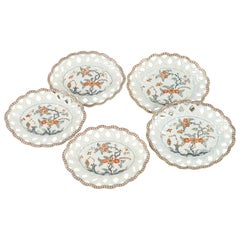
Five oval maiolica dishes with pierced edge
Manufacture of Pasquale Rubati
Milan, 1770-1780
Three small oval dishes 10.23 in x 7.67 in (26 cm x 19.5 cm)
Two large oval dishes 10.82 in x 8.85 in (27.5 x 22.5 cm)
lb 3.5 (kg 1.8)
State of conservation: intact
The five dishes of different sizes have an oval shape, a mixtilinear edge and a molded polylobed shape with a surface enriched with a relief weave motif extending to the brim and forming a perforated basket...
Category
Antique 1770s Italian Rococo Ceramics
Materials
Maiolica
Ancient Maiolica Dishes with flowers, Lombard Manufacture, 1770-1780 Circa
Located in Milano, IT
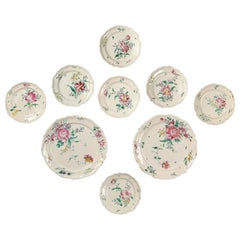
Assortment of dishes
Lombard manufacture
1770 – 1780 Circa
Maiolica polychrome decorated “a piccolo fuoco” (third fire).
Two large dishes: diameter 14.76 in (37.5 cm); weight 4.5...
Category
Antique 1770s Italian Rococo Ceramics
Materials
Maiolica
18th Century Italian Maiolica Centerpiece Bassano Venice, circa 1750
Located in Milano, IT
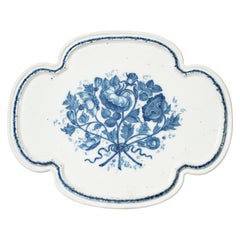
Maiolica centerpiece
Pasquale Antonibon factory
Nove di Bassano, Venice, 1740-1770.
Measures: 1.85 in x 19.21 in x 15.27 in
4.7 cm X 48.8 cm X 38.8 cm.
lb 5.29 (kg 2.4)
State of conservation: thin passing fêlure with covered chipping and a glued foot
The Antonibon were an important family of Venetian...
Category
Antique 1750s Italian Baroque Ceramics
Materials
Maiolica
Ancient Italian Maiolica Faenza, Ferniani Factory, Circa 1700
By Ferniani Factory
Located in Milano, IT
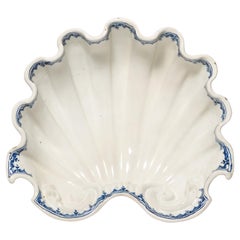
Centerpiece white maiolica shell
Ferniani factory, early period: 1693-1776
Faenza, circa 1700
Measures: 5.6 in x 14.72 in x 13.46 in (14.3 cm x 37.4...
Category
Antique Early 1700s Italian Baroque Ceramics
Materials
Maiolica
You May Also Like
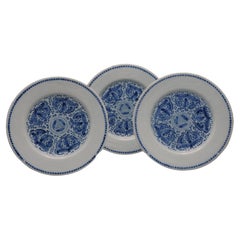
Delft - set of three plates, mid 18th century
By Delft
Located in DELFT, NL
Set of three Blue Dutch Delftware plates with a rare chinoiserie decoration of a central geometrical decoration of flowers.
Unmarked
In good condition: only the usual wear to the rim.
Category
Antique Mid-18th Century Dutch Rococo Delft and Faience
Materials
Earthenware, Faience
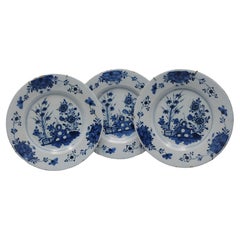
Delft - set of three chinoiserie plates, mid 18th century
By Delft
Located in DELFT, NL
Set of three Dutch Delftware faience chinoiserie plates, mid-18th century. Each plate is hand-painted in cobalt blue on a white tin-glazed ground, reflecting the strong influence of ...
Category
Antique Mid-18th Century Dutch Rococo Delft and Faience
Materials
Earthenware, Delft, Faience
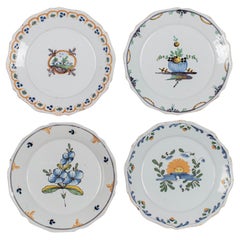
18th Century French Faience Plates Set of 4
Located in Winter Park, FL
A set of four 18th century French faience plates with primitive hand painted decoration each by different artists. In varying condition, with chips and glaze losses on edges of scall...
Category
Antique Late 18th Century French Provincial Delft and Faience
Materials
Faience
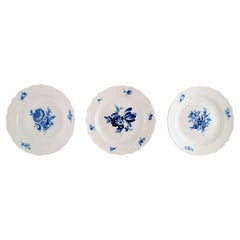
Meissen 3 Plates, circa 1920
Located in København, Copenhagen
Meissen blue onion. 3 plates, circa 1920.
In perfect condition.
2nd factory quality.
Measures: 18.5 x 2.5 cm.
Stamped.
Category
Vintage 1920s German Porcelain
$240 / set
Delft - set of three chinoiserie plates, mid 18th century
By Delft
Located in DELFT, NL
Set of three Dutch Delftware faience chinoiserie plates, mid-18th century. Each plate is hand-painted in cobalt blue on a white tin-glazed ground, reflecting the strong influence of ...
Category
Antique Mid-18th Century Dutch Rococo Delft and Faience
Materials
Earthenware, Faience, Delft
Mintons, England, Three Antique Dishes in Hand-Painted Faience, Chinese Style
Located in København, Copenhagen
Mintons, England. Three antique dishes in hand-painted faience. Chinese style, early 20th century.
Largest measures: 42 x 34 cm.
In excellent conditio...
Category
Early 20th Century English Platters and Serveware
Materials
Faience
More Ways To Browse
Silver Rim Set Of China Plates
Chinese Blue And White Pot
18th Century Blue And White Bowl
18th Century Silver Coffee Pots
Reverse Painting On Glass 18th Century
Blue And White Sugar Bowl
Blue And White Coffee Pot
Chinese Blue And White Tureen
1745 Glass
Strasbourg Faience
Yellow Delft
Delft Jar With Lid
Royal Delftware
Antique Delft Marks
Manganese Delft
18th C Delft Charger
Antique English Delft Ceramics
Black Delft Porcelain