East Asian Knife Boxes
to
4
1
2
1
1
1
1
4
3
2
1
1
2
2
47,676
126
46
40
37
4
4
4
Place of Origin: East Asian
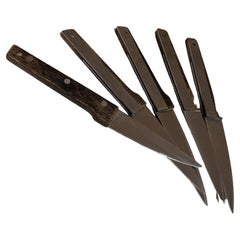
Vintage Vernco Hand Honed HI CV Stainless Steel Japan Paring Knife Set 5
Located in Chula Vista, CA
For your consideration, Vintage Vernco Hand Honed HI CV Stainless Steel Japan Paring Knife Set 5
Dimensions: 7" Overall - 4" Blade
Please visit take a look at our listings, we hav...
Category
1960s Mid-Century Modern Vintage East Asian Knife Boxes
Materials
Stainless Steel
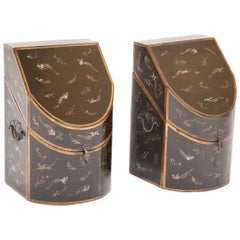
Rare pair of Japanese Nagasaki Export Lacquered Wood Knife Boxes
Located in Stamford, CT
Rare pair of Japanese Nagasaki Export lacquered wood knife boxes with mother-of-pearl inlay of flowers and birds, now converted to letter boxes...
Category
Early 19th Century Anglo-Japanese Antique East Asian Knife Boxes
Materials
Wood
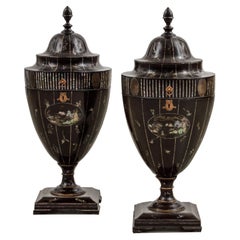
Pair of Japanese Lacquer and Mother-of-Pearl Inlaid Knife Urns, circa 1800-1815
Located in Amsterdam, NL
A rare pair of Kyoto-Nagasaki style lacquer and mother-of-pearl inlaid knife urns
Edo period, early 19th century
Measures: Height 71 x diameter 30 cm
?Formed as urns with vertically lifting covers and elongated finials, revealing fitted green velvet lined interiors for knives, decorated overall with birds, flowering stems, faux-fluting and oval panels with landscapes. The square plinth is raised on four bracket feet. Inside the lifting cover of one of the urns are Japanese characters, supposedly indications of some code by the craftsman.
A closely related knife urn, now in the collection of the Peabody Essex Museum, Salem (inv. E 73115), was acquired in Nagasaki by Captain Samuel Gardner Derby of the Margareth of Salem in 1801. Captain Gardner Derby traded in Nagasaki under charter from the VOC (Vereenigde Oostindische Compagnie), the Dutch East India Company. Between 1797 and 1814 Holland was occupied by the French and from 1811 until 1816 Java by
the English. During these periods practically no Dutch shipping was possible between Holland and Batavia (Jakarta) or between Batavia (Jakarta) and Nagasaki. To maintain a minimum amount of shipping between Batavia (Jakarta) and Nagasaki, between 1797 and 1807, the VOC chartered mainly American ships. American captains and officers ordered and bought mainly lacquered furniture in an American-English style, completely different from what the Dutch up till then had ordered. The present knife urns were possibly also ordered and acquired by Captain Gardner Derby during his stay in Deshima/Nagasaki in 1801.
Another similarly neoclassical shaped knife urn in the collection of the Ashmolean Museum Oxford (inv. 1996.17) appears to be signed by woodworker Kiyotomo koreo tsukuru (Kiyomoto made this). The same name, together with an address in the Sanjo-Teramachi District of Kyoto, has been found inside a fragmentary urn in a private collection. This is an indication that European-style furniture was not only lacquered in Japan but made there as well. This undoubtedly is not only true for knife-urns, but all European- style furniture lacquered in Japan after circa 1800 was made by Japanese furniture makers...
Category
Early 19th Century Anglo-Japanese Antique East Asian Knife Boxes
Materials
Brass
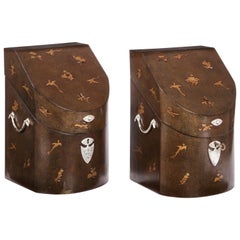
Pair of Fine Japanese Export Lacquer Cutlery Knife Boxes, 18th Century
Located in Amsterdam, NL
A pair of fine Japanese export lacquered cutlery boxes
Kyoto or Nagasaki, late 18th century
H. 33.5 x W. 24 x D. 21 cm
The bow-fronted boxes with sloping lids flat at the top are made of hinoki wood (Cypress), coated with Japanese paper and decorated in lacquer with scattered gold birds and flowers on a nashiji background. The Japanese mounts are made of copper and both boxes still have internal partitions to keep the cutlery upright.
The form of these boxes is similar to a pictorial-style knife box in the collection of the Groninger Museum (inv. 1989- 347), dated between 1730 and 1780, but the style of the decoration is more like that on a knife box in the Peabody Essex Museum in Salem (inv. E62271), which was brought to Salem by James Devereux, Captain of the Franklin, in 1799.
Provenance:
Henriette Jeane Christine van Neukirchen, called Nyvenheim (1807- 1849) and Nicolaas Johan Steengracht van Oostcapelle (1806-1866), thence by descent to the last owners, Ludolphine Emilie baronesse Schimmelpenninck van der Oye (1944) married in 1969 to Roland Daniel van Haersma Buma (1944), the last residents of castle Duivenvoorden near Voorschoten and the great-great-granddaughter of Nicolaas Johan Steengracht van Oostcapelle.
There is no evidence that Nicolaas Johan himself, or any of his or his wife’s ancestors had ever been in Japan. However, Nicolaas’ grandfather (Nicolaas Steengracht, 1754-1840) was a director of both the VOC and WIC (West Indies Company...
Category
Late 18th Century Antique East Asian Knife Boxes
Materials
Silver
Related Items
Japanese Lacquer Hokai Box, 19th Century
Located in Pasadena, CA
This is a good example of a traditional Japanese Hokai shell storage box for the Kai-awase game. This box is well-detailed in chased brass appliques and makie. The box is in overall ...
Category
Late 19th Century Japonisme Antique East Asian Knife Boxes
Materials
Wood, Lacquer

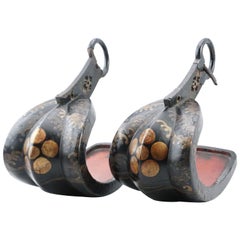
Japanese Samurai Abumi Stirrups Lacquer Edo, 18th Century
Located in Dallas, TX
Japanese Samurai Abumi Stirrups lacquer Edo late 18th century, early 19th century.
Measures: 12 inch length, 10 inch height, 5.5 inch width.
AVANTIQUES is dedicated to providing an...
Category
Late 18th Century Edo Antique East Asian Knife Boxes
Materials
Iron
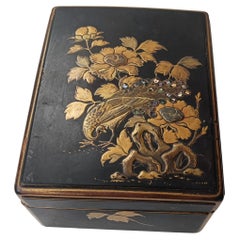
Japanese Lacquered Wood Box 19th Century Asian Antiques 中国古董
Located in London, GB
Antique Japanese lacquered wood Box
Beautiful and elegant lacquered wood box and gold gilt, decorated with a crane with floral motives and Japanese script
Measures: Height 6 inches 1...
Category
19th Century Antique East Asian Knife Boxes
Materials
Wood, Lacquer
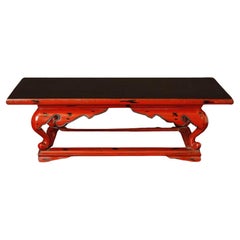
Japanese Negoro Style Lacquered Worship Stand, 17th-18th Century
Located in Fukuoka, JP
"Discover a piece of Japanese religious heritage with this exceptional Negoro lacquered stand. Crafted in the 17th to 18th century, this worship article stand is a prime example of e...
Category
Late 17th Century Edo Antique East Asian Knife Boxes
Materials
Wood, Lacquer
$1,780
H 6.11 in W 10.63 in D 20.08 in
18th Century Chinese Export Mother Of Pearl Tea Chest
Located in Basingstoke, Hampshire
An 18th century Chinese Export Lac de Bergaute tea chest, of octagonal shaped form with hinged lid and red paper-lined interior. Decorated in mother of pearl with figures in a garden...
Category
18th Century Antique East Asian Knife Boxes
Materials
Mother-of-Pearl
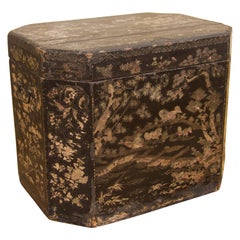
Japanese Lacquered Box Signed, Late 19th Century
Located in Beuzevillette, FR
Pretty Japanese lacquered box decorated with birds and foliage.
signed
Lacquered inside and outside
Late 19th century
Without key
Nice lock
Ideal for storing jewelry.
Category
Late 19th Century Antique East Asian Knife Boxes
Materials
Wood

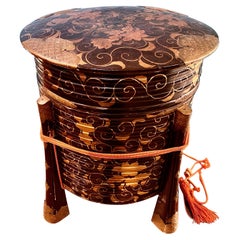
Japanese Lacquered Tebako
Box
Located in PARIS, FR
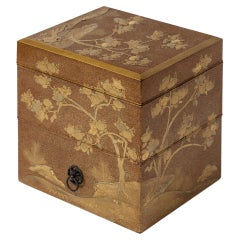
Tebako box with three compartments in golden and nashi-ji lacquer, decorated with golden, red, and kirigane lacquer, golden persimmon tree leaves, among rocks. The compartments are of increasing size from the top. The decoration is in continuity.
Persimmon has been cultivated in southern China for more than 2500 years and is believed to have been introduced to Japan in the 8th century. The veneer is a tree with very hard wood, similar to ebony. According to a legend, one specimen survived the atomic bombing of Nagasaki on August 9, 1945, close to the epicenter. It is therefore in Japan a symbol of strength and longevity. It is also the national fruit of the country. It is eaten as a traditional dish during New Year's Day celebrations.
Tebako literally means "portable box...
Category
1860s Antique East Asian Knife Boxes
Materials
Lacquer
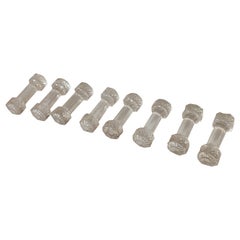
Set of 8 French Crystal Knife Rests – 1970s Elegant Table Accessories
Located in Auribeau sur Siagne, FR
Set of 8 French Crystal Knife Rests – 1970s Elegant Table Accessories
Description:
This refined set of eight crystal knife rests was crafted in France during the 1970s. Each piece f...
Category
1970s Vintage East Asian Knife Boxes
Materials
Crystal
$538 / set
H 1.19 in W 3.55 in D 0.79 in
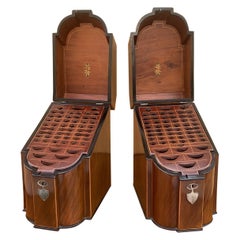
Georgian Mahogany Pair of Knife Boxes
Located in Bedfordshire, GB
A Very Good Quality, 18th century, George III Period, Mahogany Pair Of Knife, Or Cutlery, Boxes Of Typical Shape With Serpentine Fronts And Superbly Figured, Inlaid And Crossbanded Sloped Lids, Revealing Later Fabric Lined Interior Compartments.
Cutlery boxes, or as they are now more commonly referred to, Knife boxes, were of course originally made with the purpose of housing the homes most precious and valuable cutlery and enable it to be locked away when not in use. This was very important as generally the cutlery used...
Category
Late 18th Century Georgian Antique East Asian Knife Boxes
Materials
Mahogany
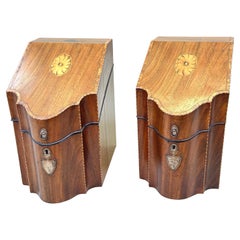
Antique English Georgian III Mahogany Knife Boxes - Pair
Located in Chicago, IL
Antique English Georgian III Mahogany Knife Boxes - Pair
A fine pair of English mahogany knife boxes with slanted hinged lids and shaped fronts. The interior with inlaid satinwood,...
Category
Mid-19th Century George III Antique East Asian Knife Boxes
Materials
Brass
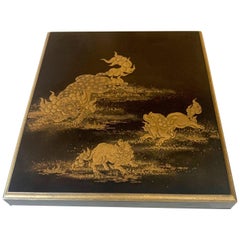
Japanese Lacquer Box with Fine Maki-e Decoration Meiji Period
Located in Atlanta, GA
A lacquered wood box with lid from Japan circa 19th century Meiji Period. The finely decorated box was used to store paper slips and small documents on the desk. It is overall finished with black lacquer (kuro) with sparse Mura-Nashiji effect outside and on the top surface of the lid, there are three Komainu, (sometimes known as Shishi or Japanese lions) frolicking and forming a circle in lively motion. Komainu are auspicious animals in Japanese cultures in both Shinto and Buddhism tradition. Originally from China, these animals symbolizes guardians to ward off evil spirits. Hiramaki-e was used in combination with carving and combing to render the lions with various surface textures. A gilt border with an slight angle was given to the lid and even the thin band is decorated with miniature floral scrolls. The interior of the box was finished in a dense nashiji. Underneath the lid, a cluster of peonies open lavishly by two gentle mounts. Takamaki-e (high relief) in both gold and silver were...
Category
Late 19th Century Japonisme Antique East Asian Knife Boxes
Materials
Wood, Lacquer
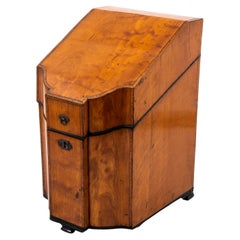
Georgian Satinwood Knife Box
Located in Northampton, GB
Solid Satinwood Deck
From our Knife Boxes collection, we are delighted to offer this original Georgian Satinwood Knife Box. The Knife Box with sloped top and breakfront D-shaped sec...
Category
Late 18th Century George III Antique East Asian Knife Boxes
Materials
Boxwood, Satinwood
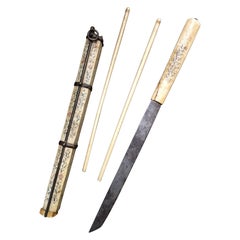
Previously Available Items
19th Century High Quality Chinese Trousse Traveling Bone Utensil Set
Located in Vero Beach, FL
This is a very fine example of an antique Chinese trousse or eating set. It contains a single edged blade knife and two chopsticks, fitting in a beauti...
Category
19th Century Qing Antique East Asian Knife Boxes
Materials
Bone
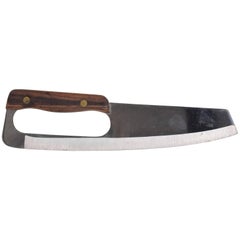
Mid-Century Modern Chef Major Stainless Steel Knife
Located in Chula Vista, CA
For your consideration a Nice Chef Major's stainless steel knife
Made in Japan.
Category
2010s Modern East Asian Knife Boxes
Materials
Stainless Steel
Still Thinking About These?
All Recently ViewedMore Ways To Browse
Antique Boning Knife
Vintage Knife Solingen Germany
Georgian Silver Cutlery
Wood Bread Box
Antique Spanish Knife
Knife Display
Cutlery Ivory
Damascus Box
Oak Cutlery Box
Vintage Laguiole Knives
Chinese Trousse
Urn Shaped Knife Box
Vintage Ivory Cutlery Set
Doves Of Pliny
Early American Primitive Antiques
Enamel Swan
English China Cabinet
English Pointer