1 of 6
Coffee Can, Blue and White "Flowers and Insects", Bow Porcelain, circa 1755
$1,200List Price
About the Item
- Creator:Bow Porcelain (Maker)
- Dimensions:Height: 2.25 in (5.72 cm)Diameter: 7 in (17.78 cm)
- Style:Chinoiserie (Of the Period)
- Materials and Techniques:
- Place of Origin:
- Period:
- Date of Manufacture:circa 1753
- Condition:Minor staining to rim.
- Seller Location:Melbourne, AU
- Reference Number:Seller: 49601stDibs: LU315139226191
Authenticity Guarantee
In the unlikely event there’s an issue with an item’s authenticity, contact us within 1 year for a full refund. DetailsMoney-Back Guarantee
If your item is not as described, is damaged in transit, or does not arrive, contact us within 7 days for a full refund. Details24-Hour Cancellation
You have a 24-hour grace period in which to reconsider your purchase, with no questions asked.Vetted Professional Sellers
Our world-class sellers must adhere to strict standards for service and quality, maintaining the integrity of our listings.Price-Match Guarantee
If you find that a seller listed the same item for a lower price elsewhere, we’ll match it.Trusted Global Delivery
Our best-in-class carrier network provides specialized shipping options worldwide, including custom delivery.You May Also Like
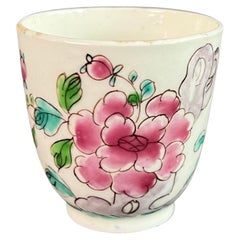
Bow Porcelain Orphaned Coffee Cup, Famille Rose Peony, circa 1755
By Bow Porcelain
Located in London, GB
This is a very charming orphaned coffee cup made by the Bow Porcelain factory in about 1755. The cup is decorated in a Chinese "famille rose" peony pattern. This cup would have been part of a large tea service, and the tiny size shows how expensive coffee was in the 18th Century.
The Bow Porcelain Factory was one of the first potteries in Britain to make soft paste porcelain, and most probably the very first to use bone ash, which later got perfected by Josiah Spode to what is now the universally used "bone china". Bow was the main competitor of the Chelsea Porcelain Factory, but where Chelsea made very fine slipcast porcelain, Bow made a different soft paste porcelain that tended to be softer and could be pressed into moulds. Bow served a larger public generally at lower prices. The factory was only in operation between 1743 and 1774, after which the tradition got incorporated into some of the later famous potteries such as Worcester and Derby.
The cup is unmarked, which is normal for Bow items of this era.
Condition report the cup is in excellent condition without any damage or repairs. There are various glazing imperfections, which are quite normal for porcelain of this era.
Antique British porcelain...
Category
Antique 1750s English Rococo Tea Sets
Materials
Porcelain
$590
Free Shipping
H 2.25 in Dm 2.25 in
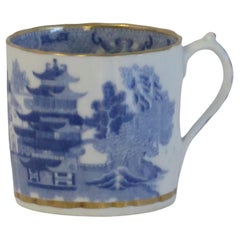
Miles Mason Porcelain Coffee Can Blue
White Broseley Gilded Ptn 50, circa 1808
By Miles Mason Porcelain
Located in Lincoln, Lincolnshire
This is a porcelain blue and white, gilded Coffee Can made by Miles Mason (Mason's), Staffordshire Potteries, in the early 19th century George 111rd period, circa 1805-1810.
The piece is well potted with vertical flutes, a slightly wavy rim and the loop handle with the distinctive thumb rest spur.
The can is decorated in the under-glaze blue printed Pagoda or Broseley, chinoiserie Willow pattern, (sometimes called Boy at the Door pattern). The piece is also richly gilded in Miles Mason pattern 50 as illustrated on Page 78 of the book; Miles Mason Patterns and Shapes, produced by the Mason's Collectors' Club. The coffee can is also hand gilded around the rims and on the outer handle.
The piece is fully marked to the base with an under-glaze blue printed square seal mark (pseudo Chinese) as illustrated on page 92 of the above publication.
Overall a very good Georgian coffee can...
Category
Antique Early 19th Century English Chinoiserie Ceramics
Materials
Porcelain
$227
H 2.5 in W 3.4 in D 2.63 in
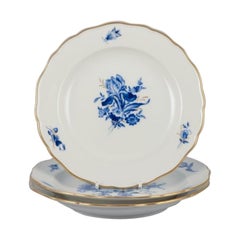
Meissen, Germany. Three porcelain plates with blue flowers and insects
Located in København, Copenhagen
Meissen, Germany. Three hand-painted porcelain plates with blue flowers and insects, gold rim.
Early 20th century.
Marked.
Perfect condition. Appears unused.
Two plates in first fact...
Category
Early 20th Century German Porcelain
Materials
Porcelain
$360 / set
H 0.79 in Dm 8.27 in
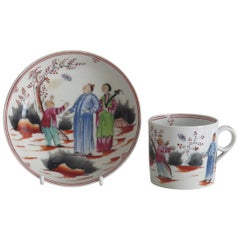
Early New Hall Porcelain Coffee Can
Saucer Duo Chinese Pattern 421, circa 1800
By New Hall
Located in Lincoln, Lincolnshire
This is a hard paste porcelain coffee can & saucer duo by New Hall, hand decorated with their Chinese figure pattern number 421, dating to the English George 3rd...
Category
Antique Late 18th Century English Chinoiserie Ceramics
Materials
Porcelain
$399 / set
H 2.38 in Dm 5.15 in
Bow Porcelain Figure of Boy Putto on C-Scroll Base, Georgian circa 1760
By Bow Porcelain
Located in London, GB
This is a wonderful little figure of a boy or putto made by the Bow Porcelain factory in about 1760.
The Bow Porcelain Factory was one of the first potteries in Britain to make soft...
Category
Antique 1760s English Rococo Figurative Sculptures
Materials
Porcelain
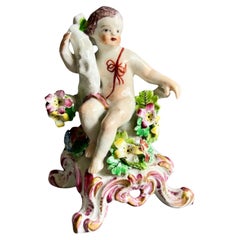
$685
Free Shipping
H 4.75 in W 2.5 in D 2.5 in
Fine Old Paris Porcelain Coffee Can and
En Grisaille
, French circa 1810
By Paris Studio
Located in Lincoln, Lincolnshire
This is a very beautiful porcelain coffee can made by a French Old - Paris maker, dating to the early 19th century, circa 1810.
The very fine Paris Porcelain coffee...
Category
Antique Early 19th Century French Empire Porcelain
Materials
Porcelain
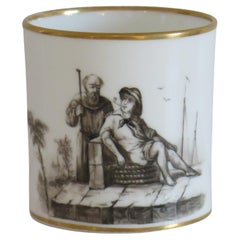
$323
H 2.63 in W 3.38 in D 2.63 in
Newhall Porcelain Coffee Can Hand Painted Pattern 683, Circa 1800
By New Hall
Located in Lincoln, Lincolnshire
This is a hard paste porcelain coffee Can by New Hall, dating to the turn of the 18th century, George 111rd period, circa 1800.
The piece is well potted of hard paste porcelain on a low foot with a loop handle having rounded attachments.
The cup is decorated over-glaze with hand painted pattern...
Category
Antique Late 18th Century English Georgian Ceramics
Materials
Porcelain
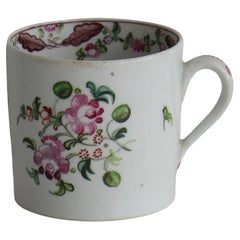
Newhall Porcelain Coffee Can Hand Painted Pattern 171, Circa 1795
By New Hall
Located in Lincoln, Lincolnshire
This is a hard paste porcelain coffee Can by New Hall, dating to the late 18th century, George 111rd period, circa 1790 t0 1795.
The piece is w...
Category
Antique Late 18th Century English Georgian Porcelain
Materials
Porcelain
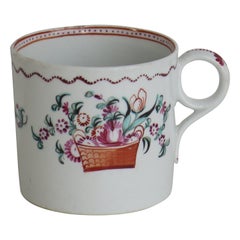
18th-cebtury Bow Porcelain Chinoiserie Tankard
By Bow Porcelain
Located in Downingtown, PA
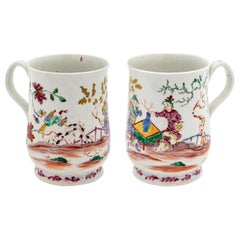
New Canton Fantasy: Bow Porcelain Chinoiserie Tankard
Object: Polychrome Polychrome Tankard (Mug)
Maker: Bow Porcelain Factory ("New Canton"), London
Date: Circa 1760-1765
Medium: S...
Category
Antique Mid-18th Century English Agra Porcelain
Materials
Porcelain
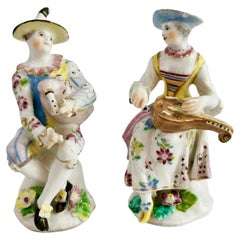
Bow Pair of Porcelain Figures, Arlecchino and Columbina, Rococo ca 1758
By Bow Porcelain
Located in London, GB
This is a wonderful pair of figures of Arlecchino and Columbina, made by the Bow Porcelain factory in about 1758. These figures formed part of a series of the Commedia dell'Arte, a very popular series of theatrical figures that served as decoration at the dinner table in the 18th Century.
The Bow Porcelain Factory was one of the first potteries in Britain to make soft paste porcelain, and most probably the very first to use bone ash, which later got perfected by Josiah Spode to what is now the universally used "bone china". Bow was the main competitor of the Chelsea Porcelain Factory, but where Chelsea made very fine slipcast porcelain, Bow made a different soft paste porcelain that tended to be softer and could be pressed into moulds. Bow served a larger public generally at lower prices. The factory was only in operation between 1743 and 1774, after which the tradition got incorporated into some of the later famous potteries such as Worcester and Derby.
These figures were used to adorn the dinner table when dessert was served; groups of figures served to express something about the host, the guests, or to direct the conversation. The Italian Commedia Dell'Arte, a comical form of masked theatre, was very popular in those days and Bow copied many figures of the German Meissen series that were brought out in the decades before.
This pair dates from about 1758, which was at the height of Bow's ability to make beautiful figurines often copied from Chelsea or Meissen. The pair is modelled after a Meissen pair by Kaendler. The porcelain is translucent with a beautiful milky glaze - Bow was probably the first pottery using bone in its porcelain recipe. Arlecchino (Harlequin) is playing the bagpipes, dressed in an odd costume of mismatched chintz and playing cards and wearing a funny black trumpet...
Category
Antique 1750s English Rococo Figurative Sculptures
Materials
Porcelain
$3,600 / set
Free Shipping
H 4.75 in Dm 2 in
Still Thinking About These?
All Recently ViewedMore Ways To Browse
Monogram Porcelain
Nantgarw Pottery On Sale
Nelson Ceramics
Noritake Hand Painted
Porcelain Chocolate Sets
Purple Herend
Rosenthal Blue And White
Rosenthal Espresso
Royal Berlin Hand Painted
Royal Copenhagen Full Lace
Royal Crown Derby Old Imari
Royal Worcester Blue Antique
Sevres Charger
Sevres Porcelain Birds
Thuringia Porcelain
Veilleuse Antique
Venetian Porcelain
Viennese Porcelain Plate