Want more images or videos?
Request additional images or videos from the seller
1 of 11
Meissen Porcelain Children and Wine Cask Figure by Schoenheit, circa 1860
$8,900List Price
About the Item
- Creator:Johann Carl Schoenheit (Sculptor)
- Dimensions:Height: 12.4 in (31.5 cm)Diameter: 9.2 in (23.37 cm)
- Style:Rococo (In the Style Of)
- Materials and Techniques:
- Place of Origin:
- Period:
- Date of Manufacture:circa 1860
- Condition:MINT (there aren t any imperfections or any damages existing).
- Seller Location:Vienna, AT
- Reference Number:1stDibs: LU101441901092
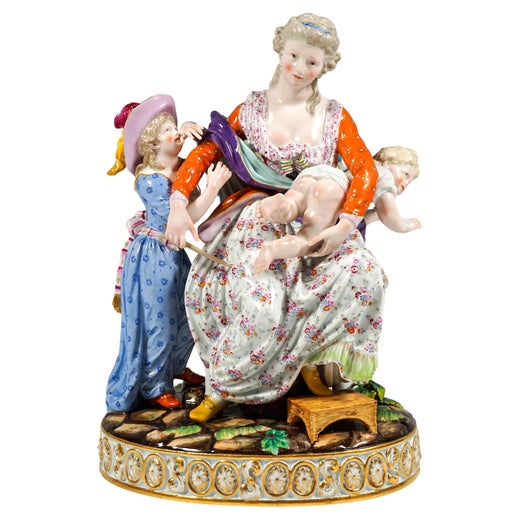
Johann Carl Schoenheit
Johann Carl Schoenheit has been active at Meissen manufactory since 1745, and from 1765, the sculptor started designing his models. He was the assistant of Johann Joachim Kaendler in an earlier period and a colleague of Acier in the later period. He retired in 1794..
About the Seller
5.0
Platinum Seller
Premium sellers with a 4.7+ rating and 24-hour response times
Established in 1988
1stDibs seller since 2013
314 sales on 1stDibs
Typical response time: 5 hours
Authenticity Guarantee
In the unlikely event there’s an issue with an item’s authenticity, contact us within 1 year for a full refund. DetailsMoney-Back Guarantee
If your item is not as described, is damaged in transit, or does not arrive, contact us within 7 days for a full refund. Details24-Hour Cancellation
You have a 24-hour grace period in which to reconsider your purchase, with no questions asked.Vetted Professional Sellers
Our world-class sellers must adhere to strict standards for service and quality, maintaining the integrity of our listings.Price-Match Guarantee
If you find that a seller listed the same item for a lower price elsewhere, we’ll match it.Trusted Global Delivery
Our best-in-class carrier network provides specialized shipping options worldwide, including custom delivery.You May Also Like
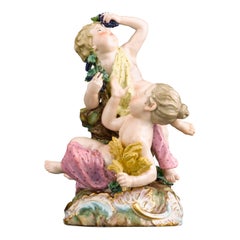
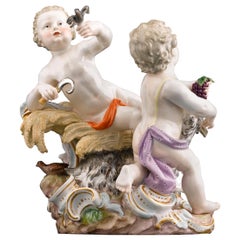
Meissen Porcelain Fall Figural Group
By Meissen Porcelain
Located in New Orleans, LA
A pair of putti holding symbols of the harvest adorn this Meissen porcelain figural group entitled Fall. Part of the company's Seasons series, these charming characters rest upon a r...
Category
Antique 19th Century German Rococo Porcelain
Materials
Porcelain
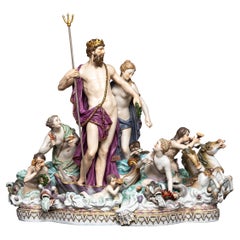
A Large Meissen Porcelain Mythological Figure Centerpiece, *Neptune and Thetis*
By Meissen Porcelain
Located in New York, NY
An exceptionally rare and large Meissen porcelain mythological figure centerpiece titled *Neptune and Thetis*, produced in the late 19th century by the renowned Meissen porcelain man...
Category
Antique 1880s German Rococo Porcelain
Materials
Porcelain
$48,500
H 20 in W 24 in D 3 in
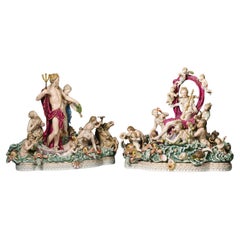
A Pair Of Meissen Porcelain Mythological Figural Groups
By Meissen Porcelain
Located in Brighton, West Sussex
A Pair Of Meissen Porcelain Mythological Figural groups, of 'Neptune and Thetis' and 'The Triumphal Procession of Amphitrite'.
'Neptune and Thetis' modelled with the god of the sea ...
Category
Antique 19th Century German Rococo Porcelain
Materials
Porcelain
Meissen Porcelain Summer and Fall Figural Group
By Meissen Porcelain
Located in New Orleans, LA
This beautiful Meissen Porcelain figure entitled Summer and Fall is part of the company's beloved Seasons series. The putti rest upon a rocaille-formed base holding representations o...
Category
Antique Late 19th Century German Other Figurative Sculptures
Materials
Porcelain
A Monumental Meissen Porcelain Figural Group of Mount Parnassus
By Meissen Porcelain
Located in Brighton, West Sussex
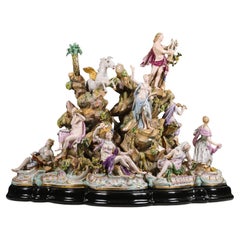
A Monumental Meissen Porcelain Figural Group of Apollo and the Nine Muses on Mount Parnassus.
Comprised of sixteen interlocking parts. Apollo standing holding a lyre and with Pegasus besides a tree, atop a rocky outcrop detailed with foliage and waterfalls above nine goddesses:
Calliope, seated and shown writing, representing eloquence and epic poetry.
Clio, seated with an open book and blowing a trumpet, representing history.
Erato, seated and holding a kithara, representing science and the arts
Euterpe, seated and holding a flute, representing music.
Melpomene, seated holding a knife and with one hand to her head, representing tragedy.
Thalia, seated and holding aloft mask, representing comedy and idyllic poetry.
Urania, seated with telescope and globe, representing astronomy and astrology,
Polyhymnia, standing with one hand raised and holding a book, representing sacred poetry.
Terpsichore, standing, representing dance.
Each piece exceptionally finely detailed and painted. The base portions with rocaille edges. On a later black polished wooden base.
Multiple blue crossed swords marks. Each piece titled to underside.
German, Circa 1880.
Mount Parnassus, is a spur of the Pindus Mountains in central Greece and was sacred to the ancient Greeks and in mythology to Apollo, the god of music and poetry and of the Sun and light. Mount Parnassus the mythical centre of poetry, music, and learning in ancient Greece was a popular theme in Barqoue and Rococo art, often substitutable with Athena’s arrival at Mount Helicon from the fifth book of Ovid’s “Metamorphoses”, where she asks the Muses to show her the new spring which gushed forth from the spot where Pegasus “with his hoof of horn opened the earth” (V, 250-260).
Here, the mountain, formed from rugged rock cliffs, culminates in a plateau on which the youthful Apollo stands and plays the lyre. The Castalian spring flows from beneath Pegasus’ hoof, representing the source of inspiration and attracting the nine muses, who embody the arts and inspire creation through song, music, and dance.
Mount Parnassus was created at the Meissen porcelain manufactory as a table centrepiece and an earlier version, apparently with only five muses, is listed in the inventory of the pastry shop of the Meissen manufactory manager and cabinet minister Heinrich Graf Brühl in 1753. The storage in the pastry shop of approximately 3,000 objects and dishes, including many individual parts for centrepieces, is related to their function as table decorations, replacing decorations previously made by the confectioner from perishable materials such as sugar or wax.
The purpose of this table decoration was as a feast for the eyes to accompany the feast of the banquet. The sculptural figurines often depicted a particular theme, with characters drawn from theatre and opera, from classical mythology or pastoral idylls. Allegories and mythological themes, such as the glorification of fine arts, were also popular. Stylistically, Mount Parnassus fits Kändler’s style of the 1740s, and was sold by Brühl in 1762 to Frederick the Great of Prussia who used mythology as a means of self-expression and had already ordered individual figures of Apollo and the Muses as table decorations in 1744. Today it is in the Museum of Applied Arts, Frankfurt (inv. no. M.L. 41). There is another version of Mount Parnassus, from the collection of Prince Alexander Dolgorukoff, in the Hermitage in Saint Petersburg.
The present version dates to the second half of the nineteenth century when there was a great revival of Kändler rococo figurines which were reissued and a “Second Rococo”. Another nineteenth century example is in the collection of the Museo Francesco Borgogna, Italy (inv. 1906, XIII, 19-20). These nineteenth century versions were made by the Meissen factory using Kändler's period models. It is recorded that a new version of Mount Parnassus, dating to the 1880s, was part of the Royal Porcelain collection in Dresden:
'In the porcelain collection there is a new version from the 1880s based on the old models, the largest group of this genre, the Parnassus, which shows the named muses all around on the lower part of the rock, each practising their own art, while on the top there is Apollo with the lyre and next to it the Castalian spring rises from the hoofbeat of Pegasus. Each figure is executed individually with its rocky background, and all the pieces are then fitted together, as we have already seen in his earlier, larger compositions. The rock pieces are finished off like a pedestal at the bottom with Rococo ornaments.' (Jean Louis Sponsel, Kabinettstücke der Meissner Porzellan-manufaktur von Johann Joachim Kändler, Leipzig, 1900, pp. 203-204).
Kunst und kunsthandwerk; monatsschrift herausgegeben vom Österreichischen museum fuer kunst und industrie, Vienna, 1894, v.7 pt.1, p.133.
Kari Berling, Das Meißner Porzellan und seine Geschichte. Leipzig 1900, S. 99, 187-200.
Helmuth Gröger, Johann Joachim Kaendler. Dresden, 1956.
Peter W Meister, Franz Adrian Dreier, Figürliche Keramik aus zwei Jahrtausenden. Kat Museum für Kunsthandwerk, Frankfurt. Frankfurt 1964, Nr. 90.
Rainer Rückert, Meißener Porzellan, 1710-1810. Kat. Ausst. Bayerisches Nationalmuseum München. München 1966.
Stefan Bursche, Tafelzier des Barock. München 1974, Abb. 300.
"Tafelaufsatz, Der Parnass", Auswahlkatalog, Museum für Kunsthandwerk (Frankfurt am Main, Germany), 1987, pp. 86-87.
Alfred Ziffer, ‘Meissener Porzellanplastik für fürstliches Interieur und Zeremoniell’, Keramos, Issue 241/242, pp. 29–52.
MEISSEN
The production of Meissen porcelain began in 1710 at the manufactory at Meissen...
Category
Antique 19th Century German Rococo Porcelain
Materials
Porcelain
$265,989
H 26.78 in W 36.23 in D 24.02 in
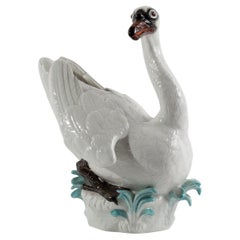
Meissen Porcelain Figure of a Swan, After a Model by Johann Joachim Kändler
By Meissen Porcelain
Located in New York, NY
Meissen Porcelain Figure of a Swan
This porcelain figure represents a swan modeled in a lifelike posture with its wings partially raised and neck gracefully arched. The surface is m...
Category
Vintage 1920s German Rococo Porcelain
Materials
Porcelain
$6,500
H 9 in W 7 in D 4.5 in
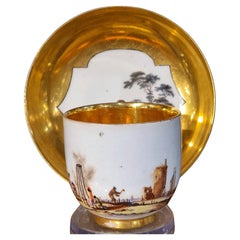
Meissen porcelain cup and saucer, Germany, circa 1720-1730
Located in Vicenza, IT
Elegant cup and saucer made of Meissen porcelain, entirely hand-painted with vivid genre scenes and river landscapes enlivened by figures, architecture and boats, inspired by Dutch m...
Category
Antique 1730s German Rococo Porcelain
Materials
Porcelain
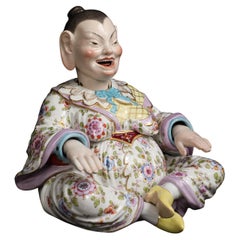
A Meissen Porcelain Pagoda Nodding Head Figure
By Meissen Porcelain
Located in New York, NY
A 19th century Meissen porcelain nodding head figure modeled as a seated pagoda figure, with head and hands articulated by internal counterweights. The un...
Category
Antique 1880s German Chinoiserie Porcelain
Materials
Porcelain
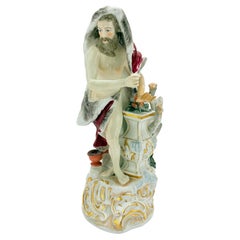
Sevres Style "Winter" Porcelain Figure After Meissen Friedrich Elias
By Manufacture Nationale de Sèvres, Meissen Porcelain
Located in Atlanta, GA
This exquisite porcelain figure, titled "Winter," is produced after with the influence of the artistry of Friedrich Elias Meyer (circa 1723–1785), a distinguished sculptor for the Me...
Category
Early 20th Century German Rococo Porcelain
Materials
Porcelain
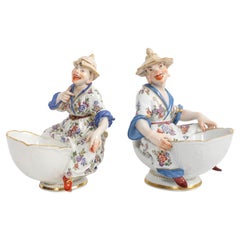
Pair of Meissen Porcelain Chinoiserie Figural Sweetmeat Dishes, J.J. Kandler
By Meissen Porcelain
Located in New York, NY
A fine pair of Meissen porcelain chinoiserie figural sweetmeat dishes, after a model by J.J. Kandler
Each with a Malabar chinoiserie figure seated on...
Category
Mid-20th Century German Rococo Porcelain
Materials
Porcelain
$11,800 / set
H 8 in W 6.75 in D 5.5 in
More From This Seller
View AllMeissen Rococo Figure
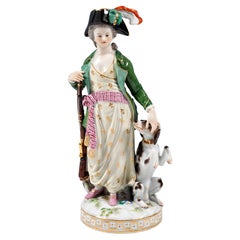
Huntress with Dog
, by J.C. Schoenheit, Around 1880
By Johann Carl Schoenheit, Meissen Porcelain
Located in Vienna, AT
Elaborate porcelain figure of the 19th century:
Young lady with rococo wig dressed as a huntress: black trident hat with colorful feather decoration, softly falling dress...
Category
Antique Mid-19th Century German Rococo Porcelain
Materials
Porcelain
Meissen Rococo Group
Love and Reward
, by J.C. Schoenheit, Around 1850
By Johann Carl Schoenheit, Meissen Porcelain
Located in Vienna, AT
Elaborate porcelain group of the 19th century:
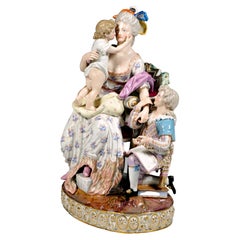
Young mother in elaborate Rococo clothing, seated on a magnificent Louis XVI-style armchair, resting her left foot on a low pedestal, ...
Category
Antique Mid-19th Century German Rococo Porcelain
Materials
Porcelain
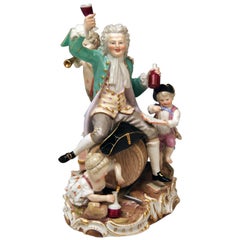
Meissen Figurines The German Bacchus Model D 13 Johann C. Schoenheit, circa 1880
By Johann Carl Schoenheit
Located in Vienna, AT
Meissen quite rare figurine group: the so-said German Bacchus
Excellently painted & modelled (the details are stunningly sculptured = finest modelling)
Design:
-- Johann Carl Sc...
Category
Antique 1880s German Rococo Porcelain
Materials
Porcelain
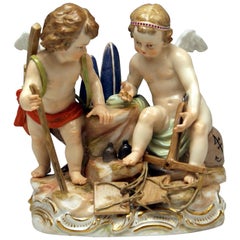
Meissen Figurines Cherubs Allegory of Trading Model C42 by Schoenheit
By Johann Carl Schoenheit
Located in Vienna, AT
Meissen gorgeous figurine group: Cherubs personifying allegory of trade
The details are stunningly scupltured = finest modelling!
Design:
Johann Carl Schoenheit (1730-1805)
Sch...
Category
Antique 1850s German Rococo Porcelain
Materials
Porcelain
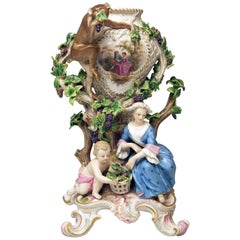
Meissen Potpourri Vase Wine Grapes Monkey Model 1002 by Eberlein Made circa 1860
By Johann Friedrich Eberlein
Located in Vienna, AT
Meissen nice Potpourri vase: Monkey eating wine grapes / lady with boy
The details are stunningly scupltured = finest modelling!
Design:
Johann Friedrich Eberlein (1696-1749) / Model 1002 Created 1748.
Since 1735 second chief modeller of Meissen manufactory, Eberlein was one of the best contributors Johann J. Kaendler had.
Made circa 1860
Hallmarked:
Meissen Blue Sword Mark (glazed bottom)
model number 1002 / painter's number 9 / former's number 70
First quality
Specification:
Excellently modelled bellied vase: The vase's base is of square form type, having four feet shaped as volutes / the vase is painted at front side - it is a picture in Watteau style, depicting a gallant couple situated in garden landscape. Additionally, sculptured decorations are attached to vase's wall - these are vine tendrils with grapes. Very special feature: A sculptured monkey's figurine eating grapes. - Further there is a lady visible - accompanied by little boy with basket...
Category
Antique 1860s German Rococo Porcelain
Materials
Porcelain
Meissen Porcelain, Seated Buddha Figure As Wiggling Pagoda, By Kaendler, Ca 1860
By Johann Joachim Kaendler, Meissen Porcelain
Located in Vienna, AT
Depiction of a sitting, smiling Buddha figure from a series of folk types. Voluminous body with hair strictly combed back and a wide robe sitting cross-legged, arms straight in front...
Category
Antique 1860s German Baroque Porcelain
Materials
Porcelain
Still Thinking About These?
All Recently ViewedMore Ways To Browse
J J Kaendler Meissen Porcelain
Hurdy Gurdy
Wine Cask
Childrens Dresser
Antique Childrens Dresser
Herend Porcelain China
Espresso Cup Set
Antique Rockingham
Hand Painted Mugs
Vienna 1880
Limoges Art Deco
Meissen Germany Bowl
Porcelain Dessert Service
Rosebud Antique
Baroque Decor
Hand Painted Limoges Plate
Meissen Pink
19th Century Dresden Porcelain