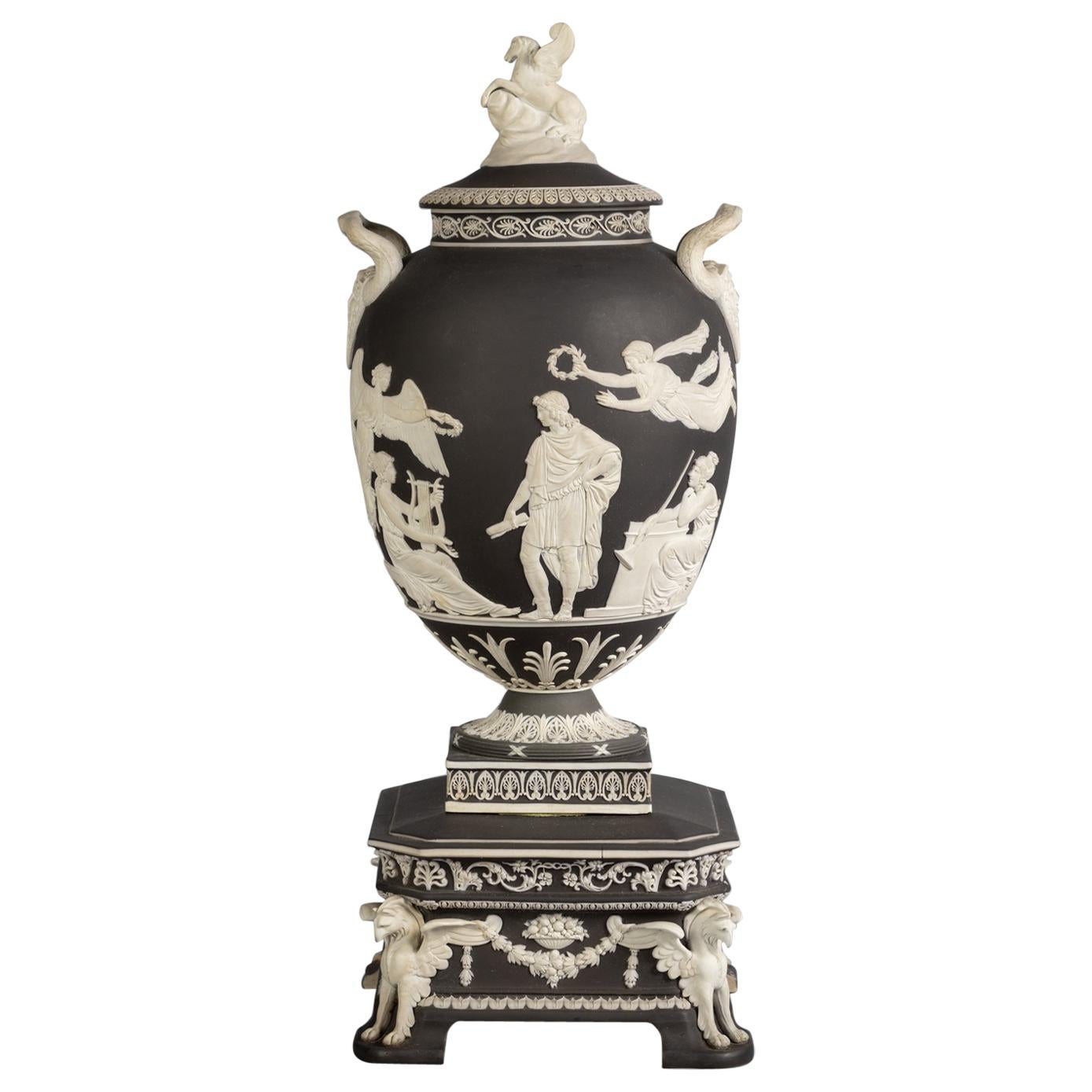
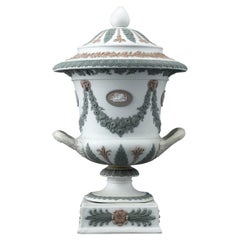
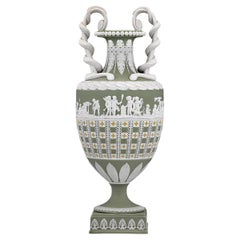
Wedgwood's Etruria factory, Staffordshire, 1786. Green Jasper dip on solid white Jasper ware ground, with finely tooled, applied white Jasper bas-relief. White figural Pegasus surmounting a solid blue Jasper cloud, inset to a stepped, green dip, domed cover. Broad, oviform body flattened on the shoulders. Decoration depicting the crowning of a kitharist or poet, with an altar, palm tree, Athena in a temple, and vases beyond. Neck of the vase wreathed in olive, resembling snakeskin; honeysuckle and other applied ornaments on lower body. Handles, in the form of two serpents disputing a blue Jasper dip egg, springing from Gorgon masks. On a constructed square plinth with meander at sides; evidence of previous 2 inch interior sump dome, base impressed "WEDGWOOD/[mark resembling double leaves]", 18 x 11 x 8 1/2 in.
Provenance: Bonhams Skinner, Massachusetts; Stanley F. Goldfein, New York.
Note: The Wedgwood collection of Stanley F. Goldfein was divided for 2024 sale in the UK by Dreweatts with the assistance of Christie's and in the US by Bonhams Skinner, when this vase was cataloged as 19th century. This vase is indeed 18th century and has been specifically referenced in the following literature, included in the sale:
2007, Wood, P. Wedgwood: The Felix Joseph Collection of 18th Century Jasper, 63.
1994, Reilly, R. Wedgwood Jasper, 56.
.
Reilly states, "Only two examples of the vase in this rare colour have so far been found (the second is in a private collection in America)." This note is also present in Volume I of his 1989 text, "Wedgwood."
Additionally, it's pair is referenced in the following literature, all of which are also included with the sale:
2007, Wood, P. Wedgwood: The Felix Joseph Collection of 18th Century Jasper, 27, 63.
1994, Reilly, R. Wedgwood Jasper, 56, 196-8.
1984, Dawson, A. Masterpieces of Wedgwood in the British Museum, 108-9.
1980, Buten, D. 18th Century Wedgwood, 100.
Only these two 18th century examples of the vase with white relief over buff green dip on white jasper, with a white base, and a blue-clouded finial, are documented. They are only the second and third examples of the Pegasus Vase ever thrown - the first is two-toned blue and resides at the British Museum. The unique potter's mark matches the two other blue-clouded examples of this vase at the British Museum and Nottingham Castle Museum, as noted by Dawson and Reilly.
The first vase is mentioned in William Burton, 'Josiah Wedgwood and his pottery', p. 71, quoting a letter from Josiah Wedgwood to Sir William Hamilton of 24 June 1786: “I lamented much that I could not obtain liberty of the merchant to send a vase, the finest and most perfect I have ever made, and which I have since presented to the British Museum. I enclose a rough sketch
of it ; it is 18 inches high, and the price 20 guineas.”
Alieen Dawson, former curator at the British Museum, continues describing this first, almost identical vase in these next few paragraphs from her 1984 "Masterpieces of Wedgwood in the British Museum."
The dome-shaped lid is ornamented in white Jasper near the rim with a pattern loosely based on a classical motif. The edge of the upper part of the lid has been lathe-turned. The pale blue cloud on which the white jasper figure of the horse rests appears to have been hand-modeled. Examination of the interior of the lid suggests that a hole was cut in the peak of the dome and a lump of pale blue clay put over the top and then carefully modeled by the craftsman. The figure of the horse was probably made in a two-part mould, but the seam line is almost invisible. The wings, mane and other details have been tooled. The base is impressed with the potter’s name and with two leaf-like marks, perhaps those of the craftsman responsible for forming the vase, its lid, foot and base. All except the last were thrown on a wheel. The base is made of five flat rectangular pieces of clay joined together while in the leather-hard state with water.
The body itself is ovoid in shape but flattened at the top, and conforms in general to the Greek stamnos. Athene is based on the Minerva Giustiniani, now in the Vatican Museum. Representations of palm trees are not especially rare in classical art, but none has yet been discovered in the eighteenth-century collections of engravings such as de Montfaucon's work which parallels the ridged trunk and feathery leaves shown on the reverse of the vase. The small altar is reminiscent of altars painted on fourth-century BC classical vases from Greece and south Italy, but no eighteenth-century printed source has been traced. The handle terminals were copied from an illustration of a sandal shown in de Montfaucon where the Medusa head appears as an ornament (Dawson).
She continues:
The history of the making of the Pegasus Vase was until quite recently a complete mystery: it appeared that no records had survived of the manufacture of this model, a strange omission in view of Wedgwood's delight in it. However, recent work on the “Oven Books,” or records of firings kept at the factory, has brought to light the following information. Under the date “18 and 25 February” 1786 is the curious entry “two blue
white vases 23 Ins with palm tree angel temple &c.” This unlikely description of the Pegasus Vase, lacking any illustration in the left-hand margin (which has been torn), is the first-known mention of the production of the vase.
The vase, which is notable for its silky surface, crisp reliefs and distinctive outline, is a reminder of the excellence achieved by the potter. Characteristically Josiah Wedgwood wished his achievement to be demonstrated to the world at large. This generous gift to the Museum, accepted by the Archbishop of Canterbury and his fellow Trustees and recorded in the Minutes of the General Meeting of 27 May 1786, received only the tersest of acknowledgements: “Mr Wedgewood [sic] having presented a Vase of his own manufacture, thanks were ordered to be returned for the same.” As items of contemporary manufacture were not generally taken into the collections, it must indeed have been much admired. The Pegasus Vase marked the cornerstone of what was to become one of the finest collections of eighteenth century Wedgwood. The vase must certainly be counted amongst Wedgwood's masterpieces. A triumph of the potter’s art (Dawson).
Former Wedgwood executive Robin Reilly discusses Dawson's book in his "Wedgwood Jasper" (1994):
Many later reproductions of this vase were made, though the complexity of its manufacture limited the quantity by price, through most of the nineteenth and the early years of the twentieth centuries. Their ornament varies slightly, and the grandeur of the accompanying plinths appears to have altered according to fashion. The vase presented to the British Museum by Josiah is therefore specially important as a criterion of excellence (Reilly).
Dawson adds further insight from the factory record:
There is another entry in the book for “4 and II March:” “2 fine white jasper vases 23Ins diped. Made thrown, turned
finished
broke/? ... angels &c on.” The shape number is given as 298. Although an entry dated “1 and 8 September” records the firing of “1 white odd cover to an Apotheosis” and “6 blue
white vases 20Ins high” with the shape number 298 appear on “15
22 September,” there is no other blue example resembling the vase in the British Museum known to the author. Still others may have been produced, but the factory records do not survive for the period shortly after 1786.
There are, however, other eighteenth century examples of the vase in existence.
Perhaps the most well-known is a green jasper dip one in the Felix Joseph Collection at the Nottingham Castle Museum. The concealment of the fixture of the vase to its base differs from that of the British Museum vase, although the actual method of fixing may well be the same. Inside the Nottingham vase is a white jasper ware dome, about 2 in (5 cm) in height, covering the fitment. On the British Museum vase the fitment has been left exposed inside a 1 1/2 in. deep well formed of blue jasper ware. It seems to be made of some kind of glue or mastic, and is dark brown in color (Dawson).
According to "Wedgwood: The Joseph Felix Collection of 18th Century Jasper," published for Nottingham Castle Museum (2008):
The only other surviving example of the vase in this rare color [green with blue] is in a private American collection. It is not a direct copy of one antique object, but takes elements from different sources. The primary figure relief known as the 'Apotheosis of Homer' (glorification of Homer) or a 'Crowning of a Citharist' or 'A Victorious Citharist was based on a design on a 4th century Greek red figure vase. This vase was in Sir William Hamilton's collection of Greek and Italian vases, described and illustrated in D'Hancarville and Hamilton's publication 'Antiquités étrusques, greques, et romaines', published in 1766-67, now at the British Museum.
In conclusion, sister to one of the highlights of the British Museum and pair to the example in Nottingham, this is the only privately-owned example of Josiah's original three blue-clouded Pegasus Vases. In his own words, it is "the finest and most perfect I have ever made."