Items Similar to 19th Century Italian Sterling Silver Glass and Wine Coasters, circa 1830
Video Loading
Want more images or videos?
Request additional images or videos from the seller
1 of 19
19th Century Italian Sterling Silver Glass and Wine Coasters, circa 1830
$10,059.17per set
£7,516.94per set
€8,500per set
CA$14,006.89per set
A$15,051.88per set
CHF 8,076.21per set
MX$177,301.95per set
NOK 101,549.35per set
SEK 92,764.67per set
DKK 64,796.15per set
About the Item
Twelve silver glass coasters and four silver wine coasters.
Silversmith Antonio Mantelli
Milan, circa 1830
They measure:
Glass coasters: 0.78 in high x 3.46 in diameter (2 cm x 8.8 cm)
Wine coasters: 0.86 in high x 5.24 in diameter (cm 2.2 e cm 13.3)
lb 1.86 (kg 0.84)
State of conservation: slight dents and defects due to use.
Each glass coaster or wine coaster has a circular shape with a vertical brim adorned with a continuous, perforated pattern of linked palmettes. The rim is everted and decorated with lance-shaped leaves interspersed with tiny beading. At the center of the support surface is a continuous crown of leaflets in relief arranged in a V-shape.
Each of the sixteen pieces bears three marks under the base:
1)“Forma eptagona. Globo col Zodiaco ed i setti (sic) Trioni.”
Heptagon form. Globe with the Zodiac and the seven Trioni (seven stars of the Ursa Major).
Mark of the Guarantee Office in use in the Napoleonic Kingdom of Italy from 1812 for works with a title of 800 thousandths.
2) "Aratro". Plow.
Mark of the Guarantee Office in use in the Napoleonic Kingdom of Italy from 1812.
3) "Dragon" and letters "AM".
Mark of the silversmith Antonio Mantelli, active between 1830 and 1839.
Reference bibliography:
V. DONAVER - R. DABBENE, Punzoni degli argentieri milanesi dell'800, Milano, 1985;
G. SAMBONET, Gli Argenti Milanesi, Milano, 1987.
- Creator:Antonio Mantelli (Maker)
- Dimensions:Height: 0.87 in (2.2 cm)Diameter: 5.24 in (13.3 cm)
- Sold As:Set of 16
- Style:Neoclassical (Of the Period)
- Materials and Techniques:Sterling Silver,Embossed
- Place of Origin:
- Period:
- Date of Manufacture:circa 1830
- Condition:Minor fading. Slight dents and defects due to use.
- Seller Location:Milano, IT
- Reference Number:1stDibs: LU4352215395912
About the Seller
4.3
Vetted Professional Seller
Every seller passes strict standards for authenticity and reliability
Established in 1860
1stDibs seller since 2018
23 sales on 1stDibs
Typical response time: 3 hours
Associations
International Confederation of Art and Antique Dealers
Associations
- ShippingRetrieving quote...Shipping from: Milano, Italy
- Return Policy
More From This Seller
View AllAncient Maiolica Plates Pasquale Rubati, Milan Circa 1770-1780
By Pasquale Rubati
Located in Milano, IT
Five oval maiolica dishes with pierced edge
Manufacture of Pasquale Rubati
Milan, 1770-1780
Three small oval dishes 10.23 in x 7.67 in (26 cm x 19.5 cm)
Two large oval dishes 10.82 in x 8.85 in (27.5 x 22.5 cm)
lb 3.5 (kg 1.8)
State of conservation: intact
The five dishes of different sizes have an oval shape, a mixtilinear edge and a molded polylobed shape with a surface enriched with a relief weave motif extending to the brim and forming a perforated basket...
Category
Antique 1770s Italian Rococo Ceramics
Materials
Maiolica
Ancient Maiolica Dishes with flowers, Lombard Manufacture, 1770-1780 Circa
Located in Milano, IT
Assortment of dishes
Lombard manufacture
1770 – 1780 Circa
Maiolica polychrome decorated “a piccolo fuoco” (third fire).
Two large dishes: diameter 14.76 in (37.5 cm); weight 4.5...
Category
Antique 1770s Italian Rococo Ceramics
Materials
Maiolica
Two Small Italian Dishes Antonio Maria Coppellotti Manufacture, Lodi, Circa 1740
By Antonio Maria Coppellotti
Located in Milano, IT
Two small dishes
Antonio Maria Coppellotti Manufacture
Lodi, Circa 1740
High fire polychrome majolica
They measure: diameter 7.08 in(18 cm)
Weight: 0.37 lb (170 g)
State of conservat...
Category
Antique 1740s Italian Baroque Ceramics
Materials
Maiolica
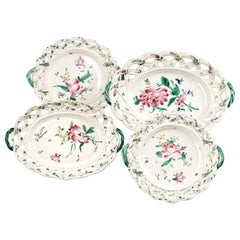
Four Italian Ancient Dishes, Antonio Ferretti, Lodi, circa 1770-1780
By Antonio Ferretti
Located in Milano, IT
Assortment of 4 dishes with braided rim
Antonio Ferretti Manufacture
Lodi, circa 1770-1780
Maiolica polychrome decorated “a piccolo fuoco” (third fire).
Measures: 14 x 10 in (35.5 x 25.5 cm);
12.2 x 8.39 in (31 x 21.3 cm);
10.4 x 9.65 in (26.5 x 24.5 cm);
10.8 x 9.61 in (27.5 x 24.4 cm).
Weight: 4.4 lb (1.998 kg)
State of conservation: some chips due to use on the edges and on the parts in relief.
The four different dishes have a foot with a low lip from which extends a wide, flat, slanted rim resembling a basket weave. The small handles are painted green: they resemble wickerwork in the two oval dishes and take the form of a sinuous branch in the round ones.
The third fire decoration is inspired by the naturalistic floral botanical patterns on the ceramics produced by the Hannong family in Strasbourg. Here the pattern is defined by the rapidity and subtlety of the brushstrokes and the result is particularly tasteful, characterized by compositional intelligence and pictorial expertise.
A main corolla, either a wild or garden rose, is set slightly off center in each well. From this extends a thin stem holding a small secondary bud and there are small field florets dotting the composition to lend volume to the delicate bunch of flowers.
On the brim, small polychrome flowers add color to the weave, accompanied by lanceolate leaves of a very intense green.
There exist few and very rare examples for comparison with this morphology: a round plate - entirely consistent with those in question - has been dated to around 1775 (S. Levy, Maioliche settecentesche lombarde e venete, Milano 1962, tav. 200). Two other dishes with a basket rim, but with parallel striped brim decoration, were exhibited in the 1995 exhibition on Lodi ceramics; the attribution to the Lombard town near Milan is therefore almost exclusively derived from the decoration called "alla rosa contornata" or "alla vecchia Lodi" and constitutes one of the most popular decorations during the eighteenth century. (M. L. Gelmini, in Maioliche lodigiane del '700 (cat. mostra Lodi), Milano 1995, pp. 31 p. 162-163 nn. 181-182).
This decorative choice represented a strong point of the Lodi factory, which established itself thanks to the vivid nature of the colors made possible by the introduction of a new technique perfected by Paul Hannong in Strasbourg and which Antonio Ferretti introduced in Italy. This production process, called “piccolo fuoco” (third fire), allowed the use of a greater number of colors than in the past; in particular, the purple of Cassius, a red made from gold chloride, was introduced. Its use allowed for many more tones and shades, from pink to purple.
The Ferretti family had started their Maiolica manufacturing business in Lodi in 1725.
The forefather Simpliciano had started the business by purchasing an ancient furnace in 1725 and, indeed, we have evidence of the full activity of the furnaces from April of the same year (Novasconi-Ferrari-Corvi, 1964, p. 26 n. 4). Simpliciano had started a production of excellence also thanks to the ownership of clay quarries in Stradella, not far from Pavia. The production was so successful that in 1726 a decree of the Turin Chamber came to prohibit the importation of foreign ceramics, especially from Lodi, to protect internal production (G. Lise, La ceramica a Lodi, Lodi 1981, p. 59).
In its initial stages, the manufacture produced maolicas painted with the “a gran fuoco” (double fire) technique, often in turquoise monochrome, with ornamentation derived from compositional modules in vogue in Rouen in France. This was also thanks to the collaboration of painters like Giorgio Giacinto Rossetti, who placed his name on the best specimens next to the initials of the factory.
In 1748 Simpliciano made his will (Gelmini, 1995, p. 30) appointing his son Giuseppe Antonio (known as Antonio) as universal heir. After 1750, when Simpliciano passed away, Antonio was directly involved in the Maiolica factory, increasing its fortunes and achieving a reputation on a European level. Particularly important was the aforementioned introduction in 1760 of the innovative “a piccolo fuoco” (third fire) processing, which, expanding the ornamental repertoire with Saxon-inspired floral themes, could commercially compete with the German porcelains that had one of its most renowned offerings in the naturalistic Deutsche Blumen. Antonio Ferretti understood and promoted this technique and this decoration, proposing it in a fresher and more corrective version, less linked to botanical tables...
Category
Antique 1770s Italian Neoclassical Ceramics
Materials
Maiolica
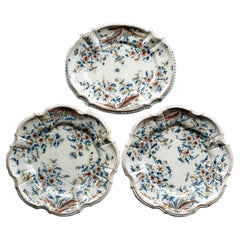
Three Dishes, Antonio Maria Coppellotti Factory, Lodi, Italy, Circa 1745
By Antonio Maria Coppellotti
Located in Milano, IT
Pair of round dishes and a small oval tray
Antonio Maria Coppellotti factory
Lodi, circa 1745
High fire polychrome majolica
Dishes size: diameter 9.44 in, height 0.78 in (24 cm, 2 c...
Category
Antique 1740s Italian Rococo Delft and Faience
Materials
Maiolica
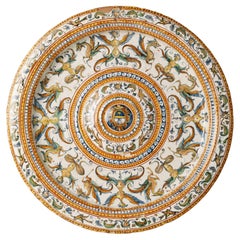
Italian Renaissance Plate, Patanazzi Workshop Urbino, End of 16th Century
By Patanazzi Workshop
Located in Milano, IT
Acquareccia plate
Patanazzi workshop
Urbino, last quarter of the 16th century
It measures diameter 17.12 in; foot diameter 11.53 in; height 1.88 in (43.5 cm; 29.3 cm; 4.8 cm).
Weight
State of conservation: wear and a few small minimal detachments of enamel, chipping on the raised areas, peeling of enamel at the brim on the back.
This large, shallow basin is equipped with a wide and convex well. It is umbonate with a contoured center. The brim, short and flat, is enclosed in a double rounded and barely raised edge. The basin has a flat base without rims; it has a slightly concave center in correspondence to the well.
The shape takes inspiration from the basins associated with the metal forged amphora pourers that traditionally adorned the credenza. These were used from the Middle Ages to wash hands during banquets. Two or three people washed their hands in the same basin and it was considered an honor to wash one’s hands with an illustrious person.
The decoration is arranged in concentric bands with, in the center of the umbo, an unidentified shield on a blue background: an oval banded in gold with a blue head, a gold star and a field with a burning pitcher.
Rings of faux pods separate the center from a series of grotesque motifs of small birds and masks. These go around the basin and are, in fact, faithfully repeated on the brim. The main decoration develops inside the flounce of the basin, which sees alternating symmetrical figures of winged harpies and chimeras. The ornamentation, outlined in orange, green and blue, stands out against the white enamel background.
This decorative style, defined since the Renaissance as “grottesche” or “raffaellesche”, refers to the decorations introduced after the discovery of the paintings of the Domus Aurea towards the end of the fifteenth century. The discovery of Nero's palace, buried inside Colle Oppio by damnatio memoriae, occurred by chance when a young Roman, in 1480, fell into a large crack which had opened in the ground on the hill, thus finding himself in a cave with walls covered with painted figures.
The great artists present in the papal city, including Pinturicchio, Ghirlandaio, Raffaello, immediately visited these caves. The decorations found there soon became a decorative subject of immense success: the term grotesque , with the meaning of “unusual,” “caricatured,” or “monstrous,” was later commented by Vasari in 1550 as “una spezie di pittura licenziose e ridicole molto”( “a very licentious and ridiculous kind of painting”).
The decorations “a grottesche” also widely circulated in ceramic factories, through the use of engravings, variously interpreted according to the creativity of the artists or the requests of the client.
Our basin is reflected in similar artifacts produced at the end of the sixteenth century by the factories of the Urbino district. See the series of basins preserved in the main French museums, among which the closest in morphology is that of the Campana collection of the Louvre (Inv. OA1496); this however has a more complex figure decoration, while the decoration of our specimen is sober and with a watercolor style.
The style, sure in its execution, approaches decorative results still close to the works produced around the middle of the sixteenth century by the Fontana workshop. The decoration is closely linked to their taste, which later finds its natural outlet, through the work of Antonio, also in the Patanazzi workshop. Studies show the contiguity between the two workshops due to the kinship and collaboration between the masters Orazio Fontana and Antonio Patanazzi, both trained in the workshop of Guido Fontana il Durantino. It is therefore almost natural that their works, often created according to similar typologies and under the aegis of the same commissions, are not always easily distinguishable, so much so that the presence of historiated or “grottesche” works by Orazio is documented and preserved in Antonio Patanazzi's workshop. Given that the studies have always emphasized the collaboration between several hands in the context of the shops, it is known that the most ancient “grottesche” works thus far known, can be dated from 1560, when the Fontana shop created the so-called Servizio Spagnolo (Spanish Service) and how, from that moment on, this ornamentation became one of the most requested by high-ranking clients. We remember the works created for the Granduchi di Toscana, when Flaminio Fontana along with his uncle Orazio supplied ceramics to Florence, and, later, other commissions of considerable importance: those for the service of the Duchi d’Este or for the Messina Farmacia of Roccavaldina, associated with the Patanazzi workshop when, now after 1580, Antonio Patanazzi began to sign his own work.
Thus, in our basin, the presence of masks hanging from garlands, a theme of more ancient memory, is associated in the work with more advanced stylistic motifs, such as the hatching of the chimeras and harpies. These are found here on the front with the wings painted in two ornate ways. In addition, the theme of the birds on the edge completes the decoration along the thin brim and can be seen as representing an early style typical of the Urbino district during a period of activity and collaboration between the two workshops. Later, a more “doll-like” decorative choice, typical of the end of the century and the beginning of the seventeenth century, characterized the period of the Patanazzi workshop under the direction of Francesco.
Bibliography:
Philippe Morel, Il funzionamento simbolico e la critica delle grottesche nella seconda metà del Cinquecento, in: Marcello Fagiolo, (a cura di), Roma e...
Category
Antique 16th Century Italian Renaissance Ceramics
Materials
Maiolica
You May Also Like
Coasters Silver Set , Early 20th Century
Located in Roma, IT
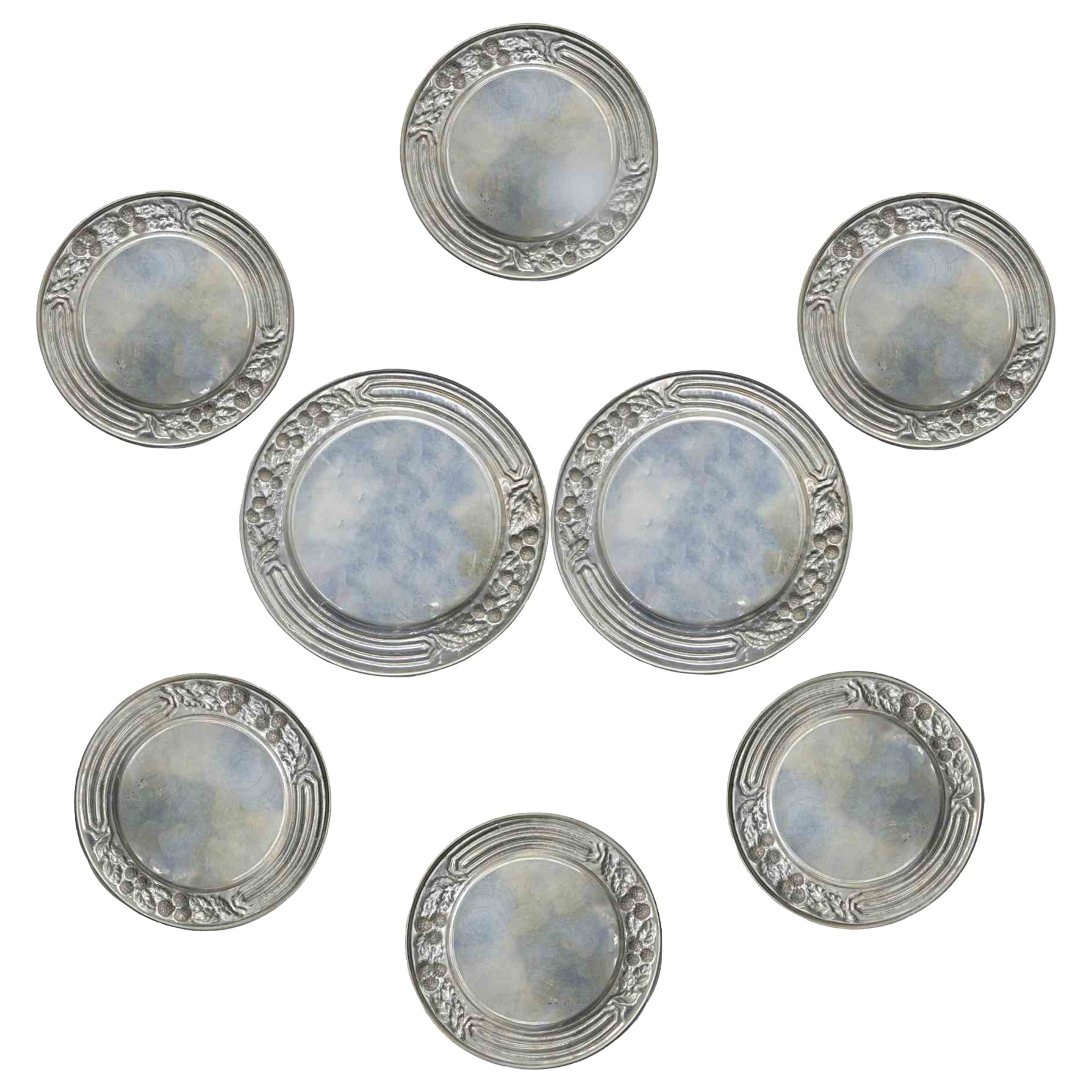
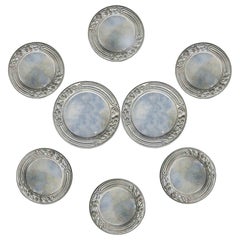
Set of 8 silver coasters.
Two larger ones with a diameter of 14 cm. ( coaster) 6 small ones with a diameter of 14 cm (coasters)
Handmade vegetable decorations
Very good conditio...
Category
Early 20th Century European Centerpieces
Materials
Silver
$769 / set
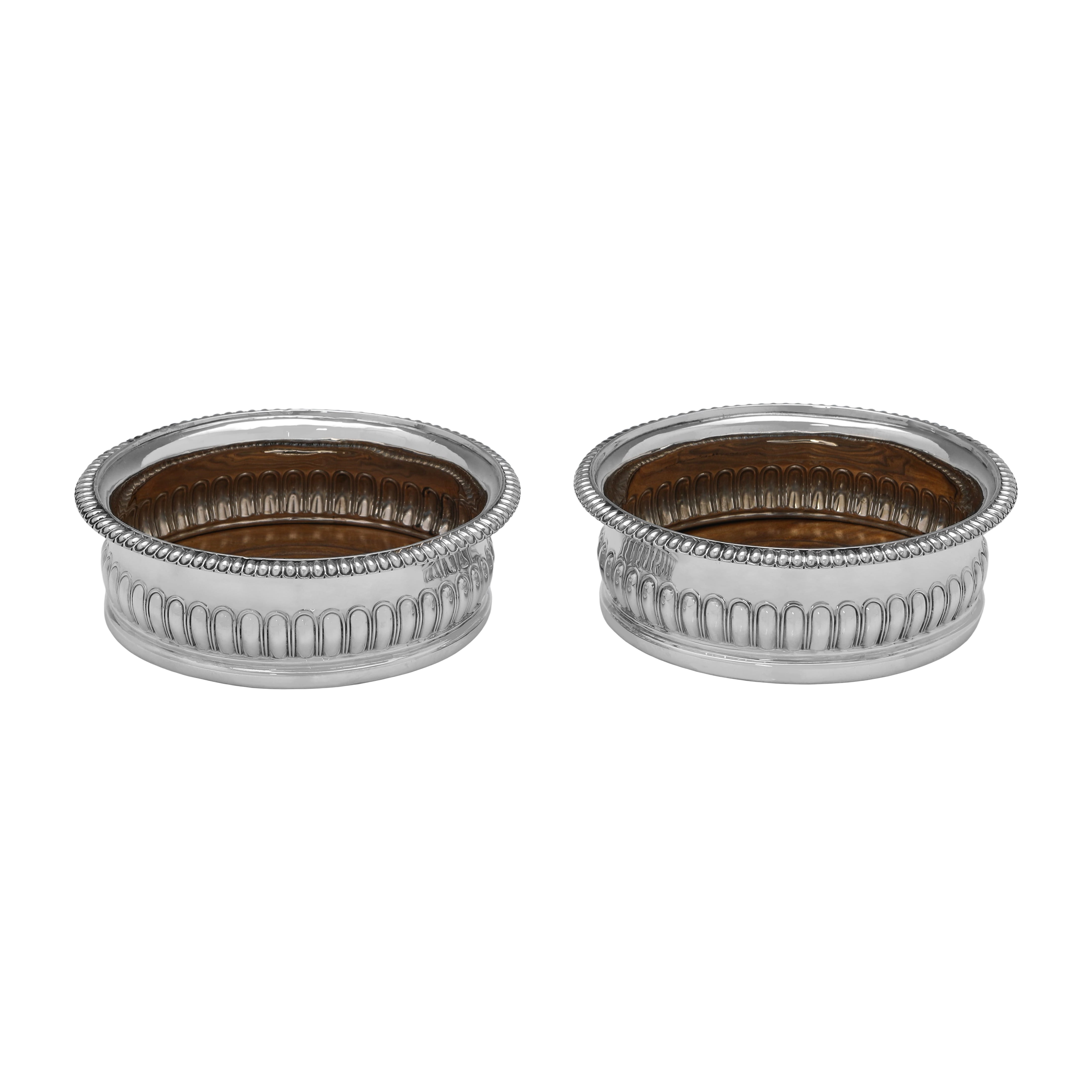
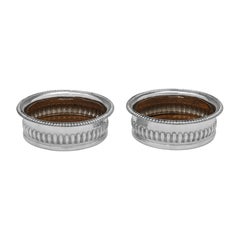
Pair of Regency period sterling silver wine coasters hallmarked in 1818
By John
Thomas Settle
Located in London, London
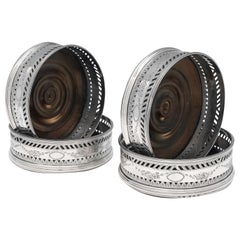
Hallmarked in Sheffield in 1818 by John & Thomas Settle, this attractive pair of Antique, Regency period, Sterling Silver Wine Coasters, feature fluted decoration, wooden bases with ...
Category
Antique 1810s English Regency Tableware
Materials
Sterling Silver
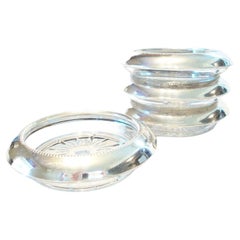
FRANK M. WHITING - 4 Sterling Silver
Glass Coasters - U.S. - Mid 20th Century
By Frank M. Whiting
Company
Located in Chatham, ON
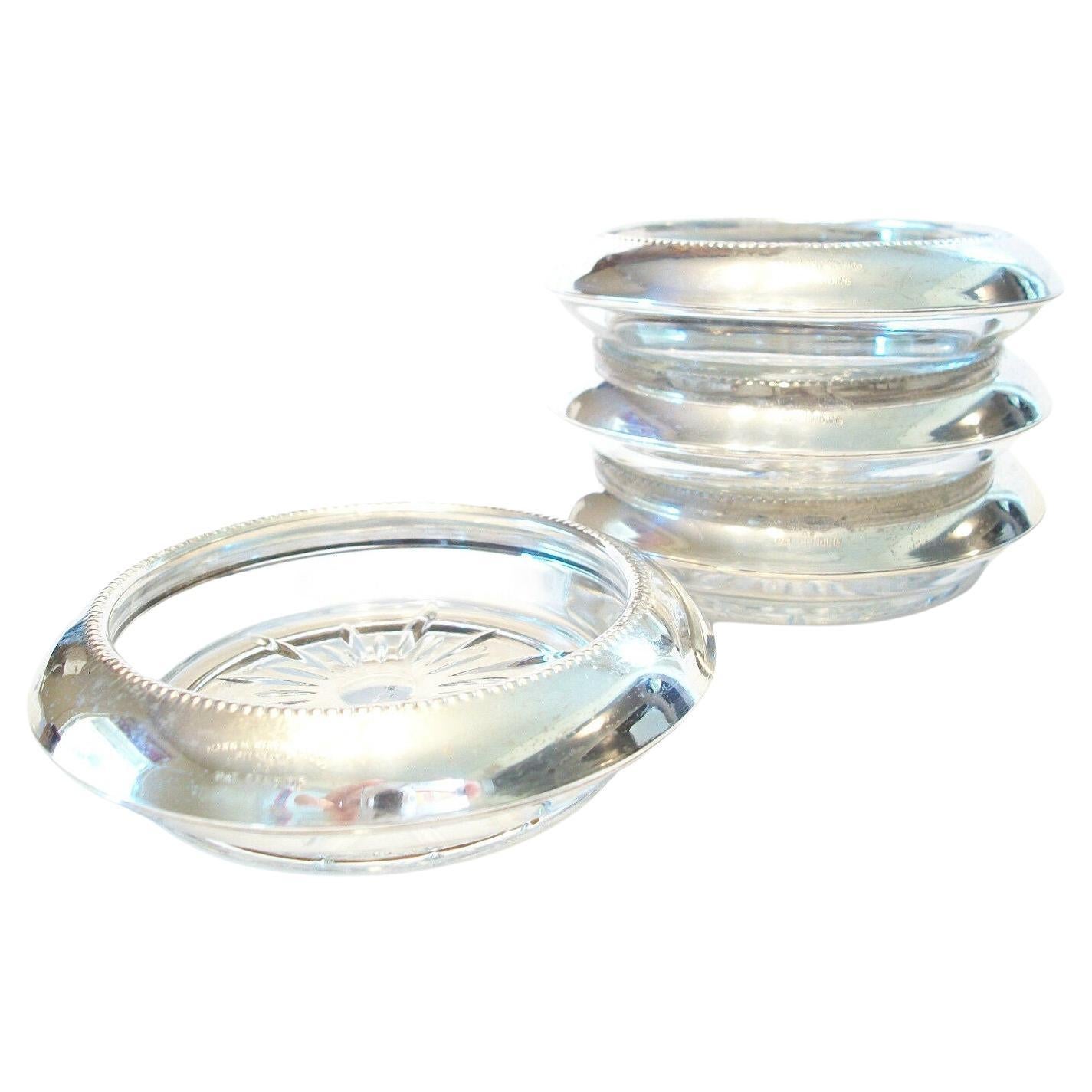
FRANK M. WHITING & CO. - Set of four vintage pressed glass coasters with sterling silver rims - stack-able - each signed - United States - mid 20th century.
Excellent vintage condit...
Category
Mid-20th Century American American Classical Barware
Materials
Sterling Silver
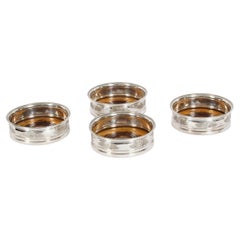
Antique Set 4 Regency Period Old Sheffield Plate Wine Coasters 19th Century
Located in London, GB
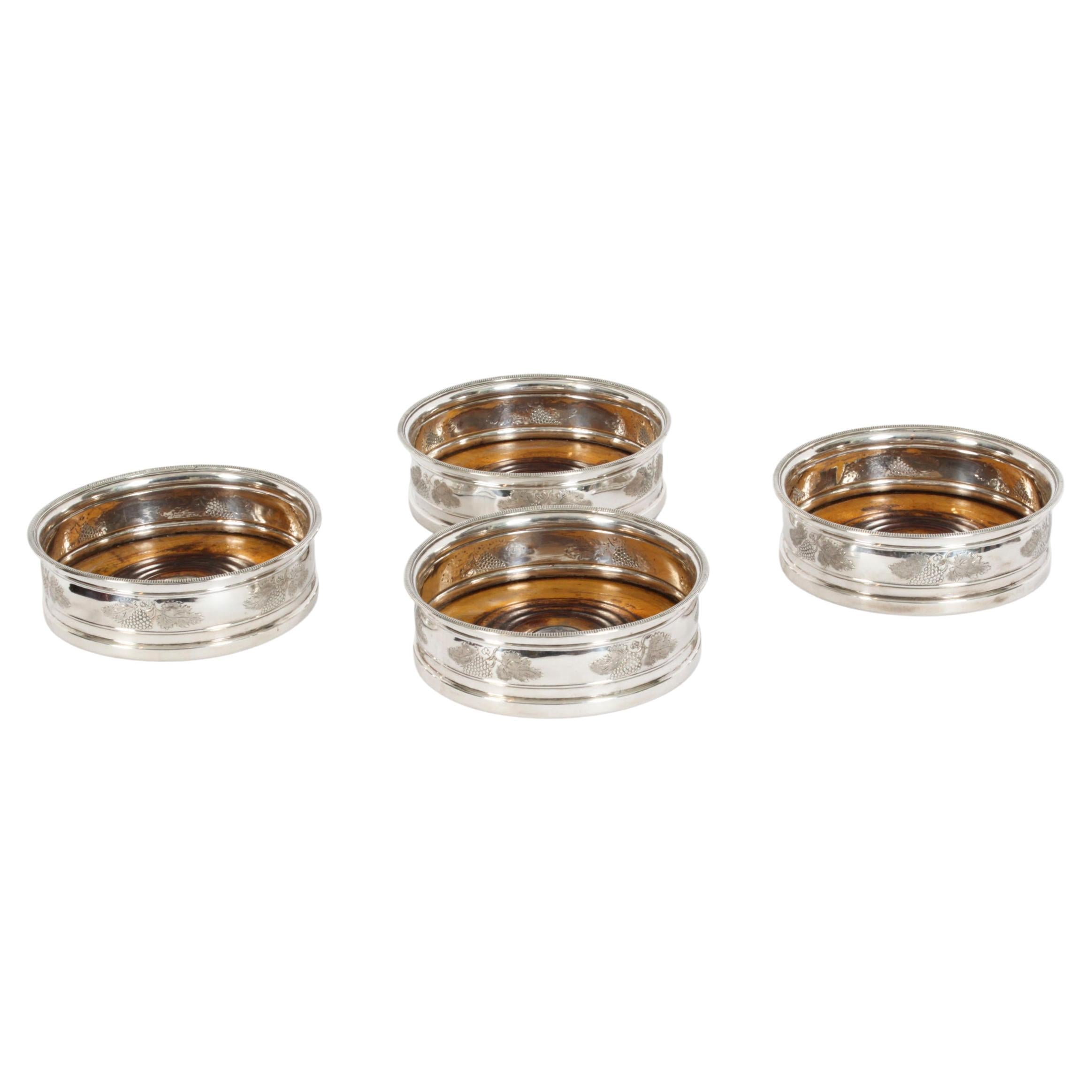
This is a very attractive set of 4 of antique George III Old Sheffield plate wine bottle coasters, circa 1820 in date.
The set are of circular form with a beaded edge decorated w...
Category
Antique 1820s English Regency Sheffield and Silverplate
Materials
Sheffield Plate
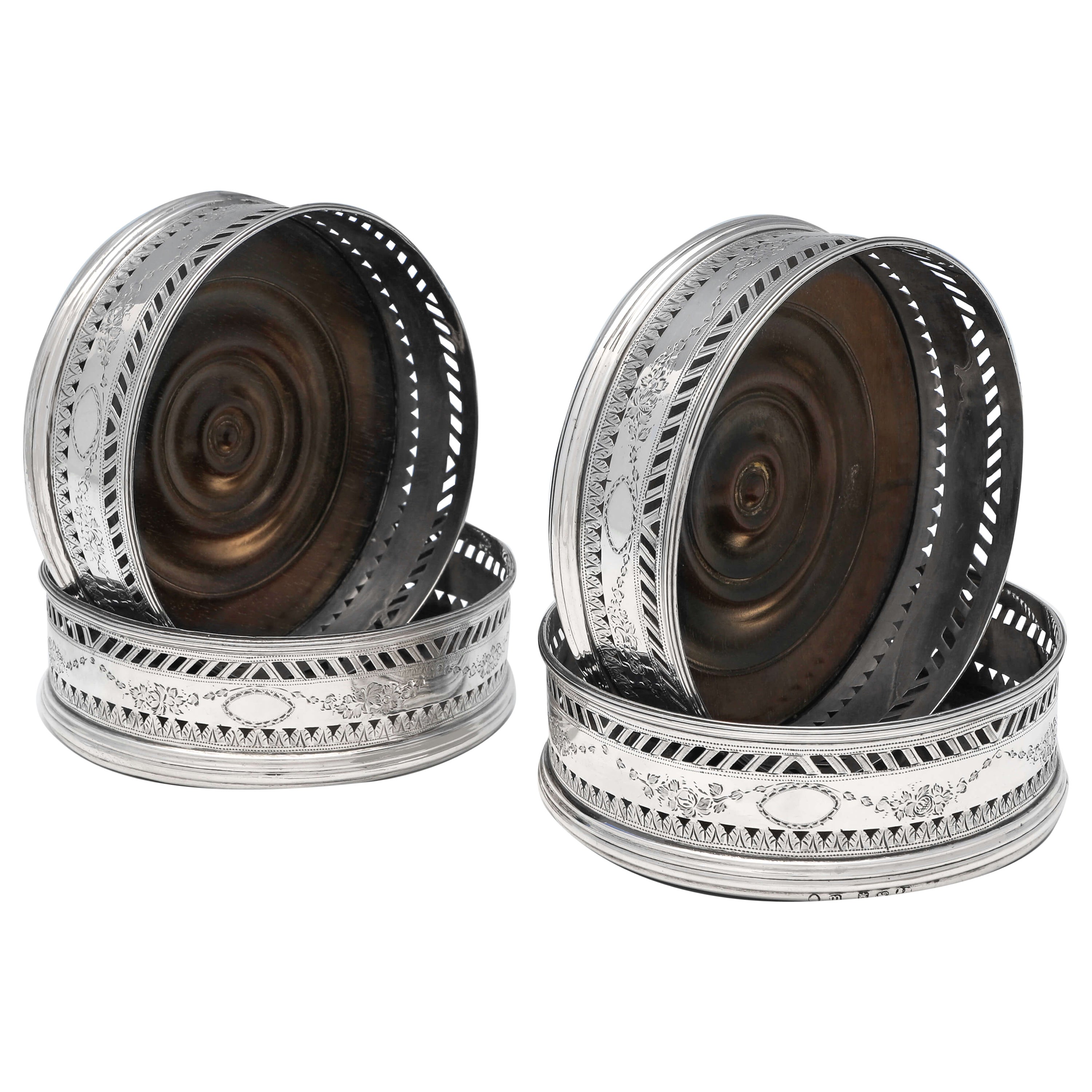
Neoclassical Set of 4 Antique Sterling Silver Wine Coasters, London, 1787
Located in London, London
Hallmarked in London in 1787, this striking set of four George III, Antique Sterling Silver Wine Coasters, feature pierced and eng...
Category
Antique 1780s English Neoclassical Sterling Silver
Materials
Sterling Silver
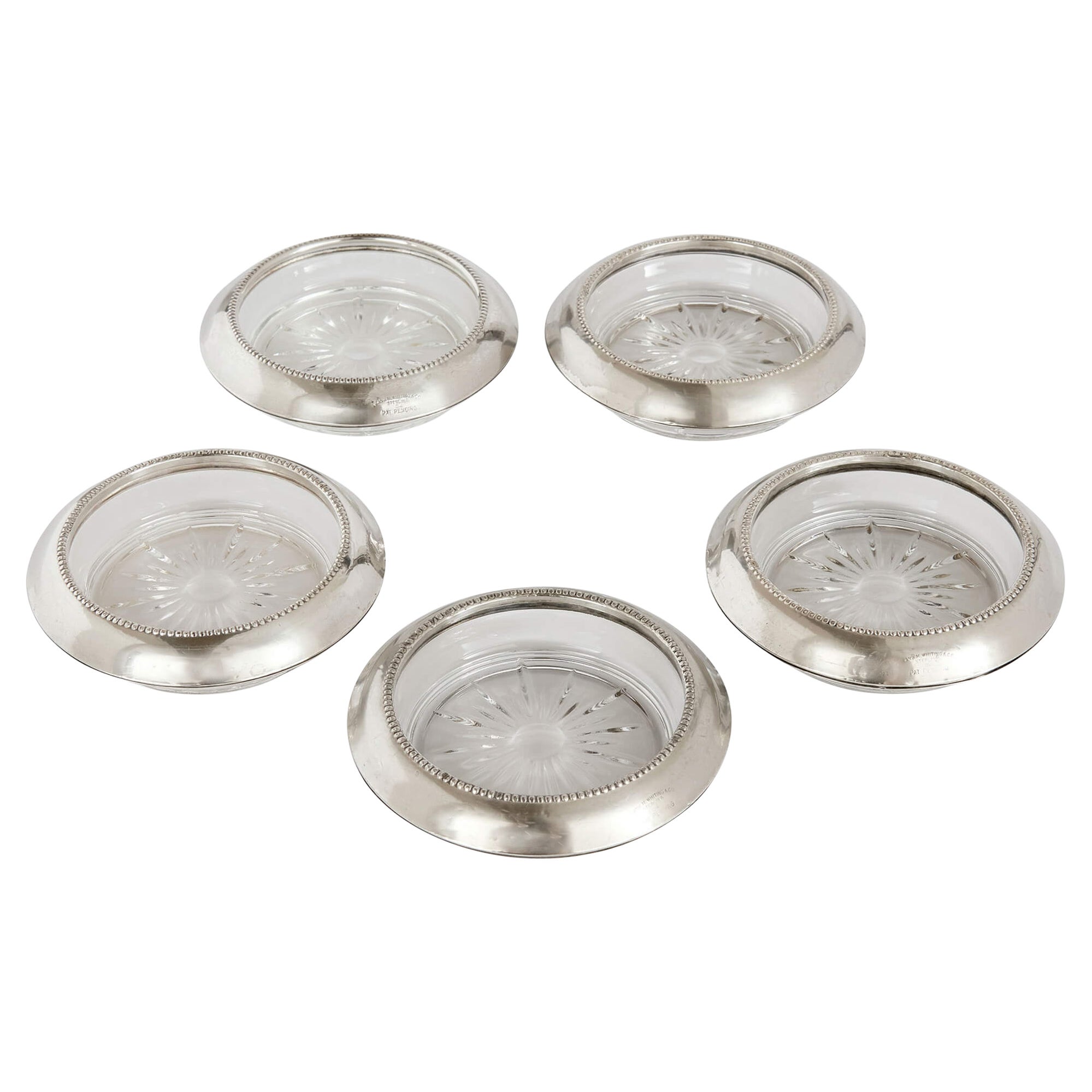
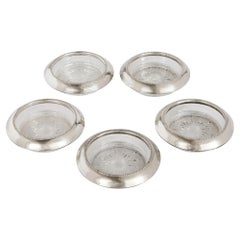
Collection Five American Sterling Silver Cut Glass Coasters Frank M. Whiting
C
Located in London, GB
Collection Five American Sterling Silver Cut Glass Coasters Frank M. Whiting & Co.
American, Early 20th Century
Height 3cm, diameter 10cm
A refined set of five sterling silver and...
Category
Early 20th Century North American Belle Époque Tableware
Materials
Sterling Silver
More Ways To Browse
Sterling Wine Coaster
Antique Plow
Antique Sterling Wine Coaster
Wine Coaster Italy
Used Silverware Sets
Georg Jensen Cactus
Place Card Holders
Antique Wood Plains
Art Reed Glass
Silver Crab
Sterling Egg
Sterling Silver Egg
Sterling Silver Trophies
Trophy Silver Cup
Unmarked Silver
Antique Silver Hall Marks
Celtic Furniture
Eaton Antique