Video Loading
Want more images or videos?
Request additional images or videos from the seller
1 of 13

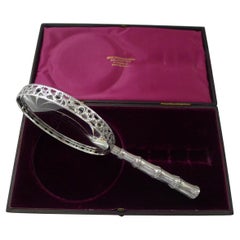
Antique Victorian Sterling Silver Magnifying Glass by Asprey 19th Century

$579.07List Price

You May Also Like

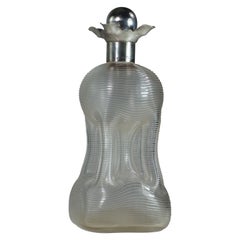
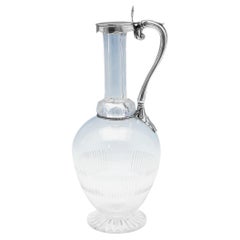
1890 Asprey London Victorian Sterling Silver Glass Decanter
By Asprey Garrard Limited
Located in Brescia, IT
Victorian Decanter Asprey, London 1890-1900 Sterling Silver and Blown Glass Excellent condiction Silver Marks and "Asprey London" engraved Original Victorian era
Category

Antique 1890s English Victorian Sterling Silver

Materials

Sterling Silver

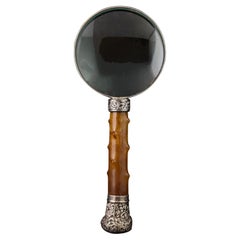
Antique Victorian sterling silver and cattle horn magnifying glass
Located in NEWARK, GB
A grand antique Victorian era sterling silver and cattle horn magnifying glass. A heavy glass lense encased in a thick stainless steel frame, the handle has been adapted from a walk...
Category

Antique 19th Century British Victorian Sterling Silver

Materials

Silver, Steel

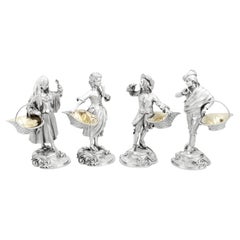
Asprey Garrard 18th Century Sterling Silver Salts
By Asprey Garrard Limited
Located in Jesmond, Newcastle Upon Tyne
An exceptional, fine and impressive set of four contemporary Elizabeth II English sterling silver salts; part of our silver cruet and condiments collection. These exceptional cast sterling silver salts have been realistically modeled in the form of two male and two female figures gesturing towards each other, in the 18th century style. Each female figure is embellished with period attire comprised of a mid-calf length skirt with a bodice style top, one incorporating a fan and the other a lace...
Category

Early 2000s English Tableware

Materials

Sterling Silver

Asprey 
Garrard 18th Century Sterling Silver Salts
$11,915 / set
H 17 in W 10.1 in D 8.8 in
Magnificent Victorian Solid / Sterling Silver Magnifying Glass - 1887
Located in Bath, GB
A truly fine example of a Scottish solid / sterling silver magnifying glass within it's original presentation case. All original with a "bamboo" handle marked at the top with the Qu...
Category

Antique 1880s Scottish Late Victorian Sterling Silver

Materials

Sterling Silver

Magnificent Victorian Solid / Sterling Silver Magnifying Glass - 1887
$1,021
Free Shipping
H 7.5 in W 3.75 in D 0.5 in
19th Century Victorian Cut Glass Antique Sterling Silver Claret Jug from 1870
Located in London, London
Hallmarked in Birmingham, in 1870 by John Gough, this striking, Victorian, antique silver claret Jug, features cut glass, and engraved decora...
Category

Antique 1870s English Victorian Sterling Silver

Materials

Sterling Silver

19th Century, Victorian Sterling Silver Cream Jug
By James Wakely Frank Clarke Wheeler
Located in Jesmond, Newcastle Upon Tyne
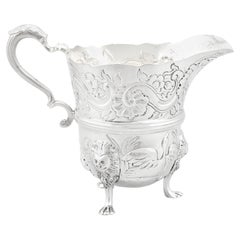
This fine antique Victorian sterling silver cream jug has a plain circular inverted bell shaped form, in the classic Georgian Irish style. The body of this Victorian cream jug is embellished with chased floral and scrolling foliate designs above a plain applied girdle. The lower portion of the body is embellished with further chased decoration depicting a swan and antique fish design amidst water reeds...
Category

Antique 1890s Great Britain (UK) Victorian Serving Pieces

Materials

Silver, Sterling Silver

19th Century Victorian Glass and Sterling Silver-Mounted Claret Jug
By Edward Charles Brown 1
Located in Jesmond, Newcastle Upon Tyne
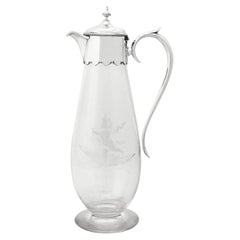
An exceptional, fine and impressive antique Victorian glass and silver mounted claret jug; part of our silver mounted glass collection. This exceptional antique Victorian glass and sterling silver and glass claret jug has a circular rounded form onto a circular spreading foot. The upper portion of the glass body is fitted with the original hallmarked sterling silver mount embellished with an incurved shaped border. The plain domed hallmarked hinged cover is encircled with a band of applied bead decoration and surmounted with an impressive swept, knopped bead decorated finial. This Victorian claret jug is fitted with an S-scroll handle featuring a plain scrolling thumb piece. The glass body of the jug is embellished with an exceptional acid etched illustration depicting a putto entangled with flowing ribbons, playing a stylized percussion triangle whilst standing on the back of a moth style insect. In art and culture, a putto (plural: putti) is a chubby male child, usually nude and occasionally bearing wings. Condition The mount of this antique silver and glass claret jug is an exceptional gauge of silver, exceptional quality and in exceptional condition. The mount has been professionally polished and is in presentation condition. The plain glass body of the jug is in perfect condition. Full hallmarks struck to the surface of the mount and part hallmarks struck to the interior of the cover are very clear. Dimensions Length from back of handle to lip 15.3cm/6". Diameter of rim 5.4cm/2.1". Diameter of body 10.3cm/4.1". Diameter of foot 9.5cm/3.7". Height 30.8cm/12.1". Maker: Richards & Brown (Edward Charles Brown...
Category

Antique 1870s English Victorian Sterling Silver

Materials

Silver, Sterling Silver

19th Century Victorian Sterling Silver Bachelor Coffee Pot
By John Samuel Hunt
Located in Jesmond, Newcastle Upon Tyne
A magnificent, fine and impressive antique Victorian English sterling silver bachelor coffee pot made by John Samuel Hunt; an addition to our silve...
Category

Antique 1850s British Victorian Sterling Silver

Materials

Sterling Silver

19th Century Victorian English Sterling Silver Mustard Pot
By Stokes Ireland Ltd
Located in Jesmond, Newcastle Upon Tyne
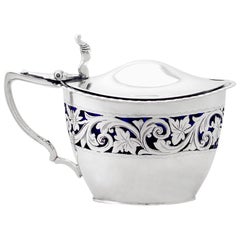
A fine and impressive antique Victorian English sterling silver mustard pot; an addition to our silver cruets/condiments collection. This exceptional antique Victorian sterling silver mustard pot has an oval tapering form. The body of the mustard pot is embellished with a broad shaped band of pierced scrolling leaf ornamentation flanked with undulating wigglework decorated borders. The flared upper rim of this silver mustard pot is encompassed with an applied gadroon decorated border. This Victorian mustard pot retains the original hallmarked hinged, plain domed cover surmounted a shaped bifurcating thumbpiece. This fine example of antique silverware is fitted with a shaped handle featuring an incurved, shaped thumbpiece. The mustard pot is fitted with the original removable blue glass liner. This impressive sterling mustard pot...
Category

Antique 1890s English Victorian Sterling Silver

Materials

Silver, Sterling Silver

19th Century Victorian Sterling Silver Travelling Collapsible Beaker
Located in Jesmond, Newcastle Upon Tyne
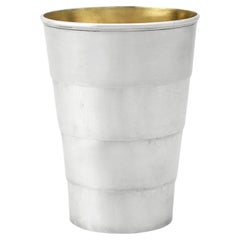
A fine and impressive antique Victorian English sterling silver collapsible beaker - boxed; an addition to our ornamental silverware collection. This impressive antique Victorian sterling silver travelling collapsible beaker has a circular tapering form. The surface of the beaker is plain and unembellished, apart from the hallmarks to each concentric section. The interior of the beaker retains the original gilt interior. This antique beaker...
Category

Antique 1890s English Victorian Sterling Silver

Materials

Silver, Sterling Silver

More From This Seller

View All
Antique Pair Victorian Sterling Silver Butter Dishes Dated 19th Century
Located in London, GB
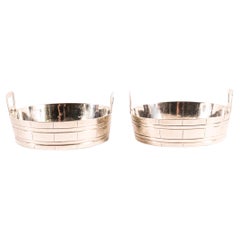
This is a very attractive pair of antique Victorian sterling silver dishes / coasters with hallmarks for London 1890.   They feature attractive faux-coopered decoration with a handle...
Category

Antique Late 19th Century English Victorian Sterling Silver

Materials

Sterling Silver

Antique Graduating Pair Victorian Sterling Silver Cream Jugs 19th Century
By Charles Perry Co.
Located in London, GB
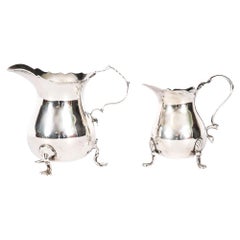
This is an exquisite set of two Victorian sterling silver cream jugs with hallmarks for Chester 1868 and the makers mark of the silversmiths Charles Perry & Co., Chester England. Th...
Category

Antique Mid-19th Century English Victorian Sterling Silver

Materials

Sterling Silver

Antique George III Sterling Silver Salver by Paul Storr 19th Century
By Paul Storr
Located in London, GB
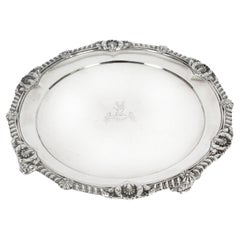
This is a wonderful English antique George III sterling silver 10 inch salver, by the world famous silversmith Paul Storr. It has clear hallmarks for London 1811 and the makers mark of Paul Storr. It is typical of his work with the raised gadrooned rim with anthemion at intervals, on four fabulous foliate bracket feet. The salver is engraved with a crest and motto and the underside is later engraved Charlotte J. Parke from C. J. Parke, March 1893' The centre is engraved with a crest above a motto 'True and Fast' and I have researched this crest: The Crest of Parke The crest as engraved upon this George III English Sterling Silver Footed Salver by Paul Storr hallmarked London 1811 is that of the family of Parke. It may be blazoned as follows: Crest: A stag’s head couped sable holding in the mouth a key or Motto: True and fast The family of Parke originally hailed from the County of Cumberland in the northeast of England1 later settling in the County of Dorset at Henbury House, Sturminster Marshal, near Wimborne. Given the evidence of the inscription found on the underside of the salver ‘Charlotte J. Parke from C. J. Parke, March 1893’ it was undoubtedly at one time in the possession of Charles Joseph Parke (died 9th March 1893) of Henbury House aforesaid and gifted to Charlotte Josephine Parke (baptised 4th January 1857 died 2nd January 1941) his third daughter by his wife, Ellen Mary Ethelston. I would venture the following hypothesis that the salver was bequeathed to Charlotte in her father’s will that was granted probate at London on the 20th May 1893. The ‘March 1893’ of the inscription acts as a remembrance of the month of the death of her father. It was noted that Charlotte’s father left an estate worth some £66,892, 19 shillings and one pence, a very considerable sum in the last decade of the 19th Century and even thereafter. Charlotte never married and was living at the time of her death at The Coppice, Sixpenny Handley in the County of Dorset. Her will was proved for probate at Llandudno on the 25th March 1941. She left an estate worth £18,866, 10 shillings and 4 pence. Again, a comfortable sum in 1941. See the photo of Henbury House, Sturminster Marshal, near Wimborne, Co. Dorset. The former seat of the Parke family. The house was destroyed by fire, the remains of which were demolished in the 1990's. There is no mistaking its unique quality and design, which is sure to make it a treasured piece by any discerning collector. Condition: In excellent condition with clear hallmarks and no dings, dents or signs of repair. Please see photos for confirmation. Dimensions in cm: Height 2 x Width 26.5 x Depth 26.5 Weight 0.69 kg Dimensions in inches: Height 1 inch x Width 10 inches x Depth 10 inches Weight 1.5 lbs Paul Storr born in London England in 1771, was to become one of the most talented silversmiths of the nineteenth century. Today his legacy of exceptionally well crafted silver, found worldwide in museums and private collections, leaves one in awe when compared to that of his contemporaries.After having served a seven year apprenticeship from the age of 14, he began his career in 1792 when he went into a brief partnership with William Frisbee. This did not last and in 1793 a new mark, (his initials ‘P S’) was entered. By the beginning of the nineteenth century he had established himself as one of London’s top silversmiths producing, amongst others, commissions for Royalty. In 1801 he married Elizabeth Susanna Beyer with whom he was to have ten children. In 1807 Paul Storr entered into a working relationship with Philip Rundell and by 1811 was a partner, and managing the workshops for Rundell, Bridge & Rundell. During this period he kept his own marks and separate workshop. However it was through Rundell, Bridge & Rundell who were appointed Goldsmith in Ordinary to George III in 1804 that his reputation as a master silversmith grew. His talents lay in being able to transform ideas and designs from Rundell, Bridge & Rundell’s designers, William Theed...
Category

Antique 1810s English George III Sterling Silver

Materials

Sterling Silver

Antique Victorian Sterling Silver Casket by William Comyns Sons 1898
By William Comyns Sons 1
Located in London, GB
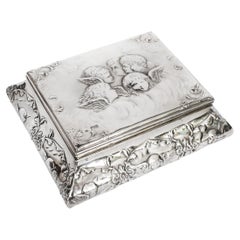
This is an elegant antique Victorian sterling silver casket with hallmarks for London, 1898 and the makers marks of the renowned silversmith William Comyns & Sons. The shaped casket...
Category

Antique 19th Century English Victorian Sterling Silver

Materials

Sterling Silver

Antique Pair Belgian Silver Grouse Game Birds 19th Century
Located in London, GB
This is a stunning Antique Belgian pair of silver grouse with exceptional detailing to the modelling of the birds, bearing the makers mark ZL and the silver mark A835 405g (13.02 oz....
Category

Antique Late 19th Century Belgian Sterling Silver

Materials

Silver

Antique Large William IV Silver Tray Salver by Paul Storr 19th Century
By Paul Storr
Located in London, GB
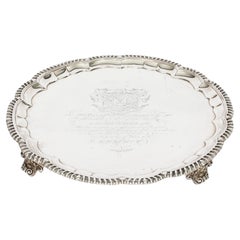
This is a wonderful English antique William IV sterling silver tray, or salver, by the world famous silversmith Paul Storr. It has clear hallmarks for London 1820 the makers mark of Paul Storr. It is typical of his work with the octafoil shape and the exquisitely detailed reeded rim, and it is raised on four delightful foliate and scroll feet. The centre is engraved with a shield shaped coat of arms which I have had researched. The Marital Arms of Knollis and Hallifax The armorial bearings as engraved upon this George IV Large English Sterling Silver Footed Salver by Paul Storr hallmarked London 1820 are those of the family of Knollis with Hallifax in pretence. These armorial bearings denote the marshalling of a marital coat showing the arms of the husband over the entire surface of the shield, whilst the arms of the wife (as an heraldic heiress) are placed on a small shield (known as an escutcheon of pretence) centrally on the husband’s arms. They may be blazoned as follows: Arms: Quarterly 1st and 4th Azure crusily of cross crosslets a cross moline voided or (for Knollys) 2nd and 3rd Gules on a chevron argent three roses of the field barbed proper (for Knollys) over all an escutcheon of pretence Or on a pile engrailed sable between two fountains barry wavy of six argent and azure three cross crosslets of the first (for Hallifax) Crest: An elephant argent [differenced with a mullet1 ] (for Knollys) Motto: In utrumque paratus [Prepared for either] (for Knollys) These armorial bearings undoubtedly commemorate the marriage of The Honourable and Reverend Francis Knollis2 (baptised 3rd January 1743 died 27th February 1826), 1 The cadency mark for a third son of a family. 2 Francis appears to have preferred this spelling of his family’s surname. It is spelt as it is to be pronounced. of Burford in the County of Oxfordshire and of Eastleach Martin in the County of Gloucestershire and Mary Hallifax (baptised 5th March 1753 buried 18th December 1830). Francis and Mary were married at the Parish Church of St Mary, Ewell in the County of Surrey on the 9th June 1772. Francis was the third son of Charles Knollys (the titular 5th Earl of Banbury) 3 and his wife, Martha Hughes, whilst Mary was the daughter of The Reverend James Hallifax, of Ewell aforesaid and his wife, Elizabeth Chardavoyn. 3 Francis’s father claimed to be the 5th Earl of Banbury. A claim that continued to be pursued by the family until William Knollys, the titular 8th Earl of Banbury (born 1763 died 1834) was forced to discontinue its use by a resolution of the House of Lords which rejected his claim to the earldom in 1813. The crest surmounts a detailed dedication: This piece of plate was presented to the Honourable Rev Knolls by the inhabitants of the town and immediate neighbourhood of Burford on his completing the fiftieth year of his incumbency as the vicar of Burford. In testimony of their high respect 11th April 1821 There is no mistaking its unique quality and design, which is sure to make it a treasured piece by any discerning collector. Condition: In excellent condition with clear hallmarks and no dings, dents or signs of repair. Please see photos for confirmation. Dimensions in cm: Height 3 x Width 36 x Depth 36 Weight 1.52 kg Dimensions in inches: Height 1 inch x Width 1 foot, 2 inches x Depth 1 foot, 2 inches Weight 49 troy oz Paul Storr born in London England in 1771, was to become one of the most talented silversmiths of the nineteenth century. Today his legacy of exceptionally well crafted silver, found worldwide in museums and private collections, leaves one in awe when compared to that of his contemporaries.After having served a seven year apprenticeship from the age of 14, he began his career in 1792 when he went into a brief partnership with William Frisbee. This did not last and in 1793 a new mark, (his initials ‘P S’) was entered. By the beginning of the nineteenth century he had established himself as one of London’s top silversmiths producing, amongst others, commissions for Royalty. In 1801 he married Elizabeth Susanna Beyer with whom he was to have ten children. In 1807 Paul Storr entered into a working relationship with Philip Rundell and by 1811 was a partner, and managing the workshops for Rundell, Bridge & Rundell. During this period he kept his own marks and separate workshop. However it was through Rundell, Bridge & Rundell who were appointed Goldsmith in Ordinary to George III in 1804 that his reputation as a master silversmith grew. His talents lay in being able to transform ideas and designs from Rundell, Bridge & Rundell’s designers, William Theed...
Category

Antique 1820s English William IV Sterling Silver

Materials

Sterling Silver

Still Thinking About These?

All Recently Viewed