Items Similar to Important and rare jewish silver Sivlonot /wedding belt, Frankfurt 1707-1723
Want more images or videos?
Request additional images or videos from the seller
1 of 19
Important and rare jewish silver Sivlonot /wedding belt, Frankfurt 1707-1723
$18,000
£13,695.37
€15,779.85
CA$25,554.37
A$27,415.26
CHF 14,704.98
MX$330,076.08
NOK 185,373.58
SEK 169,035.01
DKK 117,896.54
About the Item
Important and rare Sivlonot belt, gilded silver, made by the famous silversmith Johann Mathias Sandrat active in 1707-1723 in Frankfurt, Germany. this JUDAICA object is a museum piece and An almost identical belt with a replaced buckle is exhibited in the Israel museum and came from the important Feuchtwanger Collection, purchased and donated by Baruch and Ruth Rappaport, Geneva.
the belt also bears 2 Christies auction stickers with the number 120, probably lot # 120, indicating it was sold in one of their auction rooms at some point.
Sivlonot (wedding) belt:
In Rabbinic literature, sivlonot refers to gifts the groom gave his wife-to-be. Among German Jews, from the 16th century on, sivlonot took the form of belts: the groom sent his bride a belt with a gold buckle; she sent him a belt with a silver buckle. The couple would then wear the belts under the huppah, sometimes attaching them by means of another belt or a chain. Sivlonot belts were often decorated with universal symbols of love, such as two intertwined hands holding a heart, or the portraits of a man and woman.
length of the belt is : 36 inch
widest point of the buckle : 2.7 inch
belt width : 1.2 inch
Frankfurt jewish community:
The beginnings of Jewish life in Frankfurt am Main date back to the twelfth century, when the first community settled in the area around where the cathedral now stands. But the pogroms of 1241 and 1349 put an end to this period of Jewish life in the city. In 1360 Jewish families returned, when the Jewish Code of Residence (Stättigkeit) once again granted them the right to settle here.
In 1464 the city’s Jews were allocated an area on the edge of the city, where later the Judengasse, or Frankfurt ghetto, emerged. With the exception of the two-year Fettmilch Rising between 1614 and 1616, this was where the city’s Jews remained until emancipation. In 1846, Jews were granted equal rights and gradually relocated to other areas of Frankfurt.
By 1933, the Jewish Community in Frankfurt numbered more than 30,000 members, the majority of them organised in the Israelite community. In 1804 the new Philanthropin schoolhouse was founded, and the Jewish Community in Frankfurt became a centre of religious reform.
In a counter-movement, Rabbi Samson Raphael Hirsch led the formation of the secessionist orthodox community, which banded together to form the Israelite Religious Society in 1848. As well as numerous smaller places of worship, there was the main synagogue in the Jewish Quarter, another at Börneplatz, a third in the Friedberger Anlage, built in 1907 for the secessionist orthodox community, and the liberal Westend Synagogue, built in 1910. The Jewish Community in Frankfurt reflected the open-mindedness of the city.
Numerous members of the Jewish Community took on prominent roles in the cultural and political life of Frankfurt, with many institutions growing from Jewish foundations or established by Jewish citizens, such as the Johann Wolfgang von Goethe University and Frankfurter Zeitung newspaper, predecessor of the Frankfurter Allgemeine Zeitung. Frankfurt has also been home to several famous rabbis of the various religious groups, including Samson Raphael Hirsch, Markus Horovitz, Nehemia Anton Nobel, Ceasar Seligmann and Georg Salzberger
- Dimensions:Height: 36 in (91.44 cm)Diameter: 2.7 in (6.86 cm)
- Materials and Techniques:
- Place of Origin:
- Period:
- Date of Manufacture:1710
- Condition:Wear consistent with age and use. minor scratches and dents.
- Seller Location:Tel Aviv - Jaffa, IL
- Reference Number:1stDibs: LU8130236074322
About the Seller
No Reviews Yet
Vetted Professional Seller
Every seller passes strict standards for authenticity and reliability
1stDibs seller since 2023
- ShippingRetrieving quote...Shipping from: Tel Aviv - Jaffa, Israel
- Return Policy
More From This Seller
View AllImportant 18th century Persian Jewish silver Amulet for mother and newborn
Located in Tel Aviv - Jaffa, IL
Mysterious Amazing, 18th century silver talismanic amulet, Amulet for mother and Newborn with image of Lilith in the center made by Jews in Persia, the top of the Amulet has an amazi...
Category
Antique 1790s Tribal Art
Materials
Agate, Silver
extremely rare Algerian Judaica silver, jewish Dowry box early 19th century
Located in Tel Aviv - Jaffa, IL
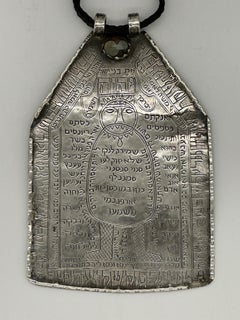
Amazing and scarce JUDAICA object, we have here one of the most touching jewish objects we had for a long time, this small silver dowry box was made in Algeria in the early 19th century, it is all covered with symbols of jewish faith and of couples, the sliding lid has 2 flanking birds with hamsa (protective hand) on each side and a flower vase in the middle.
one side shows two flanking lions with a tree in the middle and the other side shows again two big and two small birds with a flower bowl in the middle, front side has a key hole and next to it there is the Hebrew inscription ס״ט״" which says Siman tov or in English "a good sign" it is taken from the wedding blessing, underneath the lock there is another inscription with the name ״עזיזה בת אברהם בן חמו״ which is the name of the bride, her father and her grandfathers name.
the box is full marked a lot of times with the silversmith mark, every side of the box is marked.
this box was probably ordered by the grooms family to hold the jewelry they are giving to the bride as dowry, this type of objects are rare and there are just a few of them on museum collections.
DOWRY (Heb. נְדֻנְיָה), the property a wife brings to her husband at marriage; the Yiddish equivalent, nadn, is from the same root. The custom of nedunyah became clearly defined and institutionalized only in the talmudic period. In biblical times, mohar (מֹהַר), whereby the groom bought his wife from her father (Gen. 24:53; Ex. 22:15–16; Hos. 3:2), was the accepted practice. It was then customary that the groom give the bride gifts, and that she bring certain property to her husband's home upon marriage: slaves, cattle, real estate, etc. (cf. Gen. 24:59–61; 29; Judg. 1:14ff.; I Kings 9:16). Evidence of the custom of nedunyah is to be found in Tobit (7:14; 8:21) and in the Assuan papyri (Cowley, Aramaic, nos. 15, 18). Gradually, mohar was superseded by the ketubbah custom according to which the husband merely assumed the responsibility of compensation to his wife in case he divorced her: he had to pay her 200 zuzim if she had been a virgin at the time of marriage, and 100 zuzim if a widow or divorcée (see *Ketubbah).
By talmudic times, the institution of nedunyah was prevalent; the father gave a dowry to the bride since the daughter was excluded from paternal inheritance. Fifty zuzim (equivalent to the worth of 180 grams of silver) was the minimum amount a father was obliged to give to his daughter (Ket. 6:5). Parents usually gave much more, according to their social standing. Community funds provided the dowry for an orphan or a very poor girl (ibid.; cf. Sh. Ar., YD 251:8). In case of her father's death, the brothers of a minor girl were obliged to give her the minimum dowry, and the court estimated how much her father would have given her above the minimum dowry. The sum was then taken out of the father's estate and given to the daughter upon majority (Ket. 6:6; 68a–69b). In the absence of such an estimate, each daughter was entitled to receive one-tenth of the value of her father's estate in money, or in valuables (Yad, Ishut, 20:4–7; Sh. Ar., EH 113:4). If the father was unable or unwilling to pay the promised dowry at the betrothal ceremony, the groom could refuse to marry his bride (Ket. 13:5; Ket. 108b–109a). Insistence on exact payment of the promised dowry, however, was frowned upon by later rabbinic authorities (Rema to Sh. Ar., EH 2:1). In certain communities it was customary for the groom's father to make a dowry contribution equal to that of the bride's father (Ket. 102b). The dowry, whether given in real estate, slaves, money, or chattel was recorded in the marriage contract (the ketubbah) and in some instances one-third or one-fifth of the actual value of the dowry was added to the sum mentioned in the ketubbah. Based upon a decree enacted by *Simeon b. Shetah (first century C.E.), the Talmud ruled that the husband and his entire property were liable for compensation as stipulated in the ketubbah, either in case he died (when she collected the sum specified in the ketubbah from the heirs) or in case he divorced his wife (Ket. 82b). For the status of the dowry and the husband's rights and obligations, see below. The rabbinic enactments (Takkanot Shum) by R. Jacob *Tam and by the rabbinic synod of the communities of Speyer, Worms, and Mainz (Germany) stipulated that if a woman died...
Category
Antique Mid-19th Century Algerian Tribal Art
Materials
Silver
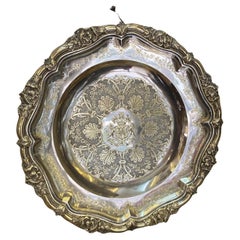
Important Rothschild family French silver presentation plate by Maurice Mayer
Located in Tel Aviv - Jaffa, IL
extremely rare french silver presentation plate/ dinner plate.
this important plate is one of the best quality work and engraving i have ever seen in my life, the outer rim is all adorned
and ornate with flowers in neoclassical style, and the actual plate is all hand engraved with the most incredible engraving with gold plating on just the engraved patterns what makes the plate looks like the gold plated part is 3 dimensional.
This important plate was made in paris by the famous silver master Maurice Mayer...
Category
Antique Late 19th Century French Neoclassical Sterling Silver
Materials
Gold Plate, Silver
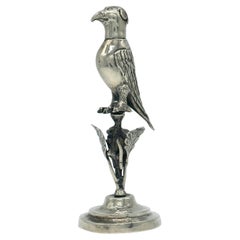
RARE Austrian silver (ALT WIEN) Havdalah spice container, Judaica ISRAEL MUSEUM
Located in Tel Aviv - Jaffa, IL
Up for sale is this museum quality Judaica Havdalah spice container, very rare with great provenance!!
This silver spice tower was made in Vienna Austria, on the early part of the 19...
Category
Antique Early 1800s Snuff Boxes and Tobacco Boxes
Materials
Silver
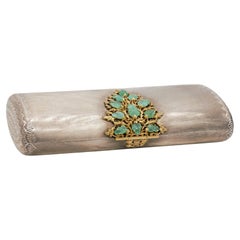
Silver Gold and Gem-Set Clutch with Black Silk Carrying Case, Mario Buccellati
By Mario Buccellati
Located in Tel Aviv - Jaffa, IL
Rare and one of a kind important Mario Buccellati clutch.
Gold, silver and carved Emeralds evening bag, The silver bag engraved in a sunburst-like Pa...
Category
Vintage 1960s Italian Sterling Silver
Materials
Gold, Silver
$41,600 Sale Price
20% Off
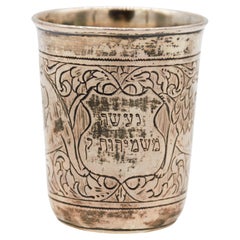
A RARE SILVER SHMIROT KIDDUSH CUP. Galician, c. 1850.
Located in Tel Aviv - Jaffa, IL
A RARE SILVER SHMIROT KIDDUSH CUP. Galician, c. 1850.
Among some Hassidic courts, it was a practice for the Rabbi to give a blessed silver coin to his Hassidim as an amulet. Such protection might be given for all manner of life events, from healing from an illness to success in travel and the amulet was carried on the body of the recipient. This custom was particularly popular among the Ryzhiner Hassidim and these coins were called "Shmirot". To such coins were attributed extraordinary power and value and they were treasured with great care and love.
this cup is marked with polish loth 12 mark which indicate silver content of 75%.
Size :
Height 2.3 inch / 6 cm
Width : 2 inch / 5 cm
After the specific event for which they had originally be given, such a coin or coins were used in the making of other objects, which maintained the special aura of the Rabbi. Such a coin would be melted in other silver with the amuletic valued being spread evenly to all the silver. Then a ritual object would be fashioned by a silversmith and the special nature of the item would be inscribed on it, indicating in one of several ways that this object had been made from "Shmirot". this objects include Kiddish cups, a Havdalah tray, a Shabbat salt holder, a Chanukkah Menorah, a Torah crown etc.
This object is a Kiddish cup fashioned from such silver. On this cup, the inscription indicating Shmirot is found in the abbreviation of the words "made from shmirot k (kodesh)' " (This is the cup of Shmirot). Such cups were used for blessing the wine so that each use renewed the power of protection granted by the Rabbi. This cup was used for the blessing over wine on Shabbat and holidays. Inscription:
the other iconography on the cup is of a lion that represent Through the tribe of Judah, the lion symbol came to represent the blessing, majesty, and even divine protection of the Jews. The lion symbol continued to be used even after the destruction of Jerusalem, the capital of Judah's nation,
and a unicorn or a re'em, also reëm (Hebrew: רְאֵם), is an animal mentioned nine times in the Hebrew Bible It has been translated as "unicorn" in the Latin Vulgate, King James Version, and in some Christian Bible translations as "oryx" (which was accepted as the referent in Modern Hebrew),[citation needed] "wild ox", "wild bull", "buffalo" or "rhinoceros". Rabbi Natan Slifkin has argued that the re'em was an aurochs, as has Isaac Asimov...
Category
Antique 1850s Sterling Silver
Materials
Silver
You May Also Like
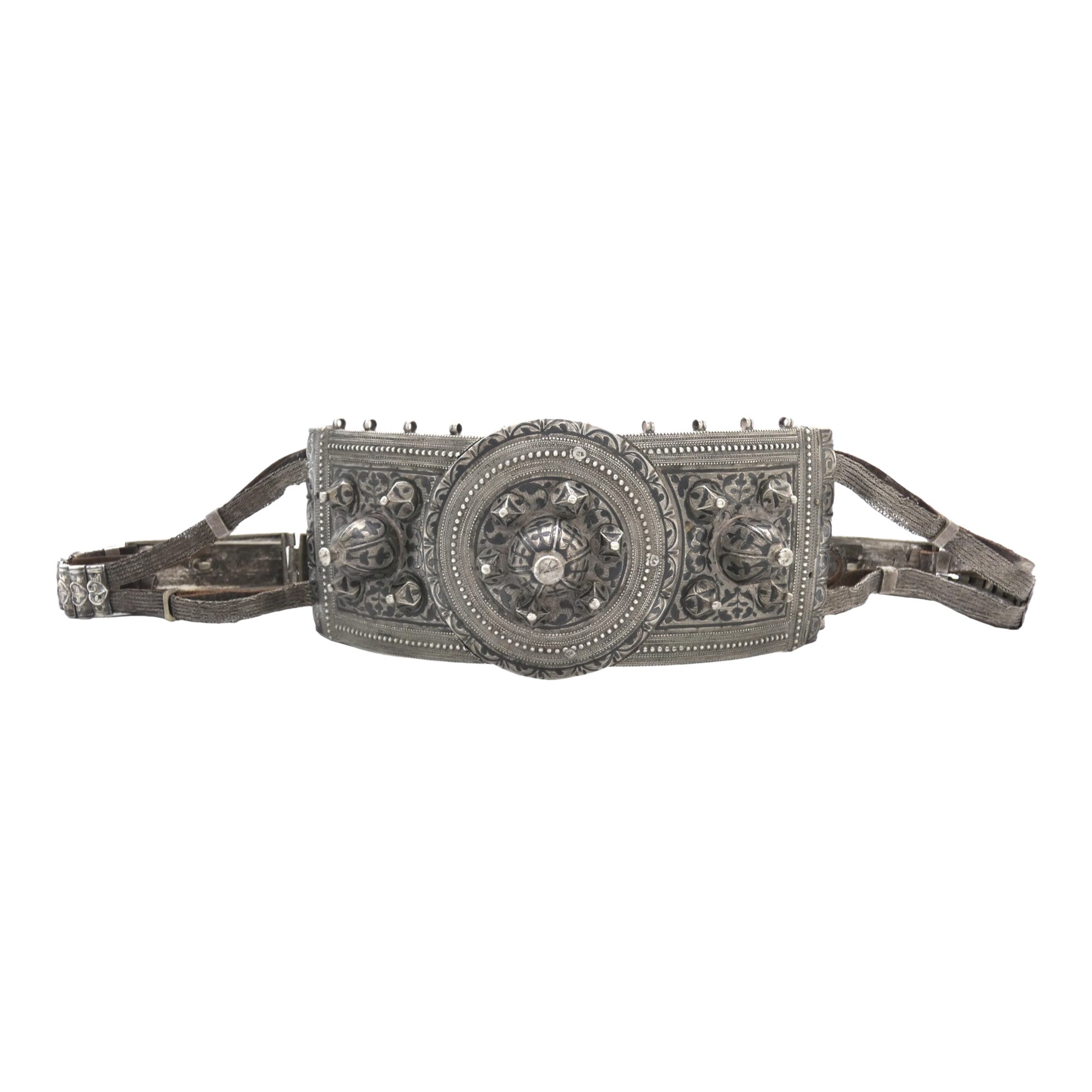
A Silver Kavkaz Belt, Russia Early 20th Century Judaica
Located in New York, NY
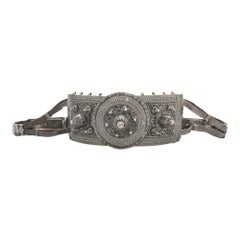
This traditional silver Kavkaz belt from early 20th century Russia featuring a niello design is a highly valuable and culturally significant piece. The Kavkaz region, encompassing th...
Category
Early 20th Century Russian Sterling Silver
Materials
Silver
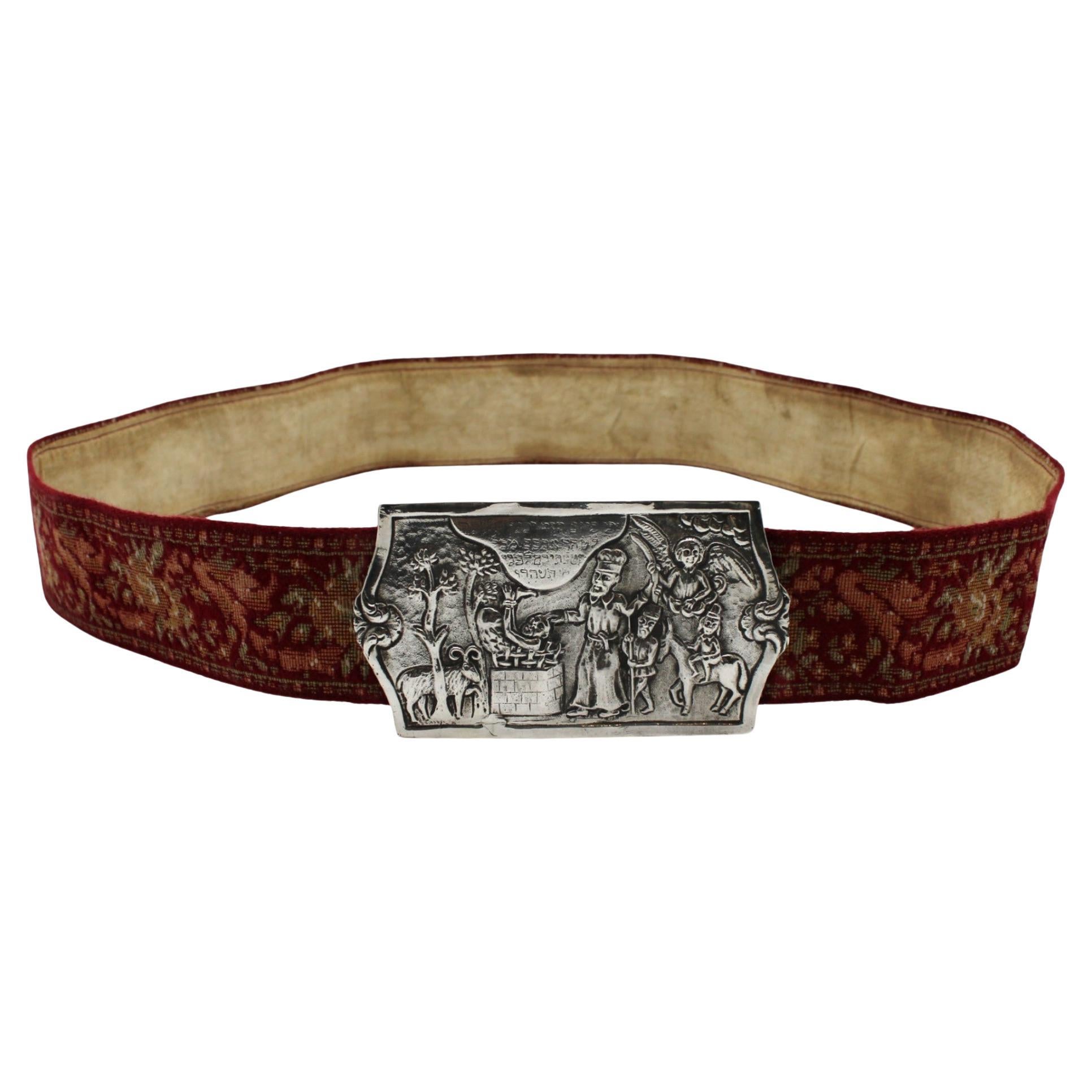
A Yom Kippur Belt with Silver Buckle, Europe, 20th Century
Located in New York, NY
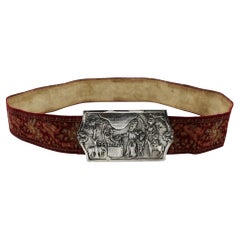
A fine ceremonial Yom Kippur belt, fashioned in continuation of an old and meaningful European Jewish tradition in which men wore a prominent belt atop the kittel on Yom Kippur as a ...
Category
20th Century Sterling Silver
Materials
Silver
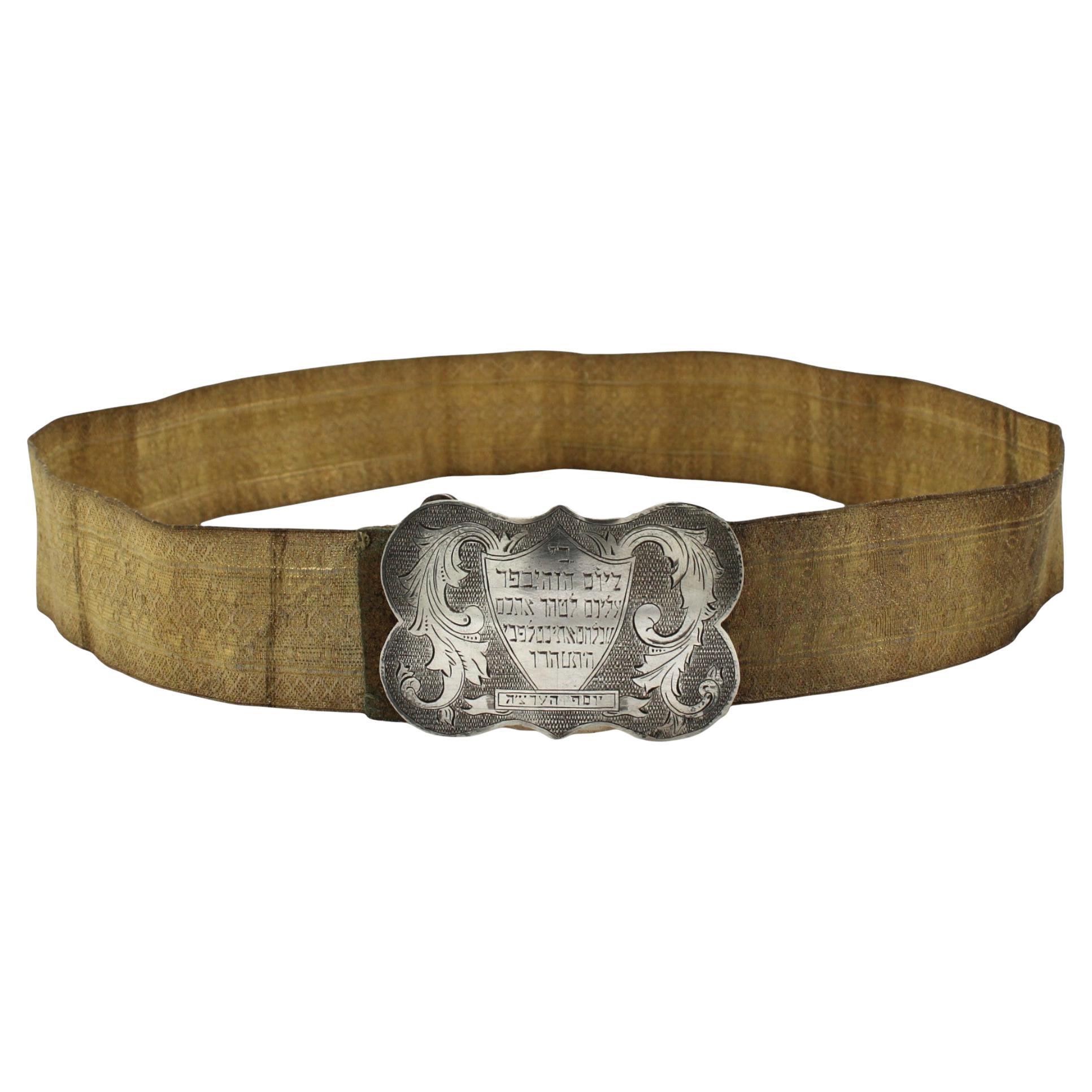
Yom Kippur Belt with Silver Buckle, Europe, 20th Century
Located in New York, NY
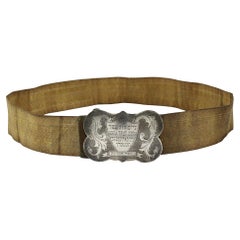
A distinguished ceremonial Yom Kippur belt, created in faithful continuation of an old and deeply meaningful Eastern European Jewish tradition. From the late 18th through the late 19...
Category
20th Century Sterling Silver
Materials
Silver
1920 Bezalel Silver Filigree Bracelet – Handmade Jerusalem Artistry
Located in New York, NY
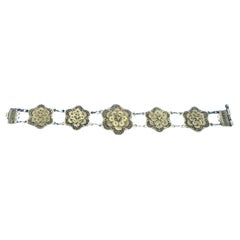
This exquisite handmade silver filigree bracelet, created circa 1920 at the renowned Bezalel School of Arts and Crafts in Jerusalem, exemplifies the intricate artistry and cultural f...
Category
Early 20th Century Israeli Collectible Jewelry
Materials
Silver
A Silver Bracelet, Jewelry for Women, Yemen Circa 1900
Located in New York, NY
This beautifully crafted silver bracelet, made in Yemen circa 1900, is an exquisite example of refined traditional jewelry designed with both elegance and functionality in mind. The ...
Category
Early 20th Century Yemeni Sterling Silver
Materials
Silver
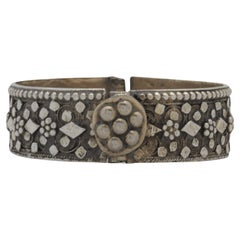
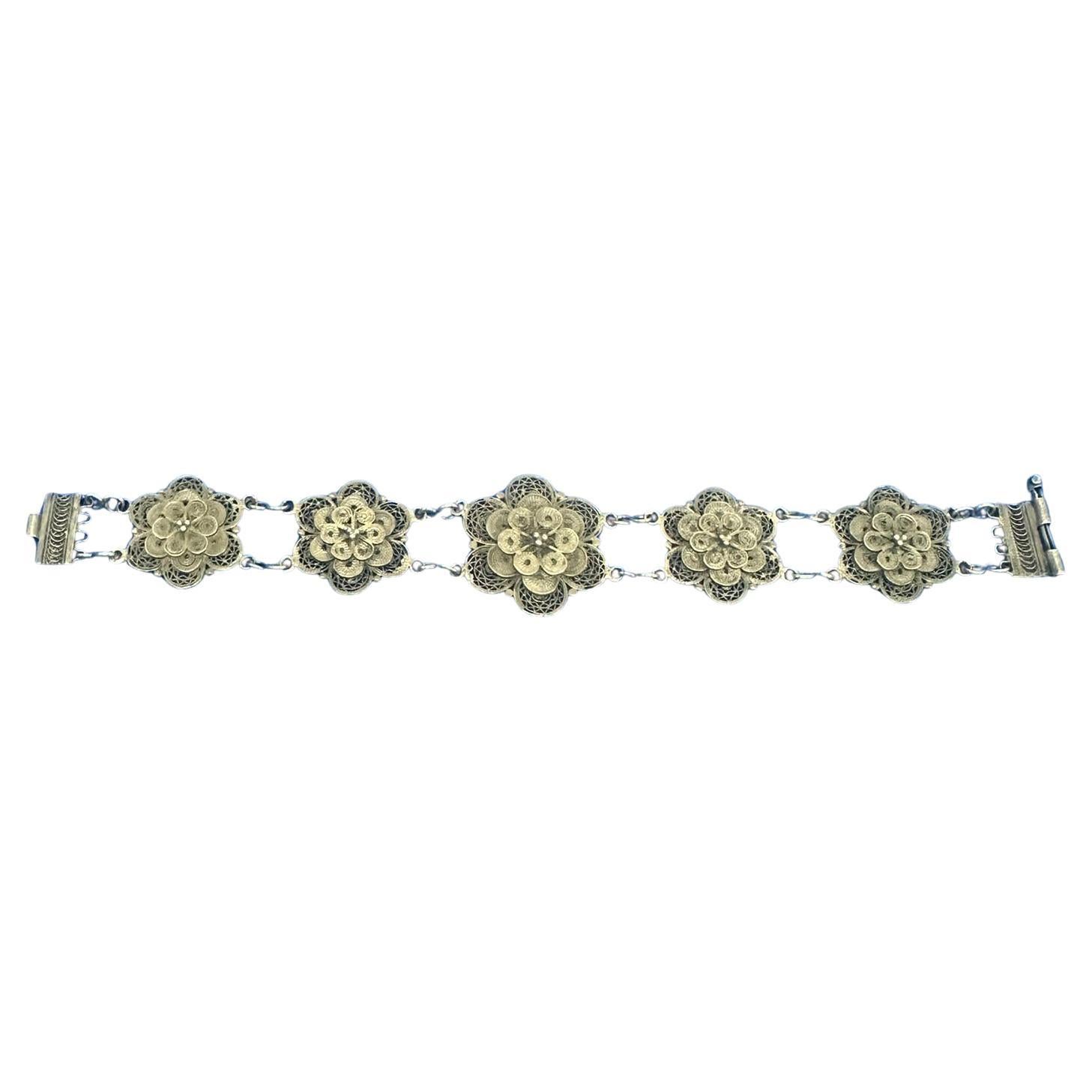
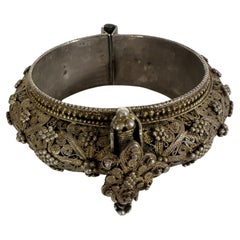
Yemenite Jewish Bridal Bracelet – Silver Filigree Dowry Ornament
Located in New York, NY
This exquisite handmade silver bracelet is a remarkable example of traditional Yemenite Jewish bridal jewelry, crafted as part of a dowry set. Meticulously fashioned in the distinctive filigree technique characteristic of Yemenite silversmiths, the piece reflects both cultural significance and exceptional artisanal skill.
The bracelet is composed of two hinged halves, secured with a screw clasp mechanism, a typical feature in historic Middle Eastern and North African jewelry...
Category
Antique Late 19th Century Yemeni Collectible Jewelry
Materials
Silver
More Ways To Browse
Hands Belt
Antique Silver Buckle
Antique Silver Buckles
Jewish Gold
Rare Antique Hammers
Antique Gold Belts
Antique Silver Belt Buckle
Silver Plated Belt
Jewish Glass
Gold And Silver Belt
Jewish Plates
Frankfurt Kitchen
Spring Glory Sterling Silver Set
State House Sterling Silver Flatware
Sterling Iris
Sterling Silver 18th Century Mug
Sterling Silver Pepper Pots
Sterling Silver Ship