Items Similar to Thomas Barker 1825 London Georgian Pair of Fruit Spoons in Gilded .925 Sterling
Want more images or videos?
Request additional images or videos from the seller
1 of 9
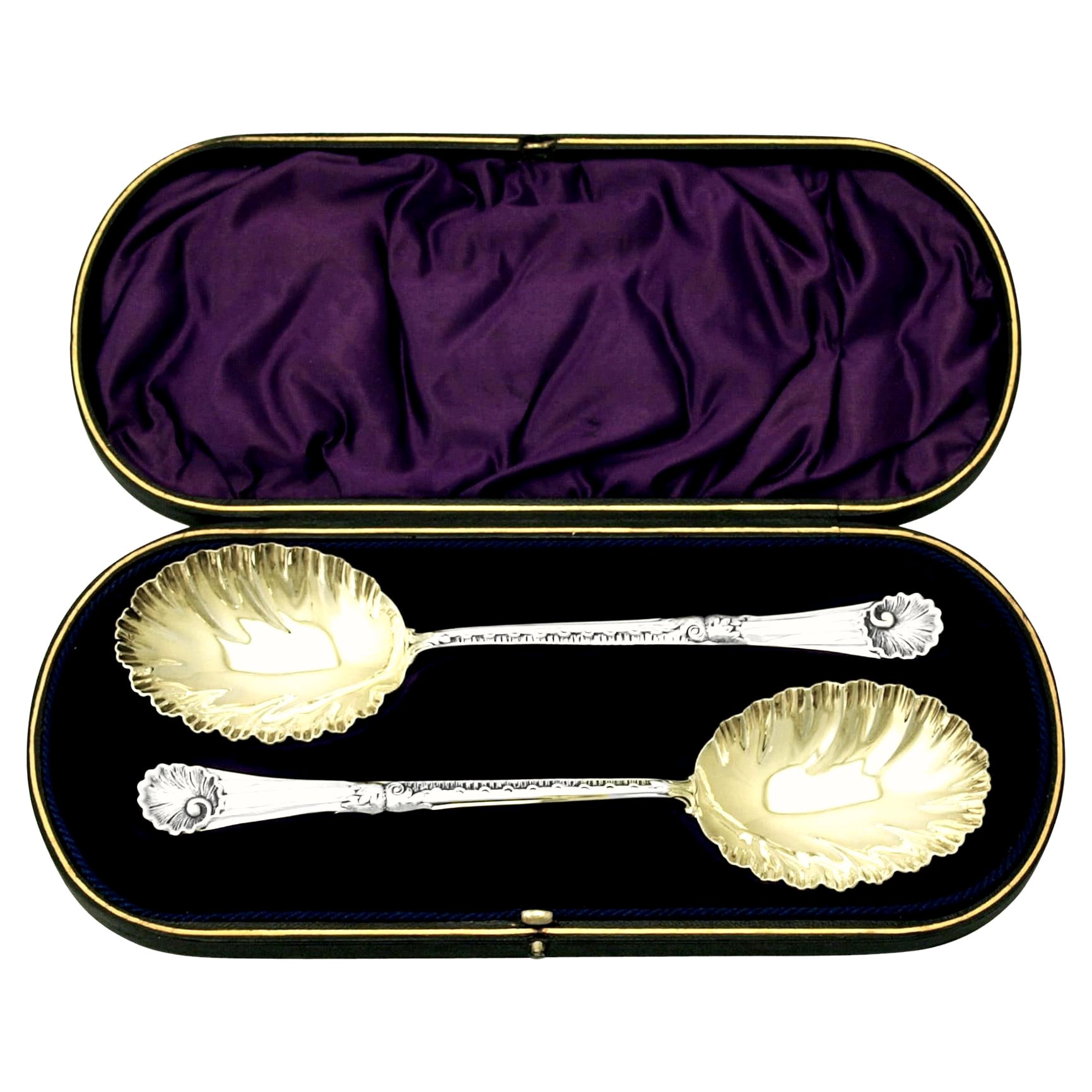
Thomas Barker 1825 London Georgian Pair of Fruit Spoons in Gilded .925 Sterling
$1,000per set
$1,250per set20% Off
£760.85per set
£951.07per set20% Off
€876.66per set
€1,095.82per set20% Off
CA$1,419.69per set
CA$1,774.61per set20% Off
A$1,523.07per set
A$1,903.84per set20% Off
CHF 816.94per set
CHF 1,021.18per set20% Off
MX$18,337.56per set
MX$22,921.95per set20% Off
NOK 10,298.53per set
NOK 12,873.17per set20% Off
SEK 9,390.83per set
SEK 11,738.54per set20% Off
DKK 6,549.81per set
DKK 8,187.26per set20% Off
About the Item
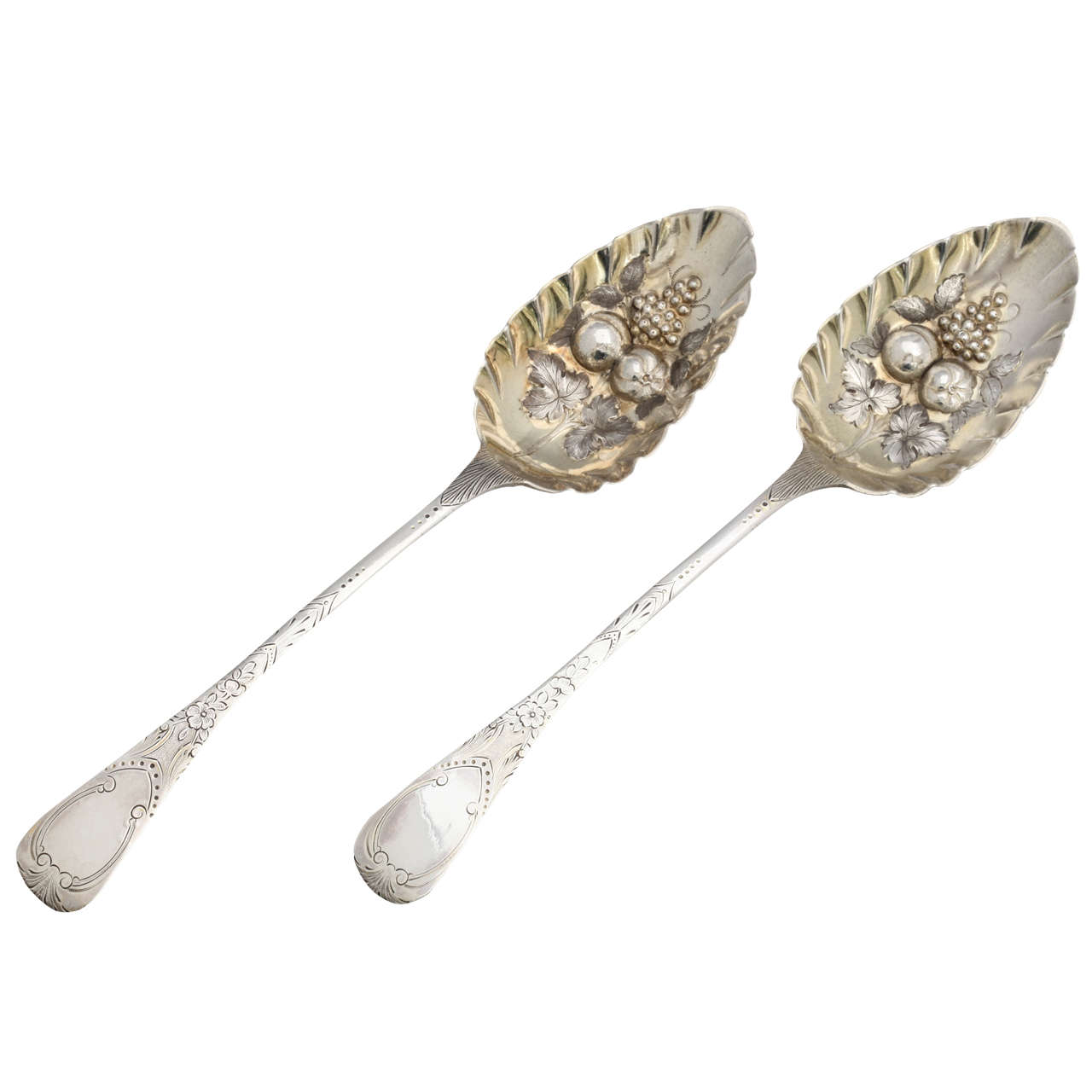
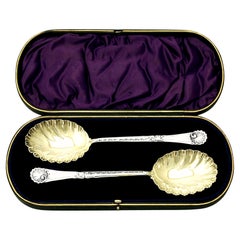
Pair of fruit spoons designed by Thomas Wilkes Barker in 1825.
Gorgeous pair of antique Georgian fruit spoons in mint condition. They was created in London England at the atelier of the silversmith Thomas Wilkes Barker in the 1825. Carefully crafted during the period of the king George IV (1820-1830) in solid .925/.999 sterling silver with 24 karats gildind. Made in the repousse technique depicting fruits such, cherries, pears and apricots. The spoon handles are finished with incised and chiseled patterns.
Weight: 118.40 Grams, (75.90 Dwt).
Measurements: 41 mm by 223 mm (1.62 x 8.75 Inches).
Hallmarks: Stamped with British marks; the standing lion for England, the bust of king George IV (1820-1830), the head of lion for London, the maker's mark TB associated to Thomas Barker, the mark for the assay of the silver and the letter K for the year of production.
Thomas Wilkes Barker
Was the son of Christopher Barker, located in Pemberton Row in Gough Square in London. Christopher leaves no record of his apprenticeship or obtaining of his freedom but his son was apprenticed to William Fearn of the famous Chawner company. Father
son entered their mark as partners on 11th October 1800, a partnership that appears to have lasted until 7th February 1805 when Thomas Barker entered a mark on his own. This seems quite a short space of time - just over 4 years. The first Mark entered in partnership with his father as spoon-makers, 11 October 1800. Address: 9 Cross Street, Hatton Garden. Second mark, on moving to Kirby Street, Hatton Garden, 8 December 1804. Third Mark alone, 7 February 1805, same address. Fourth mark (two sizes) 17 July 1811. Fifth mark ( two sizes) 1 December 1819 and later.
Georgian Period (circa 1714-1840). The term Georgian refers to an era in English history during the reign of King George I to King George IV from 1714-1840. Like the term Victorian (used for jewelry during Queen Victoria's rule), it is accepted in use as a term that refers to certain styles of jewelry. Pearls, sapphires, rubies and garnets were widely used in Georgian jewellery, often cut in the shape of a cabochon or teardrop. Rubies and pearls were a fashionable combination at the time. Some of our collection of Georgian gemstone rings. Popular cuts for diamonds included 'rose cut', 'old mine cut' and 'table cut.
Collateral: They are accompanied by the antique presentation wood box. The box is 200 years old and is not in great shape.
Condition: The overall condition of this pair is exceptional. Beside the little normal wear, there is no damage to the gold or the silver. This piece has been carefully inspected to guarantee the condition and authenticity.
INVENTORY REF: D051423MENG/3.510.
- Creator:Thomas Wilkes Barker (Maker)
- Dimensions:Height: 875 in (2,222.5 cm)Width: 1.72 in (4.37 cm)Depth: 1.1 in (2.8 cm)
- Sold As:Set of 2
- Style:George IV (Of the Period)
- Materials and Techniques:
- Place of Origin:
- Period:
- Date of Manufacture:1825
- Condition:Wear consistent with age and use. The overall condition of this pair is exceptional. Beside the little normal wear, there is no damage to the gold or the silver. This piece has been carefully inspected to guarantee the condition and authenticity.
- Seller Location:Miami, FL
- Reference Number:Seller: D051423MENG/3.5101stDibs: LU8303234279402
About the Seller
5.0
Gold Seller
Premium sellers maintaining a 4.3+ rating and 24-hour response times
1stDibs seller since 2023
250 sales on 1stDibs
Typical response time: 1 hour
- ShippingRetrieving quote...Shipping from: Miami, FL
- Return Policy
More From This Seller
View AllTIFFANY
CO. 1901 Charles T. Cook Four-Legged Nut Dish In .925 Sterling Silver
By Charles Cooke, Tiffany
Co.
Located in Miami, FL
A four-legged dish designed by Tiffany & Co.
This is a beautiful antique Edwardian four-legged open dish for nuts, created in 1901 at Tiffany & Co. in New York city. It was carefully crafted in solid sterling silver .925/.999 under the directory period of Charles T. Cook (1902-1907). This lovely elongated nuts dish is the model 15602 designed with plain patterns and decorated with a floriated border. It rests in four legs. As with all Tiffany pieces, the quality and design are beyond compared. Exceptional and rare example of Tiffany's finest work.
Country: New York City, United States.
Period: Edwardian, 1901.
Designer: Period C, for Charles T. Cook.
Model pattern: 15602.
Amount produced: 45 Pieces, this 6/45.
Weight: 186.95 Grams, (119.85 Dwt) or 6 troy ounces.
Measurements: 83 mm by 121 mm by 178 mm (3.25 x 4.75 x 7 inches).
Hallmarks: Stamped with the maker's mark, the model numbers and the order numbers, the "C" for the period of Charles T. Cook, and signed in full as follows, "TIFFANY & CO. 15602 MAKERS 4371 STERLING SILVER .925-...1000 C.".
Tiffany Hallmarking
Tiffany silver holloware and flatware is generally marked Tiffany & Co and generally includes date letters indicating the period it was made. Flatware also usually includes a pattern number. The first date letter "M (old English) used by Tiffany’s represented Edward C. Moore, who was the head of tiffany's silver operations until 1891. after his death, the date letters were based on the initial of the current tiffany president; 1891-...1902 Charles L. Tiffany (T), 1902- ..1907 Charles T. Cook (C), 1907-...1947 John C. Moore (M), 1947-...1955 Louis De Bian Moore (B), 1955-ca. William T. Lusk 1965(L).
The Tiffany dynasty
Was founded in 1837 at 259 Broadway in New York City by Charles Louis Tiffany and partner John B. Young. It began not as a jewelry & silver emporium...
Category
Antique Early 1900s American Edwardian Serving Pieces
Materials
Sterling Silver, Silver
$1,820 Sale Price
20% Off
TIFFANY
CO. 1907 John C. Moore Four-Legged Nut Dish In .925 Sterling Silver
By Tiffany
Co., John C. Moore
Located in Miami, FL
A four-legged dish designed by Tiffany & Co.
This is a beautiful antique Edwardian four-legged open dish for nuts, created in 1907 at Tiffany & Co. in New York city. It was carefull...
Category
Antique Early 1900s American Edwardian Sterling Silver
Materials
Sterling Silver, Silver
$1,438 Sale Price
20% Off
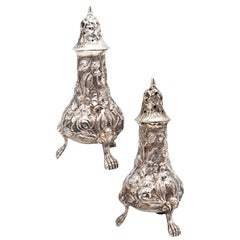
Schofield 1905 Art Nouveau Baltimore Rose Shakers Set in .925 Sterling Silver
By The Schofield Company
Located in Miami, FL
Pair of shakers designed by Schofield.
Beautiful pair of salt and pepper shakers, created in Baltimore by The Schofield Company, back in the 1905. This pair is from the iconic pattern named Baltimore Rose and was carefully crafted in the art nouveau style with a repousse of floral motifs in solid .925/.999 sterling silver. Pear shaped and mounted in three sabots and fitted with removable lids on top.
Weight: 155.45 Grams, (99.64 Dwt).
Measures: 51 mm by 115 mm (2.01 x 4.53 Inches).
Hallmarks: Stamped with the maker's mark, the mark for the assay of the silver the model numbers and signed, "BALTON.ROSE STERLING 1028 SCHOFIELD".
The Schofield Company (1903–1977) (aka Herr-Schofield, aka the Baltimore Silversmiths Manufacturing Company) was a Baltimore area silver company, whose best known pattern was Baltimore Rose. In 1891, at the age of 18, Frank Schofield started an apprenticeship at The Gorham Mfg. Co. in Providence. At Gorham, Schofield learned die-cutting and silversmithing. In some silver biographies, penned by scholarly authors, it has been written that Frank Schofield cut the dies for the original Stieff Rose...
Category
Antique Early 1900s North American Art Nouveau Sterling Silver
Materials
Silver, Sterling Silver
$559 Sale Price / set
20% Off
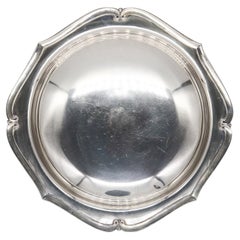
Art Deco International Sterling 1925 Minuet Vegetable Large Bowl in 925 Sterling
By International Silver
Located in Miami, FL
A vegetable bowl designed by the International Silver Co.
Beautiful antique American piece, created during the art deco period by the International Silver Co, back in the 1925. This oversized vegetable bowl has been crafted in solid .925/.999 sterling silver, with high polished finish and designed with a baroque shaped body with a rounded borders with very elegant high relief decorations.
Has a total weight of 902 Grams or 29 Ounces and a measurements of 330 mm by 330 mm by 95 .25 mm (33 x 33 x 9.53 Cm) (13 x 13 x 3.75 Inches).
Stamped, with the maker's mark, the model name and number and signed, "INTERNATIONAL STERLING MINUET V 71".
International Silver Company (1898–1983), was also known as the ISC, was formed in Meriden, Connecticut as a corporation banding together many existing silver companies in the immediate area and beyond. In Meriden and nearby Wallingford and Middletown, the companies that were banded together to form the International Silver Company included these companies: Meriden Britannia Company, Meriden Silver Plate Co., Middletown Plate Company...
Category
Vintage 1920s North American Art Deco Serving Pieces
Materials
Silver, Sterling Silver
$2,156 Sale Price
20% Off
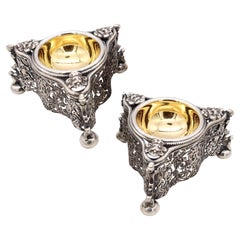
Germany 1870 Important Pair of Neoclassical Salt Species Cellars in 24kt Gilt
Located in Miami, FL
Rare pair of German Salt-Species Cellars.
An important matching pair of oversized salt and spicy cellars, created in Germany in the 19th century, circa 1870. These beautiful piece...
Category
Antique 1870s German Neoclassical Sterling Silver
Materials
Gold, Silver, Sterling Silver
$2,360 Sale Price / set
20% Off
William B. Durgin Co. 1900 Edwardian Neo Classic Center Bowl 925 Sterling Silver
By Durgin Silver Company, William B. Durgin
Located in Miami, FL
An impressive center bowl designed by William B. Durgin Co.
Magnificent very rare piece, created in the United States by the silversmiths and silverware makers William B. Durgin Co, back in the turn of the 19th century, circa 1900. This fabulous center vase bowl was crafted with Edwardian neoclassical patterns in solid .925/.999 sterling silver with high polished finish. The vase stand in a rounded pedestal foot and suited with a pair of elaborated handles with multiples garlands and tassels. The upper border is adorned with four groups of organic motifs of flowers chiseled in low and high relief and a fine bright cut decoration along the rim.
The design of this piece is extremely interesting as it brings together various artistic movements such as the Art Nouveau, the Edwardian, the Neoclassical with a hint of neo-Gothic details and the Greek Revival.
Has a total weight of 972 Grams and a measurements of 389 mm by 375 mm by 120 mm (12.16 x 14.75 x 4.75 Inches).
Stamped with the maker's mark cartouche with a D associated to William B. Durgin Co, the model number and signed, "D STERLING 930C".
NutmegGraters.Com ~ American Sterling Nutmeg Grater By Durgin
William B. Durgin Co. (1853 - 1924) was a noted American sterling silver manufacturer based in Concord, New Hampshire, and one of the largest flatware and hollowware manufacturers in the United States. Over the period between the 1905-1924 it was merged into the Gorham Manufacturing Company.
The company was founded by the silversmith William Butler Durgin (July 29, 1833 - May 6, 1905). Durgin was born in Campton, New Hampshire, and from 1849-1853 apprenticed to Boston silversmith Newell Harding. In the 1840s Durgin moved back to Concord, where he opened a small shop making spoons opposite the Free Bridge Road. He incorporated as William B. Durgin Company in 1853, in 1854 added the manufacture of silverware, and in 1866 established a large brick factory on School Street. In 1905, after the death of both Durgin and his son, George F. Durgin, the company was acquired by Gorham through a long process that culminated with an official purchase in 1924. Production was moved to Providence, Rhode Island, in 1931.
The company made the Davis Cup, the silver service for the battleship USS New Hampshire, and medals for St. Paul's School. Its Fairfax flatware...
Category
Antique Late 19th Century North American Edwardian Serving Bowls
Materials
Silver, Sterling Silver

$3,980 Sale Price
20% Off
You May Also Like
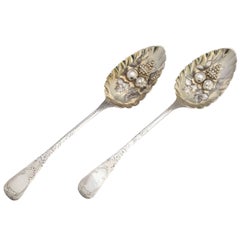
Rare Pair of Exeter Sterling Silver Parcel-Gilt Georgian Berry Spoons
By William Woodman
Located in New York, NY
Rare pair of Georgian, sterling silver, parcel-gilt berry spoons, Exeter, England, 1830, William Woodman - maker. Measures: 9" long x 2" wide (at widest point). Vacant cartouche. Bea...
Category
Antique 19th Century British Georgian Sterling Silver
Materials
Sterling Silver
Victorian Silver Plate Berry Serving Spoons, Leather Case, U.K., 1878
Located in Chatham, ON
Antique - Victorian silver plate berry serving spoons - gold wash to each finely detailed and tooled bowl - contained in their original silk and ve...
Category
Antique Late 19th Century British Victorian Sheffield and Silverplate
Materials
Silver Plate
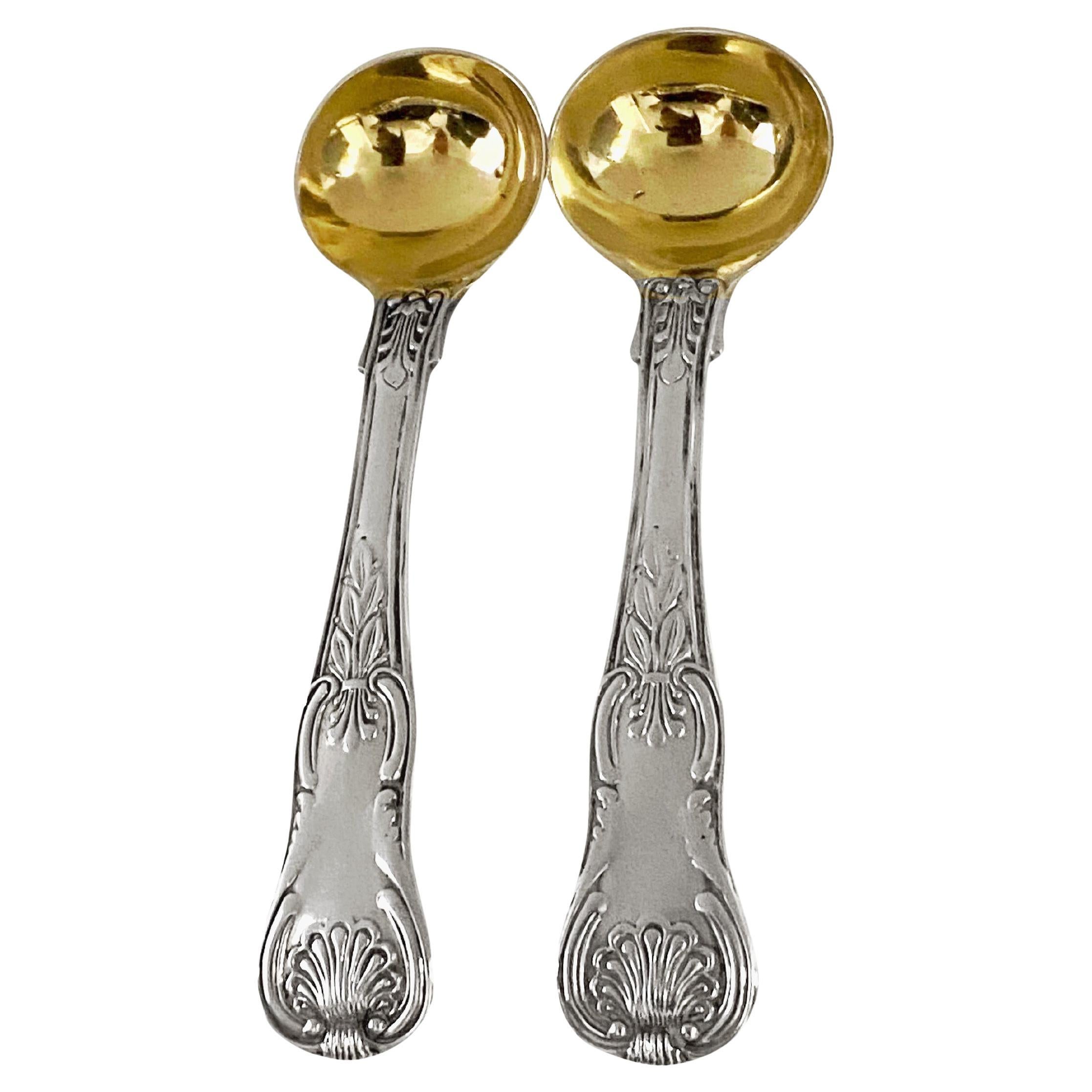
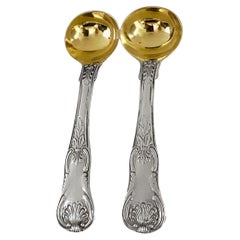
Pair Georgian Silver Kings Honseysuckle Salt Spoons 1826 Chawner
By William Chawner
Located in Toronto, Ontario
Pair Georgian Silver Kings Honseysuckle Salt Spoons 1826 William Chawner. Nice clean, heavy with gilded bowls. Lengths: 4.25 inches. Weight: 50.04 grams.
Category
Antique Early 19th Century English Sterling Silver
Materials
Sterling Silver
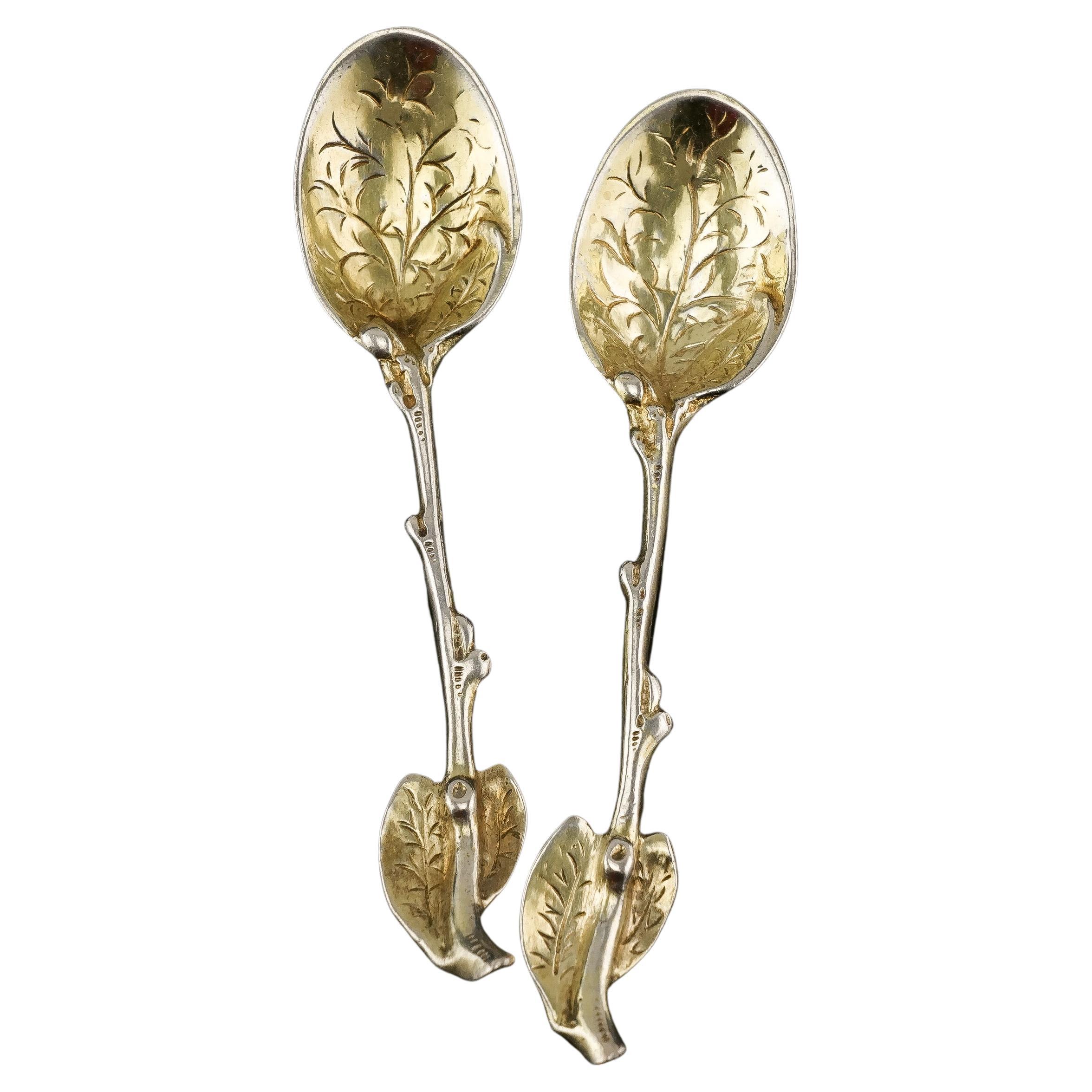
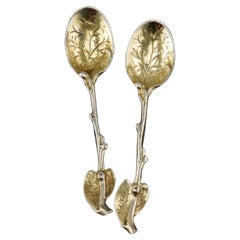
Antique Victorian Solid Silver Gilt Naturalistic Leaf Spoon Pair, 1842
By Sebastian Crespel II
Located in London, GB
We are delighted to offer this fine and exquisite pair of early Victorian solid silver tea spoons made in London 1842 with the maker's mark of Sebastian Crespell.
The pair features a highly ornate and desirable 'naturalistic' design with the entirety of the spoon-shaped as a leaf and branch.
Intricate engravings on the leaf bowls and the realistic form of the stem/branch indicate a high level of craftsmanship and artistry by the silversmith. Upon close inspection, the asymmetric and naturally flowing design is further apparent and is a delightful touch.
Not only are these spoons practical for a wide variety of uses from tea to desserts, but are a modest yet discerning addition to any collection or interior decor for a sophisticated and nature-inspired look.
The pair is gilded with a yellowish/lemon hue that has been worn and patinated in a very attractive colour/tone.
A full set of English hallmarks are present on the reverse side of the bowl.
SIZE
Size (cm) L:10cm W:2cm
Size (inches) L:3.93 W:0.78
Weight: 41.8 grams (1.34 Troy oz) the pair
CONDITION
Good Condition - The spoon is in great antique...
Category
Antique 19th Century English Victorian Sterling Silver
Materials
Sterling Silver
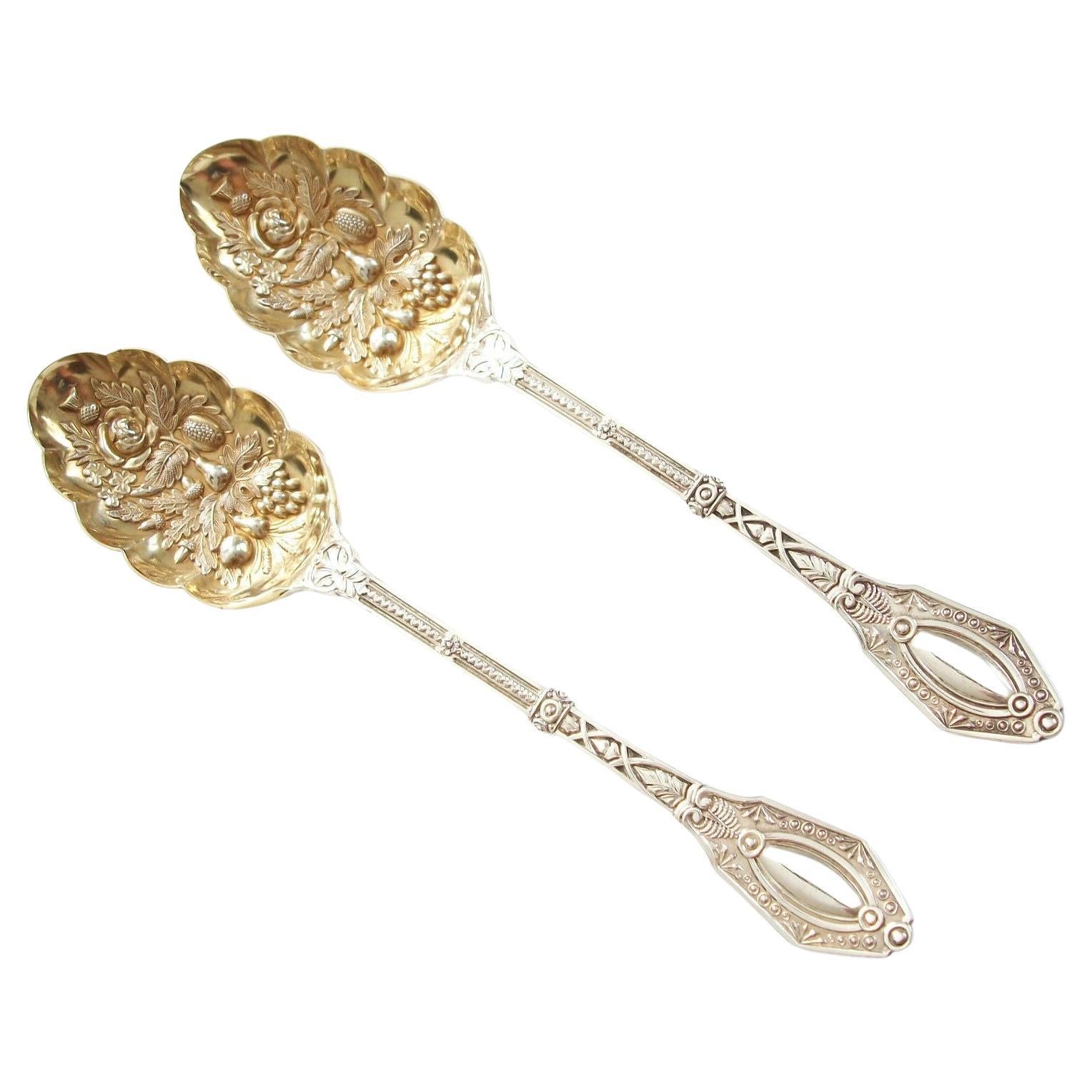
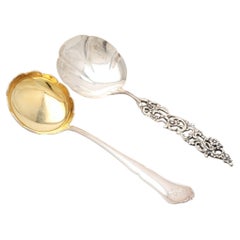
Silver Serving Spoon Antique Pair of Decorative Sterling Silver Gilded Spoon
Located in Wembley, GB
Pair of Antique Sterling Silver Serving Spoons Gilded & Ornate Handles
A distinguished pair of antique sterling silver serving spoons, exquisitely crafted and richly detailed in the ...
Category
Antique Late 19th Century Swedish Rococo Sterling Silver
Materials
Gold Plate, Silver, Sterling Silver
$553 Sale Price
57% Off
Free Shipping
1898 Victorian English Sterling Silver Fruit Spoons
By Walker
Hall
Located in Jesmond, Newcastle Upon Tyne
A fine and impressive pair of antique Victorian English sterling silver fruit spoons - boxed; an addition to our silver flatware collection.
The...
Category
Antique 1890s English Victorian Sterling Silver
Materials
Silver, Sterling Silver
More Ways To Browse
Antique Jewelry Pearls
Antique Georgian Jewelry
Used British Stamps
Georgian 18th Century Rose Cut Diamond
Ruby And Pearl Victorian Ring
Antique Hatton Garden
24 Karat Gold Ruby Ring
24k Gold Rose Cut Diamond Ring
Silver Fruit Spoons
925 Silver Spoon
Vermeil Tea And Coffee Set
Victorian Claret Jugs
Antique Clothes Brush
Antique Hawkes Crystal
Antique Powder Jars
Antique Salt Pots
Antique Silver Place Card Holders
Antique Silver Sugar Casters