Items Similar to The Watts-Russell Candelabra. Rundell, Bridge
Rundell, London 1820
Want more images or videos?
Request additional images or videos from the seller
1 of 13
The Watts-Russell Candelabra. Rundell, Bridge
Rundell, London 1820
$683,705.68
£500,000
€587,623.84
CA$951,615.76
A$1,020,913.43
CHF 547,596.98
MX$12,291,660.81
NOK 6,903,102.82
SEK 6,294,673.13
DKK 4,390,334.01
About the Item
MARK OF PHILIP RUNDELL, LONDON, 1820, RETAILED BY RUNDELL, BRIDGE AND RUNDELL, BASED ON THE DESIGNS OF JOHN FLAXMAN, MODELLED BY EDWARD HODGES BAILY
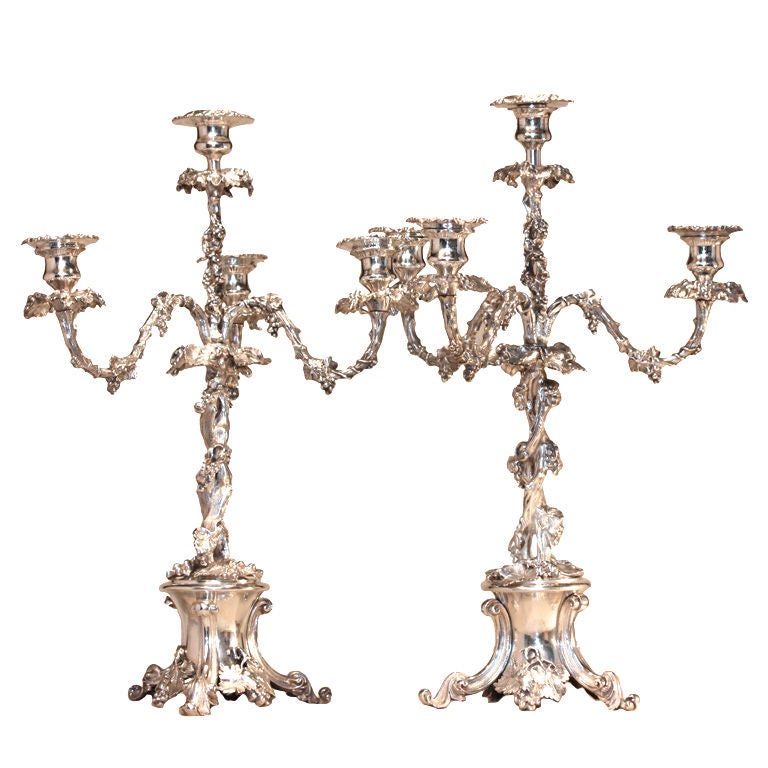
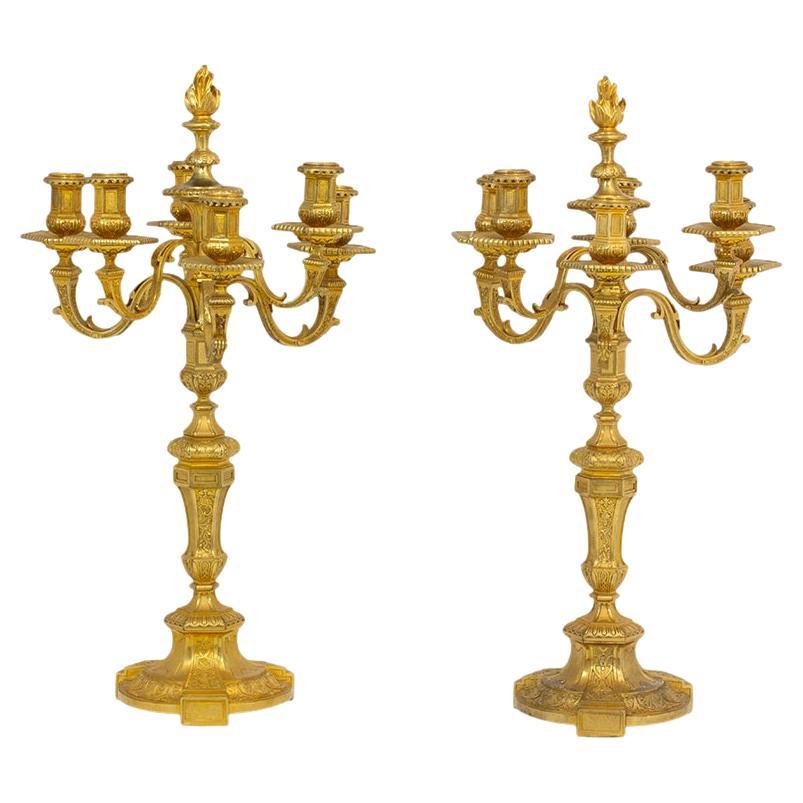
Each on circular base with fruiting grapevine border, the stem cast as Orpheus resting against fruiting grapvines as he is struck by Cupid with an arrow, the three branches each terminating in a grapevine cast socket and wax-pan, the base applied with a coat-of-arms, the sockets and wax-pans each engraved with two crests, marked on base, on branches, sockets, wax-pans and applied coats-of-arms, the bases further stamped 'RUNDELL BRIDGE ET RUNDELL AURIFICES REGIS LONDINI'
The arms are those of Russell quartering Watts with those of Watts in pretence for Jesse Watts-Russell (1786-1875) of Ilam Hall, Staffordshire.
An almost identical pair are housed in the Royal Collection (Inventory Number 49178)
Philip Rundell (1746-1827) hallmark 1821/2, Silver gilt
64.5 x 37.0 x 33.5 cm
Royal Collection Inventory Number: 49178
Acquired by George IV, King of the United Kingdom (1762-1830) bought by George IV in 1822 for £725 9s 4d.
Provenance
Jesse Watts Russell M.P. (1786-1875), of Ilam Hall.
The Eaton Family, Toronto, Canada.
A Connecticut Collector; Phillip's, New York, 16 April 1982, lot 240.
Literature
J. B. Hawkins, The Al Tajir Collection of Silver and Gold, London, 1983, pp. 160-161.
The Glory of the Goldsmith, Magnificent Gold and Silver from the
Al-Tajir Collection, 1989, p. 192.
C. Hartop, Royal Goldmsiths, The Art of Rundell
Bridge 1797-1843, 2005, p. 73, fig 63, cat. no. 44
C. Hartop, "Royal Goldmsiths, The Art of Rundell
Bridge 1797-1843" The Magazine Antiques, June, 2005
Exhibited
London, Christie's, The Glory of the Goldsmith, Magnificent Gold and Silver from the Al-Tajir Collection, 1989, no. 147.
Jesse Watts-Russell
Jesse Watts-Russell was the son of Jesse Russell (1743-1820) of Newcastle-under-Lyme, who had made a fortune through the manufacture of soap. He married as his first wife Mary (d.1840), daughter and heiress of David Pike Watts of Portland Place, London and cousin of John Constable, the artist. He subsequently assumed by Royal License in 1817 the additional surname and arms of Watts. He was to marry twice more, in 1843 Maria Ellen (d.1844), daughter of Peter Henry Barker of Bedford and in 1862 Martha, daughter of John Leech of Wexford.
These candelabra would have been commissioned for use in the dining room of Ilam Hall, the large Gothic Revival house built for Watts-Russell by the builder and engineer James Trubshaw (1777-1853) to the designs of the architect John Shaw (1776-1832). The house was sold after Watts-Russell's death in 1875, but Biggin Hall in Northamptonshire, another of his houses, has remained in the family. Ilam Hall only survives in fragmentary form, as does the memorial cross in Ilam village, which imitates the Eleanor Crosses and which was raised in memory of Watts-Russell's first wife.
About the Seller
No Reviews Yet
Recognized Seller
These prestigious sellers are industry leaders and represent the highest echelon for item quality and design.
1stDibs seller since 2023
- ShippingRetrieving quote...Shipping from: London, United Kingdom
- Return Policy
More From This Seller
View AllAn old Sheffield plate candelabrum epergne
By James Dixon
Sons
Located in London, GB
Three branches around the central dish. The central 'vase' is embellished with grape and vine. The foot and branches are decorated in a more rococo taste.
Category
Antique Early 19th Century British George III Centerpieces
Materials
Sheffield Plate
A pair of French silver 19th C Candle sticks
Located in London, GB
Heavily decorated with flowers and foliage, each engraved with an initial. Removable original nozzels. Minerva mark for French silver
Category
Antique Late 19th Century French Baroque Revival Tableware
Materials
Sterling Silver
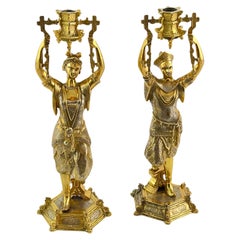
Unusual pair of silver gilt candlesticks circa 1900
Located in London, GB
An unusual pair of "Orientalist" candlesticks. formed as male and female figures each figure holding aloft a candle holder that unusually pivots. Of heavy quality, the hexaginal foot...
Category
Antique Late 19th Century European Other Sterling Silver
Materials
Silver
$10,665 / set
Early 20th Century 5 Dish Silver Plated Epergne
By Alexander Clark
Co.
Located in London, GB
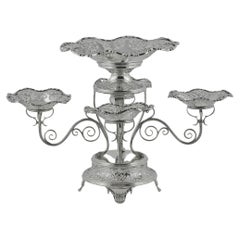
A 5 dish epergne by The Alexander Clark Company London. Formed with 5 removable pierced dishes, the circular foot raised on four feet, the frame and branches decorated throughout with elaborate pierced work and with scrolling branches.
The business was established in 1891 by Clift Alexander Mawer Clark at 138 Fenchurch Street, London. Manufacturing premises were opened in 1894 at 29 Market Place, Oxford Street.
In 1900 the firm was active at Welbeck Works, Randall Street, Sheffield, transferring its activity to James Street Works, St. Paul's, Birmingham, in 1918.
The firm was active also at 29 Market Place, London (1894-1910), 188 Oxford Street, London (1900-1915), 125-126 Fernchurch Street, London (1909-1918), 38-40 Mitre Street, Aldgate, London (1921), 17 Sycamore Street, Sheffield (1921) and 38 Leadenhall Street, London (1941).
The partners were C.A.M. Clark, Louis Vernon Clark, Robert Fead Mosley and Robert Frederick Mosley (of R.F. Mosley & Co Ltd).
The firm was converted in 1912 into a limited liability company under the style of the Alexander Clark Co Ltd.
In 1912 the firm advertised its reproduction of silver historical pieces as the Tudor Bowl (period Henry VIII), the Tudor Cup, Antique Jug...
Category
Antique Late 19th Century British Victorian Serving Pieces
Materials
Silver Plate
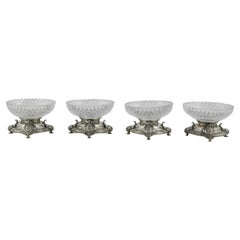
Suite of Four Silver-Plated Bronze Dessert Stand Comports, French, circa 1890
Located in London, GB
With an applied initial to each, applied inside an oval bead-edge lozenge. Each raised on four feet. further decorated with openwork latticing, floral and foliate decoration.
Category
Antique Late 19th Century French Neoclassical Serving Bowls
Materials
Silver Plate
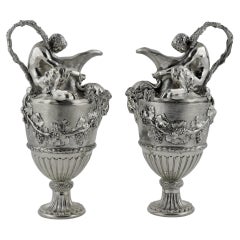
Pair of Decorative Ewer Form Ornaments
Located in London, GB
The body of each ewer is beautifully embellished with a three dimensional design of grapevines following up to the handle. The handle part forms as a satyr, possibly representative o...
Category
Antique Late 19th Century French Neoclassical Figurative Sculptures
Materials
Silver Plate
$7,930 / set
You May Also Like
Pair Of 19th Century Silver Candelabra B Hunt
Roskill Late Storr
Mortimer
Located in Dublin, IE
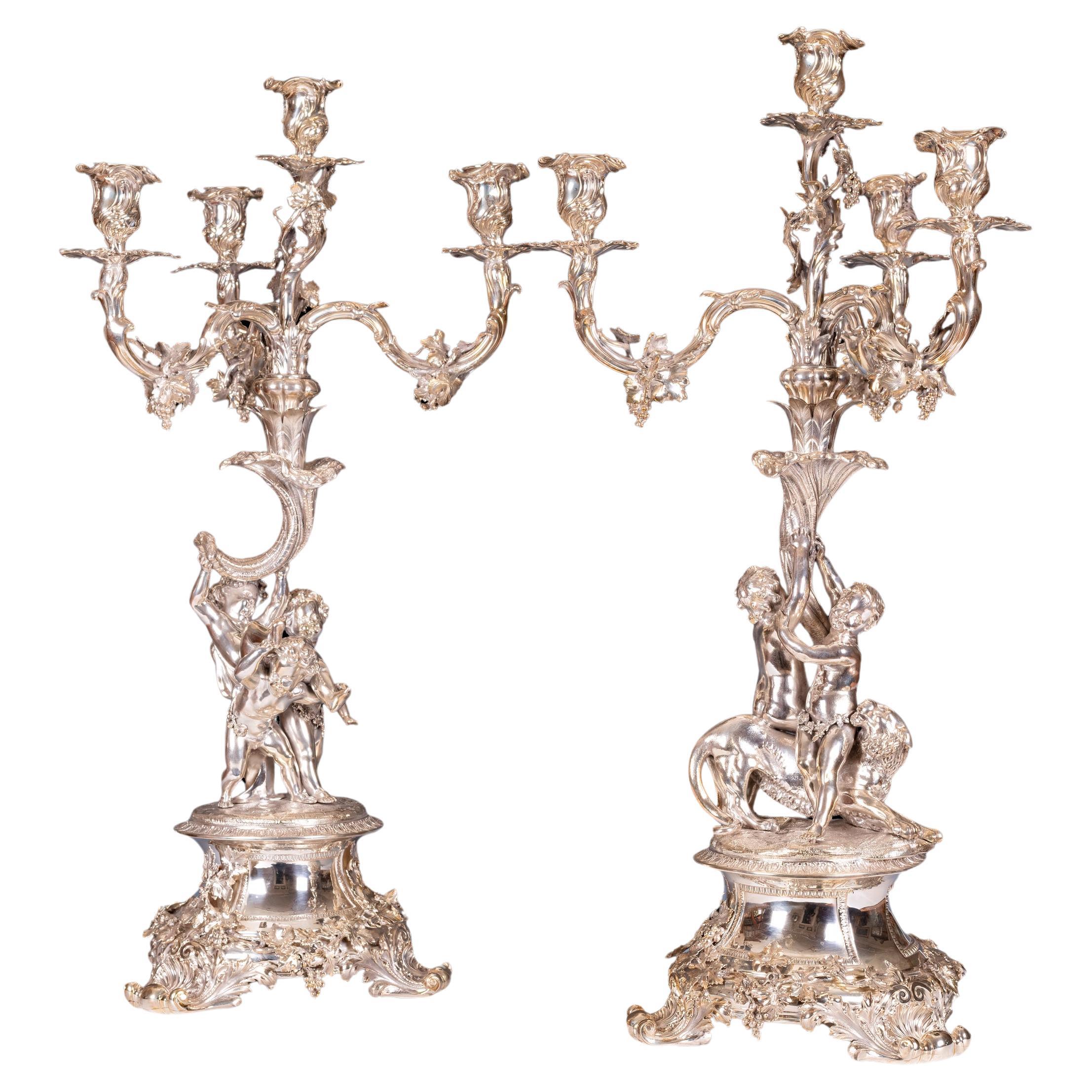
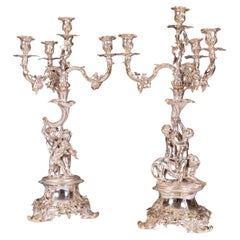
An important pair of silver four branch candelabra by Hunt and Roskill, of naturalistic form the four sconces on fruiting vine branches raised on puttis with lion shown frolicking on...
Category
Antique 19th Century English Victorian Candelabras
Materials
Silver
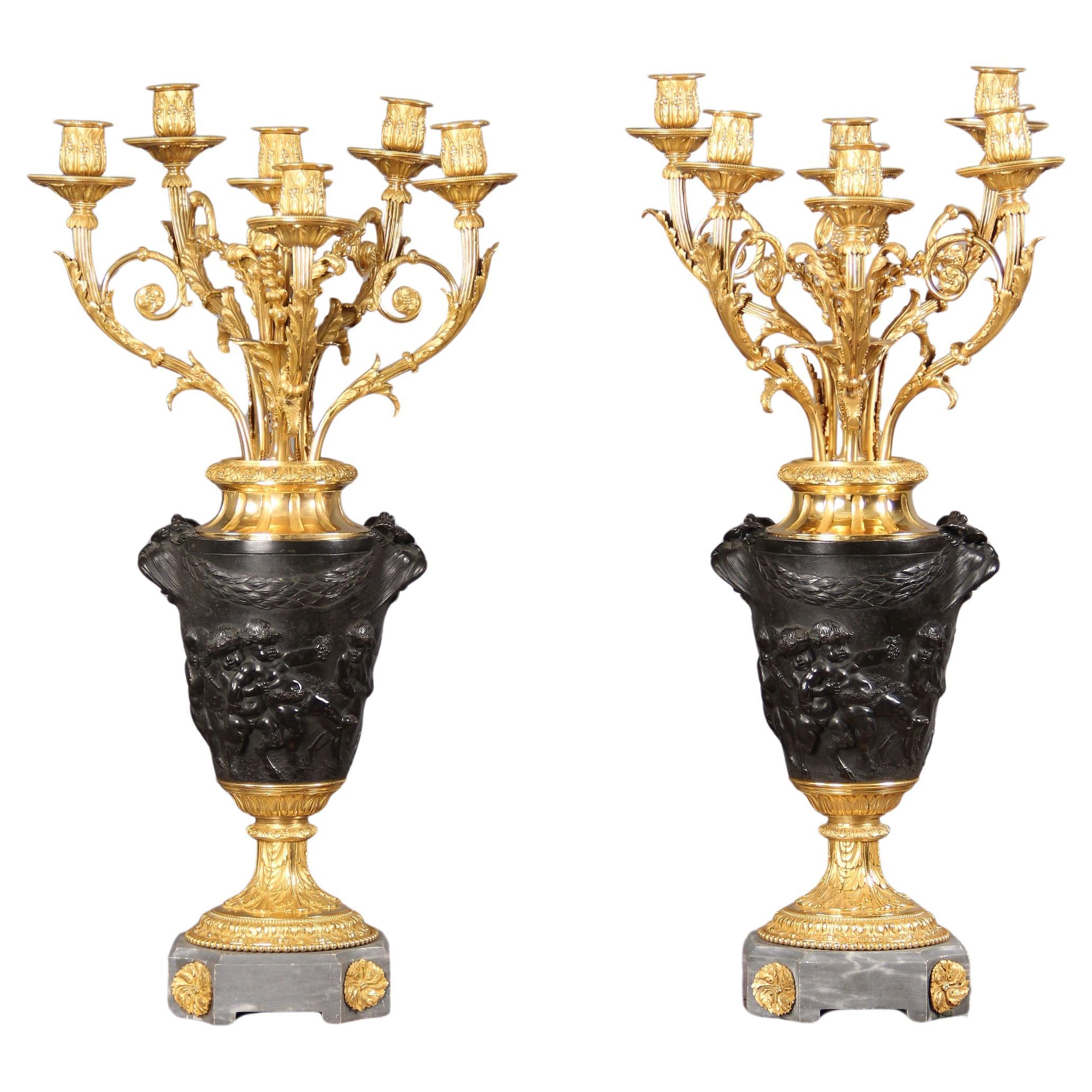
A Fine Pair of 19th Century Candelabra After Claude-Michel Clodion
By Claude Michel Clodion
Located in Long Island City, NY
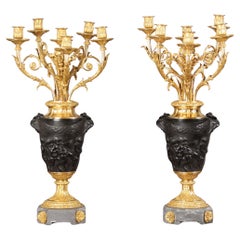
A Pair of Late 19th Century Gilt and Patinated Bronze Six Light Candelabra
After Claude-Michel Clodion
Each vase of tapering form applied with two grotesque masks hung with laurel garlands above a frieze cast in relief with depictions of putti pulling the drunken infant Silenus, surmounted by a waisted neck with central square candelabrum issuing six acanthus scrolled branches.
Claude Michael Clodion, [1738-1814], was the son-in-law of sculptor Augustin Pajou; he trained in Paris in the workshops of Lambert Sigisbert Adam, his maternal uncle and Jean-Baptiste Pigalle, the most successful sculptor of the time. After winning the Prix de Rome, he moved to Italy, sharing a studio with Jean-Antoine Houdon and studying antique, Renaissance, and Baroque sculpture.
In 1771 Clodion returned to Paris, where he continued to produce mostly in terracotta. He also worked with his brothers in other media, decorating objects...
Category
Antique 19th Century French Belle Époque Candle Holders
Materials
Marble, Bronze, Ormolu
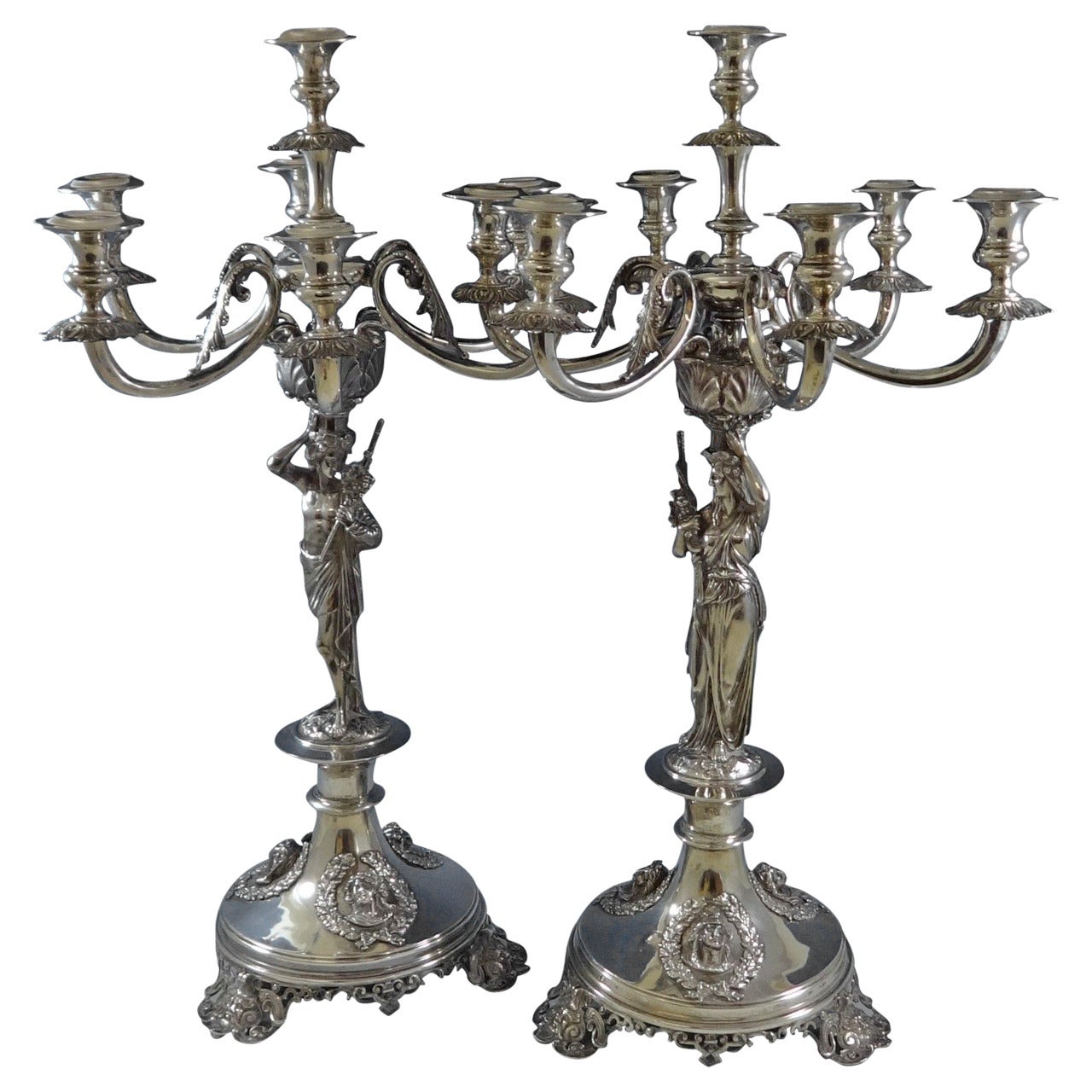
Magnificent Austrian Pair of Seven-Light Sterling Silver Candelabra, Hollowware
Located in Big Bend, WI
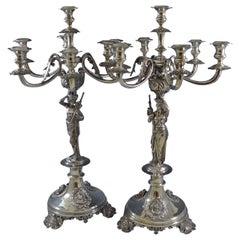
Magnificent Austrian succession sterling silver massive candelabrum pair of seven-light figural museum. Each candelabra features a Grecian style ma...
Category
Antique Late 19th Century Austrian Classical Roman Candle Holders
Materials
Sterling Silver
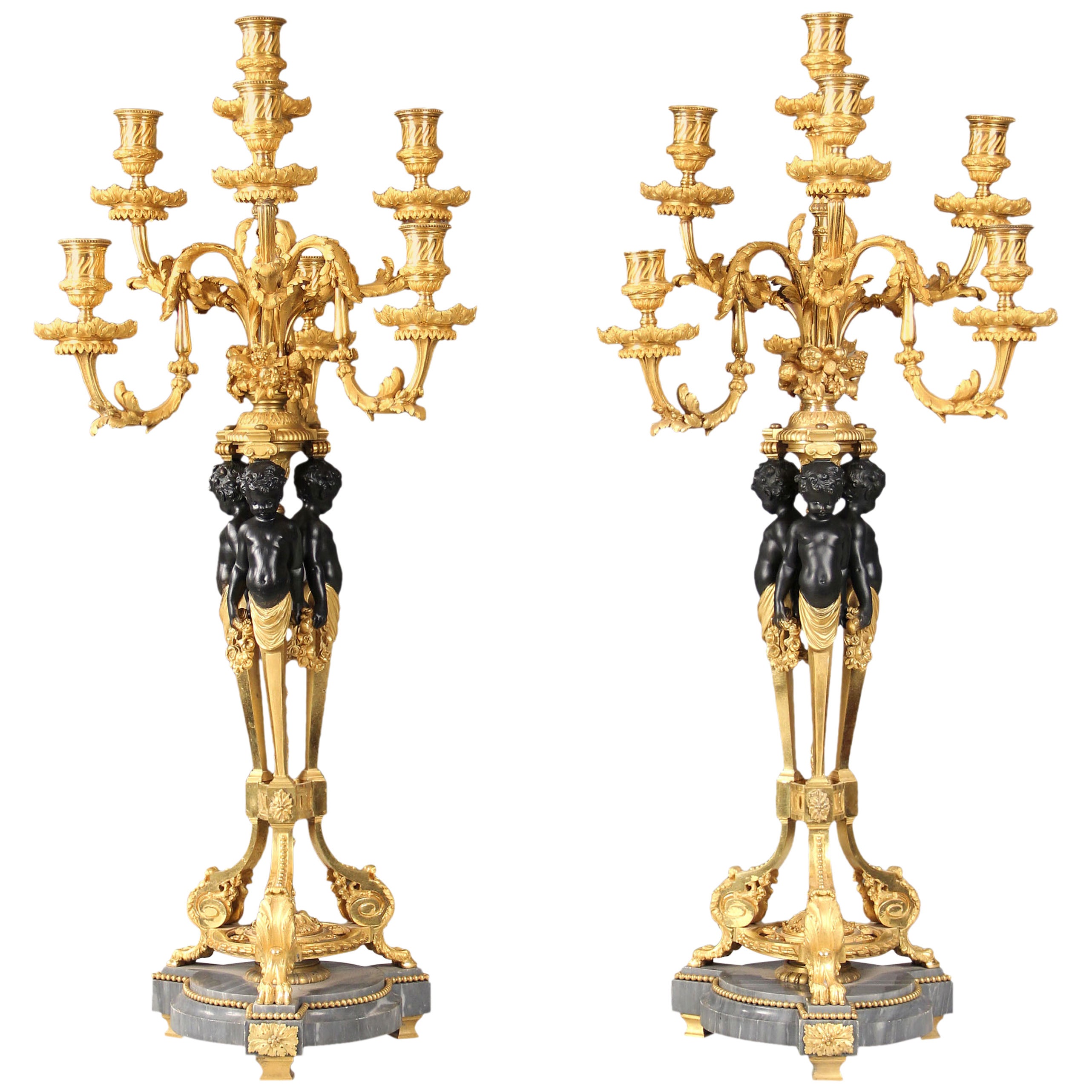
Pair of Late 19th Century or Early 20th Century Seven-Light Candelabra
Located in Long Island City, NY
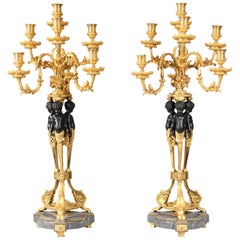
An Excellent Pair of Late 19th/Early 20th Century Louis XV Style Parcel-Gilt and Patinated Bronze Seven Light Candelabra
Each with openwork tripod base cast with hoof feet, the standard with three cherub busts...
Category
Antique Late 19th Century French Belle Époque Table Lamps
Materials
Bronze
Pair of Victorian Silver Plated Four Light Candelabra
Located in Montreal, QC
While unmarked, these seem to us to be in the style of Elkington. The prevailing motif is fruiting vine, the stem, arms and drip pans continue the theme, the three legged base is als...
Category
Antique 19th Century English Victorian Candle Holders
Materials
Silver Plate
French Pair of Ormolu Candelabra by Henry Dasson, Dated 1880
By Henry Dasson
Located in Newark, England
From our Decorative collection, we are pleased to offer this pair of French Louis XIV style ormolu candelabra by Henry Dasson, dated 1880.
Each candelabrum is cast in gilt bronze (o...
Category
Antique Late 19th Century French Louis XIV Candelabras
Materials
Bronze, Ormolu
More Ways To Browse
Gothic House
Rundell Bridge And Rundell
Russell Sterling
Tea Spoons Gold
Tiffany Shaker
Tiffany Sterling Silver Vine Pattern
Wallace Rose Point
Wallace Sterling Silver Rose Point
18th Century Sterling Salvers
Alvin Chateau Rose Sterling Silver Flatware
Alvin Chateau Rose
Alvin Sterling Chateau Rose
Antique Cheese Scoop
Antique Mauser
Antique Silver Flatware Chest
Antique Silver Grape Scissors
Antique Silver Kiddush Cup
Antique Vinegar Cruets