Items Similar to Bloor Derby Tea Service, Witches Pattern Imari, ca 1825
Want more images or videos?
Request additional images or videos from the seller
1 of 19
Bloor Derby Tea Service, Witches Pattern Imari, ca 1825
$2,750per set
£2,094.07per set
€2,411.26per set
CA$3,896.99per set
A$4,191.77per set
CHF 2,240.20per set
MX$49,409.05per set
NOK 28,243.74per set
SEK 25,820.13per set
DKK 18,016.20per set
About the Item
This is a rather extravagant tea service serving four, made by the Bloor Derby factory between 1825 and 1830 in the wonderful "Witches" pattern in the Imari colour scheme.
The set consists of a teapot with cover, a sucrier with cover, a milk jug, a slop bowl, and four true trios each consisting of a teacup, a coffee cup and a saucer.
We have some more separate trios available in this pattern, please see separate listing or send us a question.
The Derby Porcelain factory has its roots in the late 1740s, when Andrew Planché, a Walloon Huguenot refugee, started making simple porcelain toys shaped like animals in his back yard. In 1756 Staffordshire enameller William Duysbury and banker John Heath started a new porcelain factory with Planché and this was to grow out to the largest factory of its time, buying up the bankrupted Chelsea and Bow factories, as well as the stock of several other workshops including that of James Giles. The combination of various traditions, porcelain making skills and sophisticated clients enabled Duesbury to create one of the best porcelain factories of the 18th and 19th Centuries, which after many ups and downs is still operative today.
In 1811 the factory came under the ownership of Robert Bloor, and this started the "Bloor Derby" era. The company was in financial trouble and Bloor had to find a way to turn it around. He found a huge stock of items that had been rejected over the years, but that were perfectly fine to decorate and sell. This tea service was probably part of that hoard; many of these older items were beautifully painted with dark or busy patterns to hide any imperfections.
The "Witches" pattern is a wonderful pattern inspired by the Japanese Imari style, and it received its name from the famous "witch marks" that could be found on the doors of old houses around Derbyshire. The marks looked like flowers consisting of double "V"s (for the Virgin Mary) and were meant to ward off evil spirits, or witches. You can see the floral motif in this pattern, which looks similar.
All items carry the red hand painted crowned Derby mark with batons. There is a collectors label with elegantly written "Derby c. 1825" included.
CONDITION REPORT The set looks stunning and bright and is in fairly good condition, with following faults: the tip of the teapot has been restored; all serving items have various degrees of crazing; of the saucers, 3 are crazed; of the teacups, 3 are crazed, and the coffee cups all have crazing on the outside bottom, but not on the inside. There is wear and some very slight stress cracks here and there, but apart from the teapot spout no other major damage or repairs.
Antique British porcelain is never perfect. Kilns were fired on coal in the 1800s, and this meant that china from that period can have some firing specks from flying particles. British makers were also known for their experimentation, and sometimes this resulted in technically imperfect results. Due to the shrinkage in the kiln, items can have small firing lines or develop crazing over time, which should not be seen as damage but as an imperfection of the maker's recipes, probably unknown at the time of making. Items have often been used for many years and can have normal signs of wear, and gilt can have signs of slight disintegration even if never handled. I will reflect any damage, repairs, obvious stress marks, crazing or heavy wear in the item description but some minor scratches, nicks, stains and gilt disintegration can be normal for vintage items and need to be taken into account.
There is widespread confusion on the internet about the difference between chips and nicks, or hairlines and cracks. I will reflect any damage as truthfully as I can, i.e. a nick is a tiny bit of damage smaller than 1mm and a chip is something you can easily see with the eye; a glazing line is a break in the glazing only; hairline is extremely tight and/or superficial and not picked up by the finger; and a crack is obvious both to the eye and the finger. Etcetera - I try to be as accurate as I can and please feel free to ask questions or request more detailed pictures!
DIMENSIONS (diameters): teapot 29cm (11.5") between handle and spout; milk jug 16cm (6.25") between handle and mouth; sucrier 18cm (7") between the handles; slop bowl 15.5cm (6") diameter, teacup 8.8cm (3.5") diameter, coffee cup 6.6cm (2.6") diameter and saucer 13.8cm (5.5") diameter.
- Creator:Bloor Derby (Maker)
- Dimensions:Height: 1 in (2.54 cm)Diameter: 1 in (2.54 cm)
- Sold As:Set of 18
- Style:Regency (Of the Period)
- Materials and Techniques:
- Place of Origin:
- Period:
- Date of Manufacture:circa 1825
- Condition:Repaired: the tip of the teapot has been restored. Wear consistent with age and use. the tip of the teapot has been restored, some crazing and wear.
- Seller Location:London, GB
- Reference Number:Seller: LW-DER061stDibs: LU4805146927732
About the Seller
5.0
Vetted Professional Seller
Every seller passes strict standards for authenticity and reliability
Established in 2016
1stDibs seller since 2019
228 sales on 1stDibs
- ShippingRetrieving quote...Shipping from: London, United Kingdom
- Return Policy
More From This Seller
View AllNew Hall Porcelain Tea Service, Japanese Tobacco Pattern, Georgian, circa 1795
By New Hall
Located in London, GB
This is a stunning tea service made by New Hall in circa 1795. The service is made of hybrid hard paste porcelain and decorated in a bold Chinoiserie pattern of large flower sprays. The service consists of a teapot with cover, a milk jug, a slop bowl, and six tea bowls with saucers.
This service has provenance; it came from the collection of David Redstone, the well known porcelain expert who wrote leading books on Bow and Chelsea porcelain.
The New Hall factory started as a cooperative of several Staffordshire potters making use of the porcelain license of Bristol Porcelain...
Category
Antique 1790s English George III Tea Sets
Materials
Porcelain
$2,900 / set
Free Shipping
Yates Tea Service, Cobalt Blue, Gilt and Flowers patt. 1038, ca 1825
Located in London, GB
This is beautiful tea service consisting of a teapot with cover, a plate, a slop bowl, four teacups on saucers and four coffee cups on saucers. The service was made by the Yates fact...
Category
Antique 1820s English Regency Tea Sets
Materials
Porcelain
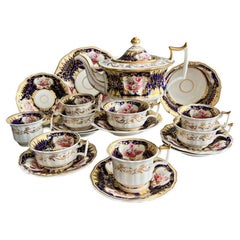
Spode Porcelain Teacup Trio, Red Imari Dollar Pattern, Regency, ca 1810
By Spode
Located in London, GB
This is a beautiful orphaned teacup made by Spode in about 1810. It bears a lavish Japanese-inspired Imari pattern.
Spode was the great pioneer among the Georgian potters in England. Around the year 1800 he perfected the bone china recipe that has been used by British potters ever since, and he was also the leading potter behind the technique of transferware, making it possible for English potters to replace the Chinese export china, which had come to an end around that time, with their own designs. This was fundamental to a thriving industry that would last for about 150 years and provide half the world with their tableware. Spode porcelain is regarded as one of the highest quality porcelains around; for a soft-paste porcelain it is surprisingly hard and fine, and has a wonderful bright white colour.
The pattern on this can is called "Dollar" pattern, a very famous pattern that was used by English potters in the 18th and early 19th Century. It is obvious why it is called “dollar” - but its origin is less obvious! It is thought that this pattern was derived from a very old Chinese pattern depicting a tree with elaborate foliage that hides a Chinese character representing longevity or happiness. Traditionally, this went with a an image called “Taotie”, which was used on very ancient bronze vases...
Category
Antique Early 1800s English Regency Porcelain
Materials
Porcelain
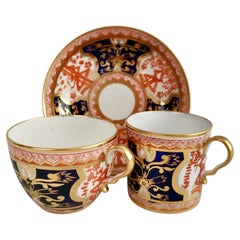
Chelsea-Derby Chocolate Cup Set, Gilt Stripes, Puce Flowers, Rococo 1770-1775
By Chelsea Porcelain, Derby, Chelsea-Derby
Located in London, GB
This is a beautiful chocolate cup set made by Chelsea-Derby between 1770 and 1775, which was the Rococo era. The set consists of a cup, a saucer and a cover, and is decorated in a st...
Category
Antique 1770s English Rococo Tea Sets
Materials
Porcelain
$1,175 / set
Free Shipping
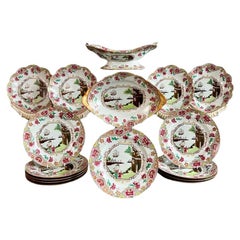
Spode Dessert Service, Ship Pattern no. 3133 on Stone China, 1813-1822
By Spode
Located in London, GB
This is a stunning and rare Spode dessert service made between 1813 and 1822, consisting of a centre piece, a lozenge shape dish, four shell dish...
Category
Antique 1810s English Regency Porcelain
Materials
Stoneware
Pinxton Tea Service, Monochrome Orange Japanese Style Blood
Milk, ca 1800
By William Billingsly
Located in London, GB
Any porcelain made at the Pinxton porcelain factory is rare, but to find a complete tea service is even rarer! This wonderful service was made around...
Category
Antique Early 1800s English Georgian Porcelain
Materials
Porcelain
You May Also Like
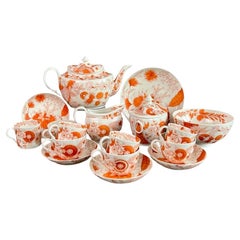
English 19thc. "Imari" Decorated Hand Painted Tea Dessert Service for 8-26 Pcs
By Hammersley
Located in Great Barrington, MA
An amazing hand painted example of the influence of the Japonesque influence on English wares ca. 1890's. This is a complete set of 8 footed cups and saucers and 8 matching dessert p...
Category
Antique 1880s English Japonisme Tea Sets
Materials
Porcelain
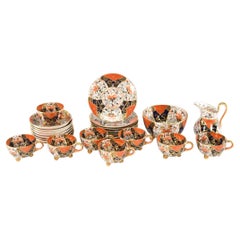
Large English Porcelain Imari Pattern Dessert and Tea Service, Spode, circa 1815
Located in New York, NY
Iron-red uppercase Spode mark and pattern 2213. Richly painted in the Imari palette and enriched in pale-blue, green and gold with flowering shrubs and a tree, the border with alternate radiating panels of the same shrubs and of gilt double diamonds...
Category
Antique 1810s English Dinner Plates
Materials
Porcelain
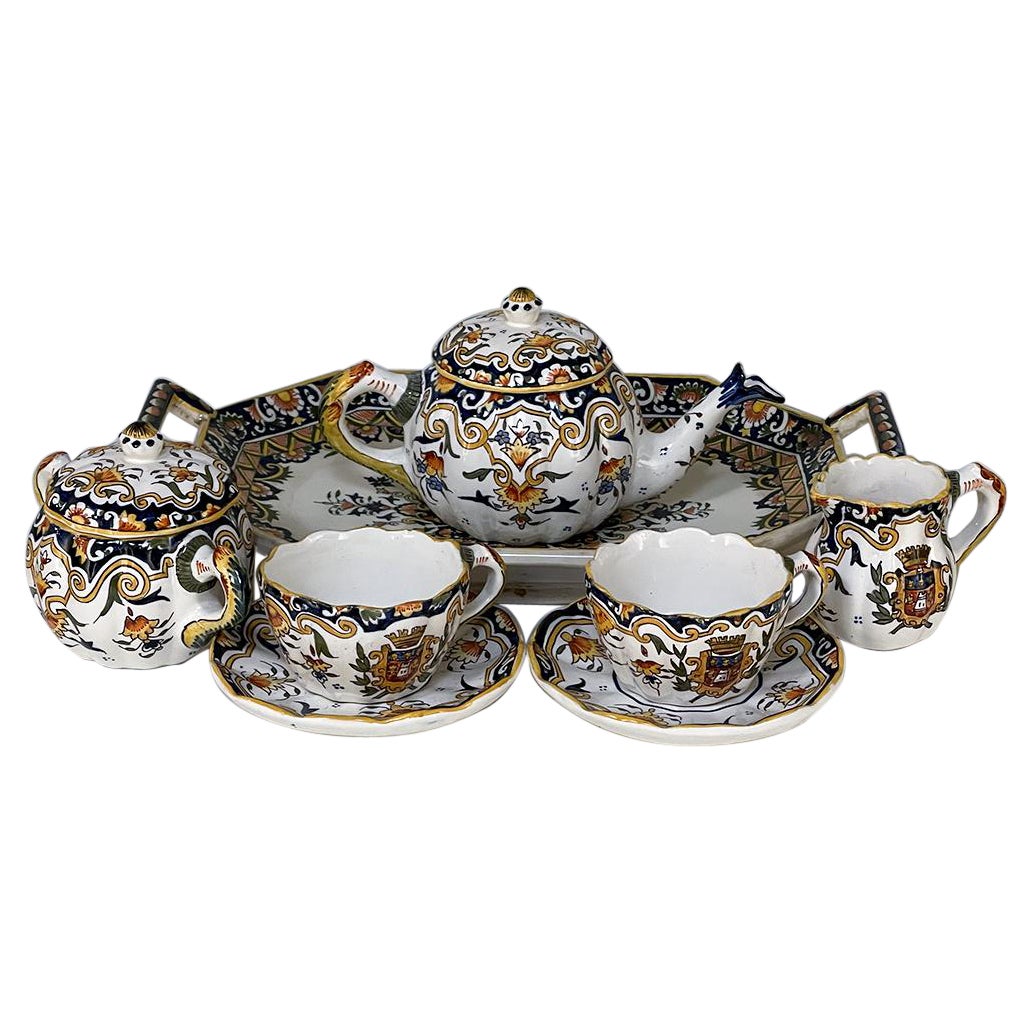
19th Century French Faience 8 Piece Hand-Painted Tea Service
Located in Dallas, TX
19th century French faience 8 piece hand-painted tea service represents the remarkably unique and definitively French porcelains produced in the fabled region around Rouen! Hand-made...
Category
Antique Late 19th Century French French Provincial Tea Sets
Materials
Faience
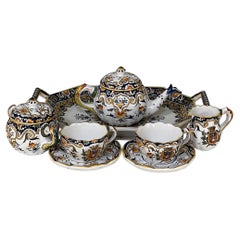
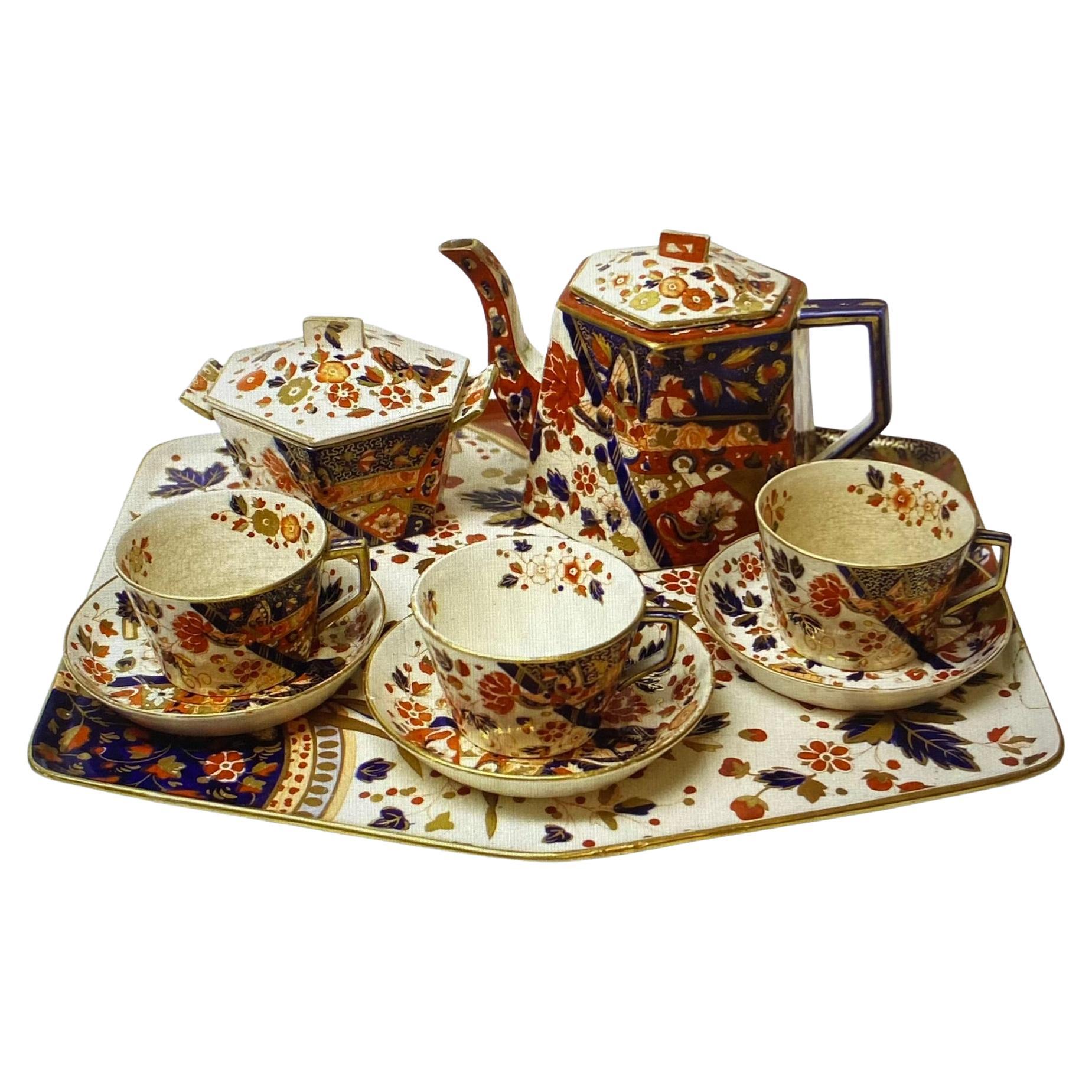
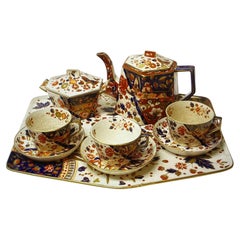
Antique Hexagonal Old Derby Imari Tea Set
By Imari Porcelain
Located in East Hampton, NY
Old Derby Imari tea set including:
Measure: Tray 15" x 14"
Tea pot 5.25" H x 7.75" W x 5.5" D
Sugar well 3.75" H x 5 W x 4.5" D
3 tea cups 2 1/8" H x 3.75" W...
Category
Antique Late 19th Century English Country Tea Sets
Materials
Ceramic
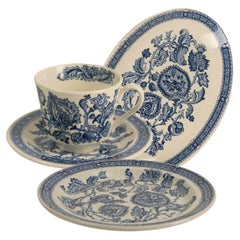
20-Piece Coffee Service Jacobean Pattern By W. H. Grindley
Co.
By W. H. Grindley
Co.
Located in Worcester Park, GB
This beautifully preserved vintage coffee service by W.H. Grindley
Co. stands out for its charming countryside motif, meticulous transferware detailing, and full, coordinated s...
Category
Mid-20th Century English Country Tea Sets
Materials
Earthenware
Antique Chinese Porcelain Tea Set, 3 Person, Early 20th C., Hand-Painted
Located in Bastogne, BE
This charming antique porcelain tea set, crafted in China at the dawn of the 20th century.
Hand-painted with exquisite detail and accented ...
Category
Vintage 1910s Chinese Chinoiserie Tea Sets
Materials
Porcelain