Want more images or videos?
Request additional images or videos from the seller
1 of 13

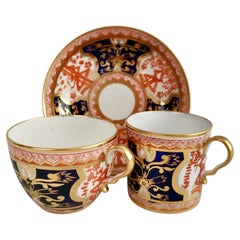
Minton Orphaned Porcelain Teacup, Imari Pattern, Regency, circa 1820

$235List Price

You May Also Like

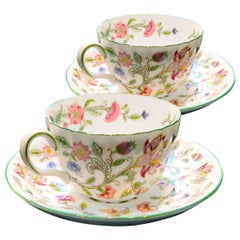
12 Teacups and Saucers Minton Bone China Porcelain Haddon Hall
By Minton
Located in Paris, FR
Set of 12 teacups and with their saucers in Minton Bone China Porcelain. Famous Minton Haddon Hall model designed by John William Wadsworth (1879-19...
Category

Early 20th Century English Porcelain

Materials

Porcelain

12 Teacups and Saucers Minton Bone China Porcelain Haddon Hall
$717 Sale Price / set
20% Off
H 2.76 in Dm 5.52 in
12 Teacups and Saucers Minton Bone China Porcelain Haddon Hall
By Minton
Located in Paris, FR
Set of 12 teacups and with their saucers in Minton Bone China Porcelain. Famous Minton Haddon Hall model designed by John William Wadsworth (1879–19...
Category

Early 20th Century English Porcelain

Materials

Porcelain

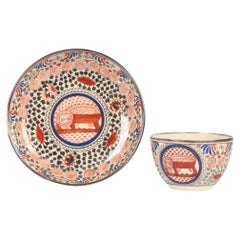
Thomas Wolfe Factory Z Lion Pattern English Teacup and Saucer
Located in Bishop s Stortford, Hertfordshire
A scarce antique English Staffordshire bone china teacup and saucer hand decorated with a red lion by Thomas Wolfe (Factory Z) and dating from...
Category

Antique 1810s English George III Tea Sets

Materials

Porcelain

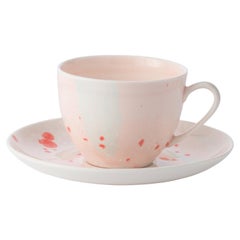
Contemporary Set of 2 Teacups and Saucer Hand Painted Porcelain
By Coralla Maiuri
Located in Roma, RM
Handcrafted in Italy from the finest porcelain, these Berry teacups and saucers are entirely decorated with a dotted pink enamel. Set of 2 teacups and saucers 10cl Piazza del Popolo, Berry collection Hand painted porcelain Made in Italy First introduced at Milan Design Week 2018, the Piazza del Popolo collection is named after a Roman landmark, at the heart of Roman everyday life, and inspired by traditional, simple Italian artisanal pottery yet decorated in a personal and elegant key. Each Coralla Maiuri product is entirely hand decorated. Each is a work of art. While ensuring consistency, they are never identical. Slight variations of decor and color from one to another are not only normal, but to be expected as a sign of their uniqueness.    For large quantities, production lead time to be confirmed. Dishwasher and microwave oven safe.
Category

2010s Italian Modern Tea Sets

Materials

Porcelain

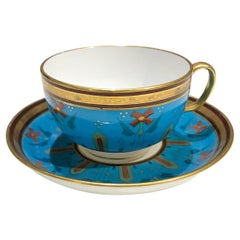
Minton Tea cup attributed to Christopher Dresser, 1871
By Minton, Christopher Dresser
Located in Paris, FR
Wonderful aesthetic movement tea cup in hand-painted and hand-gilt porcelain by the English manufactory Minton. Blue background with stylized red flowers imitating the cloisonné technique, very common in the Japonisme ware. Attributed to Christopher Dresser, a famous designer that was working for Minton in 1867. He made very decorative designs, using very often this special shade of blue. A very small quantity of his work was signed, but the quality of some designs allows to make further -attribution to him, such as this tea cup. Signed with Minton hallmarks beneath, "Minton", number of the model G596 (China ware...
Category

Antique 1870s English Aesthetic Movement Porcelain

Materials

Porcelain

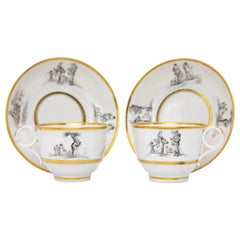
Pair of Early Barr Flight Barr Porcelain Teacups and Saucers
By Barr, Flight Barr Worcester
Located in Fort Lauderdale, FL
A pair of early transferware English porcelain teacups and saucers, made by the Worcester Porcelain Factory during the Barr, Flight & Barr ...
Category

Antique Early 19th Century English Country Porcelain

Materials

Porcelain

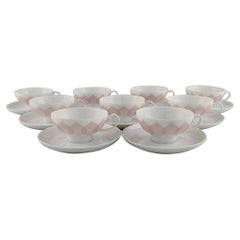
Bjørn Wiinblad for Rosenthal, Lotus Porcelain Service, 9 Teacups with Saucers
Located in København, Copenhagen
Bjørn Wiinblad for Rosenthal. Lotus porcelain service. 9 teacups with saucers decorated with pink lotus leaves. 1980s. The cup measures: 10 x 5 c...
Category

Vintage 1980s German Modern Porcelain

Materials

Porcelain

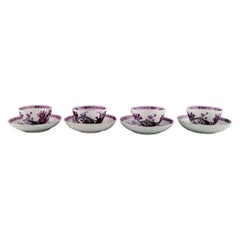
Four Antique Meissen Teacups with Saucers in Hand-Painted Porcelain
Located in København, Copenhagen
Four antique Meissen teacups with saucers in hand-painted porcelain. Purple flowers and gold decoration. Museum quality, approx. 1740. The cup meas...
Category

Antique 1740s German Porcelain

Materials

Porcelain

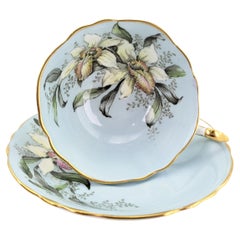
Vintage Paragon Double Warrant Bone China Teacup Saucer with Floral Pattern
By Paragon
Located in Hamilton, Ontario
This teacup and saucer set was made by the renowned Paragon fine bone china factory of England in approximately 1960. The set is done with a robin egg blue ground with a large flowered pattern on the inside of the cup which is replicated on the saucer. The cup is done with a wide square mouth...
Category

Mid-20th Century English Mid-Century Modern Porcelain

Materials

Porcelain

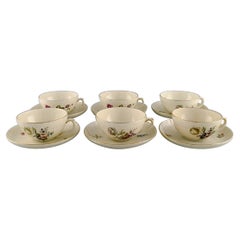
Six Royal Copenhagen Frijsenborg Teacups with Saucers in Hand-Painted Porcelain
Located in København, Copenhagen
Six Royal Copenhagen Frijsenborg teacups with saucers in hand-painted porcelain with flowers and gold edge. 1950s. The cup measures: 10 x 5 cm. Sa...
Category

Vintage 1950s Danish Porcelain

Materials

Porcelain

More From This Seller

View All
Spode Porcelain Teacup Trio, Red Imari Dollar Pattern, Regency, ca 1810
By Spode
Located in London, GB
This is a beautiful orphaned teacup made by Spode in about 1810. It bears a lavish Japanese-inspired Imari pattern. Spode was the great pioneer among the Georgian potters in England. Around the year 1800 he perfected the bone china recipe that has been used by British potters ever since, and he was also the leading potter behind the technique of transferware, making it possible for English potters to replace the Chinese export china, which had come to an end around that time, with their own designs. This was fundamental to a thriving industry that would last for about 150 years and provide half the world with their tableware. Spode porcelain is regarded as one of the highest quality porcelains around; for a soft-paste porcelain it is surprisingly hard and fine, and has a wonderful bright white colour. The pattern on this can is called "Dollar" pattern, a very famous pattern that was used by English potters in the 18th and early 19th Century. It is obvious why it is called “dollar” - but its origin is less obvious! It is thought that this pattern was derived from a very old Chinese pattern depicting a tree with elaborate foliage that hides a Chinese character representing longevity or happiness. Traditionally, this went with a an image called “Taotie”, which was used on very ancient bronze vases...
Category

Antique Early 1800s English Regency Porcelain

Materials

Porcelain

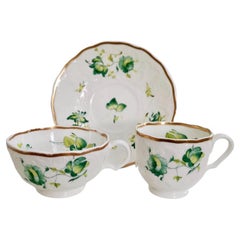
Minton Teacup Trio, Bath Embossed, Green Flowers Patt. 38/680, ca 1830
By Minton
Located in London, GB
This is an elegant "true trio" consisting of a teacup, coffee cup and saucer, made by Minton in about 1830. The set is decorated with the beautifully hand painted pattern no. 680 con...
Category

Antique 1830s English Rococo Revival Tea Sets

Materials

Porcelain

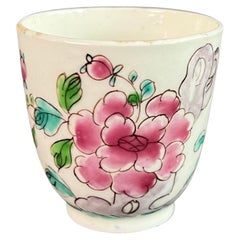
Bow Porcelain Orphaned Coffee Cup, Famille Rose Peony, circa 1755
By Bow Porcelain
Located in London, GB
This is a very charming orphaned coffee cup made by the Bow Porcelain factory in about 1755. The cup is decorated in a Chinese "famille rose" peony pattern. This cup would have been part of a large tea service, and the tiny size shows how expensive coffee was in the 18th Century. The Bow Porcelain Factory was one of the first potteries in Britain to make soft paste porcelain, and most probably the very first to use bone ash, which later got perfected by Josiah Spode to what is now the universally used "bone china". Bow was the main competitor of the Chelsea Porcelain Factory, but where Chelsea made very fine slipcast porcelain, Bow made a different soft paste porcelain that tended to be softer and could be pressed into moulds. Bow served a larger public generally at lower prices. The factory was only in operation between 1743 and 1774, after which the tradition got incorporated into some of the later famous potteries such as Worcester and Derby. The cup is unmarked, which is normal for Bow items of this era. Condition report the cup is in excellent condition without any damage or repairs. There are various glazing imperfections, which are quite normal for porcelain of this era. Antique British porcelain...
Category

Antique 1750s English Rococo Tea Sets

Materials

Porcelain

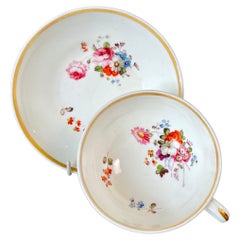
Samuel Alcock Porcelain Teacup, White with Flower Sprays, ca 1823
By Samuel Alcock Co.
Located in London, GB
A teacup and saucer in the “half orange” shape, white with simple gilt rim and beautiful hand painted flower sprays Pattern unknown but similar to 1082 Year: ca 1823 Size: cup diameter 10cm (4”), saucer diameter 14.2cm (5.5”) Condition: excellent, some rubbing to gilt There are several items available in this design, please see group image and ask for more info if interested. The Samuel Alcock factory was operative in Staffordshire between 1822 and 1856, after which it was bought by Sir James Duke and Nephews. The factory started as a partnership between the young Samuel Alcock and the older Ralph Stevenson, who provided the factory and capital. Alcock quickly took the factory to great heights, building one of the biggest factories of its time. Alcock jumped on the new Rococo Revival fashion and served a huge new middle class market. The reason we now don't hear much about Samuel Alcock porcelain...
Category

Antique 1820s English Regency Tea Sets

Materials

Porcelain

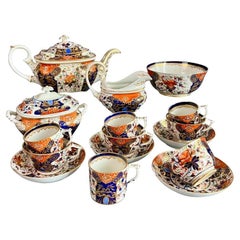
Bloor Derby Tea Service, Witches Pattern Imari, ca 1825
By Bloor Derby
Located in London, GB
This is a rather extravagant tea service serving four, made by the Bloor Derby factory between 1825 and 1830 in the wonderful "Witches" pattern in the Imari colour scheme. The set c...
Category

Antique 1820s English Regency Tea Sets

Materials

Porcelain

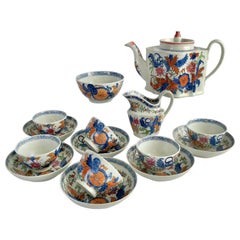
New Hall Porcelain Tea Service, Japanese Tobacco Pattern, Georgian, circa 1795
By New Hall
Located in London, GB
This is a stunning tea service made by New Hall in circa 1795. The service is made of hybrid hard paste porcelain and decorated in a bold Chinoiserie pattern of large flower sprays. The service consists of a teapot with cover, a milk jug, a slop bowl, and six tea bowls with saucers. This service has provenance; it came from the collection of David Redstone, the well known porcelain expert who wrote leading books on Bow and Chelsea porcelain. The New Hall factory started as a cooperative of several Staffordshire potters making use of the porcelain license of Bristol Porcelain...
Category

Antique 1790s English George III Tea Sets

Materials

Porcelain

Still Thinking About These?

All Recently Viewed