Items Similar to Corsican Bronze Hoard

Want more images or videos?
Request additional images or videos from the seller
1 of 8
Corsican Bronze Hoard
$89,011.47per set
£64,800per set
€75,900.08per set
CA$122,297.31per set
A$133,011.80per set
CHF 70,491.39per set
MX$1,593,759.25per set
NOK 895,909.33per set
SEK 820,774.75per set
DKK 567,323.50per set
About the Item
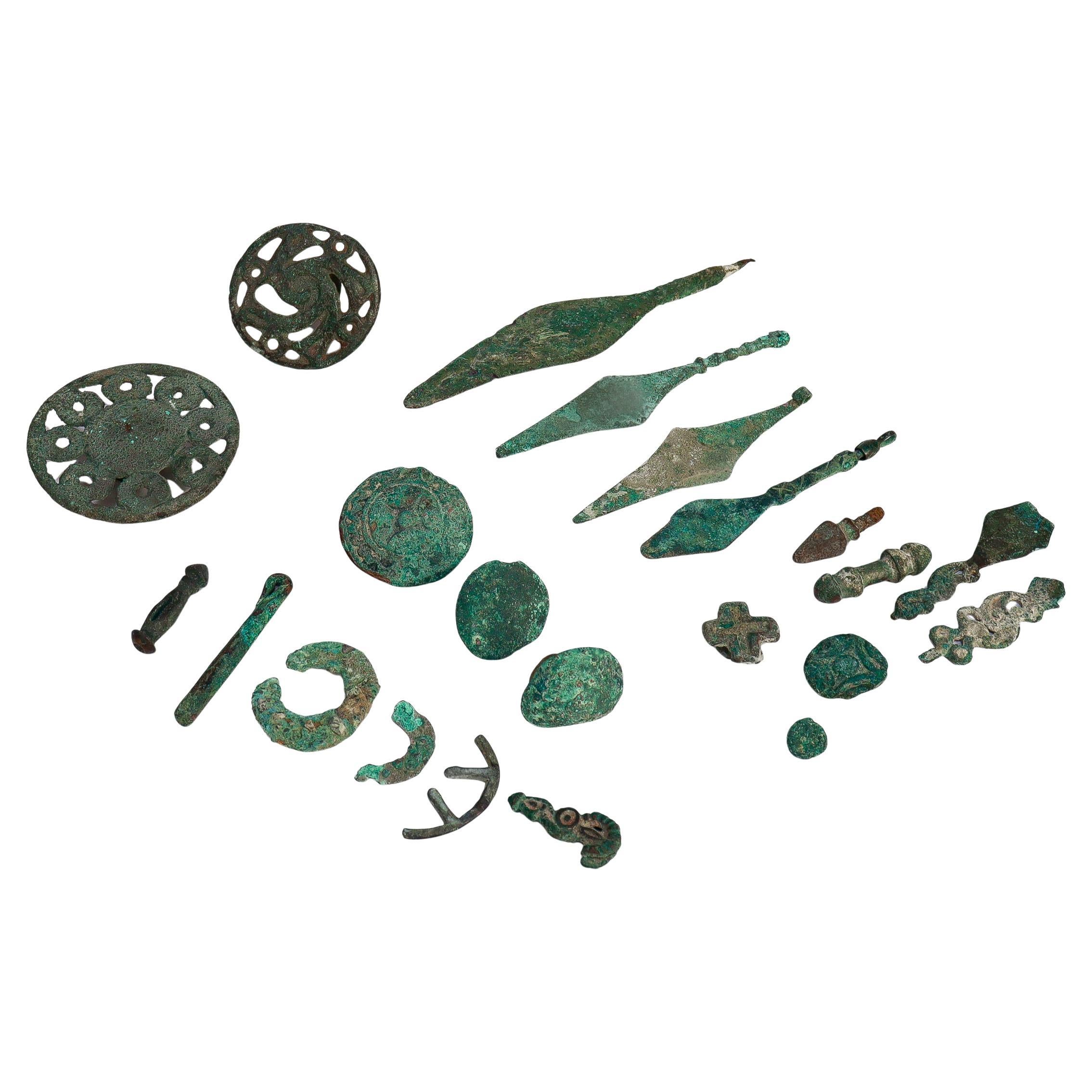
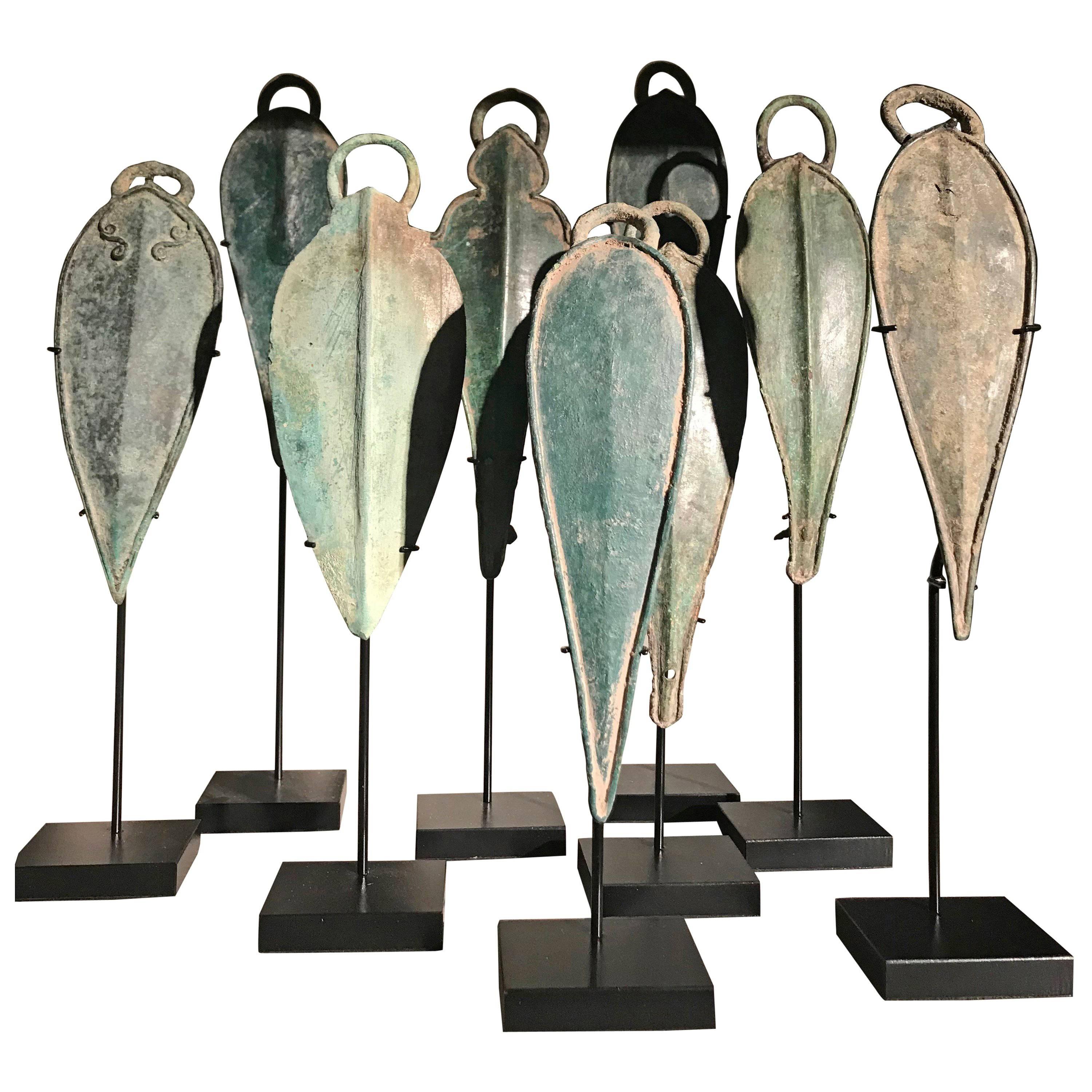
Dagger L: 27.8 cm,
Luniform bronze, possibly a belt buckle L: 10.8 cm,
Shield-shaped bronze with a point Diam: 6.5 cm,
Pommel Diam: 3.7 cm,
Violin-bow brooch L: 17.5 cm,
P-Shaped bow brooch L: 9 cm,
Bow brooch L: 3.5 cm,
Ring 1 Diam: 7.7 cm, Ring 2 Diam: 4.8 cm, Ring 3 Diam: 3.7 cm
A collection of unique bronzes found together on the bed of the Gravona river in the French territorial collectivity of Corsica, during the construction of the Ajaccio-Bastia railway line, which first opened in 1888. This provides two possible precise locations for the find, at the two points where bridges were constructed for the line to cross the river: either in Carbuccia, 10 km north-east of Ajaccio, or at Bocognano, 10 km further in the same direction along the valley. This discovery was published in 1924, in an 8-page essay in the bulletin of the Société Préhistorique Française by Dr Robert Forrer, the director of the Musée préhistorique et gallo-romain in Strasbourg.
Various reasons for the discovery of this group in one place have been suggested. It may have been part of a funerary hoard, or perhaps several burials along the banks of the Gravona, a trader’s wares, or even the hidden treasure of a warrior. Both potential discovery sites are in inland mountainous regions. Forrer posits that the bronzes were brought in from Sardinia, via Ajaccio and up the river, and were the property of a Sherden warrior. However, recent research indicates that the Torrean civilisation in the south of Corsica – previously thought to have begun in the second millennium BCE when Sherden warriors landed on the island – was in fact an indigenous population. There is at least one confirmed example of the distinctive megalithic towers (torri) built by this civilisation in the Gravona valley, north-east of the capital. Therefore, these bronzes may have been produced near the discovery site.
The group contains: a dagger; a luniform bronze that may have been a belt-buckle; a pommel; a disc with a projecting spike, which may have been part of a horses harness or brooch; three bow fibula of various sizes; and three simple rings of differing sizes, possibly a form of proto-currency. The style of these objects suggests a burial date of around 900 BCE.
The dagger is in the style of swords of the late Bronze Age, featuring a leaf-shaped blade with a raised medial rib down its length. The blade and hilt appear to have been cast as one. The hilt joins the blade via a raised semi-circle, and is adorned with five raised round rivets.
The crescent-shaped object features five similar rivets along the arc, and a pointed hook on the reverse. A short cross with rounded ends extends from the inner centre of the arc. The rivets and hook could have served as a means of affixing the bronze in place, suggesting that this object may have been a belt-buckle, or perhaps part of a scabbard or horse harness.
The circular disc features a large rounded spike projecting from its centre, recalling the shields held by warriors in Nuragic bronze statues. Small holes are pierced around the circumference, four of which contain chain links, suggesting that this disc was previously part of a larger object. The disc may have been a phalera on a horse harness or perhaps the centrepiece of a brooch, as in a contemporaneous example in the Metropolitan Museum of Art, New York (2007.498.2).
The pommel takes the form of a hollow ovoid, pierced longitudinally with a hole about 1.3-1.4 cm in dia meter, and with another very small hole through one side. This would allow a stick to be inserted through the pommel and held in place by a small nail, so that the pommel could be wielded as a part of a sceptre or other weapon. However, at only 69 g, it seems most likely that this pommel served a decorative, rather than a martial, function.
This collection contains three brooches, including one of remarkable size. The largest brooch is of the typical violin-bow form, with a long pin and spiral coil. The broad catchplate is adorned with raised points of hammered decoration, with a few horizontal lines incised on the bar connecting the plate to the spiral. The median-sized P-shaped brooch, now missing its pin, features an incised pattern of a cross across the arch. Three thin rings attached in a chain at the foot of the brooch suggest an additional ornament of some kind was originally affixed here. The smallest brooch curves towards a pronounced raised rib in the centre of the bow.
Each of the three rings in this find are formed from a single bronze rod, bent into its circular shape. The largest is made from a cylindrical rod, while the others are each formed from a rhomboid rod. It is unlikely that these would have been bracelets, as their diameters are too small. Forrer proposed that, due to their simple forms and the relationship between each of their weights (the weight of the smallest is about 2/3 of the second smallest, which is approximately 1/4 of the largest), these rings may have been a form of currency, of the kind found in other Bronze Age settlements in Europe.
Published:
R Forrer, ‘Un trésor de bronzes préhistoriques decouvert en Corse’, Bulletin de la Société préhistorique de France, 10, 1924, pp. 224-232.
Provenance:
Discovered c. 1880-90 near Ajaccio, Corsica.
Private Collection of Mr Ducasse.
Thence by descent to Jean Dimitri Ducasse (b. 1883), Sarrebourg.
Thence by descent.
ALR: S00228228, with IADAA Certificate, this item has been checked against the Interpol database.
- Dimensions:Height: 10.95 in (27.8 cm)Width: 4.22 in (10.7 cm)Depth: 1.38 in (3.5 cm)
- Sold As:Set of 10
- Style:Classical Roman (Of the Period)
- Materials and Techniques:
- Place of Origin:
- Period:
- Date of Manufacture:circa 900 B.C
- Condition:Wear consistent with age and use.
- Seller Location:London, GB
- Reference Number:Seller: D41351stDibs: LU5517239202382
About the Seller
5.0
Vetted Professional Seller
Every seller passes strict standards for authenticity and reliability
Established in 1910
1stDibs seller since 2020
- ShippingRetrieving quote...Shipping from: London, United Kingdom
- Return Policy
More From This Seller
View AllFacial Fragment of a Corinthian Helmet
Located in London, GB
Ancient Greek city-states such as Corinth were defended by the hoplites (derived from the hopla or round shield), citizen-soldiers primarily armed with swords, spears and shields. S...
Category
Antique 15th Century and Earlier Greek Classical Greek Antiquities
Materials
Bronze
Byzantine Mosaic Panel
Located in London, GB
A rectangular Byzantine mosaic, comprising six lines of Greek text in black and red tesserae set within a blue rectangular frame against a white background. The second line down is i...
Category
Antique 15th Century and Earlier Turkish Classical Greek Antiquities
Materials
Stone

$302,886
Cycladic Idol
Located in London, GB
A marble figure of the early Spedos type of sculpture produced during the Early Cycladic II Period. The simplified figure is depicted in the canonical posture, with incised arms fold...
Category
Antique 15th Century and Earlier Greek Classical Greek Antiquities
Materials
Marble
$122,253
Arabic-Inscribed Archaistic Vase
Located in London, GB
An elegantly cast bronze vessel from Qing Dynasty China. The pear-shaped body sits atop a splayed foot, and rises to a waisted neck and flared rim. A broad band of gold and silver in...
Category
Antique 17th Century Chinese Antiquities
Materials
Bronze
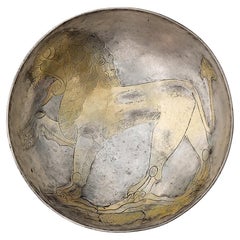
Plate with Lion Motif
Located in London, GB
A plate of silver gilt bronze, incised with a large image of a roaring lion. The lion is depicted mid-stride, with its foreleg raised in front of it. The lion’s mouth is opened wide,...
Category
Antique 15th Century and Earlier Persian Antiquities
Materials
Silver
$44,643
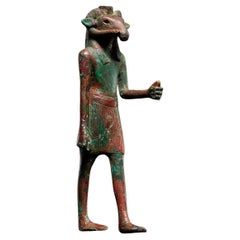
Figure of Khnum
Located in London, GB
A striding figure of the Egyptian god Khnum, in bronze. The god is depicted as a man with a ram’s head, with two large horns curving inwards and forwards towards the face, in the sty...
Category
Antique 15th Century and Earlier Egyptian Egyptian Antiquities
Materials
Bronze
$29,088
You May Also Like
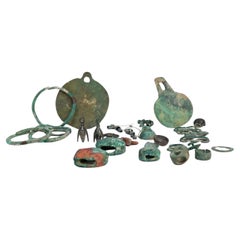
Set of Assorted Ancient Gandharan Bronze Jewelry Artifacts
Located in Philadelphia, PA
A fine set of assorted ancient jewelry.
Likely Gandharan in origin.
In verdigris covered bronze.
Comprising 1 beaded necklace, 3 bracelets, 1 signet ring, 2 band rings,, 2 pendants, 4 rams head buckles...
Category
Antique 15th Century and Earlier Indian Antiquities
Materials
Bronze
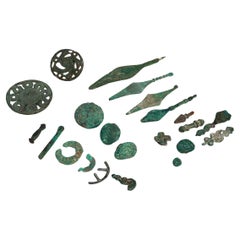
Set of Assorted Ancient Gandharan Bronze Artifacts / Objects
Located in Philadelphia, PA
A fine set of assorted ancient tools
Likely Gandharan in origin.
In verdigris covered bronze.
Comprising 2 scalpels, 2 razors, 2 razor handles with broken blades, 7 wax seals of ...
Category
Antique 15th Century and Earlier Indian Antiquities
Materials
Bronze
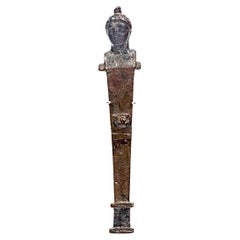
Ancient Roman Bronze Herm on Stand, 1st-4th Century AD
Located in Bradenton, FL
Ancient Roman Bronze Herm Statue dating from the 1st to 4th Century A.D. A herm was a statue consisting of a a head atop a square pillar, originally an artifact to honor the god Herm...
Category
Antique 15th Century and Earlier Italian Classical Roman Figurative Scul...
Materials
Bronze
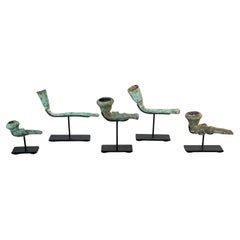
16th-18th Century Bronze Pipe Heads excavated from Central Highlands, Vietnam
Located in Wainscott, NY
16th-17th Century Bronze Pipe Heads from Central Highlands, Vietnam. The set of five bronze pipe heads, recovered during controlled excavation in Central Highlands, Vietnam. Techni...
Category
Antique 17th Century Vietnamese Mounted Objects
Materials
Bronze
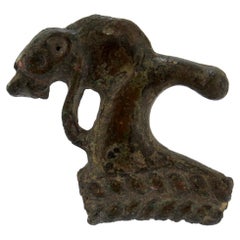
Ancient Roman Bronze Handle or Artifact
Located in Philadelphia, PA
An antique or ancient Roman bronze element.
This piece was an element of a vase or possibly handle to something larger.
It has the head of...
Category
Antique 15th Century and Earlier European Classical Roman Antiquities
Materials
Bronze
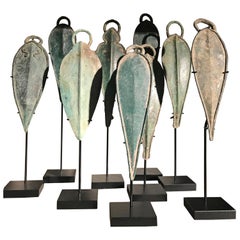
Set of Nine Bronze Ornaments, Pectoral Ornaments
Located in Schellebelle, BE
Exceptional Set Of 9 Pectoral Ornaments
South East Asia,Cambodia,11-13th Century
broze material with great oxidation patina
stands with different heights 21/22/23/23/25/27/27/27/30 c...
Category
Antique 15th Century and Earlier Burmese Metalwork
Materials
Bronze
$5,382 / set