1 of 6
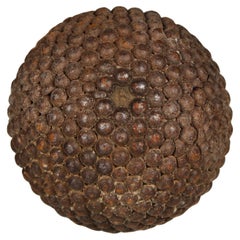
Early American gum ball machine
$650List Price
About the Item
- Dimensions:Height: 15.5 in (39.37 cm)Width: 8.5 in (21.59 cm)
- Materials and Techniques:
- Place of Origin:
- Period:
- Date of Manufacture:Crica 1910
- Condition:
- Seller Location:Sheffield, MA
- Reference Number:1stDibs: 0910098333301
Authenticity Guarantee
In the unlikely event there’s an issue with an item’s authenticity, contact us within 1 year for a full refund. DetailsMoney-Back Guarantee
If your item is not as described, is damaged in transit, or does not arrive, contact us within 7 days for a full refund. Details24-Hour Cancellation
You have a 24-hour grace period in which to reconsider your purchase, with no questions asked.Vetted Professional Sellers
Our world-class sellers must adhere to strict standards for service and quality, maintaining the integrity of our listings.Price-Match Guarantee
If you find that a seller listed the same item for a lower price elsewhere, we’ll match it.Trusted Global Delivery
Our best-in-class carrier network provides specialized shipping options worldwide, including custom delivery.You May Also Like
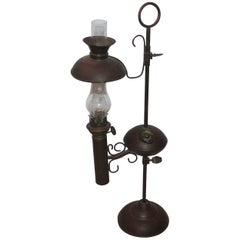
Rare and Early American 19th Century Brass Oil Lamp
Located in Los Angeles, CA
This fine masterpiece is quite unusual and is in unbelievable condition. This is a fragile and amazing oil lamp with a handblown original glass globe. The condition is very good.
Category
Antique Mid-19th Century American American Colonial Antiquities
Materials
Brass
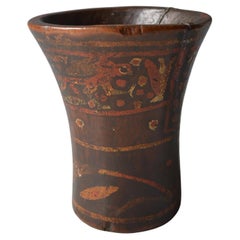
Pre Columbian Inca Early Colonial period Wood Kero South American Antiques
Located in London, GB
Pre Columbian INCA / Early Colonial period Wood Kero
A superb Inca Kero carved and painted in a mosaic style with Avian floral and animal designs
Height...
Category
Antique 15th Century and Earlier Peruvian Antiquities
Materials
Wood
$619
Free Shipping
H 5.91 in W 5.12 in D 5.12 in
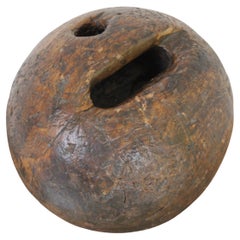
Boule ball hard wood
Located in Diest, BE
French ball from a folk art game. Great patina and form.
Normandy, France ca. 1860
Category
Antique 1860s French French Provincial Antiquities
Materials
Wood
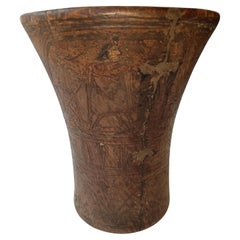
Pre Columbian Large Inca Early Colonial period Wood Kero South American Antiques
Located in London, GB
Large Pre Columbian INCA / Early Colonial period Wood Kero
A superb Large Inca Kero cup profusely carved in the mosaic style with a image of the Inca or...
Category
Antique 15th Century and Earlier Peruvian Antiquities
Materials
Wood
$760 Sale Price
35% Off
H 9.45 in W 6.3 in D 5.12 in
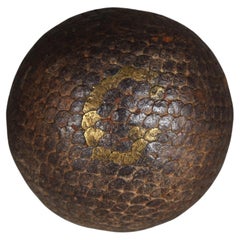
Antique Boule Ball "G", Pétanque, 1880s, France, Craftsmanship
Located in Greven, DE
Beautiful, unique Boule ball, France, late 19th Century.
In the 19th century, the manufacture of boules balls underwent significant development in France as the game of boules, particularly the pétanque variant, gained in popularity. The manufacture of boules balls during this period was a manual process that required expertise, precision and love to detail.
In the late 19th and early 20th centuries, particularly in rural areas of France and other Mediterranean regions, olive wood was a commonly used source of material for making boules balls. This was not only due to the availability of the material, but also to the outstanding properties of olive wood, which was characterized by hardness, strength and a rich grain.
First, the olive wood was carefully selected and shaped into raw balls, which were then sanded to the desired size and shape. The nails were then hammered into the balls one by one, making sure that they were evenly distributed and firmly anchored. Finally, the spheres were polished and coated with a protective varnish to enhance their natural beauty and protect them from the elements.
The use of nails to decorate and reinforce olive wood boules was a traditional practice that not only gave the ball a rustic aesthetic, but also improved its durability and contributed to customization. Many balls were made according to the specific requirements and preferences of the players. Nails were driven at regular intervals around the ball, with each nail hole precisely placed so as not to affect the balance and weight distribution of the ball. These nails not only served as a decorative element, but also helped to strengthen the structure of the ball and make it more resistant to the hard knocks and wear and tear during play. Individual engravings or decorations were often applied to the balls to make them unique and identify the player.
Antique boules...
Category
Antique Late 19th Century French Late Victorian Antiquities
Materials
Metal
Antique Boule Ball "G", Pétanque, 1880s, France, Craftsmanship
Located in Greven, DE
Beautiful, unique Boule ball, France, late 19th Century.
In the 19th century, the manufacture of boules balls underwent significant development in France as the game of boules, particularly the pétanque variant, gained in popularity. The manufacture of boules balls during this period was a manual process that required expertise, precision and love to detail.
In the late 19th and early 20th centuries, particularly in rural areas of France and other Mediterranean regions, olive wood was a commonly used source of material for making boules balls. This was not only due to the availability of the material, but also to the outstanding properties of olive wood, which was characterized by hardness, strength and a rich grain.
First, the olive wood was carefully selected and shaped into raw balls, which were then sanded to the desired size and shape. The nails were then hammered into the balls one by one, making sure that they were evenly distributed and firmly anchored. Finally, the spheres were polished and coated with a protective varnish to enhance their natural beauty and protect them from the elements.
The use of nails to decorate and reinforce olive wood boules was a traditional practice that not only gave the ball a rustic aesthetic, but also improved its durability and contributed to customization. Many balls were made according to the specific requirements and preferences of the players. Nails were driven at regular intervals around the ball, with each nail hole precisely placed so as not to affect the balance and weight distribution of the ball. These nails not only served as a decorative element, but also helped to strengthen the structure of the ball and make it more resistant to the hard knocks and wear and tear during play. Individual engravings or decorations were often applied to the balls to make them unique and identify the player.
Antique boules...
Category
Antique Late 19th Century French Late Victorian Antiquities
Materials
Metal
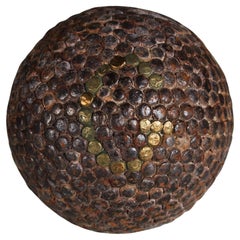
Antique Boule Ball "6", Pétanque, 1880s, France, Craftsmanship
Located in Greven, DE
Beautiful, unique Boule ball, France, late 19th Century.
In the 19th century, the manufacture of boules balls underwent significant development in France as the game of boules, part...
Category
Antique Late 19th Century French Late Victorian Antiquities
Materials
Metal, Brass
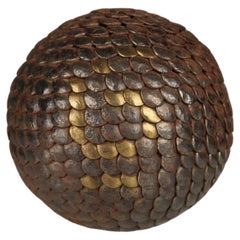
Antique Boule Ball, Pétanque, 1880s, France, Craftsmanship
Located in Greven, DE
Beautiful, unique Boule ball, France, late 19th Century.
In the 19th century, the manufacture of boules balls underwent significant development in France as the game of boules, part...
Category
Antique Late 19th Century French Late Victorian Antiquities
Materials
Metal
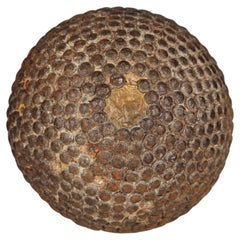
Antique Boule Ball "7", Pétanque, 1880s, France, Craftsmanship
Located in Greven, DE
Beautiful, unique Boule ball, France, late 19th Century.
In the 19th century, the manufacture of boules balls underwent significant development in France as the game of boules, particularly the pétanque variant, gained in popularity. The manufacture of boules balls during this period was a manual process that required expertise, precision and love to detail.
In the late 19th and early 20th centuries, particularly in rural areas of France and other Mediterranean regions, olive wood was a commonly used source of material for making boules balls. This was not only due to the availability of the material, but also to the outstanding properties of olive wood, which was characterized by hardness, strength and a rich grain.
First, the olive wood was carefully selected and shaped into raw balls, which were then sanded to the desired size and shape. The nails were then hammered into the balls one by one, making sure that they were evenly distributed and firmly anchored. Finally, the spheres were polished and coated with a protective varnish to enhance their natural beauty and protect them from the elements.
The use of nails to decorate and reinforce olive wood boules was a traditional practice that not only gave the ball a rustic aesthetic, but also improved its durability and contributed to customization. Many balls were made according to the specific requirements and preferences of the players. Nails were driven at regular intervals around the ball, with each nail hole precisely placed so as not to affect the balance and weight distribution of the ball. These nails not only served as a decorative element, but also helped to strengthen the structure of the ball and make it more resistant to the hard knocks and wear and tear during play. Individual engravings or decorations were often applied to the balls to make them unique and identify the player.
Antique boules...
Category
Antique Late 19th Century French Late Victorian Antiquities
Materials
Metal
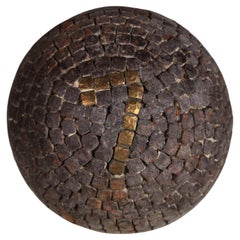
Antique Boule Ball "B", Pétanque, 1880s, France, Craftsmanship
Located in Greven, DE
Beautiful, unique Boule ball, France, late 19th Century.
In the 19th century, the manufacture of boules balls underwent significant development in France as the game of boules, part...
Category
Antique Late 19th Century French Late Victorian Antiquities
Materials
Metal