Want more images or videos?
Request additional images or videos from the seller
1 of 6
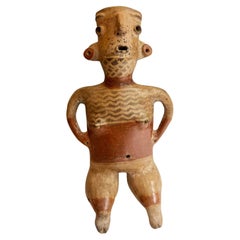
Pre Columbian Female Stone Fertility figure Costa Rica
$602.86List Price
About the Item
- Dimensions:Height: 10.24 in (26 cm)Width: 5.52 in (14 cm)Depth: 1.97 in (5 cm)
- Materials and Techniques:
- Place of Origin:
- Period:
- Date of Manufacture:15th Century and Earlier
- Condition:Wear consistent with age and use. no restorations.
- Seller Location:London, GB
- Reference Number:1stDibs: LU6460244532872
About the Seller
4.9
Vetted Professional Seller
Every seller passes strict standards for authenticity and reliability
Established in 1985
1stDibs seller since 2022
110 sales on 1stDibs
Typical response time: 5 hours
Authenticity Guarantee
In the unlikely event there’s an issue with an item’s authenticity, contact us within 1 year for a full refund. DetailsMoney-Back Guarantee
If your item is not as described, is damaged in transit, or does not arrive, contact us within 7 days for a full refund. Details24-Hour Cancellation
You have a 24-hour grace period in which to reconsider your purchase, with no questions asked.Vetted Professional Sellers
Our world-class sellers must adhere to strict standards for service and quality, maintaining the integrity of our listings.Price-Match Guarantee
If you find that a seller listed the same item for a lower price elsewhere, we’ll match it.Trusted Global Delivery
Our best-in-class carrier network provides specialized shipping options worldwide, including custom delivery.You May Also Like
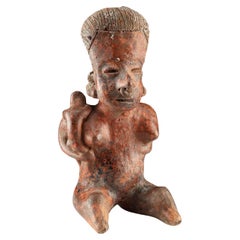
Nayarit Pottery Fertility Female Figure With Child
By Nayarit Culture
Located in Dallas, TX
Nayarit Fertility Female Figure With Child
Pre-Columbian, West Mexico, Nayarit,
Ca. 300 BCE to 300 CE.
A seated terracotta female figure from the shaft tomb tradition, shown cradling an infant over her right shoulder - likely a symbolic representation of fertility, maternity, and the continuity of life. This expressive red-slipped sculpture is boldly modeled with exaggerated limbs and stylized facial features, impressed eyes, a broad nose adorned with a septum piercing, and ear ornaments. Her elaborate coiffure is incised with vertical striations and rises into a high crest, pierced at the top with a vent hole connecting to the hollow interior. Manganese blooms across the surface attest to its long burial. Such figures were ritually interred in shaft tombs to accompany the dead, offering symbolic protection or ensuring rebirth in the afterlife.
Dimensions: 4 Inches Wide x 8.4 Inches Height (10.2 cm x 21.1 cm)
Condition: Presents beautifully with restorations to the head.
Provenance: Collection of Y. Kayvan, Los Angeles, California, USA, acquired from a Los Angeles, California, USA gallery acquisition dates range from the late 1990s to 2005
Legal to acquire under U.S. Statute covering cultural patrimony Code 2600, CHAPTER 14.
This Nayarit Figure...
Category
Antique 15th Century and Earlier Mexican Pre-Columbian Figurative Sculpt...
Materials
Pottery
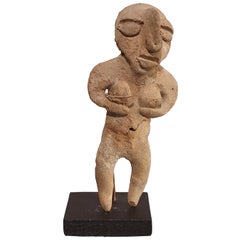
Small Ecuadorian Moulded Clay Figure on Stand
Located in London, GB
This rare and wonderful example of a formative stage figure from the woodland period is attached to a small wire and wood stand, and is in extraordinarily very good condition for its...
Category
Antique 15th Century and Earlier Ecuadorean Antiquities
Materials
Clay
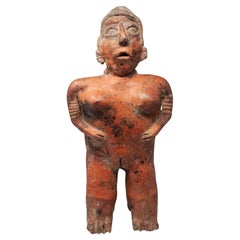
Pre-Columbian Earthenware Female Figure, Nayarit, Mexico
Located in Point Richmond, CA
Pre-Columbian Earthenware Female Figure, Nayarit, Mexico
A tall standing nude female figure of the San Sebastian Red type. The expressive face is adorned with ear ornaments and a sh...
Category
Antique 15th Century and Earlier Mexican Pre-Columbian Jars
Materials
Terracotta
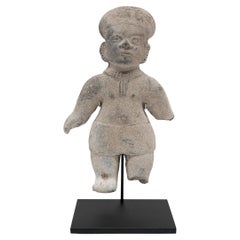
La Tolita-Tumaco Standing Female Figure
Located in Chicago, IL
This standing effigy was crafted in 500 A.D. - 1000 A.D. Mesoamerica using the gray clay paste that characterizes La Tolita-Tumaco ceramics of early Colombia-Ecuador. The art of La Tolita-Tumaco civilization is considered one of the most developed of the pre-Columbian period as metalwork and ceramics were the most popular form of cultural expression. The ceramic creations of this culture were often based on the human figure to create portraits of people and realistic daily scenes of life cycles and the human condition.
This figure appears to be wearing a loincloth and is adorned with a beaded necklace and an elaborate coiffure or headdress. There are holes lining each ear indicating the potential use of ear spools...
Category
Antique 15th Century and Earlier South American Pre-Columbian Figurative...
Materials
Ceramic
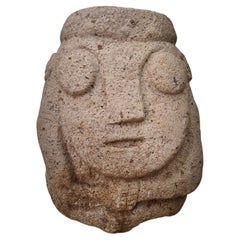
Stone Carved Anthropomorphic Sculpture From The Recuay Culture Peru 400bc-400ac
Located in Madrid, ES
ANTHROPOMORPHIC SCULPTURE CARVED IN STONE OF THE RECUAY CULTURE PERU 400BC-400AC
Recuay is an archaeological culture of Ancient Peru that developed in the Sierra of the current Peruvian department of Áncash between 200 AD. C. until 600 d. C. It corresponds to the stage called Regional Developments, it has also been called the Huaylas or Santa culture.
Like the other Early Intermediate cultures, little is known about this culture. The most accepted position is that it was an extension of the Chavin culture, after the influence of the "White on Red" style in the region. Regarding the political aspect of the recuay, there is a hypothesis that questions their autonomy and maintains that Recuay would be part of one of the many political units that made up the Moche state.
The recuay style, characterized by its ceramics and stone sculpture, was initially described by Eduard Seler in 1893, based on ceramic specimens brought to the Ethnographic Museum in Berlin by Mariano M. Macedo. Seler named this style of pottery Recuay, based on the report that these pieces had been found in the town of Recuay. Later studies showed that this characteristic pottery was not originally from Recuay but from Copa, near Carhuaz, for which reason the name change to that of this town was proposed. Eventually the name of Huaylas was used for this culture. In 1919 Julio C. Tello explored the area and recovered lithic sculptures and Recuay-type ceramics. In the 1960s Rafael Larco Hoyle proposed changing the names of Recuay and Copa to Santa, arguing that the Recuay style had originated in the coastal regions of the Santa Valley. However, the name Recuay has persisted.
Its chronology is also highly debatable. The time of its origin between 0 and 200 AD is discussed. C. and its end or collapse is commonly set to 600 d. C. probably caused by the invasion of the Huari conquerors.
It encompassed almost the entire Callejón de Huaylas, a narrow valley fed by the Santa River and enclosed between two mountain ranges, the Cordillera Blanca to the west and the Cordillera Negra to the east. Its influence extended to the east to the Marañón river basin and to the west to the upper parts of the Santa, Casma and Huarmey valleys. To the north it reached the town of Pashash, in the province of Pallasca.
The Copa area, Marca district, Recuay province, Ancash department seems to have been the center or main nucleus of cohesion of this culture. The name of the culture would then be justified, derived from the province of the same name. Other important settlements were those of Huilcahuaín (near the current city of Ancash), Cátac, Araucay, Tambo, Jancu, Upayacu and Pashash (near the current city of Cabana).
Its main form of expression of art was through stone work (carving and masonry), inherited from its predecessor, the Chavín culture. In addition, they made sculptures in lumps that represent warriors with shields or trophy heads, with which they decorated their complex architectural constructions. They also made white clay pottery...
Category
Antique 15th Century and Earlier Figurative Sculptures
Materials
Stone
$52,798
H 14.57 in W 10.24 in D 11.03 in
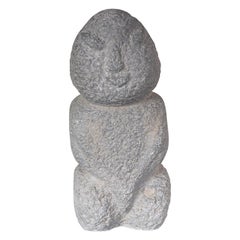
Chinese Stone Fertility Sculpture, 4700-2900 BC
Located in South Burlington, VT
China, a fine archaic male effigy hand carved from a granular medium to dark gray stone. Neolithic period, Hongshan culture (circa 4700-2900 BC)
Likely a fertility fetish. Note the pecked surfaces and the stone carved hair line top knot.
Quality: Fine original condition, no repairs, as collected. Dark varied patina from appropriate age.
Dimensions: 13.5 inches tall and 6 inches width.
About Hongshan Culture:
The Hongshan culture was a Neolithic culture in northeastern China. Hongshan sites have been found in an area stretching from Inner Mongolia to Liaoning, and dated from about 4700-2900 BC. The culture is named after Hongshanhou, a site in Hongshan District, Chifeng. The Hongshanhou site was discovered by the Japanese archaeologist Torii Ryuzo in 1908 and extensively excavated in 1935 by Kosaku Hamada and Mizuno Seiichi.
Provenance:
Our private collection and accompanied by our Lifetime Guarantee of Authenticity. Originally collected in the area of Chifeng City, Inner Mongolia.
In addition, our Hongshan stone effigy...
Category
Antique 15th Century and Earlier Chinese Antiquities
Materials
Stone
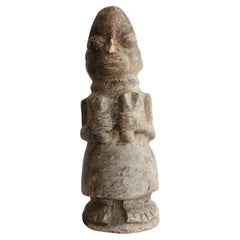
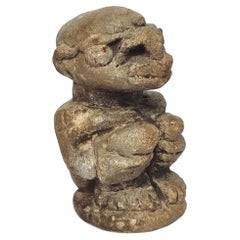
Nomoli - Carved Stone Figurine, Kissi People, Sierra Leone, 19th Century
Located in Aramits, Nouvelle-Aquitaine
A Nomoli is a carved stone figurine native to Sierra Leone and Liberia. They are usually made of soapstone, limestone, or granite.
The carving depicts a woman in a dress and choker,...
Category
Antique 19th Century Sierra Leonean Tribal Tribal Art
Materials
Stone, Soapstone
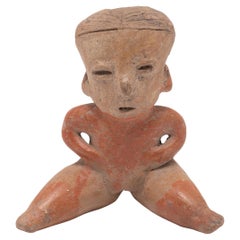
Nayarit Chinesco-Style Figure
Located in Chicago, IL
This seated effigy figure was crafted in 300 BC to 300 AD from the ancient Nayarit region of Mexico and was likely used as a ritual or burial offering. The ceramic works of the Chine...
Category
Antique 15th Century and Earlier Mexican Pre-Columbian Figurative Sculpt...
Materials
Ceramic
Nomoli Stone Figure, Sierra Leone, Kissi, Tribal Art
Located in Bochum, NRW
A Kissi Nomoli carved stone figure, a male with his hands wrapped around his knees, on a base; from the Kissi people of Sierra Leone.
Greyish brown patina, snout-like mouth, large no...
Category
Antique Late 19th Century Sierra Leonean Tribal Figurative Sculptures
Materials
Soapstone
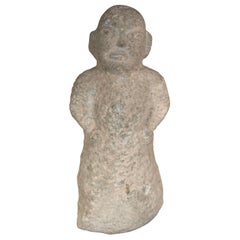
Chinese Ancient Stone Male Figure, 206 BC-220 AD
Located in South Burlington, VT
China, a rare hand carved stone male figure from the Han dynasty (206 BCE-220 CE).
Dimensions: 16 inches tall on its custom stand and and 6 inches wide
Condition: old patina wi...
Category
Antique 15th Century and Earlier Chinese Han Sculptures and Carvings
Materials
Stone
More From This Seller
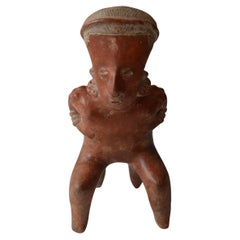
View AllPre Columbian Jalisco Figure West Mexico Circa B.C. 100-300 A.D
Located in London, GB
A Pre Columbian Jalisco seated figure
Jalisco West Mexico circa B.C. 100-300 A.D,
A Male pottery figure with red slip with elongated head and linear delineated hair wearing ear and nose ornaments, the slim body finely modelled with hands on chest seated...
Category
Antique 15th Century and Earlier Mexican Antiquities
Materials
Pottery
$915 Sale Price
30% Off
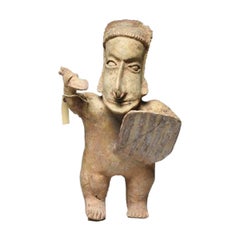
Pre Columbian Large Jalisco Figure West Mexico Circa B.C. 100-300 A.D
Located in London, GB
A Pre Columbian Jalisco warrior figure
Jalisco West Mexico circa B.C. 100-300 A.D,
A stunning large pottery warrior figure wearing a banded headdress with disco arm ornaments , ...
Category
Antique 15th Century and Earlier Mexican Antiquities
Materials
Pottery
$1,204 Sale Price
30% Off
Pre Columbian Rare Large Zacatecas Figure Latin American Antiques Art
Located in London, GB
Rare large Zacatecas seated Figure
Pre-Columbian, West Mexico ca. 200 BCE – 300 CE
A striking large terracotta figure from the Zacatecas culture, depicting a standing female with ...
Category
Antique 15th Century and Earlier Mexican Antiquities
Materials
Pottery
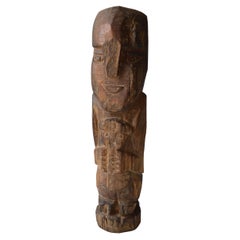
Pre Columbian Rare Lambayeque Wood Figure
Located in London, GB
Pre columbian Lamabayeque wood figure Peru Circa 750 to 1375 AD
A rare standing figure of a deity with triangular tear drop shaped eyes holding a child,
Carved in very dense heavy hard wood
Measures: Height 14 inches, 36 cm weight, 1.5 kg approx
Ex collection of a Oxford Academic, reputed to have came from Pit rivers...
Category
Antique 15th Century and Earlier Peruvian Antiquities
Materials
Wood
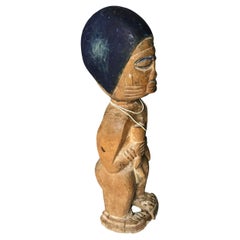
Large Yoruba Ritual Shrine figure Abeokuta Nigeria African Tribal Art
Located in London, GB
Large Yoruba Ritual Shrine figure Abeokuta Nigeria African Tribal Art
A rare exceptionally large male Cup bearer ritual shrine figure standing upright holding a cup in front
carv...
Category
Mid-20th Century Nigerian Tribal Art
Materials
Wood
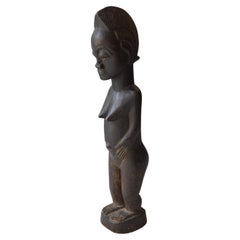
African Tribal Art Fine Baule figure
Located in London, GB
A fine Baule female figure
Standing leaning forward with serene expression with hands on abdomen
Period: early 20th century
Condition: Old Insect holes and minor damage
Measures: H ...
Category
Early 20th Century Ivorian Tribal Art
Materials
Wood
Still Thinking About These?
All Recently ViewedMore Ways To Browse
Volcanic Stone
Fertility Art
Pre Columbian Stone
Pre Columbian Costa Rica
Lamps
Mid Century Modern Office Furniture
Bamboo Or Wicker Chairs
Used Modern Office Furniture
Rattan Or Wicker Chairs
Used Bar Furniture
Antique Office Furniture
Arabian Or Moorish Chairs
Used Bars Furniture
Living Room Lamp
Hand Knotted Rugs
Vintage United Furniture
Used Carpets
T