Items Similar to 13 Star Antique American Parade Flag, ca 1876-1899

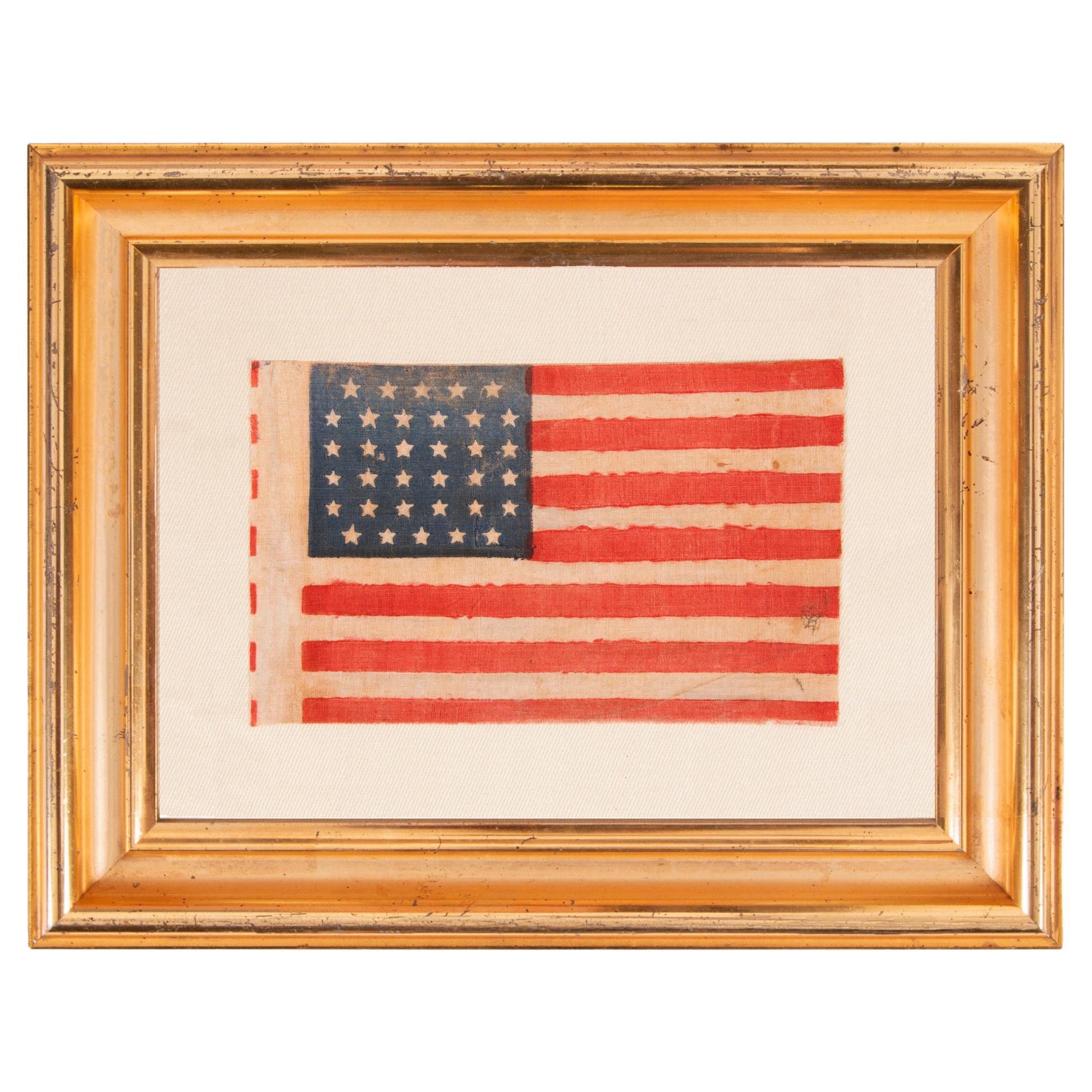
Want more images or videos?
Request additional images or videos from the seller
1 of 6
13 Star Antique American Parade Flag, ca 1876-1899
Price Upon Request
Price Upon Request
Price Upon Request
Price Upon Request
Price Upon Request
Price Upon Request
Price Upon Request
Price Upon Request
Price Upon Request
Price Upon Request
About the Item
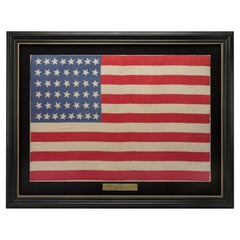
13 STAR ANTIQUE AMERICAN PARADE FLAG, WITH A 3-2-3-2-3 CONFIGURATION OF STARS, AN EXTREMELY SCARCE AND UNUSUALLY LARGE VARIETY, MADE circa 1876-1899
13 star American national parade flag, printed on cotton, made sometime during the last quarter of the 19th century. This is a very rare size for a parade flag in the 13 star count. The most common variety measures just 3 inches on the fly, and practically none reach over 10 inches. Before acquiring a small group in this large and unusual form, close to 20 years ago, neither I, nor anyone else I knew in the world of flag collecting, had seen anything similar.* The group I acquired was discovered in Canada, and, given what I knew about 13 star parade flags, it was reasonable to assume that they were likely either produced there for the American market, or else made in the States for some Canadian-based event with U.S. involvement. Whatever the case may be, others in the same style have since been found north of the border, and Canadian manufacture would explain the scarcity.
The stars are quite large in scale. Each is canted at a slight angle, such that one point is directed in the 1:00 position. These are arranged in staggered lineal rows in counts of 3-2-3-2-3, which is the most common configuration found in 13 star flags of the late 19th century, with pieced-and-sewn construction, but is highly unusual among printed parade flags.
In most cases the 3-2-3-2-3 design can also be viewed as a diamond of stars, with a star in each corner and a star in the very center. It is of interest to note that the 3-2-3-2-3 pattern can also be interpreted as a combination of the crosses of St. Andrew and St. George, which some feel could have been the design of the very first American flag and may identify a link between this star configuration and the British Union Jack. The pattern is often attributed--albeit erroneously in my opinion--to New Jersey Senator Francis Hopkinson, a member of the Second Continental Congress and signer of the Declaration of Independence, who is credited with having played the most significant role in the original design of the American national flag. Hopkinson's original drawings for the design of the flag have not survived and his other depictions of 13 star arrangements for other devices are inconsistent.
On this particular example, note the unusual coloration of the hoist area, adjacent to the canton, which is red instead of the typical white. This adds a distinctly unusual feature to the flag's visual presentation and is a nice compliment to the field of large, canted stars.
The presence of so much white fabric beyond the last red stripe is also not typical of parade flag production. This was done so that there would be room for error when trimming between one flag and the next. Parade flags were printed on a bolt of fabric, like other printed textiles, and were clipped from the bolt at the point of sale, or perhaps afterwards, if the buyer bought multiple flags. When printed horizontally across the bolt, or when small flags were printed next to one-another vertically in multiples, Most parade flags had only a tiny amount of space between them, and some print runs allowed no space at all. It is extremely unusual to encounter flag printed perpendicular to the bolt, with selvage (finished, woven edges) along the hoist and fly, that have enough white fabric beneath and above them to actually look as if the maker intended American flags to have 14 stripes.**
13 star flags have been flown throughout our nation’s history for a variety of purposes. They were hoisted at patriotic events, including Lafayette’s visit in 1824-25, the celebration of the nation’s centennial in 1876, and the sesquicentennial in 1926. They were displayed during the Civil War, to reference past struggles for American liberty, and were used by 19th century politicians in political campaigning for the same reason. The U.S. Navy used the 13 star count on small boats until 1916, because it was easier to discern fewer stars at a distance on a small flag. Commercial flag-makers mirrored this practice and some private ships flew 13 star flags during the same period as the Navy. The use of yachting ensigns with a wreath of 13 stars surrounding a fouled anchor, which allowed pleasure boats to bypass customs between 1848 and 1980, persists today without an official purpose.
Mounting: The flag was mounted and framed within our own conservation department, which is led by expert staff. We take great care in the mounting and preservation of flags and have framed thousands of examples.
The background fabric is 100% cotton twill, black in color, that has been washed and treated for colorfastness. The extraordinary, 3-part molding is constructed of wood, but has a finish that presents like antique iron. Spacers keep the textile away from the glass, which is U.V. protective. Feel free to contact us for more details.
Condition: There is minor to modest soiling in the white fabric, accompanied by a semi-lineal streak across the white are below the last red stripe. Many of my clients prefer early flags to show their age and history of use.
* With the exception of a tiny handful of extremely rare examples with political advertising, made during the mid 19th century.
** Note that some parade flags are printed parallel to the bolt, and on occasion have lots of fabric on one or both sides. This is also unusual and is typically seen on very early examples, pre-dating the American Civil War (1861-65).
Frame Size (H x L): Approx. 24.25" x 33.25"
Flag Size (H x L): 15.25" x 24"
- Dimensions:Height: 24.25 in (61.6 cm)Width: 33.25 in (84.46 cm)Depth: 2 in (5.08 cm)
- Materials and Techniques:
- Place of Origin:
- Period:
- Date of Manufacture:1876-1899
- Condition:See Item Description.
- Seller Location:York County, PA
- Reference Number:Seller: 13j-17161stDibs: LU849745343372
About the Seller
5.0
Recognized Seller
These prestigious sellers are industry leaders and represent the highest echelon for item quality and design.
Established in 1991
1stDibs seller since 2008
71 sales on 1stDibs
Typical response time: Several days
- ShippingRetrieving quote...Shipping from: York County, PA
- Return Policy
More From This Seller
View All38 Star Antique American Parade Flag, Colorado Statehood, ca 1876-1889
Located in York County, PA
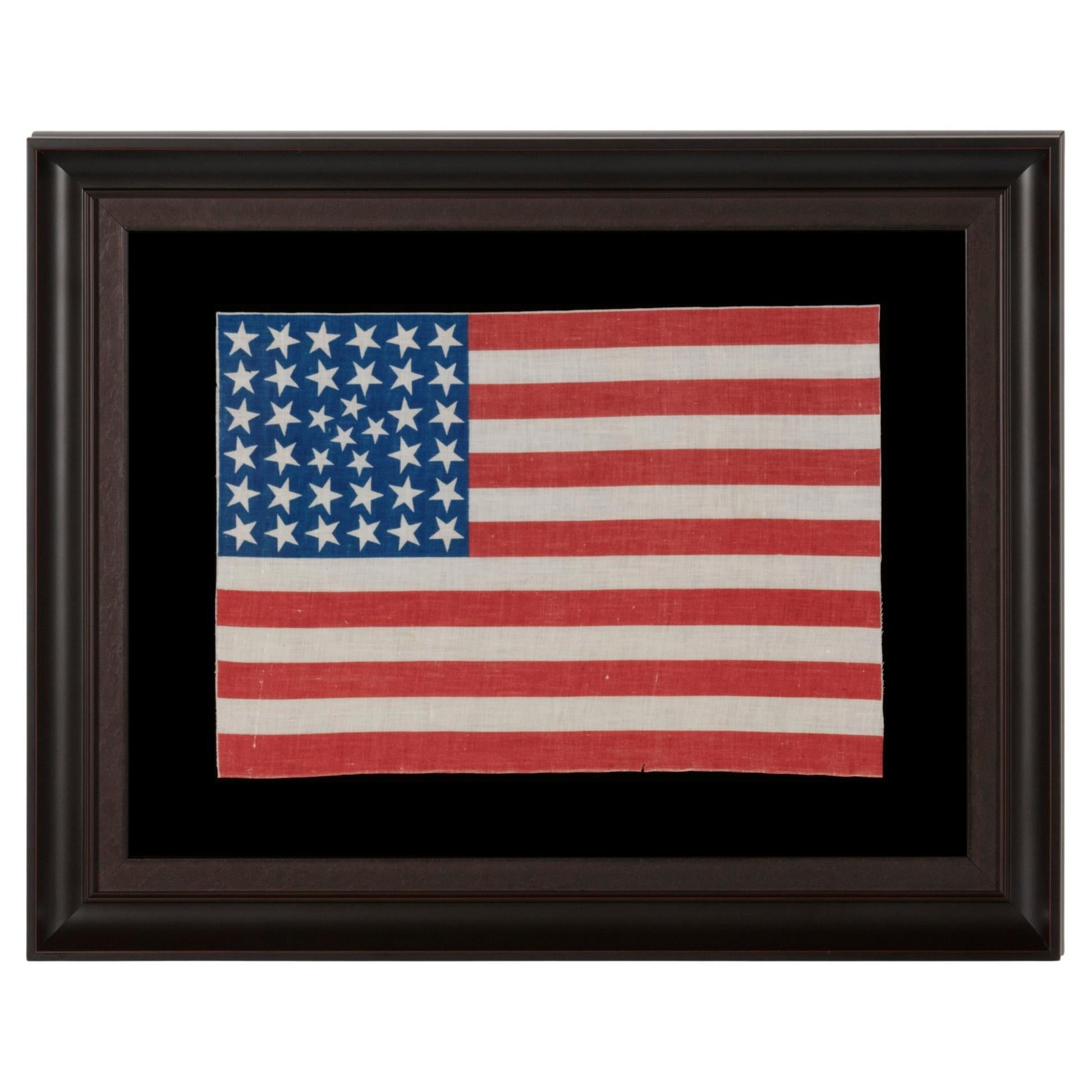
38 STARS IN AN EXTREMELY UNUSUAL CONFIGURATION THAT BEARS A CLUSTER OF 6 SMALL STARS WITHIN A LINEAL PATTERN OF LARGER STARS, 1876-1889, COLORADO STATEHOOD
38 star American national parade flag, printed on cotton. This is an extremely rare example of a lineal pattern flag with a wreath or cluster of smaller stars inserted in the center. A very small number of flags in this style are known to have survived, the colors of which are typically saturated and vibrant, like this example, in scarlet red and rich, royal blue.
The particular wreath in the center of the configuration is really more of a pentagon with a single, center star. The reason for the choice of the design and 6 smaller stars seems a curious one on the surface, but its purpose was probably nothing more than to simply augment a 36 star print block to one with 38 stars. One may observe how 4 stars, that would have comprised the center of a 6 x 6 pattern, could have simply been removed and 6 smaller stars inserted in their place, in an artful fashion.
At least two other similar 38-star patterns are known that incorporate 4 small stars intermingled between rows of what most certainly were two very similar 34-star flag print blocks originally. It was easier to modify these blocks rather than create brand new ones. In these particular instances, the results are rare, quirky configurations that are highly prized by collectors.
Colorado became the 38th state on August 1st, 1876. This was the year of our nation’s 100-year anniversary of independence. Per the Third Flag Act of 1818, stars were not officially added until the 4th of July following a state's addition. For this reason, 37 was the official star count for the American flag in 1876. Flag-making was a competitive venture, however, and few flag-makers would have been continuing to produce 37 star flags when their competitors were making 38’s. It is for this reason that 38 and 13 stars (to represent the original 13 colonies) are more often seen at the Centennial International Exposition, the six-month long World’s Fair held in Philadelphia in honor of the event. Some flag-makers would have been adding a star for the 38th state even before it entered the Union, in the early part of 1876 or even prior. In fact, many makers of parade flags were actually producing 39 star flags, in hopeful anticipation of the addition of two more Western Territories instead of one. But the 39th state would not join the Union for another 13 years, when the Dakota Territory entered as two states on the same day. The 38 star flag became official on July 4th, 1877 and was generally used until the addition of the Dakotas in 1889.
Provenance: Jeff R. Bridgman Antiques to the late collector Jim Ring...
Category
Antique Late 19th Century American Political and Patriotic Memorabilia
Materials
Cotton
Price Upon Request
39 Star Antique American Parade Flag with Stars in Two Sizes, Ca 1876
Located in York County, PA
39 STARS IN TWO SIZES, ALTERNATING FROM ONE COLUMN TO THE NEXT, ON AN ANTIQUE AMERICAN PARADE FLAG WITH AN UNUSUALLY ELONGATED PROFILE, DATING TO THE 1876 CENTENNIAL, NEVER AN OFFICI...
Category
Antique 1870s American Political and Patriotic Memorabilia
Materials
Cotton
42 Stars on a Antique American Parade Flag, Washington Statehood, ca 1889-1890
Located in York County, PA
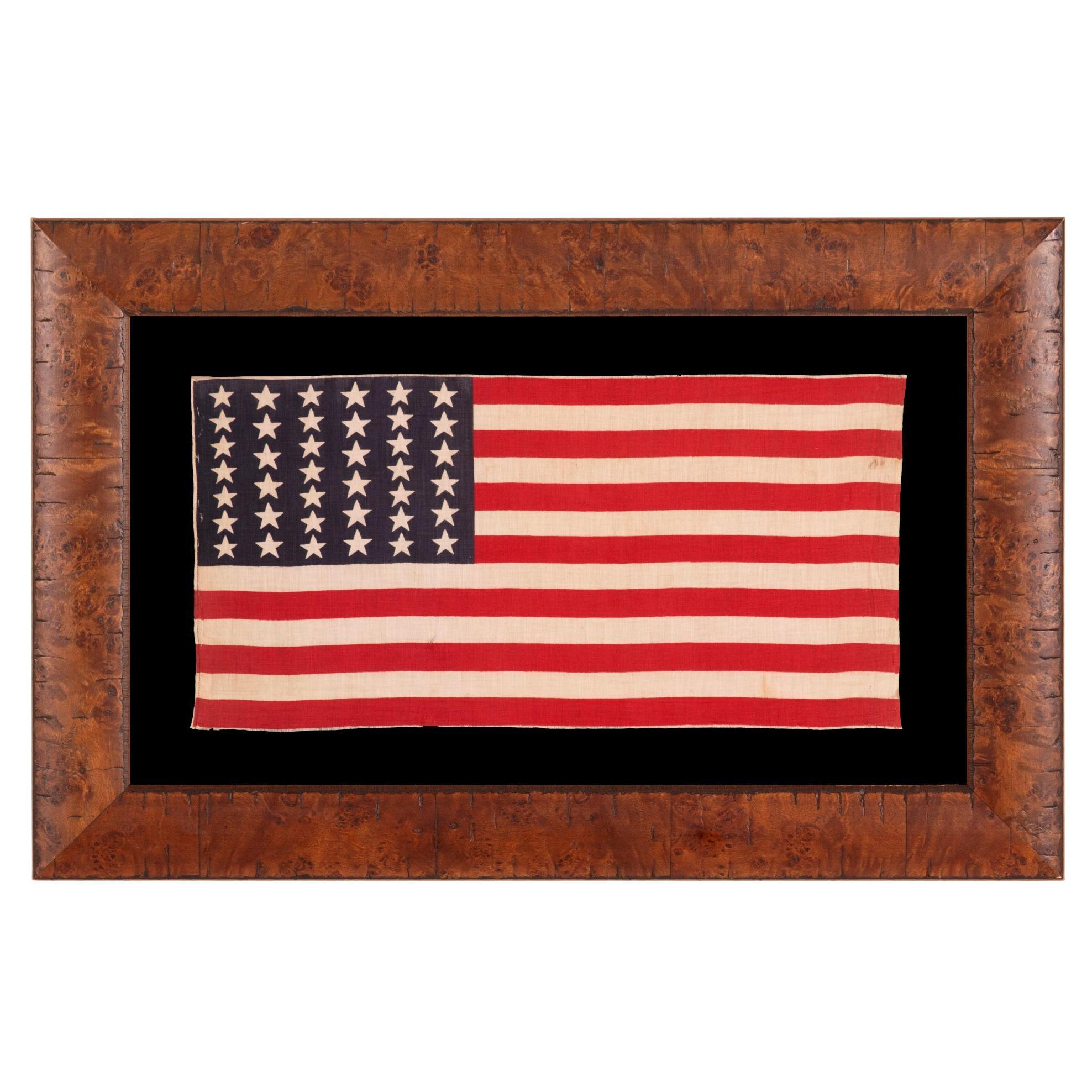
42 STARS ON AN ANTIQUE AMERICAN FLAG WITH A WAVE CONFIGURATION OF LINEAL COLUMNS, AN UNOFFICIAL STAR COUNT THAT REFLECTS THE ADDITION OF WASHINGTON STATE, MONTANA, AND THE DAKOTAS, c...
Category
Antique Late 19th Century American Political and Patriotic Memorabilia
Materials
Cotton
45 Stars Antique American Parade Flag, Utah Statehood, ca 1896-1908
Located in York County, PA
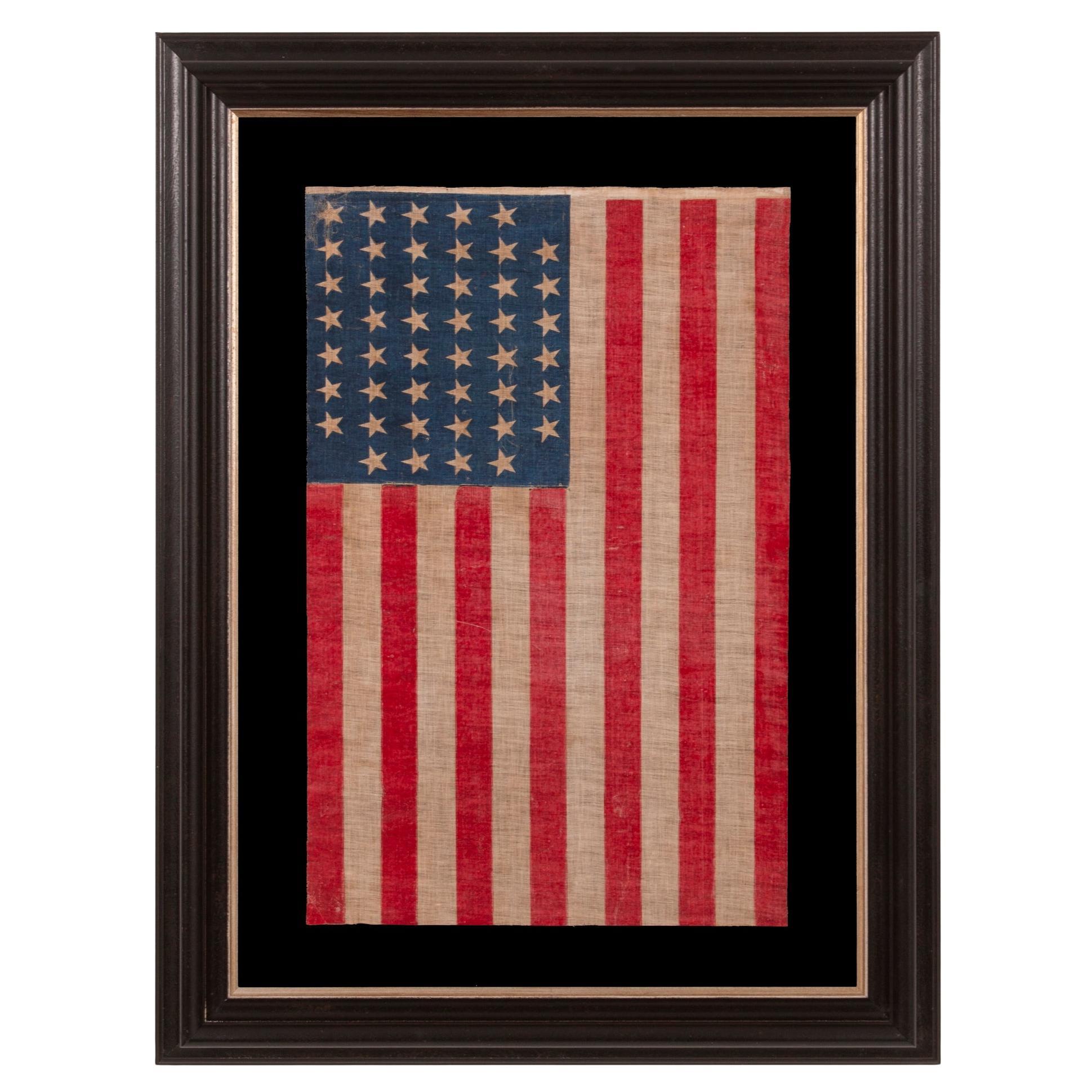
45 STAR ANTIQUE AMERICAN PARADE FLAG WITH ITS STARS ARRANGED IN A NOTCHED PATTERN, 1896-1908, UTAH STATEHOOD:
45 star American national flag, printed on coarse, glazed cotton. Evide...
Category
Antique 1890s American Political and Patriotic Memorabilia
Materials
Cotton
Price Upon Request
30 Star Antique American Parade Flag, Wisconsin Statehood, ca 1848-1850
Located in York County, PA
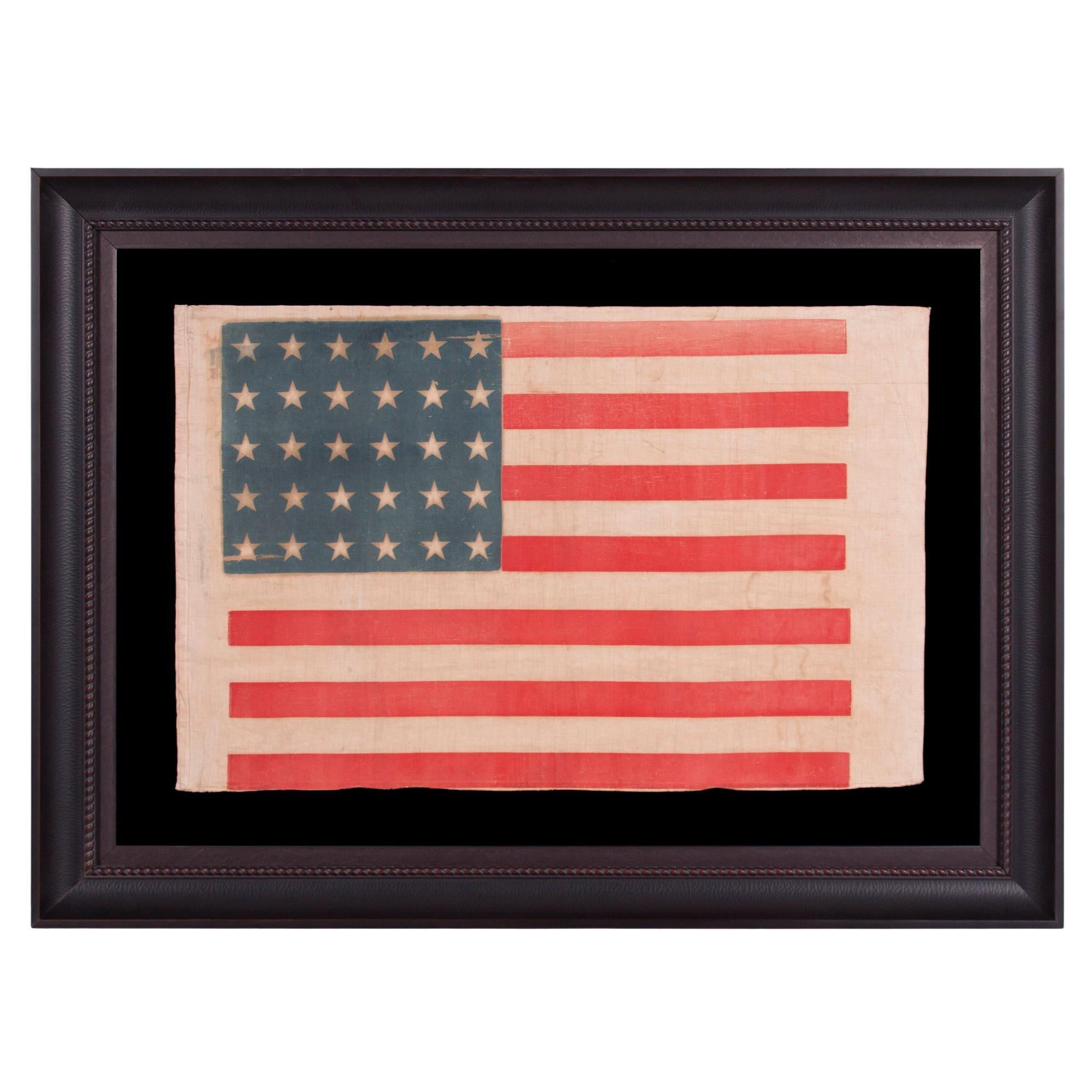
ANTIQUE AMERICAN PARADE FLAG WITH 30 STARS, THE ONLY KNOWN EXAMPLE IN THIS SIMPLE BUT EXTRAORDINARY STYLE, PRE-CIVIL WAR, OFFICIAL FOR JUST TWO YEARS, REFLECTS THE ADDITION OF WISCON...
Category
Antique Mid-19th Century American Political and Patriotic Memorabilia
Materials
Cotton
Price Upon Request
34 Star Antique American Parade Flag, Kansas Statehood, ca 1861-1863
Located in York County, PA
34 STAR ANTIQUE AMERICAN FLAG WITH A LINEAL ARRANGEMENT THAT I HAVE TERMED "GLOBAL ROWS, WITH EXCEPTIONAL COLOR AND CRUDE YET BEAUTIFUL FEATURES, OPENING TWO YEARS OF THE CIVIL WAR, ...
Category
Antique 1860s American Political and Patriotic Memorabilia
Materials
Cotton
Price Upon Request
You May Also Like
42-Star American Parade Flag, Commemorating Washington Statehood, 1889
Located in Colorado Springs, CO
This is an uncommon 42-star flag, commemorating the addition of the state of Washington to the Union. The flag dates to 1889-1890, and is printed on cotton. The canton consists of s...
Category
Antique 1880s American Political and Patriotic Memorabilia
Materials
Cotton
36-Star American Printed Parade Flag, Circa 1865-1867
Located in Colorado Springs, CO
This is an antique 36-star American flag, as striking as it is scarce. The flag has a glazed cotton construction, with a blue canton printed with 36 white stars. The stars are arrang...
Category
Antique 1860s American Political and Patriotic Memorabilia
Materials
Cotton
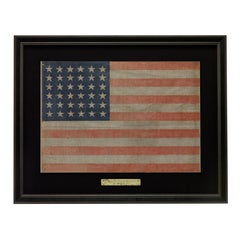
34-Star American Parade Flag, Commemorating Kansas Statehood, Circa 1861-1863
Located in Colorado Springs, CO
Offered is a spectacular 34-star American flag, produced during the Civil War. This flag features 34 printed white stars, on a blue wool blend canton. The stars are arranged in whims...
Category
Antique 1860s American American Classical Political and Patriotic Memora...
Materials
Brass
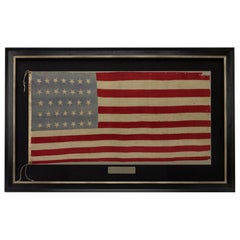
31-Star Printed American Flag, Celebrating California Statehood, Circa 1850
Located in Colorado Springs, CO
This is a rare 31-star medallion printed American flag, celebrating the addition of California to the Union. The flag is printed on silk and has a spectacular “Great Star” canton pat...
Category
Antique 1850s American Political and Patriotic Memorabilia
Materials
Silk
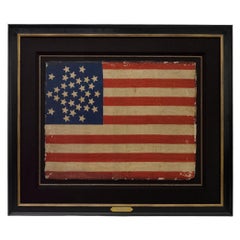
38-Star American Parade Flag, Flown at a Reception for President Grant, 1880
Located in Colorado Springs, CO
This is a beautifully colored 38-star American parade flag, flown at a public reception for Ulysses S. Grant in October of 1880. This printed flag features a rare, triple medallion s...
Category
Antique 1880s American Political and Patriotic Memorabilia
Materials
Cotton
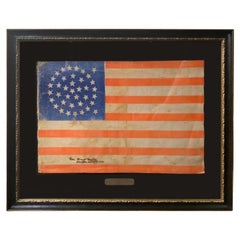
44-Star Silk American Flag, Celebrating Wyoming Statehood, Circa 1890-1896
Located in Colorado Springs, CO
Presented is a 44-star silk American flag, commemorating Wyoming statehood. The flag dates to 1890-1896. The flag has an “8-7-7-7-7-8” star configuration, with the stars whimsically ...
Category
Antique 1890s American Political and Patriotic Memorabilia
Materials
Silk
More Ways To Browse
Black Memorabilia
Canada Antiques
Declaration Of Independence
British Union Jack
13 Star Flag
1876 American Flag
Antique 13 Star Flag
Antique 13 Star American Flag
World War 2 American Flag
Teddy Roosevelt
Navy Flags
Antique British Flag
British Union Jack
Used Flag Poles
48 Star Flag
Centennial Furniture
Framed American Flag Art
1889 Flag