Items Similar to 13 Star Antique Parade Flag, Hand Inscribed by the Owner in Salem, MA 1896
Want more images or videos?
Request additional images or videos from the seller
1 of 6
13 Star Antique Parade Flag, Hand Inscribed by the Owner in Salem, MA 1896
Price Upon Request
Price Upon Request
Price Upon Request
Price Upon Request
Price Upon Request
Price Upon Request
Price Upon Request
Price Upon Request
Price Upon Request
Price Upon Request
About the Item
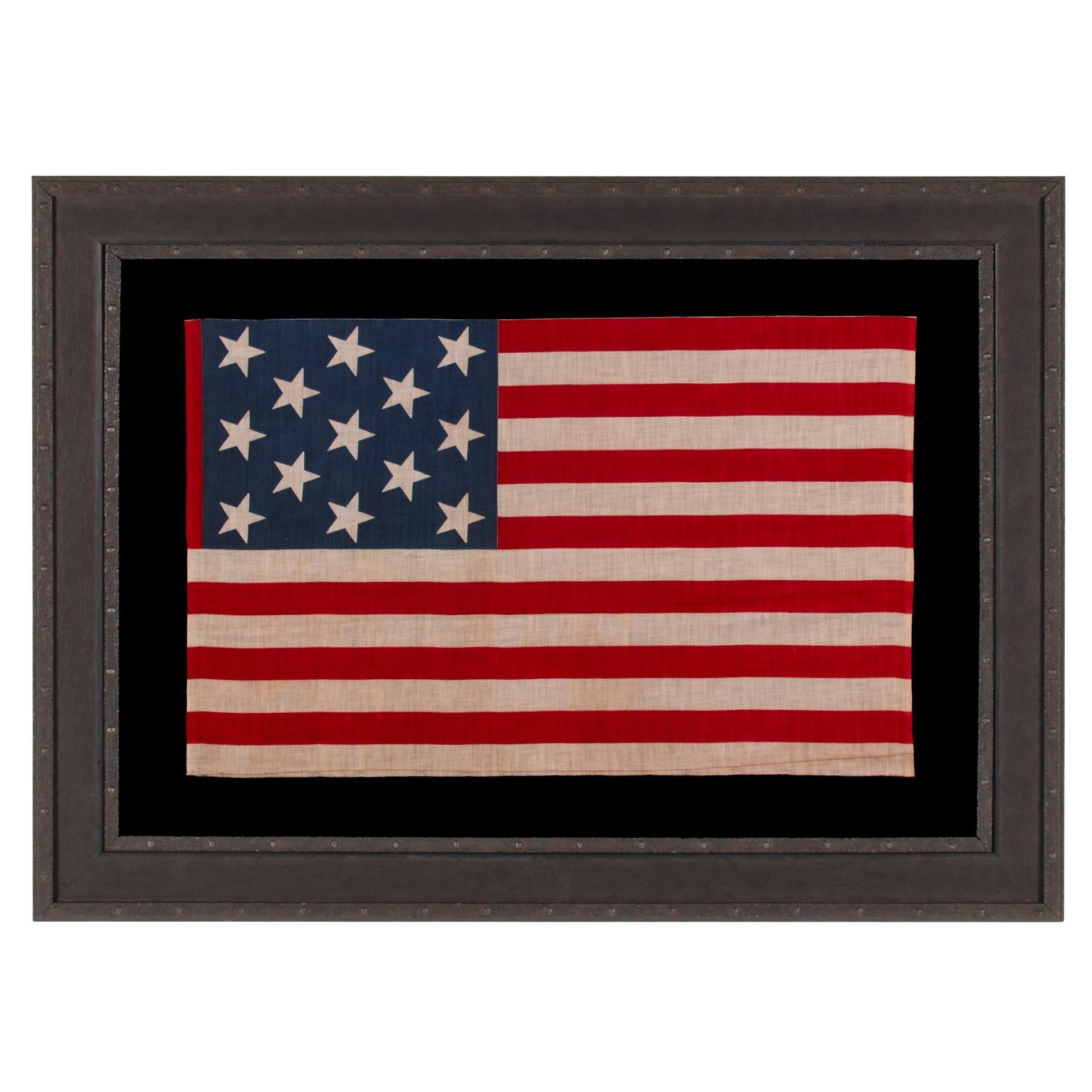
ANTIQUE AMERICAN FLAG WITH 13 STARS ARRANGED IN 6-POINTED GREAT STAR / STAR OF DAVID PATTERN, OF A TYPE MADE FOR THE 1876 CENTENNIAL OF AMERICAN INDEPENDENCE, WORN AND HAND-INSCRIBED BY THE OWNER IN 1896, IN SALEM, MASSACHUSETTS, IN CELEBRATION OF THE VICTORY OF REPUBLICAN PRESIDENT-ELECT WILLIAM McKINLEY; FORMERLY IN THE COLLECTION OF RICHARD PIERCE
13 star American national parade flag, printed on coarse, glazed cotton. The stars are arranged in a six-pointed version of what is known as the "Great Star" or "Great Luminary" pattern, which is distinguished by one large star made out of smaller ones. All surviving 19th century flags with this star pattern fall between extremely scarce and extremely rare. This variety is of a type produced for the 100th anniversary of American independence in 1876, though this particular flag gained some more interesting history in the last decade of the 19th century. An inscription that runs through all six white stripes, written with a dip pen, reads as follows:
Worn Nov. 6 , 1896.
At the parade in Salem to celebrate the Republican victory.
Josh rode Baby in this parade
McKinley
Gold
Wolcott Governor
Flags with hand-written inscriptions are some of the most endearing within the realm of flag collecting, humanizing their function. In this example, the whimsical, graphic qualities of the bold, saturated lettering, make it far more graphically compelling, in my opinion, elevating both the historical and visual properties of the object. In this instance, the flag records a victory parade in Salem, Massachusetts, in which, presumably, a child rode a horse, a pony, or some sort of animal with the given name of “Baby.”
Years ago I sold this wonderful little flag to my good friend, collector Richard Pierce, who featured it in his book, “The Stars
Stripes: Fabric of American Spirit” by J. Richard Pierce (J. Richard Pierce, LLC, 2005), on page 34. Richard’s own description of the election is as good and as concise as any I could formalize, included here with my thanks for his permission:
“The election of 1896 was a contrast in styles between William McKinley, with his “front porch” campaign, and flamboyant orator William Jennings Bryan, who traveled across the country making speeches before large audiences. In the end, the voters chose republican candidate McKinley, a strong supporter of the gold standard, by a convincing margin over Brian, an advocate of the pro-silver movement.
Congress passed the Gold Standard Act in 1900, establishing gold as the only standard for redeeming paper money and putting an end to bimetallism, a monetary system based on both gold and silver. The gold standard was revoked in 1933 when the federal government feared the depletion of its gold supply during the Depression years.”
Roger Wolcott (1847-1900), a Harvard-educated, Boston lawyer, served as a member of the Massachusetts State Legislature from 1881-1884. He was elected Lieutenant Governor in 1892, serving from 1893-1896, then became acting Governor following the 1896 death of fellow Republican Frederic T. Greenhalge. He was elected to the office that November—his victory also noted in the flag’s inscription—and served until 1900. In 1898, when the Span-Am war broke out, he secured monetary support for military action instantly, and was among the very first governors to supply troops to the war effort. He didn’t run again in 1900, instead deciding to travel to Europe with his family in May, while still in office. He did help his party campaign upon his return, but contracted typhoid fever and died that December.
It is of some patriotic interest to note that Wolcott’s wife, Edith Prescott Wolcott, (wed Sept. 2, 1874), was the great-granddaughter of Revolutionary War Colonel William Prescott, famous for his words at the Battle of Bunker Hill: “Do not fire until you see the whites of their eyes.”
Brief Bio of President William McKinley
President William McKinley was born in Ohio in 1843. He enlisted as a private in the Union Army during the Civil War, achieving the rank of brevet major. He studied and practiced law before serving three terms in Congress and two terms as Governor of Ohio. His expertise was in tariffs and trade, and the McKinley Act of 1990 is named for him. Foreign policy dominated his time as president, and the most notable foreign event was the Spanish American War. McKinley was loath to begin the campaign, but congressional and American opinion forced his reluctant involvement. In just 100 days, the Spanish fleet was destroyed outside Santiago harbor in Cuba, Manila was seized in the Philippines, and the U.S. occupied Puerto Rico.
During his second term, McKinley became the 3rd president to be assassinated. On Sept. 6th, 1901, he was shot by Leon Czolgosz, a deranged anarchist, while attending the Pan Am Exposition in Buffalo. He died there eight days later and Teddy Roosevelt assumed the Presidency.
Notes Concerning the Six-Pointed Great Star Configuration:
Though the precise reason behind the decision to select the six-pointed Great Star pattern is unknown, several explanations are plausible. One is that it mimics the arrangement of stars found on the Great Seal of the United States, which appears in the cloud-like shape above the American eagle. This can be most ready viewed on the flag of the President of the United States, or the back of the current, U.S. dollar bill.
In present times, one might identify the design as the Star of David, though this symbol, also known as the Shield of David, was not in widespread use by members of the Jewish faith until the 20th century. It could be that the star configuration draws a connection between this particular flag and a historical example of the Revolutionary War era. No 18th century flags are presently known to have survived with this pattern, however, and I know of none that are illustrated in period paintings or drawings. It may be that the source was simply lost to time, but whatever the case may be, one may note that it does represent the most logical manner by which 13 stars may be arranged in a star-shaped pattern.
Why 13 Stars?
13 star flags have been flown throughout our nation’s history for a variety of purposes. In addition to their use at the centennial, they were hoisted at all manner of patriotic events, including Lafayette's visit in 1825-26, celebrations of Independence Day, and the sesquicentennial in 1926. They were displayed during the Civil War, to reference past struggles for American liberty and victory over oppression, and were used by 19th century politicians in political campaigning for the same reason. The U.S. Navy used the 13 star count on small boats until 1916, because it was easier to discern fewer stars at a distance on a small flag. Commercial flag-makers mirrored this practice, and some private ships flew 13 star flags during the same period as the Navy. The use of yachting ensigns with a wreath of 13 stars, surrounding a fouled anchor, which allowed pleasure boats to bypass customs between 1848 and 1980, persists today without an official purpose.
Mounting: The flag was mounted and framed within our own conservation department, which is led by expert trained staff. We take great care in the mounting and preservation of flags and have framed thousands of examples.
The exceptional, gilded molding has a beveled face, set between a flat cap and lip, with a shadowbox-style profile. The background is 100% cotton twill, black in color, that has been washed and treated for colorfastness. Spacers keep the textile away from the glazing, which is U.V. protective glass. Feel free to contact us for more details.
Condition: There is minor to modest soiling along the hoist, some misprinting, and minor to modest bleeding of the ink. Many of my clients prefer early flags to display their age and history of use.
- Dimensions:Height: 10.5 in (26.67 cm)Width: 11.5 in (29.21 cm)Depth: 2 in (5.08 cm)
- Materials and Techniques:
- Place of Origin:
- Period:
- Date of Manufacture:1876
- Condition:See Item Description.
- Seller Location:York County, PA
- Reference Number:Seller: 13-8691stDibs: LU849744273102
About the Seller
5.0
Recognized Seller
These prestigious sellers are industry leaders and represent the highest echelon for item quality and design.
Established in 1991
1stDibs seller since 2008
70 sales on 1stDibs
Typical response time: Several days
- ShippingRetrieving quote...Shipping from: York County, PA
- Return Policy
More From This Seller
View All13 Star Antique American Parade Flag, ca 1876-1899
Located in York County, PA
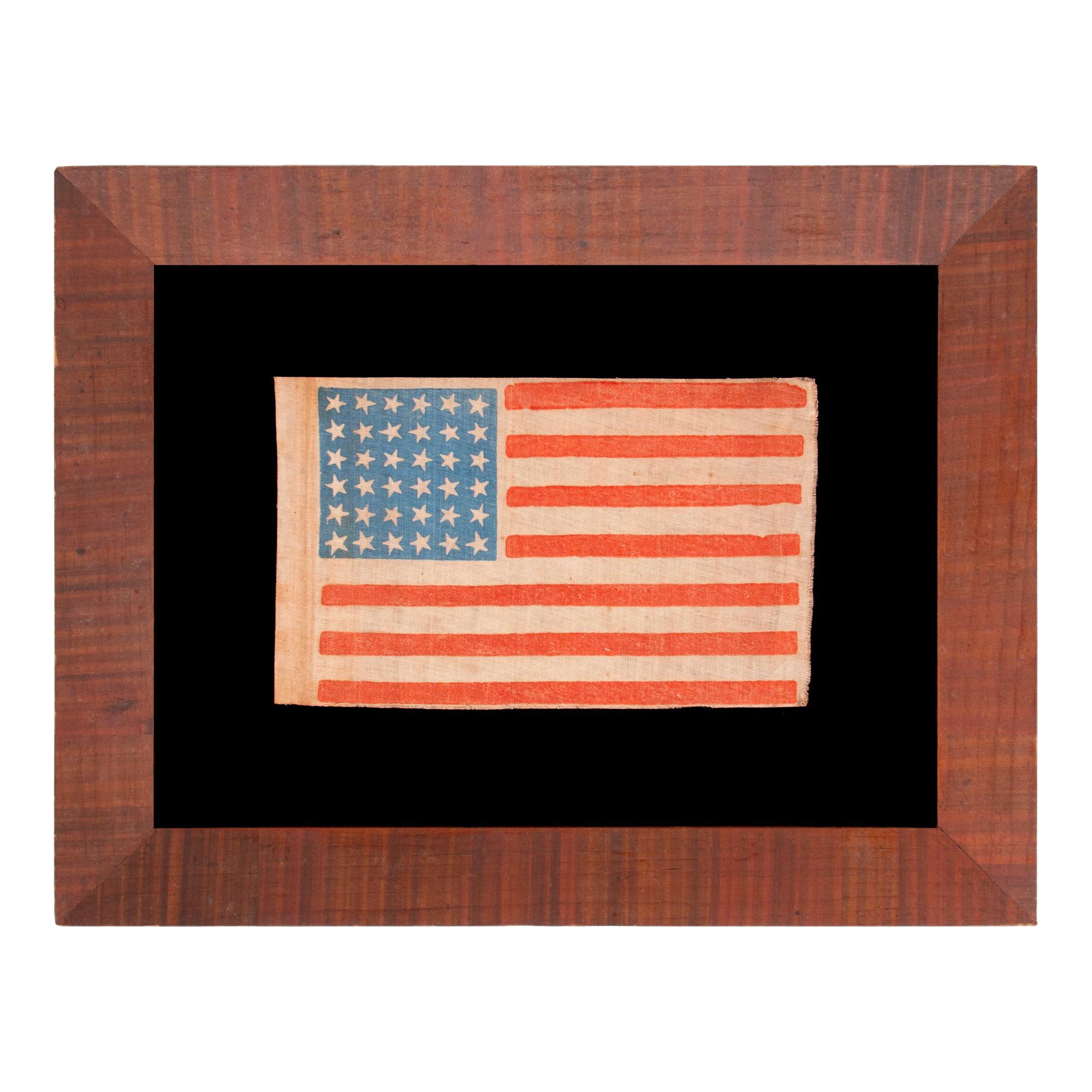
13 STAR ANTIQUE AMERICAN PARADE FLAG, WITH A 3-2-3-2-3 CONFIGURATION OF STARS, AN EXTREMELY SCARCE AND UNUSUALLY LARGE VARIETY, MADE circa 1876-1899
13 star American national parade...
Category
Antique Late 19th Century Canadian Political and Patriotic Memorabilia
Materials
Cotton
Price Upon Request
34 Star Antique American Parade Flag, Kansas Statehood, ca 1861-1863
Located in York County, PA
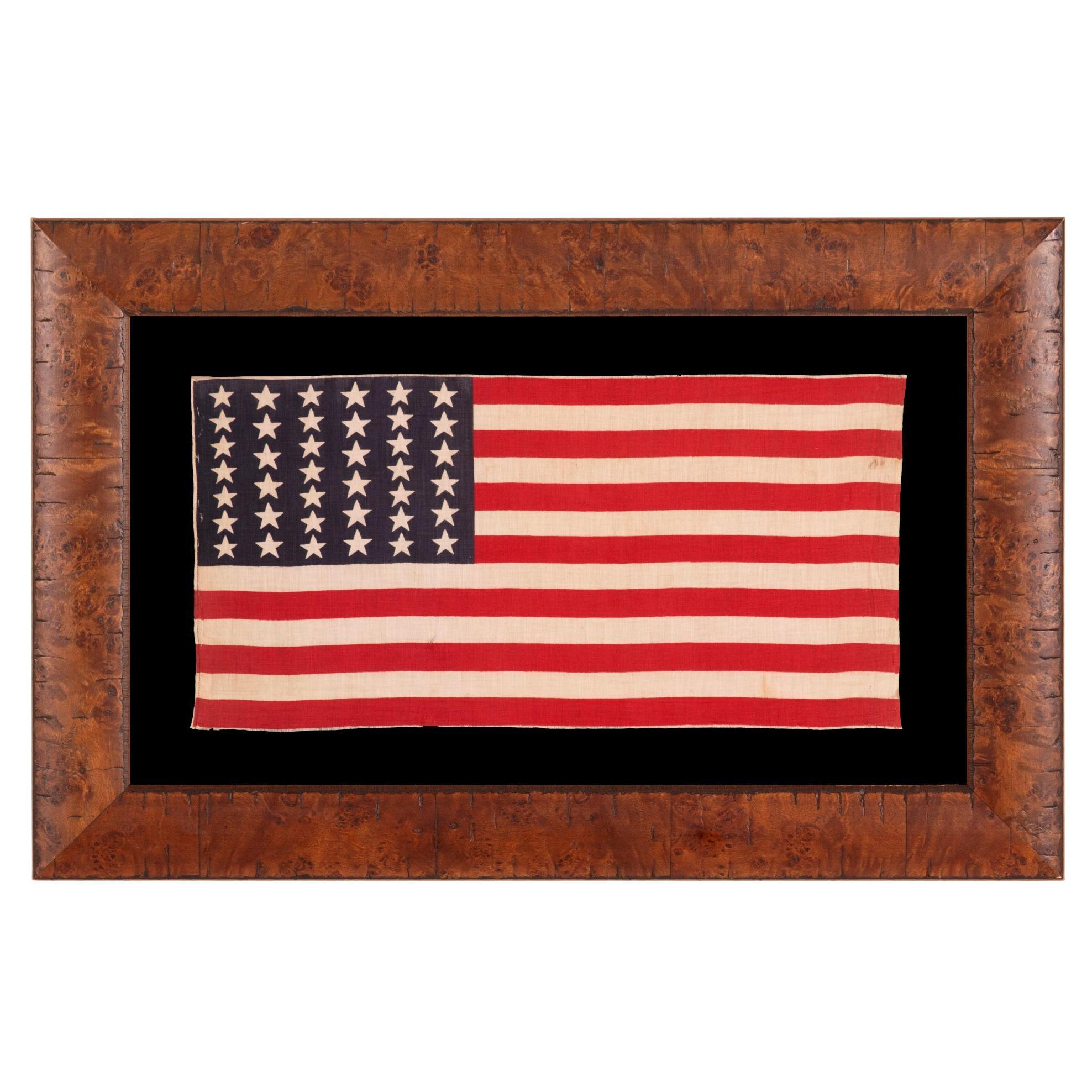
34 STAR ANTIQUE AMERICAN FLAG WITH A LINEAL ARRANGEMENT THAT I HAVE TERMED "GLOBAL ROWS, WITH EXCEPTIONAL COLOR AND CRUDE YET BEAUTIFUL FEATURES, OPENING TWO YEARS OF THE CIVIL WAR, ...
Category
Antique 1860s American Political and Patriotic Memorabilia
Materials
Cotton
Price Upon Request
38 Star Antique American Parade Flag, Colorado Statehood, ca 1876-1889
Located in York County, PA
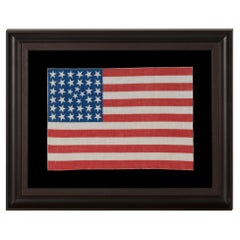
38 STARS IN AN EXTREMELY UNUSUAL CONFIGURATION THAT BEARS A CLUSTER OF 6 SMALL STARS WITHIN A LINEAL PATTERN OF LARGER STARS, 1876-1889, COLORADO STATEHOOD
38 star American national parade flag, printed on cotton. This is an extremely rare example of a lineal pattern flag with a wreath or cluster of smaller stars inserted in the center. A very small number of flags in this style are known to have survived, the colors of which are typically saturated and vibrant, like this example, in scarlet red and rich, royal blue.
The particular wreath in the center of the configuration is really more of a pentagon with a single, center star. The reason for the choice of the design and 6 smaller stars seems a curious one on the surface, but its purpose was probably nothing more than to simply augment a 36 star print block to one with 38 stars. One may observe how 4 stars, that would have comprised the center of a 6 x 6 pattern, could have simply been removed and 6 smaller stars inserted in their place, in an artful fashion.
At least two other similar 38-star patterns are known that incorporate 4 small stars intermingled between rows of what most certainly were two very similar 34-star flag print blocks originally. It was easier to modify these blocks rather than create brand new ones. In these particular instances, the results are rare, quirky configurations that are highly prized by collectors.
Colorado became the 38th state on August 1st, 1876. This was the year of our nation’s 100-year anniversary of independence. Per the Third Flag Act of 1818, stars were not officially added until the 4th of July following a state's addition. For this reason, 37 was the official star count for the American flag in 1876. Flag-making was a competitive venture, however, and few flag-makers would have been continuing to produce 37 star flags when their competitors were making 38’s. It is for this reason that 38 and 13 stars (to represent the original 13 colonies) are more often seen at the Centennial International Exposition, the six-month long World’s Fair held in Philadelphia in honor of the event. Some flag-makers would have been adding a star for the 38th state even before it entered the Union, in the early part of 1876 or even prior. In fact, many makers of parade flags were actually producing 39 star flags, in hopeful anticipation of the addition of two more Western Territories instead of one. But the 39th state would not join the Union for another 13 years, when the Dakota Territory entered as two states on the same day. The 38 star flag became official on July 4th, 1877 and was generally used until the addition of the Dakotas in 1889.
Provenance: Jeff R. Bridgman Antiques to the late collector Jim Ring...
Category
Antique Late 19th Century American Political and Patriotic Memorabilia
Materials
Cotton
Price Upon Request
36 Star Antique American Parade Flag, with Canted Stars, ca 1864-1867
Located in York County, PA
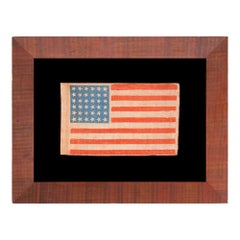
36 STAR ANTIQUE AMERICAN PARADE FLAG WITH CANTED STARS IN DANCING ROWS, ON A BEAUTIFUL, CORNFLOWER BLUE CANTON; CIVIL WAR ERA, NEVADA STATEHOOD, 1864-1867
36 star antique American f...
Category
Antique 1860s American Political and Patriotic Memorabilia
Materials
Cotton
Price Upon Request
39 Star Antique American Parade Flag with Stars in Two Sizes, Ca 1876
Located in York County, PA
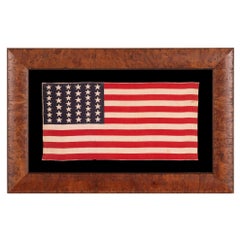
39 STARS IN TWO SIZES, ALTERNATING FROM ONE COLUMN TO THE NEXT, ON AN ANTIQUE AMERICAN PARADE FLAG WITH AN UNUSUALLY ELONGATED PROFILE, DATING TO THE 1876 CENTENNIAL, NEVER AN OFFICI...
Category
Antique 1870s American Political and Patriotic Memorabilia
Materials
Cotton
42 Star Parade Flag with Scattered Stars, ca 1889-1890
Located in York County, PA
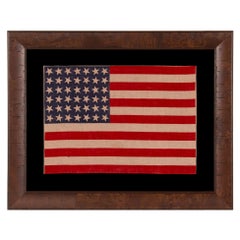
42 STARS ON AN ANTIQUE AMERICAN FLAG WITH SCATTERED STAR POSITIONING, REFLECTS THE ADDITION OF WASHINGTON STATE, MONTANA, AND THE DAKOTAS, NEVER AN OFFICIAL STAR COUNT, circa 1889-18...
Category
Antique Late 19th Century American Political and Patriotic Memorabilia
Materials
Cotton
You May Also Like
42-Star American Parade Flag, Commemorating Washington Statehood, 1889
Located in Colorado Springs, CO
This is an uncommon 42-star flag, commemorating the addition of the state of Washington to the Union. The flag dates to 1889-1890, and is printed on cotton. The canton consists of s...
Category
Antique 1880s American Political and Patriotic Memorabilia
Materials
Cotton
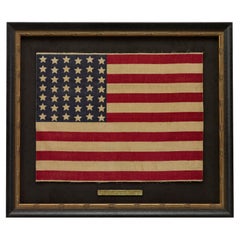
38-Star American Parade Flag, Flown at a Reception for President Grant, 1880
Located in Colorado Springs, CO
This is a beautifully colored 38-star American parade flag, flown at a public reception for Ulysses S. Grant in October of 1880. This printed flag features a rare, triple medallion s...
Category
Antique 1880s American Political and Patriotic Memorabilia
Materials
Cotton
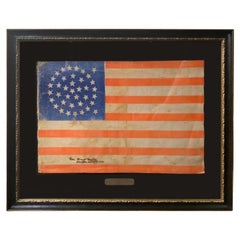
36-Star American Printed Parade Flag, Circa 1865-1867
Located in Colorado Springs, CO
This is an antique 36-star American flag, as striking as it is scarce. The flag has a glazed cotton construction, with a blue canton printed with 36 white stars. The stars are arrang...
Category
Antique 1860s American Political and Patriotic Memorabilia
Materials
Cotton
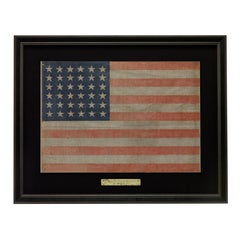
13-Star Bennington "76" Parade Flag, Early 20th Century
Located in Colorado Springs, CO
Presented here is a striking 20th century 13-star Bennington “76” style parade flag, modeled after the historic example preserved at the Bennington Museum in Vermont. This commemorat...
Category
Early 20th Century American American Colonial Political and Patriotic Me...
Materials
Fabric
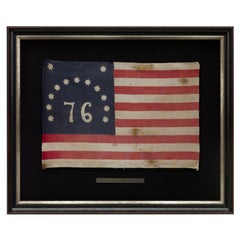
31-Star Printed American Flag, Celebrating California Statehood, Circa 1850
Located in Colorado Springs, CO
This is a rare 31-star medallion printed American flag, celebrating the addition of California to the Union. The flag is printed on silk and has a spectacular “Great Star” canton pat...
Category
Antique 1850s American Political and Patriotic Memorabilia
Materials
Silk
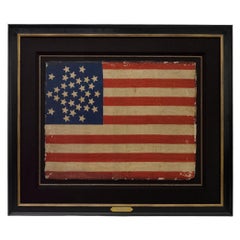
34-Star American Parade Flag, Commemorating Kansas Statehood, Circa 1861-1863
Located in Colorado Springs, CO
Offered is a spectacular 34-star American flag, produced during the Civil War. This flag features 34 printed white stars, on a blue wool blend canton. The stars are arranged in whims...
Category
Antique 1860s American American Classical Political and Patriotic Memora...
Materials
Brass
More Ways To Browse
Harvard Antique
Antique Governor
Philippines Antique
Great Seal Of The United States
18th Century Pen And Ink
Antique Star Of David
Revolutionary War Antique
Pan Am
Antique Stripe Fabric
Antique Puerto Rico
Teddy Roosevelt
Dip Pen
Dip Pens
13 Star Flag
Antique 13 Star Flag
Antique 13 Star American Flag
Used Furniture In Ma
Teddy Roosevelt