Want more images or videos?
Request additional images or videos from the seller
1 of 6
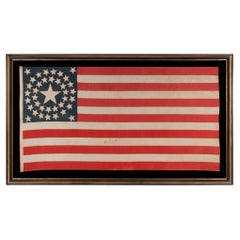
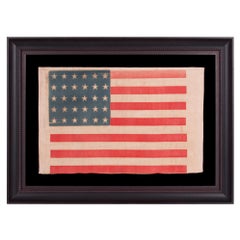
30 Star Flag, Pre-Civil War Ear, Haloed Center Star, Wisconsin Statehood
About the Item
- Dimensions:Height: 26 in (66.04 cm)Width: 33.5 in (85.09 cm)Depth: 2.5 in (6.35 cm)
- Materials and Techniques:
- Place of Origin:
- Period:
- Date of Manufacture:1848-1850
- Condition:See Item Description.
- Seller Location:York County, PA
- Reference Number:Seller: 30j-8141stDibs: LU849720730812
About the Seller
5.0
Recognized Seller
These prestigious sellers are industry leaders and represent the highest echelon for item quality and design.
Established in 1991
1stDibs seller since 2008
71 sales on 1stDibs
Typical response time: Several days
Authenticity Guarantee
In the unlikely event there’s an issue with an item’s authenticity, contact us within 1 year for a full refund. DetailsMoney-Back Guarantee
If your item is not as described, is damaged in transit, or does not arrive, contact us within 7 days for a full refund. Details24-Hour Cancellation
You have a 24-hour grace period in which to reconsider your purchase, with no questions asked.Vetted Professional Sellers
Our world-class sellers must adhere to strict standards for service and quality, maintaining the integrity of our listings.Price-Match Guarantee
If you find that a seller listed the same item for a lower price elsewhere, we’ll match it.Trusted Global Delivery
Our best-in-class carrier network provides specialized shipping options worldwide, including custom delivery.You May Also Like
31-Star Printed American Flag, Celebrating California Statehood, Circa 1850
Located in Colorado Springs, CO
This is a rare 31-star medallion printed American flag, celebrating the addition of California to the Union. The flag is printed on silk and has a spectacular “Great Star” canton pat...
Category
Antique 1850s American Political and Patriotic Memorabilia
Materials
Silk
$38,500
H 43 in W 50.5 in D 2.5 in
42-Star American Parade Flag, Commemorating Washington Statehood, 1889
Located in Colorado Springs, CO
This is an uncommon 42-star flag, commemorating the addition of the state of Washington to the Union. The flag dates to 1889-1890, and is printed on cotton. The canton consists of s...
Category
Antique 1880s American Political and Patriotic Memorabilia
Materials
Cotton
$5,850
H 28.38 in W 32.88 in D 2 in
39-Star Printed American Flag, Commemorating North Dakota Statehood, 1889-1890
Located in Colorado Springs, CO
This is a 39-star unofficial American flag, celebrating North Dakota statehood. The printed flag dates to 1889 and showcases a “whimsical” star pattern in the canton. The flag's cant...
Category
Antique 1880s American Political and Patriotic Memorabilia
Materials
Fabric
$6,950
H 29.75 in W 39 in D 3.13 in
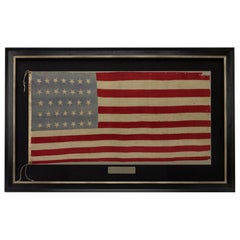
34-Star American Parade Flag, Commemorating Kansas Statehood, Circa 1861-1863
Located in Colorado Springs, CO
Offered is a spectacular 34-star American flag, produced during the Civil War. This flag features 34 printed white stars, on a blue wool blend canton. The stars are arranged in whims...
Category
Antique 1860s American American Classical Political and Patriotic Memora...
Materials
Brass
$32,500
H 37 in W 59 in D 1.75 in
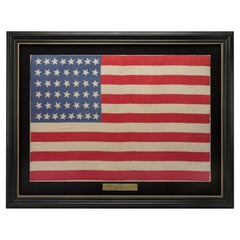
44-Star Silk American Flag, Celebrating Wyoming Statehood, Circa 1890-1896
Located in Colorado Springs, CO
Presented is a 44-star silk American flag, commemorating Wyoming statehood. The flag dates to 1890-1896. The flag has an “8-7-7-7-7-8” star configuration, with the stars whimsically ...
Category
Antique 1890s American Political and Patriotic Memorabilia
Materials
Silk
$8,500
H 45.75 in W 58.75 in D 2.13 in
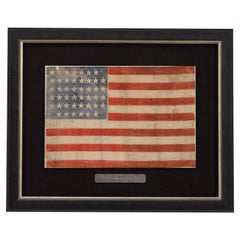
45-Star American Flag, Printed on Cotton, Celebrating Utah Statehood, 1896-1908
Located in Colorado Springs, CO
This 45-star United States flag celebrates the statehood of Utah. 45-star flags served as the official American flag from 1896-1908. This particular flag was flown as a parade flag. ...
Category
Antique 1890s American Political and Patriotic Memorabilia
Materials
Cotton
$4,500
H 22 in W 27.13 in D 0.88 in
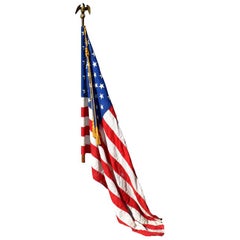
Antique Federal Eagle American 50 Star Flag with Brass Eagle Pole, 19th Century
Located in Oklahoma City, OK
Monumental 50 star American Flag with antique Federal Eagle brass and wood pole. A patriotic piece suitable for any home. This set includes both ...
Category
Antique 19th Century American Federal Political and Patriotic Memorabilia
Materials
Brass, Bronze
$4,500 Sale Price
25% Off
H 66 in W 69 in D 1.25 in
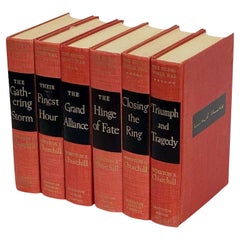
"The Second World War, " by Winston Churchill
By Houghton Mifflin
Co.
Located in Austin, TX
The Second World War by Winston Churchill from Houghton-Mifflin Company, Boston.
A vintage edition of Winston Churchill's six-volume memoir, The Second World War, for which he was a...
Category
Mid-20th Century American Modern Books
Materials
Paper
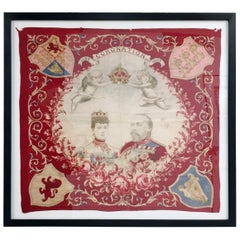
King Edward VII Coronation, June 1902 Framed Red Flag
Located in Hastings, GB
King Edward VII coronation, June 1902 framed scarf / flag.
This scarf is an original antique piece of British history and patriotic memorabilia.
...
Category
Antique Early 1900s British Edwardian Political and Patriotic Memorabilia
Materials
Cotton
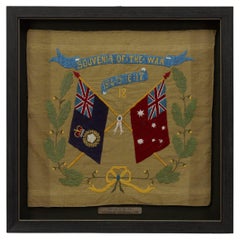
Souvenir of the War 1914-15-16-17-18 Banner
Located in Colorado Springs, CO
Presented is a stunning textile banner from the first World War, dating to 1918. The square tan cotton cloth is embroidered with two crossed flags, the ...
Category
Vintage 1910s Australian Political and Patriotic Memorabilia
Materials
Cotton
More From This Seller
View All30 Star Antique American Parade Flag, Wisconsin Statehood, ca 1848-1850
Located in York County, PA
ANTIQUE AMERICAN PARADE FLAG WITH 30 STARS, THE ONLY KNOWN EXAMPLE IN THIS SIMPLE BUT EXTRAORDINARY STYLE, PRE-CIVIL WAR, OFFICIAL FOR JUST TWO YEARS, REFLECTS THE ADDITION OF WISCON...
Category
Antique Mid-19th Century American Political and Patriotic Memorabilia
Materials
Cotton
Price Upon Request
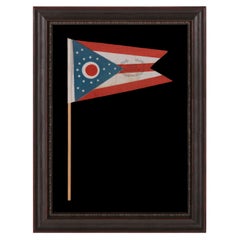
Ohio State Parade Flag with a Civil War Veterans Overprint
Located in York County, PA
OHIO STATE FLAG WITH CIVIL WAR VETERANS' OVERPRINT FROM THE GRAND ARMY OF THE REPUBLIC POST IN COLUMBUS, MADE IN MOURNING OF THE 1925 PASSING OF NATIONAL G.A.R. COMMANDER IN CHIEF DANIEL M. HALL, WHO ALSO SERVED AS COMMANDER OF THE OHIO DEPARTMENT OF THE G.A.R., AS WELL AS THE LOCAL CHAPTER
Flag of the State of Ohio, printed on oilcloth-like cotton, affixed to its original wooden staff. Made for Civil War veteran's use, the flag bears a stamped overprint in the striped field that consists of an open wreath of laurel branches, inside which is the following text: “GAR [Grand Army of the Republic] Post, Dan Hall, Columbus, OH”.
Born on October 20th, 1842, Daniel M. Hall enlisted with the Union Army as a Private at the age of 18 on August 25th, 1861. On October 8th of that year he mustered into the Co. H of the 2nd Ohio Cavalry. Discharged for disability on June 28th, 1862, he reenlisted approximately 17 months later, on November 11th, 1863, and mustered into Co. F of the 12th Ohio Cavalry at Camp Cleveland. He was at some point promoted to the rank of Sergeant, and, on February 21st, 1864, to the rank of Corporal. He mustered out at Nashville on November 14th, 1865.
Hall mustered into the Hamlin Post of the Ohio G.A.R. on May 23rd, 1883. He would go on to serve not only as Commander of the Dept. of Ohio for the organization, but as National Commander of the entire Grand Army of the Republic.
The Grand Army of the Republic was the primary veterans association for Union Civil War soldiers. Founded in 1866, its members dressed up in Civil War uniforms, attended parades and reunions, and the organization was somewhat more fraternal in nature than today’s VFW or American Foreign Legion.
Flags overprinted for the purpose of advertising are a specialized form in American flag collecting. A flag with a basic G.A.R. overprint is the most common type. This might be accompanied by a post number and a date. More elaborate the overprints are more highly desired, such as this one, which is the only variation I know of that honors a particular person who was not the namesake of the chapter itself.
It is of interest to note that a sister variety of 48 star parade flag is known, printed on the same fabric, that bears the same overprint, accompanied by the words: “We Mourn Our Comrade." From the additional text on the 48 star variety, one can extrapolate that the flags were made to mourn the passing of this important leader of Civil War veterans on October 19th, 1925, just one day before his 83rd birthday.
The State Flag of Ohio was designed in 1901 by Cleveland architect John Eisenmann, who designed the Ohio building for the state's exhibition at the Pan American Exposition World's Fair in Buffalo, New York. It was officially adopted by the Ohio legislature on May 19th, 1902. It's elements are centered on a red disc, set against a circular white ground that forms a letter "O." This simultaneously represents a buckeye, the fruit of the state tree and an iconic Ohio symbol. The flag's 5 stripes are said to represent the state's waterways and roads, while the triangular shape of the union is said to illustrate hills and valleys. The presentation of 13 stars along the hoist end, arranged in a semi-circular medallion with two off-set stars above and below, reflects the original 13 colonies. The diamond of stars, towards the fly end. bring the overall count to 17 to reflect Ohio's admission. When the design was adopted by the state legislature, the position of these stars was changed slightly, moving them further around the circle to form a wreath.
Flag expert Whitney Smith, who coined the term Vexillology in the late 1950's (the accepted term for the study of flags), pointed out that the format of the flag itself was reminiscent of Civil War cavalry guidons, carried by Ohio regiments throughout the state. These were of swallowtail form, though with 13 stripes, all horizontal and 90 degrees to the hoist. Most often these had circular star patterns around an open center, which makes them even more similar to the Ohio flag...
Category
Vintage 1920s American Political and Patriotic Memorabilia
Materials
Cotton
38 Star Parade Flag with Whimsical 6-Pointed Stars, Colorado Statehood
Located in York County, PA
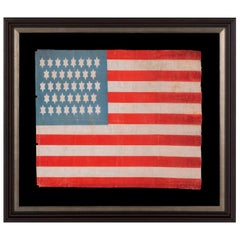
38 WHIMSICAL STARS, WITH 6-POINTED PROFILES, SIMILAR TO THE STAR OF DAVID, ON AN ANTIQUE AMERICAN FLAG OF THE CENTENNIAL ERA; A REMARKABLE SPECIMEN, ONE-OF-A-KIND AMONG KNOWN EXAMPLE...
Category
Antique Late 19th Century American Political and Patriotic Memorabilia
Materials
Cotton
Price Upon Request
38 Star Antique American Flag, Colorado Statehood, circa 1876-1889
Located in York County, PA
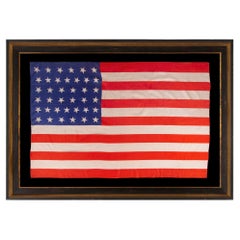
38 star antique American parade flag with scattered star orientation, made of silk, with generous scale and vivid colors, Colorado Statehood, 1876-1889
38 star American national p...
Category
Antique Late 19th Century American Political and Patriotic Memorabilia
Materials
Silk
Price Upon Request
34 STAR AMERICAN FLAG, CIVIL WAR, 1861-63, KANSAS STATEHOOD, 2nd KY CAVALRY
Located in York County, PA
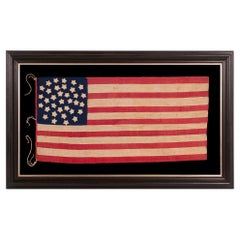
34 STAR ANTIQUE AMERICAN FLAG OF THE CIVIL WAR PERIOD (1861-63), IN A TINY SCALE AMONG PIECED-AND-SEWN FLAGS OF THE PERIOD, WITH A TRIPLE-WREATH CONFIGURATION, AN ELONGATED FORMAT, AND ENTIRELY HAND-SEWN; FOUND WITH A LETTER FROM JOHN W. RUDE OF THE 2ND KENTUCKY VETERAN VOLUNTEER CAVALRY (UNION):
34 star flag of the Civil War period with a variety of extremely desirable features, handed down with a letter written by John W. Rude on November 8th, 1864, while encamped with the Army’s 1st Brigade, 3rd Division, as a member of the 2nd Regiment of Veteran Volunteer Cavalry. Tiny in scale among pieced and sewn examples, the flag displays a star pattern that consists of a three consecutive wreaths, with a single star in the very center. Because it lacks a single star in each corner, outside the basic pattern—usually present in flags of this design made during the mid-late 19th century—this is something I classify as a “snowball medallion.” Entirely hand-sewn throughout, note the square format of the blue canton, with its beautiful, circular star arrangement, and how interesting this combination is when paired with the elongated format of the flag itself. The stars are double-appliqued, meaning that they are applied to both sides. These are fat in shape and inconsistent in size. Note how the lowest star in the outermost ring actually dips into the white stripe below.
Made of plain weave cotton, there is a narrow binding along the hoist, red in color, with three sets of cotton ties. Those at the top and bottom are made of fine, braided hemp or hemp and cotton cord, stitched into place, while the one in the center, looped around the binding and tied, is made of lightweight, twisted, cotton thread. Note how the 5th, 6th, and 7th red stripes are pieced from two lengths of cotton fabric, which reflects that the maker was being conscious of conserving available fabric.
In the 19th century, most flags with pieced and sewn construction were 8 feet long and larger. A six-footer was considered small. Even military battle flags, carried on foot, measured 6’ x 6.5’, which translates into approximately 7’ x 7.5’ after framing, about the size of an average quilt and larger than can comfortably fit on a wall in a house with 8-foot ceilings and average width baseboard. Flags smaller than this exist, but the smaller they get, the more unusual they are. At just 1.5’ x 3’, this is about as small as one will ever encounter in a sewn flag of the Civil War era.
The flag appears to have likely been hand-carried. I expect that it probably saw military use of some sort as a camp flag...
Category
Antique 1860s American Political and Patriotic Memorabilia
Materials
Cotton
38 Star Antique Flag, Stars in Double Wreath Pattern, Colorado Statehood 1876-89
Located in York County, PA
38 STAR ANTIQUE AMERICAN FLAG WITH A DOUBLE-WREATH CONFIGURATION THAT FEATURES AN ENORMOUS CENTER STAR, REFLECTS THE PERIOD OF COLORADO STATEHOOD, 1876-1889:
38 star American national flag, made entirely of plain weave cotton. The stars are arranged in a medallion configuration. This features an enormous center star, surrounded by two wreaths of much smaller stars, with a flanking star in each corner of the blue canton. The sort of disparity here, present in the scale of the large star, versus those around it, is both exceptionally unusual and graphically dynamic.
Colorado became the 38th state on August 1st, 1876. This was the year of our nation’s centennial. Per the Third Flag Act of 1818, stars were not officially added until the 4th of July following a state's addition. For this reason, 37 remained the official star count for the American flag until part way through the following year. Flag-making was a competitive venture, however, and few flag-makers would have continued to produce 37 star flags when their competitors were making 38’s. Many flag-makers added a 38th star before Colorado entered the Union, in the early part of 1876, or possibly even prior. In fact, many makers of printed flags, called parade flags or hand-wavers, were actually producing flags in the 39 star count, in hopeful anticipation of the addition of two more Western Territories instead of one.
It is for these reasons that 38, 39, and 13 stars, to representing the original 13 colonies, are most often seen on flags displayed at the Centennial International Exhibition. Hosted in Philadelphia, this enormous event was our nation’s first World’s Fair, lasted for a duration of six months, and served as the nucleus of celebrations held to honor America’s 100-year anniversary of independence. The 38 star flag became official on July 4th, 1877 and was generally used until the 39th state was added in November of 1889.
This is probably a homemade flag, though sewn by a very skilled hand, or possibly, by two different individuals. The stripes are pieced and sewn entirely by hand, with remarkable care and precision. The canton is constructed of two lengths of blue fabric, that have been joined with treadle stitching. This was joined to the striped field by hand. The stars are double-appliquéd (applied to both sides) with treadle stitching. There is a treadle-sewn, cotton binding along the hoist, with five, hand-sewn grommets.
It is extremely unusual to encounter this combination of sewing methods. Soon after the sewing machine was mass-marketed, in the mid-1850’s, flag-makers both public and private made good use of treadle machines, to join stripes, when constructing American flags. During the Civil War (1861-65), most stripes were treadle-sewn. Stars were another matter. Until the advent of electric machines...
Category
Antique Late 19th Century American Political and Patriotic Memorabilia
Materials
Cotton