Items Similar to 33 Star Antique American Flag with a Great Star Configuration, ca 1859-1861
Want more images or videos?
Request additional images or videos from the seller
1 of 6
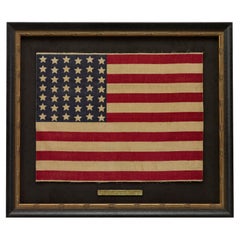
33 Star Antique American Flag with a Great Star Configuration, ca 1859-1861
Price Upon Request
Price Upon Request
Price Upon Request
Price Upon Request
Price Upon Request
Price Upon Request
Price Upon Request
Price Upon Request
Price Upon Request
Price Upon Request
About the Item
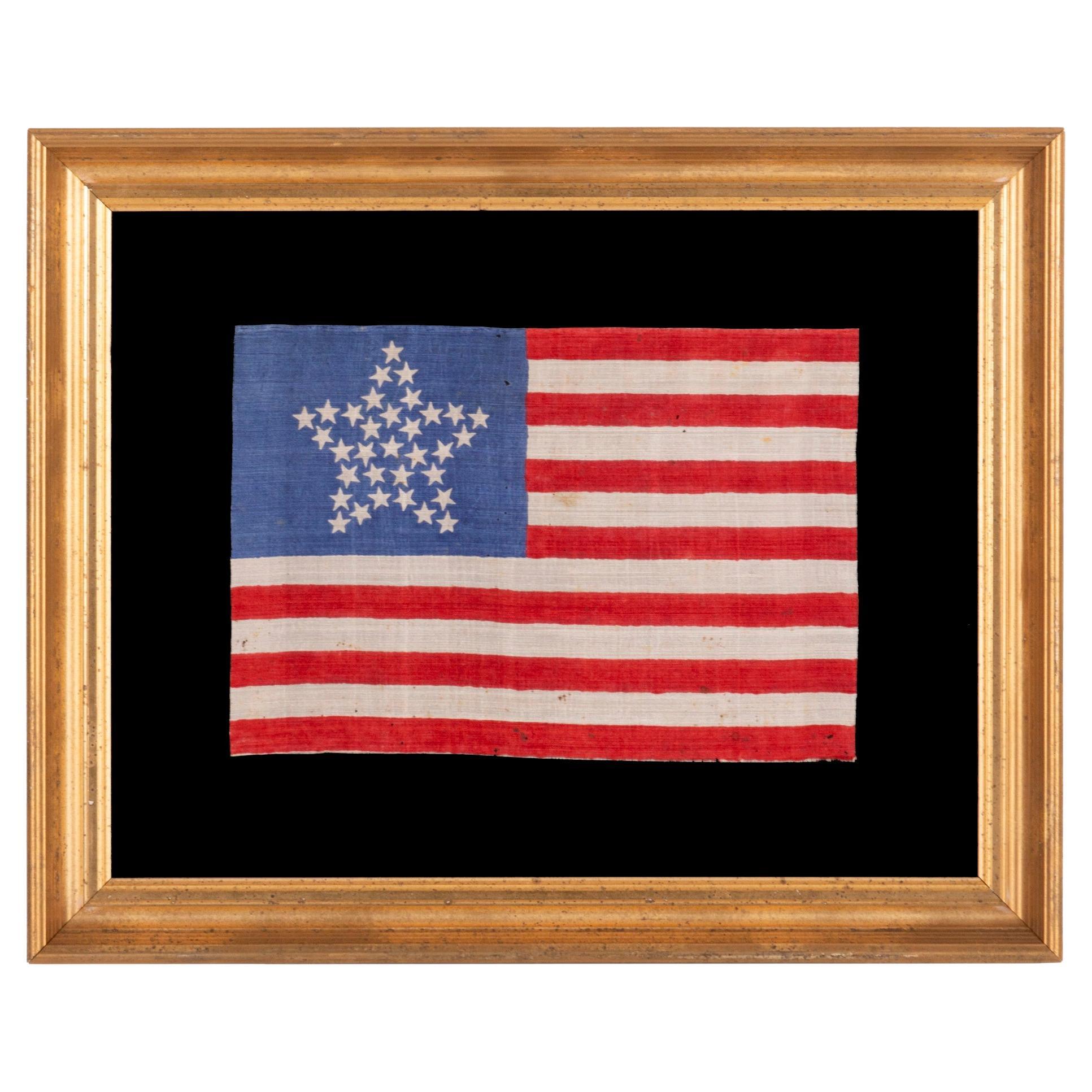
33 STARS ANTIQUE AMERICAN FLAG WITH A "GREAT STAR" CONFIGURATION ON A BRILLIANT, INDIGO BLUE CANTON, A RARE AND EXTRAORDINARY EXAMPLE, PRE-CIVIL WAR THROUGH THE WAR'S OPENING YEAR, 1859-1861, OREGON STATEHOOD
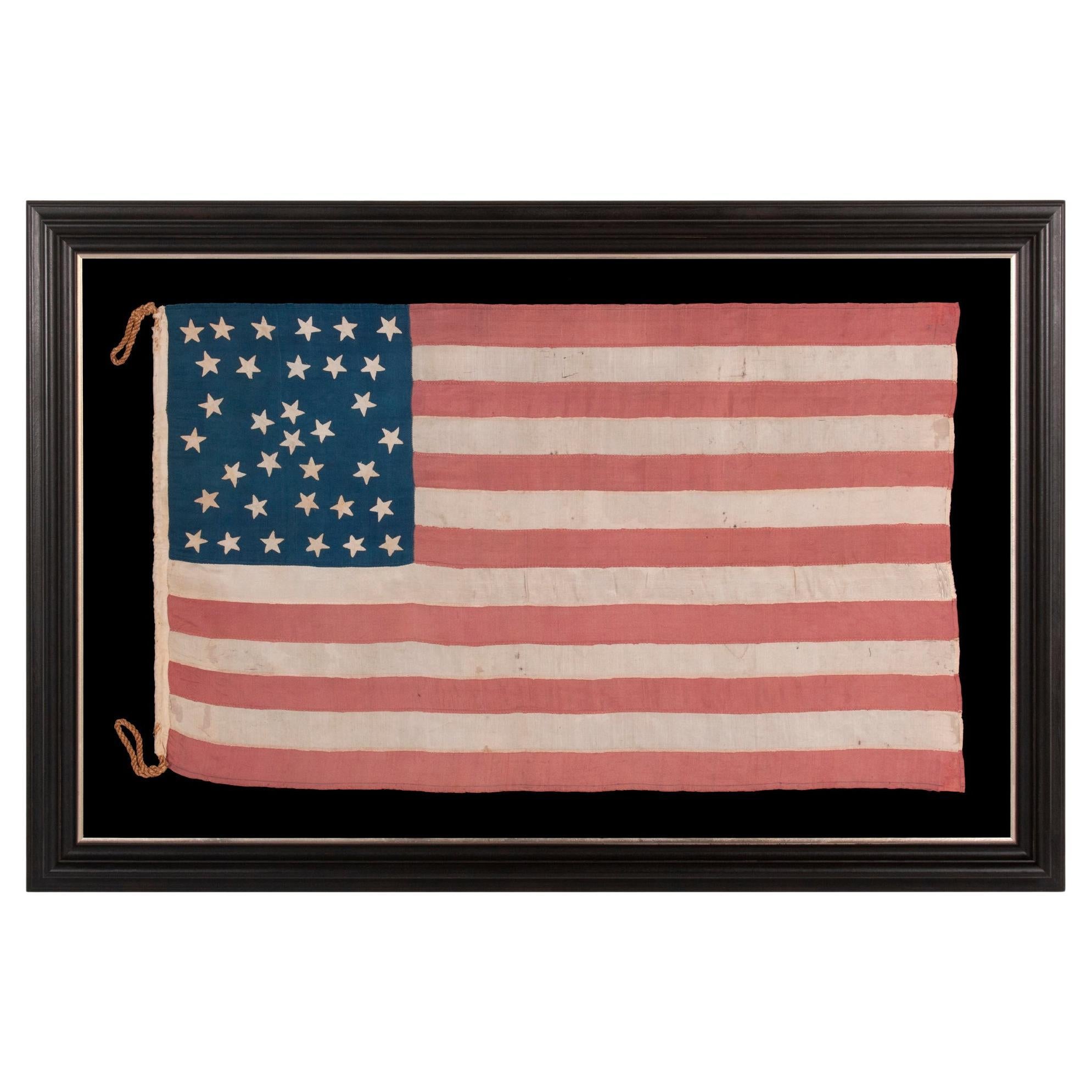
33 star parade flag, printed on silk. The stars are configured in a variation of what is known as the “Great Star” pattern [one large star made out of smaller stars]. Great Stars take on many forms. This particular one is comprised of a star-shaped perimeter, surrounding a wreath of 7 stars, with a single star in the very center. This variety is interesting, not only because of the inner wreath, but because when star-shaped or circular designs appear in printed flags, they are almost always accompanied by additional stars outside the primary pattern. Sometimes simplicity is better. There is something to be said about the strong graphics of the one big star against the rich, indigo blue ground, unencumbered by smaller stars around it.
Because there was no official configuration until 1912, the design was left to the liberties of the maker. Among flag collectors, the Great Star configuration is perhaps the most coveted geometric pattern. It seems to have come about shortly before 1818, when Congressman Peter Wendover of New York requested that Captain Samuel Reid, a War of 1812 Naval hero, help to create a new design that would become the third official format of the Stars
Stripes. The primary concern of ship captains was that the signal be easily recognized on the open seas. Reid’s concept of placing all the stars in a star-shaped pattern would have kept the constellation in roughly the same format as the number of states grew and more stars were added. Such a distinct design could be quickly identified at a distance. Though his proposal was rejected by President Monroe due to the increased cost of arranging the stars in this manner, the Great Star was produced by anyone willing to make it. Its rarity today, along with its beauty, has driven its desirability among collectors.
This is an extremely rare example. Oregon joined the Union as the 33rd state on February 14th, Valentine’s Day, 1859. The 33 star flag was official from 1859-1861, and was thus still the official flag when Ft. Sumter was fired upon, on April 12th of that year. This event marked the beginning of the Civil War and a 33 star flag was flying at Ft. Sumter during the attack. Because the 34th state, Kansas, had already acquired statehood on January 29th, 1861, flag makers knew that the 34 star flag would soon become official. For this reason, 33 star flags were not produced in great quantity for the war, which would last until 1865, and the 33 can be considered to be more of a pre-Civil war flag than a war-period flag. 33’s are considerably more rare than 34 and 35 star examples.
Flags made prior to the Civil War are extremely rare, comprising less than one percent of 19th century flags that exist in the 21st century. Prior to the Confederate attack on Fort Sumter in 1861, the Stars
Stripes was simply not used for most of the same purposes we employ it in today. Private individuals did not typically display the flag in their yards and on their porches. Parade flags didn't often fly from carriages and horses. Places of business didn’t regularly hang flags in their windows. The only consistent private use prior to 1861 seems to have accompanied political campaigning. Private use of the national flag rose swiftly during the patriotism that accompanied the Civil War, then exploded in 1876 during the centennial of American independence.
Even the military did not use the flag in a manner that most people might think. The primary purpose before the Civil War was to mark ships on the open seas. While flags were used to mark garrisons and government buildings, those of ground troops were often limited to the flag of their own regiment, with a design peculiar unto itself, plus flank markers bearing the unit’s numeric / alphabetic designations (usually on a buff yellow or blue ground), and perhaps a federal standard (also blue or buff yellow) bearing the arms of the United States.
Most people are surprised to learn that ground forces were not authorized to carry the Stars
Stripes until it was assigned to artillery regiments in 1834. Infantry was afforded the privilege in 1841, just prior to the Mexican War (1846-1848), while cavalry regiments were not issued their iconic, swallowtail, Stars
Stripes format guidons until the second year of the Civil War, in 1862, and even then were not formally authorized to carry the national flag until long afterward, in the 1890’s. The first actual war in which the Stars
Stripes was officially carried was thus the Mexican War (1846-48). In more than 20 years of aggressive buying and research, I have encountered almost no American national flags produced in an obvious, land-use, military style that are of the Mexican War period.
All-in-all, a rare and stunning representation of a pre-Civil War parade flag in the Great Star pattern.
Mounting: The flag was mounted and framed within our own conservation department, which is led by expert staff. We take great care in the mounting and preservation of flags and have framed thousands of examples.
The flag has been hand-stitched to a background of 100% hemp fabric, ivory in color, with a twill weave. The gilded American molding dates to the period between 1840 and 1870. The glazing is U.V. protective acrylic (Plexiglas).
Condition: There are tiny holes in limited areas in the striped field, in and around the center region, as well as in the top, hoist-end corner of the canton. There is a scattering of foxing throughout, and well as minor to modest bleaching in the canton. The colors are strong and bright.
- Dimensions:Height: 16 in (40.64 cm)Width: 19.5 in (49.53 cm)Depth: 2 in (5.08 cm)
- Materials and Techniques:
- Place of Origin:
- Period:
- Date of Manufacture:1859-1861
- Condition:See Item Description.
- Seller Location:York County, PA
- Reference Number:Seller: 33j-8681stDibs: LU849740705292
About the Seller
5.0
Recognized Seller
These prestigious sellers are industry leaders and represent the highest echelon for item quality and design.
Established in 1991
1stDibs seller since 2008
71 sales on 1stDibs
Typical response time: Several days
- ShippingRetrieving quote...Shipping from: York County, PA
- Return Policy
More From This Seller
View All26 Star Antique American Flag, with 11 Stripes, Michigan Statehood, ca 1837-1846
Located in York County, PA
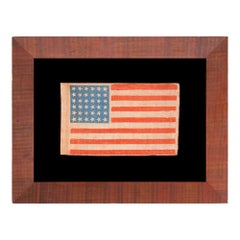
26 STAR ANTIQUE AMERICAN PARADE FLAG WITH 11 STRIPES AND IT’S CANTON RESTING ON THE “WAR STRIPE.” THE EARLIEST KNOWN STAR COUNT FOR PRINTED EXAMPLES, 1837-1846, MICHIGAN STATEHOOD
2...
Category
Antique Mid-19th Century American Political and Patriotic Memorabilia
Materials
Cotton
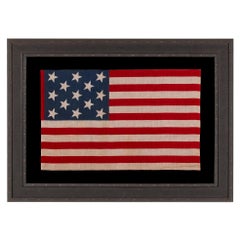
36 Star Antique American Parade Flag, with Canted Stars, ca 1864-1867
Located in York County, PA
36 STAR ANTIQUE AMERICAN PARADE FLAG WITH CANTED STARS IN DANCING ROWS, ON A BEAUTIFUL, CORNFLOWER BLUE CANTON; CIVIL WAR ERA, NEVADA STATEHOOD, 1864-1867
36 star antique American f...
Category
Antique 1860s American Political and Patriotic Memorabilia
Materials
Cotton
Price Upon Request
33 Star Flag with Stars in a "Great Star" Pattern, Oregon State, ca 1859-1861
Located in York County, PA
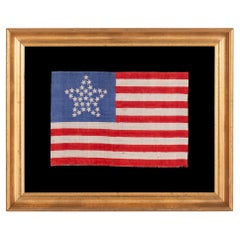
33 STARS IN A "GREAT STAR" PATTER ON A BRILLIANT, ROYAL BLUE CANTON, A RARE AND EXTRAORDINARY EXAMPLE, PRE-CIVIL WAR THROUGH THE WAR'S OPENING YEAR, 1859-1861, OREGON STATEHOOD
33 s...
Category
Antique Mid-19th Century American Political and Patriotic Memorabilia
Materials
Silk
39 Star Antique American Parade Flag with Stars in Two Sizes, Ca 1876
Located in York County, PA
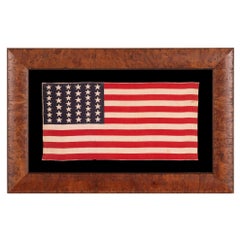
39 STARS IN TWO SIZES, ALTERNATING FROM ONE COLUMN TO THE NEXT, ON AN ANTIQUE AMERICAN PARADE FLAG WITH AN UNUSUALLY ELONGATED PROFILE, DATING TO THE 1876 CENTENNIAL, NEVER AN OFFICI...
Category
Antique 1870s American Political and Patriotic Memorabilia
Materials
Cotton
34 Star Antique American Flag with Hourglass Medallion Stars, ca 1861-1863
Located in York County, PA
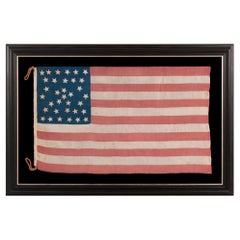
EXTRAORDINARY 34 STAR ANTIQUE AMERICAN FLAG WITH AN ACCORDION OR HOURGLASS MEDALLION CONFIGURATION THAT SURROUNDS A PENTAGON OF STARS IN THE CENTER; MADE OF FINE SILK AND ENTIRELY HAND-SEWN; MADE DURING THE OPENING YEARS OF THE CIVIL WAR (1861-63), IN A TINY SIZE AMONG ITS COUNTERPARTS OF THE PERIOD; REFLECTS THE ADDITION OF KANSAS AS THE 34TH STATE
34 star flag of the Civil War period with an array of rare, beautiful, and otherwise desirable features. Extremely small among flags of this period with pieced and sewn construction, the flag displays a star pattern that is not only highly unusual, but unique to this particular example. This consists of a single star in the very center, surrounded by a pentagon of stars, flanked by angular bracket of three stars to either side. Above and below are rows of 5 stars, followed by rows of 6 that line the top and bottom of the canton. The resulting configuration is what I have termed an “accordion medallion,” though “hourglass medallion” or “standing bow tie” would be perfectly acceptable.
When rotated 90 degrees, to view the harder-to-identify, bow tie formation, students of early star patterns may note the visual similarity between this and what I call “Starburst” or “Crosshatch” medallions. The pattern, however, conspicuously lacks the crosses of St. Andrew (a saltire) and St. George (roman cross), that would allow it to be more accurately categorized as such.
Entirely hand-sewn, the canton and stripes of the flag are made of fine silk. The hemming of this was accomplished with great skill. The top and bottom edges are selvedge. These are so similar in nature as to have come from the same maker. There is a white, silk binding along the hoist, in the form of an open sleeve, through which a length of braided hemp rope was passed, expertly looped and re-braided into itself at the top and bottom for strength.
The stars are made of white, polished cotton. These were stitched to both sides (double-appliqued). Note how the edges of the fabric were not turned under, providing evidence of the fact that the maker was not especially skilled in appliqueing. This was common, as applique work was far more difficult than producing French seams.
In the 19th century, most flags with pieced and sewn construction were 8 feet long and larger. A six-footer was considered small. Even military battle flags, carried on foot, measured 6’ x 6.5’, which translates into approximately 7’ x 7.5’ after framing, about the size of an average quilt and larger than can comfortably fit on a wall in a house with 8-foot ceilings and average width baseboard. Flags smaller than this were produced both commercially and at home, but the smaller they are, the more unusual they are. At just 26.5 x 46.5 inches, this flag is extremely small for a Civil war period flag with sewn construction.
Silk was both beautiful and lightweight, which made it elegant for military unit colors and preferable for flags meant to be carried on foot. Most outdoor use flags...
Category
Antique 1860s American Political and Patriotic Memorabilia
Materials
Silk
13 Star Antique American Parade Flag, ca 1876-1899
Located in York County, PA
13 STAR ANTIQUE AMERICAN PARADE FLAG, WITH A 3-2-3-2-3 CONFIGURATION OF STARS, AN EXTREMELY SCARCE AND UNUSUALLY LARGE VARIETY, MADE circa 1876-1899
13 star American national parade...
Category
Antique Late 19th Century Canadian Political and Patriotic Memorabilia
Materials
Cotton
Price Upon Request
You May Also Like
31-Star Printed American Flag, Celebrating California Statehood, Circa 1850
Located in Colorado Springs, CO
This is a rare 31-star medallion printed American flag, celebrating the addition of California to the Union. The flag is printed on silk and has a spectacular “Great Star” canton pat...
Category
Antique 1850s American Political and Patriotic Memorabilia
Materials
Silk
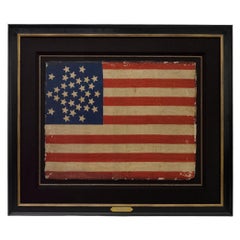
19th Century American 42 Star Flag, circa 1889
Located in Nantucket, MA
19th Century American 42 Star Flag, circa 1889, printed on linen period flag in the "Dancing Star" pattern. This was never an official U.S. flag sanctioned b y congress, but was made...
Category
Antique 1880s American Federal Political and Patriotic Memorabilia
Materials
Linen
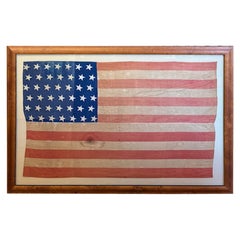
13-Star Wool American Flag, with Zig-Zag Stars, Circa 1900
Located in Colorado Springs, CO
This is a beautiful 13-star American flag, each star sewn with zig-zag stitching. The wool flag was sewn at the turn of the century, circa 1900. The flag features 13 white stars rest...
Category
Antique Early 1900s American American Classical Political and Patriotic ...
Materials
Brass
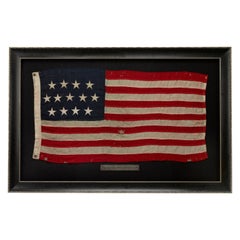
42-Star American Parade Flag, Commemorating Washington Statehood, 1889
Located in Colorado Springs, CO
This is an uncommon 42-star flag, commemorating the addition of the state of Washington to the Union. The flag dates to 1889-1890, and is printed on cotton. The canton consists of s...
Category
Antique 1880s American Political and Patriotic Memorabilia
Materials
Cotton
44-Star Silk American Flag, Celebrating Wyoming Statehood, Circa 1890-1896
Located in Colorado Springs, CO
Presented is a 44-star silk American flag, commemorating Wyoming statehood. The flag dates to 1890-1896. The flag has an “8-7-7-7-7-8” star configuration, with the stars whimsically ...
Category
Antique 1890s American Political and Patriotic Memorabilia
Materials
Silk
Rare Antique 45-Star American Flag Hand-Painted on Cotton, Spanish-American War
Located in Doha, QA
This exceptional and exceedingly scarce 45-star American flag, commemorating Utah’s admission as the 45th state in 1896, represents one of the earliest surviving examples of a hand-p...
Category
Antique Late 19th Century American Folk Art Historical Memorabilia
Materials
Cotton, Glass, Wood, Paint