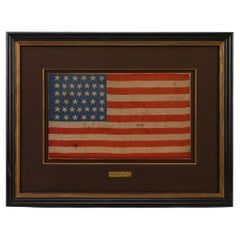
Items Similar to 33 Star Flag with Stars in a "Great Star" Pattern, Oregon State, ca 1859-1861
Want more images or videos?
Request additional images or videos from the seller
1 of 6
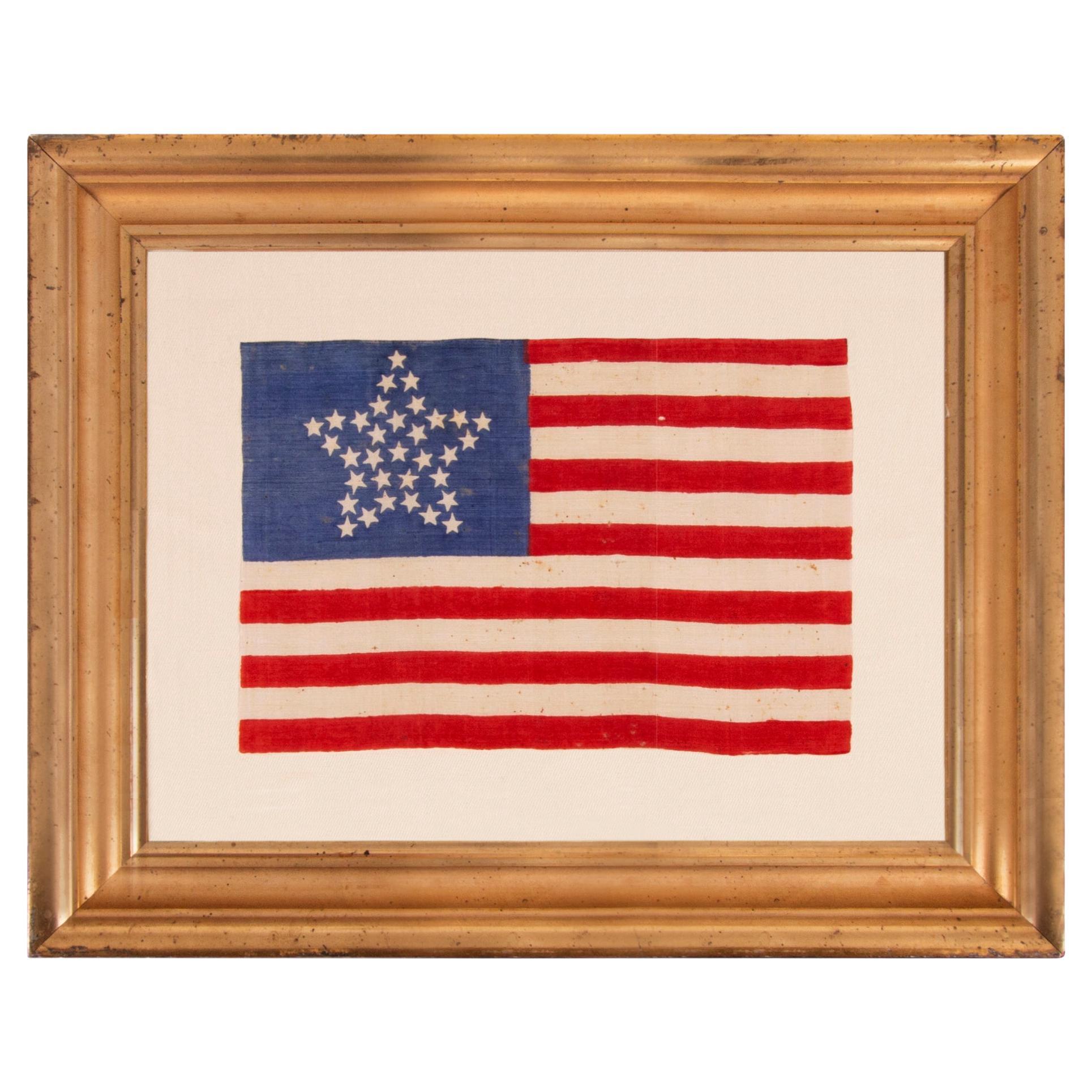
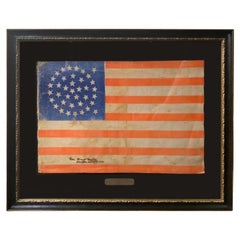
33 Star Flag with Stars in a "Great Star" Pattern, Oregon State, ca 1859-1861
Price Upon Request
Price Upon Request
Price Upon Request
Price Upon Request
Price Upon Request
Price Upon Request
Price Upon Request
Price Upon Request
Price Upon Request
Price Upon Request
About the Item
33 STARS IN A "GREAT STAR" PATTER ON A BRILLIANT, ROYAL BLUE CANTON, A RARE AND EXTRAORDINARY EXAMPLE, PRE-CIVIL WAR THROUGH THE WAR'S OPENING YEAR, 1859-1861, OREGON STATEHOOD
33 star parade flag, printed on silk. The stars are configured in a variation of what is known as the “Great Star” pattern [one large star made out of smaller stars]. Great Stars take on many forms. This particular one is comprised of a star-shaped perimeter, surrounding a wreath of 7 stars, with a single star in the very center. This variety is interesting, not only because of the inner wreath, but because when star-shaped or circular designs appear in printed flags, they are almost always accompanied by additional stars outside the primary pattern. Sometimes simplicity is better. There is something to be said about the strong graphics of the one big star against the rich, royal blue ground, unencumbered by smaller stars around it.
Because there was no official configuration until 1912, the design was left to the liberties of the maker. Among flag collectors, the Great Star configuration is perhaps the most coveted geometric pattern. It seems to have come about shortly before 1818, when Congressman Peter Wendover of New York requested that Captain Samuel Reid, a War of 1812 Naval hero, help to create a new design that would become the third official format of the Stars
Stripes. The primary concern of ship captains was that the signal be easily recognized on the open seas. Reid’s concept of placing all the stars in a star-shaped pattern would have kept the constellation in roughly the same format as the number of states grew and more stars were added. Such a distinct design could be quickly identified at a distance. Though his proposal was rejected by President Monroe due to the increased cost of arranging the stars in this manner, the Great Star was produced by anyone willing to make it. Its rarity today, along with its beauty, has driven its desirability among collectors.
This is an extremely rare example. Oregon joined the Union as the 33rd state on February 14th, Valentine’s Day, 1859. The 33 star flag was official from 1859-1861, and was thus still the official flag when Ft. Sumter was fired upon, on April 12th of that year. This event marked the beginning of the Civil War and a 33 star flag was flying at Ft. Sumter during the attack. Because the 34th state, Kansas, had already acquired statehood on January 29th, 1861, flag makers knew that the 34 star flag would soon become official. For this reason, 33 star flags were not produced in great quantity for the war, which would last until 1865, and the 33 can be considered to be more of a pre-Civil war flag than a war-period flag. 33’s are considerably more rare than 34 and 35 star examples.
Flags made prior to the Civil War are extremely rare, comprising less than one percent of 19th century flags that exist in the 21st century. Prior to the Confederate attack on Fort Sumter in 1861, the Stars
Stripes was simply not used for most of the same purposes we employ it in today. Private individuals did not typically display the flag in their yards and on their porches. Parade flags didn't often fly from carriages and horses. Places of business didn’t regularly hang flags in their windows. The only consistent private use prior to 1861 seems to have accompanied political campaigning. Private use of the national flag rose swiftly during the patriotism that accompanied the Civil War, then exploded in 1876 during the centennial of American independence.
Even the military did not use the flag in a manner that most people might think. The primary purpose before the Civil War was to mark ships on the open seas. While flags were used to mark garrisons and government buildings, those of ground troops were often limited to the flag of their own regiment, with a design peculiar unto itself, plus flank markers bearing the unit’s numeric / alphabetic designations (usually on a buff yellow or blue ground), and perhaps a federal standard (also blue or buff yellow) bearing the arms of the United States.
Most people are surprised to learn that ground forces were not authorized to carry the Stars
Stripes until it was assigned to artillery regiments in 1834. Infantry was afforded the privilege in 1841, just prior to the Mexican War (1846-1848), while cavalry regiments were not issued their iconic, swallowtail, Stars
Stripes format guidons until the second year of the Civil War, in 1862, and even then were not formally authorized to carry the national flag until long afterward, in the 1890’s. The first actual war in which the Stars
Stripes was officially carried was thus the Mexican War (1846-48). In more than 20 years of aggressive buying and research, I have encountered almost no American national flags produced in an obvious, land-use, military style that are of the Mexican War period.
All-in-all, a rare and stunning representation of a pre-Civil War parade flag in the Great Star pattern.
Mounting: The flag was mounted and framed within our own conservation department, which is led by expert staff. We take great care in the mounting and preservation of flags and have framed thousands of examples.
The flag has been hand-stitched to a background of 100% cotton twill, black in color, that has been washed and treated for colorfastness. The gilded American molding dates to the period between 1840 and 1870. The glazing is U.V. protective acrylic (Plexiglas).
Condition: There is very minor foxing and staining in limited areas. The most significant of these occurrences are near the end of the 2nd white stripe, near the beginning of the 3rd white stripe, and in an area encompassing just over half of the last 3 stripes, toward the fly end. There are tiny holes in limited areas, in both the canton and the striped field. The colors are strong and bright.
Frame Size (H x L): 15.75" x 19.5"
Flag Size (H x L): 8.25" x 11.75"
- Dimensions:Height: 15.75 in (40.01 cm)Width: 19.5 in (49.53 cm)Depth: 2 in (5.08 cm)
- Materials and Techniques:
- Place of Origin:
- Period:
- Date of Manufacture:1859-1861
- Condition:See Item Description.
- Seller Location:York County, PA
- Reference Number:Seller: 33j-8671stDibs: LU849738446782
About the Seller
5.0
Recognized Seller
These prestigious sellers are industry leaders and represent the highest echelon for item quality and design.
Established in 1991
1stDibs seller since 2008
71 sales on 1stDibs
Typical response time: Several days
- ShippingRetrieving quote...Shipping from: York County, PA
- Return Policy
More From This Seller
View All33 Star Antique American Flag with a Great Star Configuration, ca 1859-1861
Located in York County, PA
33 STARS ANTIQUE AMERICAN FLAG WITH A "GREAT STAR" CONFIGURATION ON A BRILLIANT, INDIGO BLUE CANTON, A RARE AND EXTRAORDINARY EXAMPLE, PRE-CIVIL WAR THROUGH THE WAR'S OPENING YEAR, 1...
Category
Antique Late 19th Century American Political and Patriotic Memorabilia
Materials
Silk
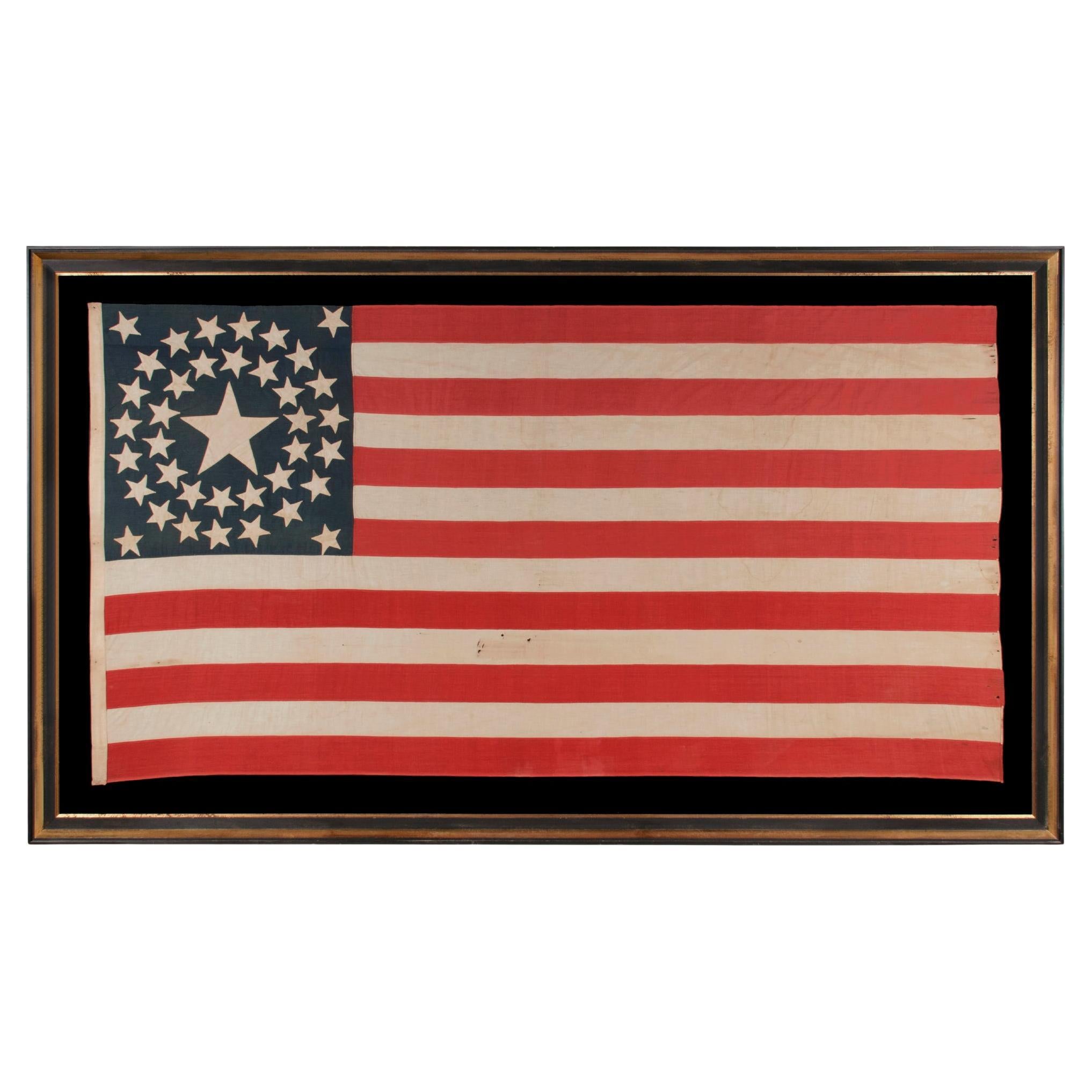
38 Star Antique Flag, Stars in Double Wreath Pattern, Colorado Statehood 1876-89
Located in York County, PA
38 STAR ANTIQUE AMERICAN FLAG WITH A DOUBLE-WREATH CONFIGURATION THAT FEATURES AN ENORMOUS CENTER STAR, REFLECTS THE PERIOD OF COLORADO STATEHOOD, 1876-1889:
38 star American national flag, made entirely of plain weave cotton. The stars are arranged in a medallion configuration. This features an enormous center star, surrounded by two wreaths of much smaller stars, with a flanking star in each corner of the blue canton. The sort of disparity here, present in the scale of the large star, versus those around it, is both exceptionally unusual and graphically dynamic.
Colorado became the 38th state on August 1st, 1876. This was the year of our nation’s centennial. Per the Third Flag Act of 1818, stars were not officially added until the 4th of July following a state's addition. For this reason, 37 remained the official star count for the American flag until part way through the following year. Flag-making was a competitive venture, however, and few flag-makers would have continued to produce 37 star flags when their competitors were making 38’s. Many flag-makers added a 38th star before Colorado entered the Union, in the early part of 1876, or possibly even prior. In fact, many makers of printed flags, called parade flags or hand-wavers, were actually producing flags in the 39 star count, in hopeful anticipation of the addition of two more Western Territories instead of one.
It is for these reasons that 38, 39, and 13 stars, to representing the original 13 colonies, are most often seen on flags displayed at the Centennial International Exhibition. Hosted in Philadelphia, this enormous event was our nation’s first World’s Fair, lasted for a duration of six months, and served as the nucleus of celebrations held to honor America’s 100-year anniversary of independence. The 38 star flag became official on July 4th, 1877 and was generally used until the 39th state was added in November of 1889.
This is probably a homemade flag, though sewn by a very skilled hand, or possibly, by two different individuals. The stripes are pieced and sewn entirely by hand, with remarkable care and precision. The canton is constructed of two lengths of blue fabric, that have been joined with treadle stitching. This was joined to the striped field by hand. The stars are double-appliquéd (applied to both sides) with treadle stitching. There is a treadle-sewn, cotton binding along the hoist, with five, hand-sewn grommets.
It is extremely unusual to encounter this combination of sewing methods. Soon after the sewing machine was mass-marketed, in the mid-1850’s, flag-makers both public and private made good use of treadle machines, to join stripes, when constructing American flags. During the Civil War (1861-65), most stripes were treadle-sewn. Stars were another matter. Until the advent of electric machines...
Category
Antique Late 19th Century American Political and Patriotic Memorabilia
Materials
Cotton
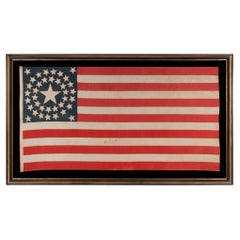
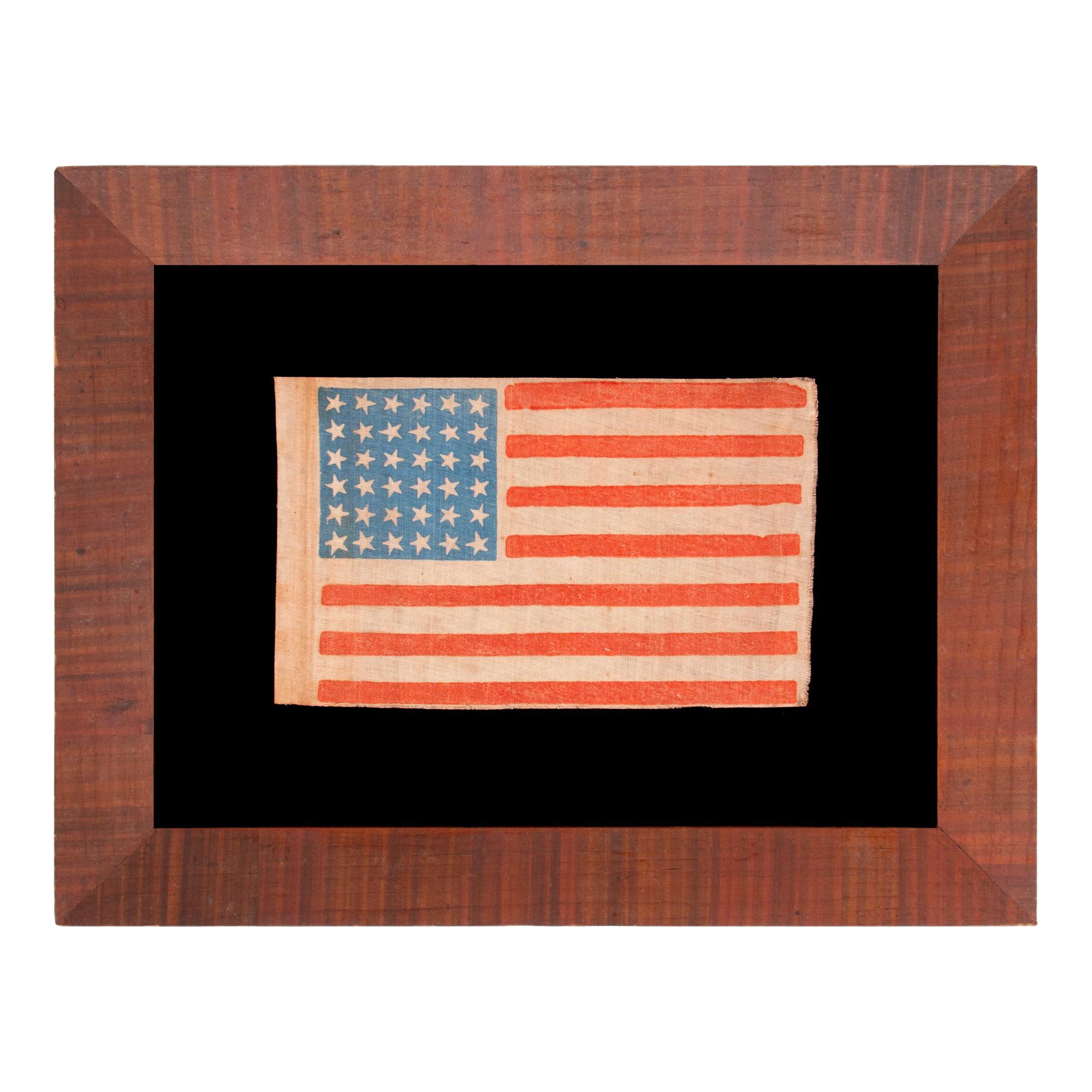
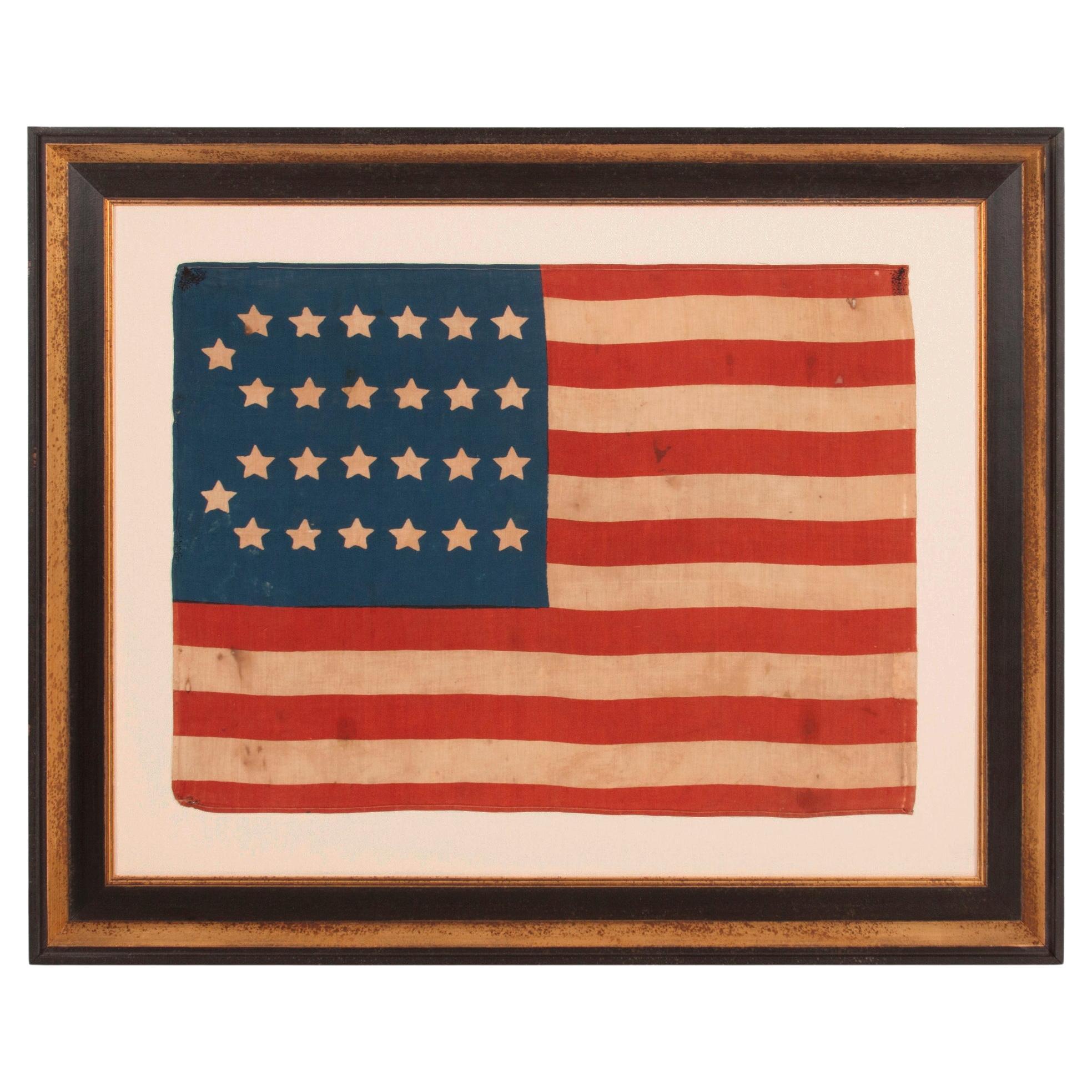
36 Star Antique American Parade Flag, with Canted Stars, ca 1864-1867
Located in York County, PA
36 STAR ANTIQUE AMERICAN PARADE FLAG WITH CANTED STARS IN DANCING ROWS, ON A BEAUTIFUL, CORNFLOWER BLUE CANTON; CIVIL WAR ERA, NEVADA STATEHOOD, 1864-1867
36 star antique American f...
Category
Antique 1860s American Political and Patriotic Memorabilia
Materials
Cotton
Price Upon Request
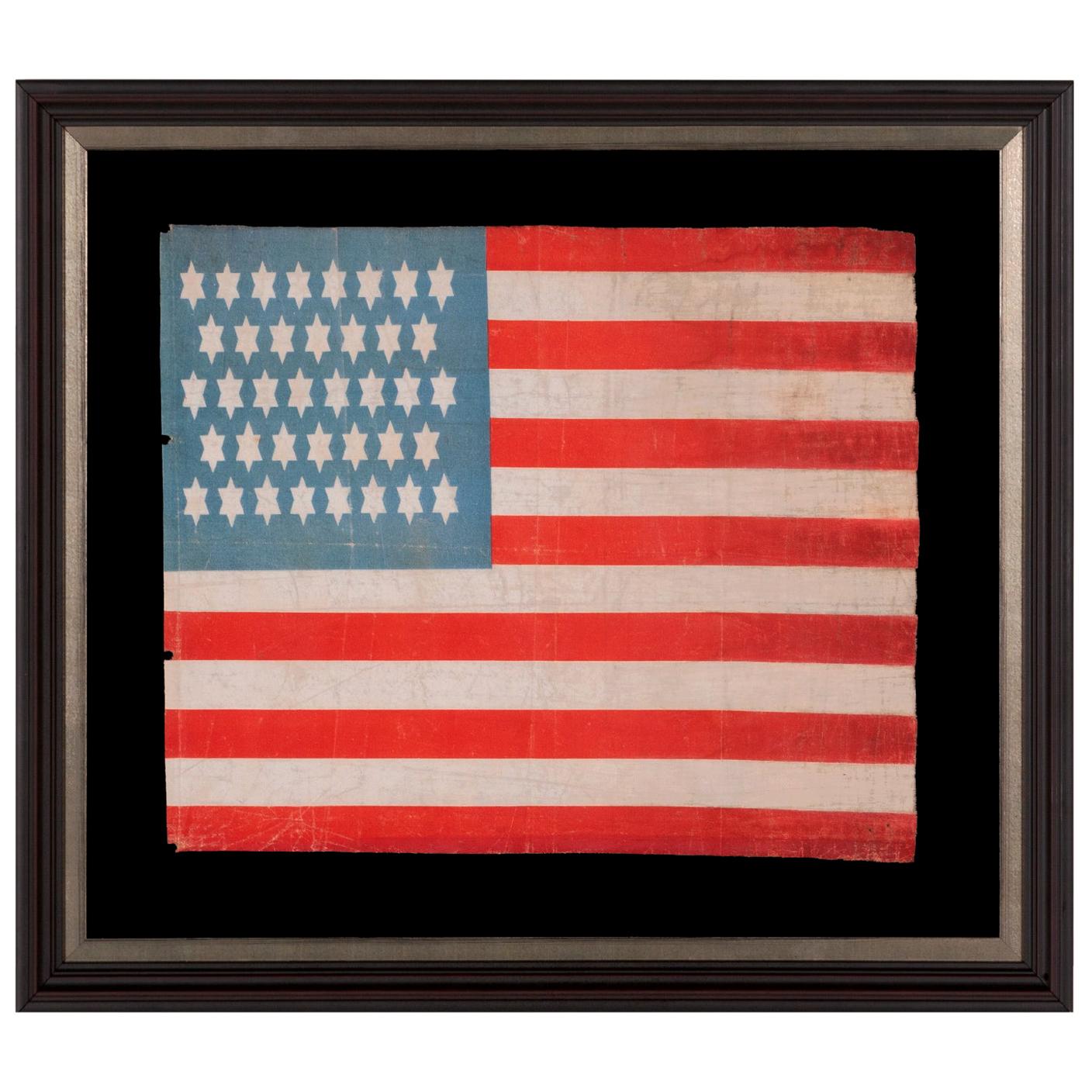
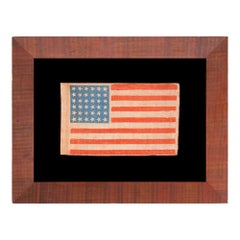
38 Star Parade Flag with Whimsical 6-Pointed Stars, Colorado Statehood
Located in York County, PA
38 WHIMSICAL STARS, WITH 6-POINTED PROFILES, SIMILAR TO THE STAR OF DAVID, ON AN ANTIQUE AMERICAN FLAG OF THE CENTENNIAL ERA; A REMARKABLE SPECIMEN, ONE-OF-A-KIND AMONG KNOWN EXAMPLE...
Category
Antique Late 19th Century American Political and Patriotic Memorabilia
Materials
Cotton
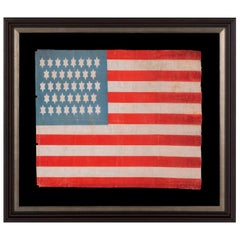
Price Upon Request
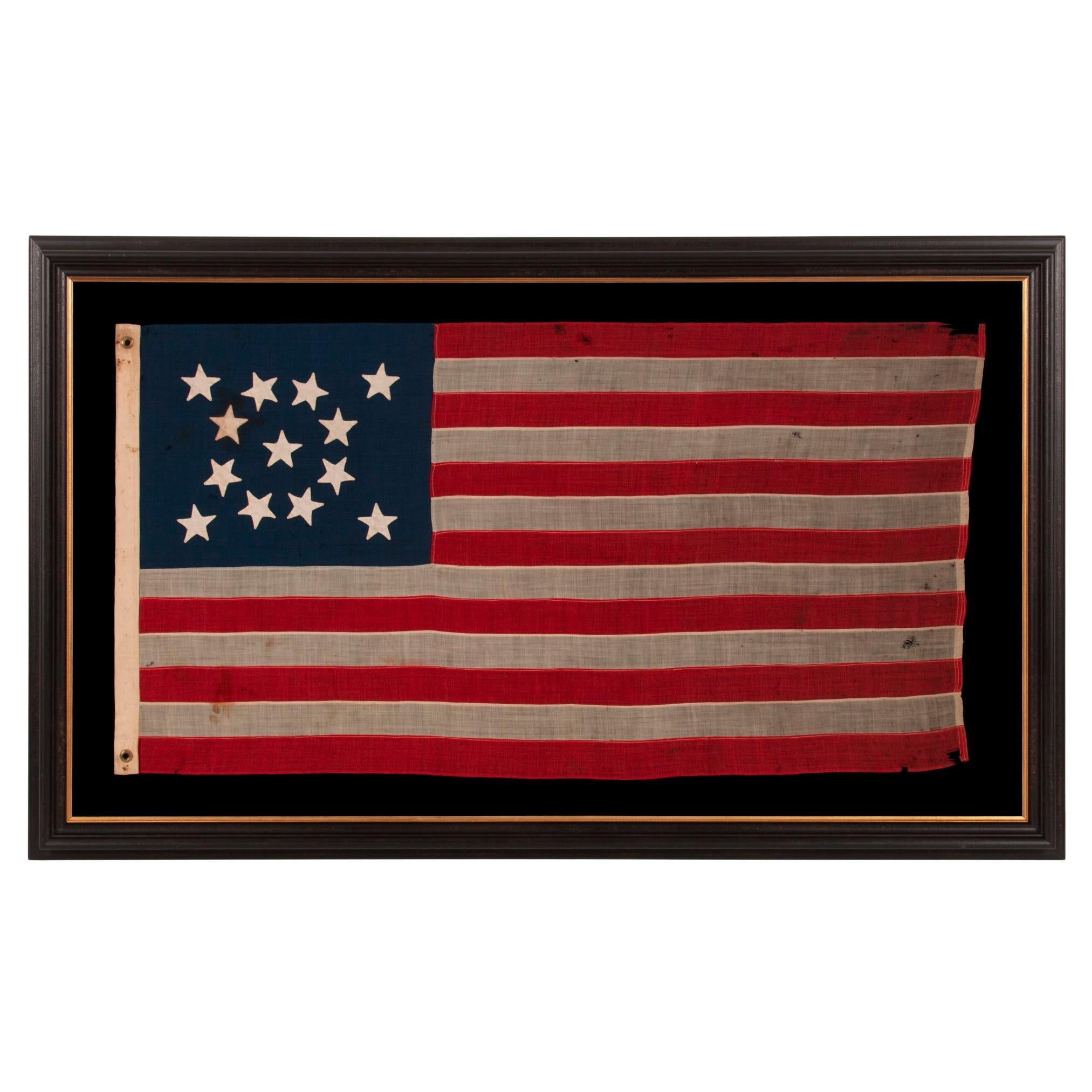
13 Star Antique American Flag , Hand-Sewn Stars in a Medallion, 1876 Centennial
Located in York County, PA
13 STAR ANTIQUE AMERICAN FLAG WITH A MEDALLION CONFIGURATION OF HAND-SEWN STARS AND A BEAUTIFUL, ELONGATED PROFILE, MADE IN THE ERA OF THE 1876 CENTENNIAL OF AMERICAN INDEPENDENCE, I...
Category
Antique 1870s Political and Patriotic Memorabilia
Materials
Wool
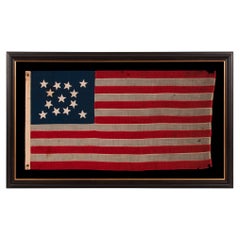
26 Star Antique American Flag, with 11 Stripes, Michigan Statehood, ca 1837-1846
Located in York County, PA
26 STAR ANTIQUE AMERICAN PARADE FLAG WITH 11 STRIPES AND IT’S CANTON RESTING ON THE “WAR STRIPE.” THE EARLIEST KNOWN STAR COUNT FOR PRINTED EXAMPLES, 1837-1846, MICHIGAN STATEHOOD
2...
Category
Antique Mid-19th Century American Political and Patriotic Memorabilia
Materials
Cotton
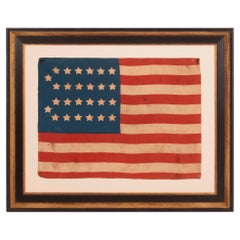
You May Also Like
31-Star Printed American Flag, Celebrating California Statehood, Circa 1850
Located in Colorado Springs, CO
This is a rare 31-star medallion printed American flag, celebrating the addition of California to the Union. The flag is printed on silk and has a spectacular “Great Star” canton pat...
Category
Antique 1850s American Political and Patriotic Memorabilia
Materials
Silk
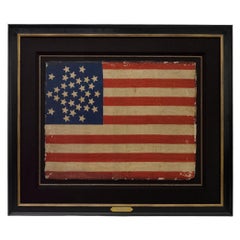
44-Star Silk American Flag, Celebrating Wyoming Statehood, Circa 1890-1896
Located in Colorado Springs, CO
Presented is a 44-star silk American flag, commemorating Wyoming statehood. The flag dates to 1890-1896. The flag has an “8-7-7-7-7-8” star configuration, with the stars whimsically ...
Category
Antique 1890s American Political and Patriotic Memorabilia
Materials
Silk
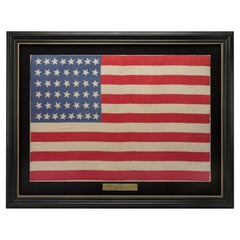
13-Star Wool American Flag, with Zig-Zag Stars, Circa 1900
Located in Colorado Springs, CO
This is a beautiful 13-star American flag, each star sewn with zig-zag stitching. The wool flag was sewn at the turn of the century, circa 1900. The flag features 13 white stars rest...
Category
Antique Early 1900s American American Classical Political and Patriotic ...
Materials
Brass
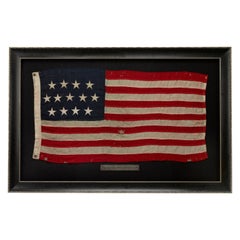
38-Star American Parade Flag, Flown at a Reception for President Grant, 1880
Located in Colorado Springs, CO
This is a beautifully colored 38-star American parade flag, flown at a public reception for Ulysses S. Grant in October of 1880. This printed flag features a rare, triple medallion s...
Category
Antique 1880s American Political and Patriotic Memorabilia
Materials
Cotton
42-Star American Parade Flag, Commemorating Washington Statehood, 1889
Located in Colorado Springs, CO
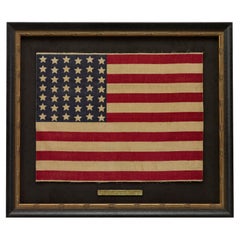
This is an uncommon 42-star flag, commemorating the addition of the state of Washington to the Union. The flag dates to 1889-1890, and is printed on cotton. The canton consists of s...
Category
Antique 1880s American Political and Patriotic Memorabilia
Materials
Cotton
39-Star Printed American Flag, Commemorating North Dakota Statehood, 1889-1890
Located in Colorado Springs, CO
This is a 39-star unofficial American flag, celebrating North Dakota statehood. The printed flag dates to 1889 and showcases a “whimsical” star pattern in the canton. The flag's cant...
Category
Antique 1880s American Political and Patriotic Memorabilia
Materials
Fabric