Items Similar to 34 STAR AMERICAN FLAG, CIVIL WAR, 1861-63, KANSAS STATEHOOD, 2nd KY CAVALRY
Want more images or videos?
Request additional images or videos from the seller
1 of 10
34 STAR AMERICAN FLAG, CIVIL WAR, 1861-63, KANSAS STATEHOOD, 2nd KY CAVALRY
Price Upon Request
Price Upon Request
Price Upon Request
Price Upon Request
Price Upon Request
Price Upon Request
Price Upon Request
Price Upon Request
Price Upon Request
Price Upon Request
About the Item
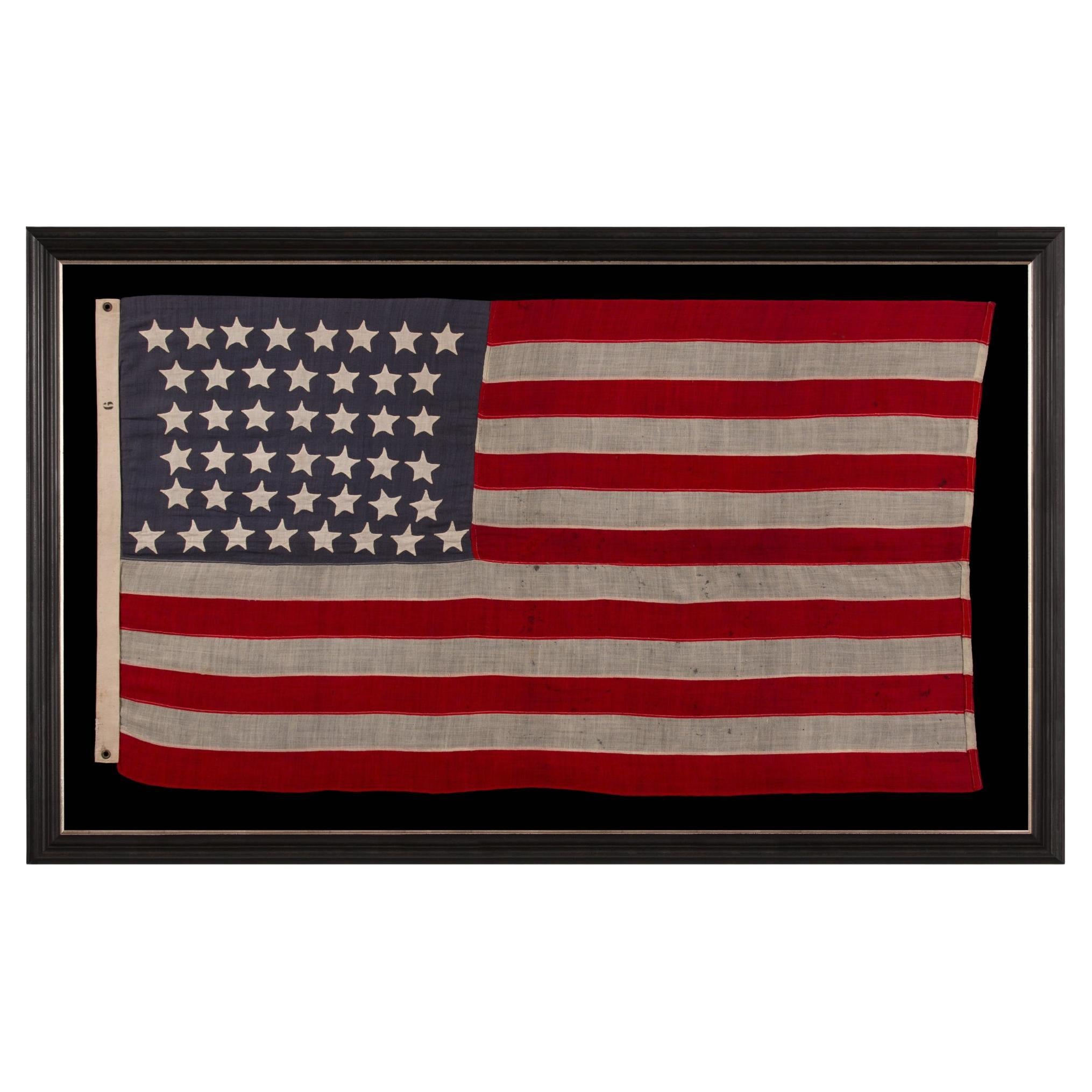
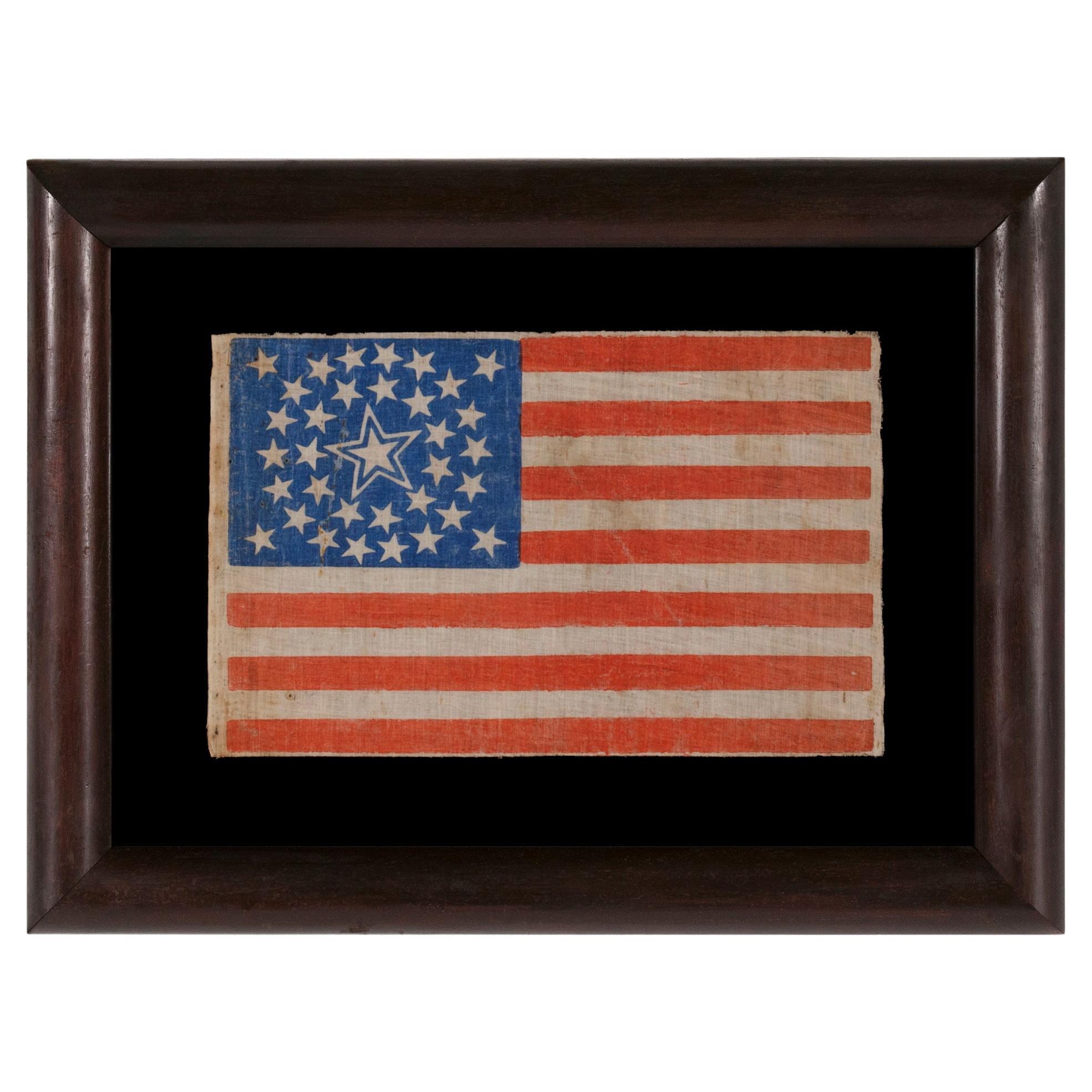
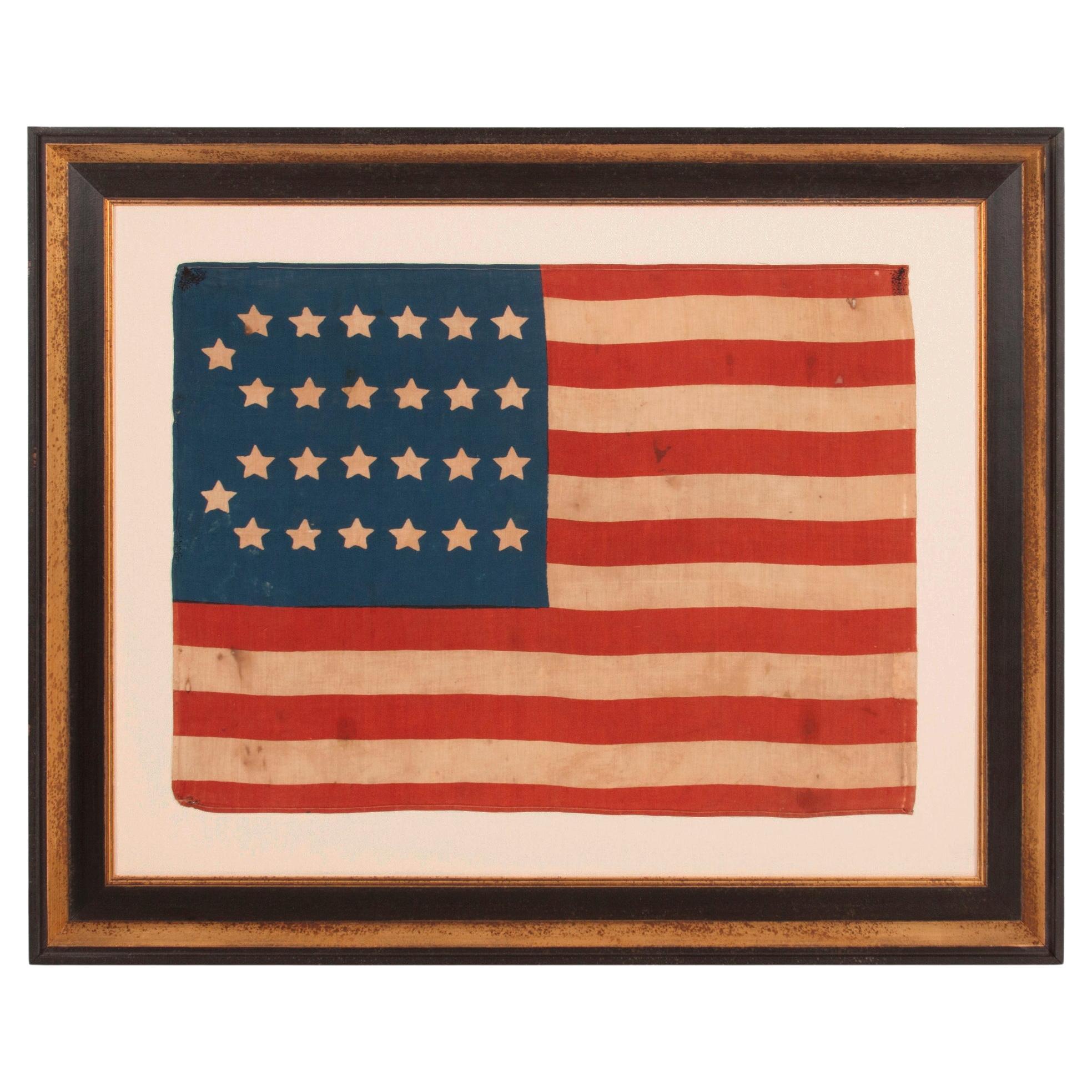
34 STAR ANTIQUE AMERICAN FLAG OF THE CIVIL WAR PERIOD (1861-63), IN A TINY SCALE AMONG PIECED-AND-SEWN FLAGS OF THE PERIOD, WITH A TRIPLE-WREATH CONFIGURATION, AN ELONGATED FORMAT, AND ENTIRELY HAND-SEWN; FOUND WITH A LETTER FROM JOHN W. RUDE OF THE 2ND KENTUCKY VETERAN VOLUNTEER CAVALRY (UNION):
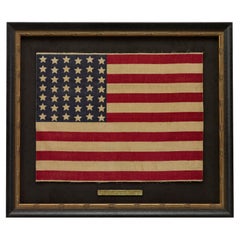
34 star flag of the Civil War period with a variety of extremely desirable features, handed down with a letter written by John W. Rude on November 8th, 1864, while encamped with the Army’s 1st Brigade, 3rd Division, as a member of the 2nd Regiment of Veteran Volunteer Cavalry. Tiny in scale among pieced and sewn examples, the flag displays a star pattern that consists of a three consecutive wreaths, with a single star in the very center. Because it lacks a single star in each corner, outside the basic pattern—usually present in flags of this design made during the mid-late 19th century—this is something I classify as a “snowball medallion.” Entirely hand-sewn throughout, note the square format of the blue canton, with its beautiful, circular star arrangement, and how interesting this combination is when paired with the elongated format of the flag itself. The stars are double-appliqued, meaning that they are applied to both sides. These are fat in shape and inconsistent in size. Note how the lowest star in the outermost ring actually dips into the white stripe below.
Made of plain weave cotton, there is a narrow binding along the hoist, red in color, with three sets of cotton ties. Those at the top and bottom are made of fine, braided hemp or hemp and cotton cord, stitched into place, while the one in the center, looped around the binding and tied, is made of lightweight, twisted, cotton thread. Note how the 5th, 6th, and 7th red stripes are pieced from two lengths of cotton fabric, which reflects that the maker was being conscious of conserving available fabric.
In the 19th century, most flags with pieced and sewn construction were 8 feet long and larger. A six-footer was considered small. Even military battle flags, carried on foot, measured 6’ x 6.5’, which translates into approximately 7’ x 7.5’ after framing, about the size of an average quilt and larger than can comfortably fit on a wall in a house with 8-foot ceilings and average width baseboard. Flags smaller than this exist, but the smaller they get, the more unusual they are. At just 1.5’ x 3’, this is about as small as one will ever encounter in a sewn flag of the Civil War era.
The flag appears to have likely been hand-carried. I expect that it probably saw military use of some sort as a camp flag, a flank marker / guidon, or perhaps as the personal flag of an officer. While cotton was a poor fabric for flag-making, because it absorbed water, it was nonetheless the fabric of choice for most makers of homemade flags. Silk was costly and likely not available in large supply. Wool bunting, used in most commercial flags produced for long-term, homemade use, was a commercial fabric and not widely available. There were clothing grade wools, but these were generally heavier, costlier, and probably less available in matching weights and weaves. Cotton was light, inexpensive, and generally available.
If the flag belonged to a Kentucky unit, it is even more likely to have been homemade than it would be if it originated in another state. This was a border state, with more limited access to railways, money, and goods in general, and regiments raised there would be less likely to have immediate access to government stores from military depots. Even so, many regiments, regardless of location, were presented with flags by local women when they went away to war. Although John Rude’s letter, penned to a girl he obviously desired to be with, named “Carrie,” is very descriptive of his unit and commanding officers, it is unclear as to just where and when he first enlisted, or what his rank and/or function was within the Union Army, or precisely where he was from. A thorough look into the name reveals that there may have been several possible spellings, typical in many surnames for various reasons. Sometimes port authorities outright misspelled names, as did U.S. Census agents and military officials. Sometimes the patriarch of a family, of his heirs, elected to start a new line, and sometimes it was deemed desirable to make a name less ethnically recognizable to thwart prejudice. Rude—a very difficult one—seems to have had a host of possible changes or misspellings within the tiny group of persons by that name in Kentucky, Ohio, and Pennsylvania, some of these being rather obvious and others not likely to be guessed. The letter would suggest that John W. Rude lived in the same town as Carrie, probably Mayfield, Kentucky, or very nearby. Tucked in a cover (small envelope) that it probably wasn’t mailed in, this was postmarked in Mayville (date not visible due to loss), addressed to Minerva Bayless of Mason County, Kentucky. The relationship between Bayless and Rude is not clear. The closest name in the 2nd Kentucky Cavalry (Union) belongs to a James Rute, but this individual passed in October of 1862 from “wounds received in a skirmish.” Because Mayville is located on the Ohio River, not far from Cincinnati, it may be that Rude did not enlist with the 2nd Kentucky initially. A man by this name, possibly with the last name misspelled as Rudel, mustered into the 9th Ohio Infantry on May 27th, 1861, and served as a “wagoner.” Wagoners were initially treated as soldiers, but in September of 1862, the Army changed its stance and no longer recognized wagon masters as regular army. This may be why Rude has no real record after his enlistment. Though he mustered in at Cincinnati, no residence was listed and there was no follow-up date or method of discharge.
Probably good with horses, it may be that at some point this John Rute’s status informally changed. The 2nd Kentucky Cavalry described by the soldier that wrote the letter was clearly not the initial representation of the unit. There actually appear to have been at least three regiments by this name. The one indicated by the writer, led by General Hugh Judson Kilpatrick, was raised at Bridgeport, Alabama on February 7th, 1864, and was one of the veteran organizations that accompanied Sherman on his famous “March to the Sea.” It mustered out at Lexington, North Carolina, on July 17th, 1865.
Although it is unclear how John Rude came to be in possession of this flag, it would appear that he most likely served throughout the entire war, and probably was gifted it at some point in his travels, perhaps for meritorious service 2 his regiment or a particular officer. It's an early war flag, and not something acquired late in the conflict, when the 2nd Kentucky Veteran Volunteer Cavalry (Union) was organized. It may be that John Rude was a brother of James Rute, Who passed in 1862 who passed in the fall of 1862, and that he became a part of the original 2nd Kentucky as a child, perhaps as a drummer boy or simply a tag along, adopted by the unit because he made himself useful. I think it likely that children sometimes entered regiments in this fashion, informally, and partook in actual skirmishes and battles as permitted by the commanding officer. This was probably more often true in border states like Kentucky and Missouri, or in the Deep South, in places where lines were more often blurred.
Whatever the case may be, this is a fantastic example of a sewn 34 star flag, with a beautiful configuration of stars, attractive proportions, hand-sewn, tiny, and of probable military use.
Kansas was admitted into the Union as the 34th state on January 29th, 1861, about two-and-a-half months before the Confederate assault on Fort Sumter that marked the beginning of the Civil War. The 34th star was officially added on July 4th of that year, but no one cared about official star counts and most flag makers would have added a 34th star previously, with the addition of Kansas in January. 34 star flags would have been produced until the addition of West Virginia in June of 1863, shortly before the Battle of Gettysburg. The 34 star count remained official until July 4th, 1863. Because production was heaviest during the war’s opening two years, 34 is the most common star count seen on Civil War flags.
Mounting: The flag was mounted and framed within our own conservation department, which is led by expert staff. We take great care in the mounting and preservation of flags and have framed thousands of examples.
The background is 100% cotton twill, black in color, that has been washed and treated for color fastness. The black-painted, hand-gilded and distressed molding is Italian. The glazing is U.V. protective acrylic.
Condition: There is minor overall golden brown oxidation of the white stripes and stars, accompanied by extremely minor to minor soiling in limited areas. There is minor wear in the bottom stripe, along the hoist end, as well as fabric loss in the lower grommet. Many of my clients prefer early flags to show their age and history of use.
- Dimensions:Height: 29.5 in (74.93 cm)Width: 49 in (124.46 cm)Depth: 2.5 in (6.35 cm)
- Materials and Techniques:
- Place of Origin:
- Period:
- Date of Manufacture:1861-1863
- Condition:Wear consistent with age and use. See condition report at the end of the description.
- Seller Location:York County, PA
- Reference Number:Seller: 34j-10201stDibs: LU849737247202
About the Seller
5.0
Recognized Seller
These prestigious sellers are industry leaders and represent the highest echelon for item quality and design.
Established in 1991
1stDibs seller since 2008
70 sales on 1stDibs
Typical response time: Several days
- ShippingRetrieving quote...Shipping from: York County, PA
- Return Policy
More From This Seller
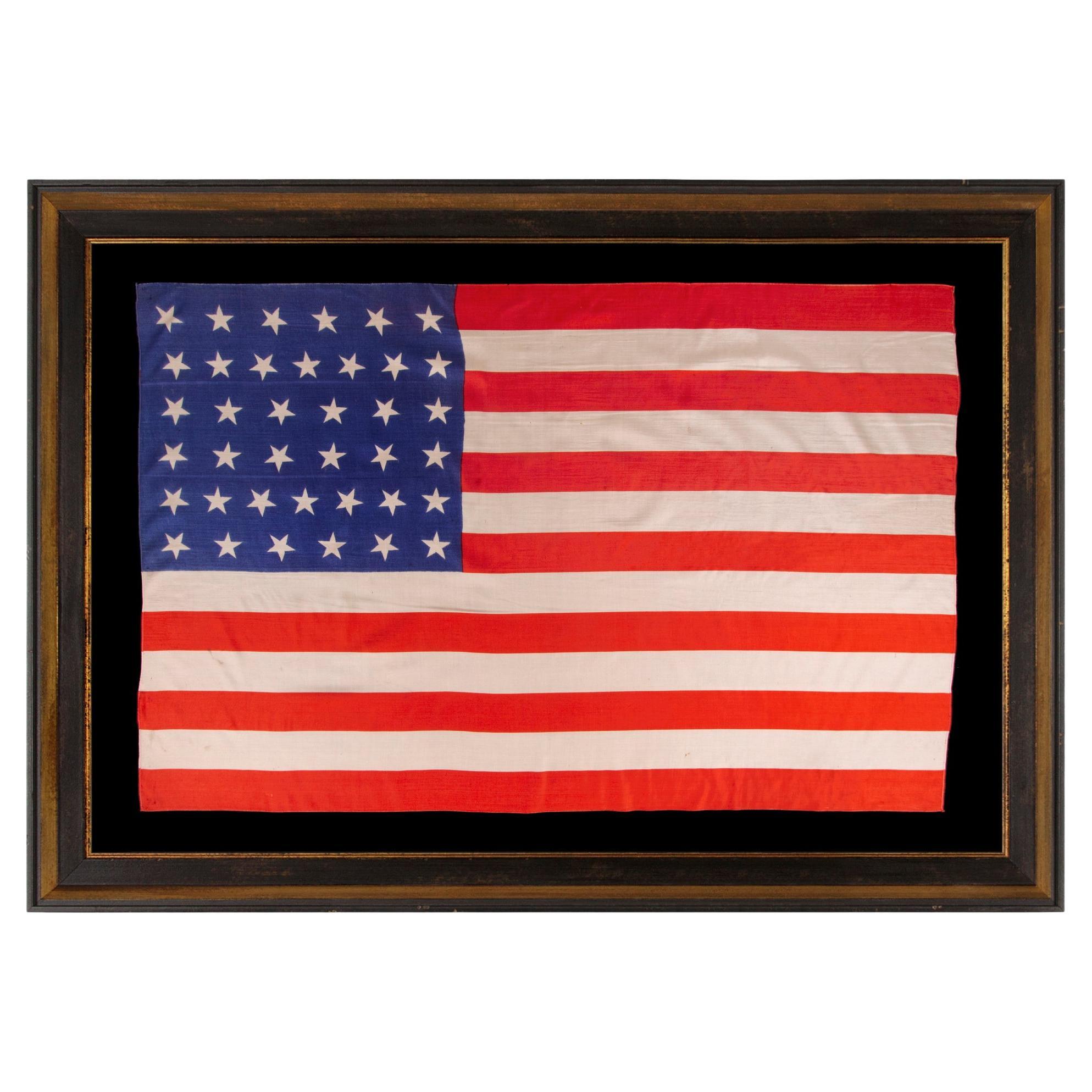
View All38 Star American Flag, Colorado Statehood, Made by Horstmann Brothers ca 1876
Located in York County, PA
38 STARS, COLORADO STATEHOOD, A SCARCE AND BEAUTIFUL ANTIQUE AMERICAN FLAG WITH A MEDALLION PATTERN AND 4 LARGE CORNER STARS, PRESS-DYED ON WOOL BUNTING, MADE BY HORSTMANN BROTHERS I...
Category
Antique Late 19th Century American Political and Patriotic Memorabilia
Materials
Wool
38 Star Antique American Flag, Colorado Statehood, circa 1876-1889
Located in York County, PA
38 star antique American parade flag with scattered star orientation, made of silk, with generous scale and vivid colors, Colorado Statehood, 1876-1889
38 star American national p...
Category
Antique Late 19th Century American Political and Patriotic Memorabilia
Materials
Silk
Price Upon Request
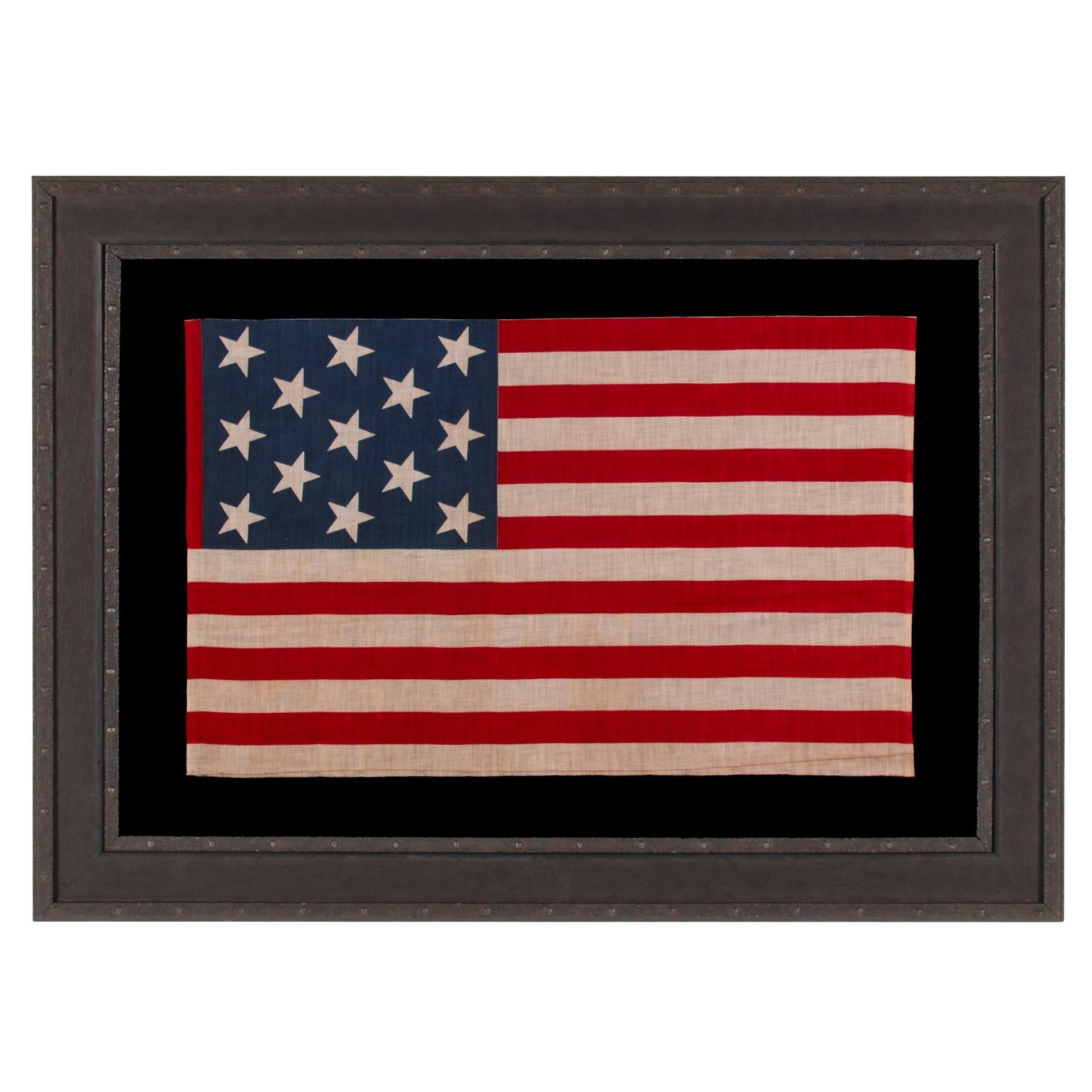
13 Star Antique American Parade Flag, ca 1876-1899
Located in York County, PA
13 STAR ANTIQUE AMERICAN PARADE FLAG, WITH A 3-2-3-2-3 CONFIGURATION OF STARS, AN EXTREMELY SCARCE AND UNUSUALLY LARGE VARIETY, MADE circa 1876-1899
13 star American national parade...
Category
Antique Late 19th Century Canadian Political and Patriotic Memorabilia
Materials
Cotton
Price Upon Request
44 Star Antique American Flag, Wyoming Statehood, ca 1890-1896
Located in York County, PA
44 STAR ANTIQUE AMERICAN FLAG WITH AN HOURGLASS ARRANGEMENT ON A DUSTY BLUE CANTON; REFLECTS THE ERA WHEN WYOMING WAS THE MOST RECENT STATE TO JOIN THE UNION, 1890-1896
Wyoming was ...
Category
Antique 1890s American Political and Patriotic Memorabilia
Materials
Wool
Price Upon Request
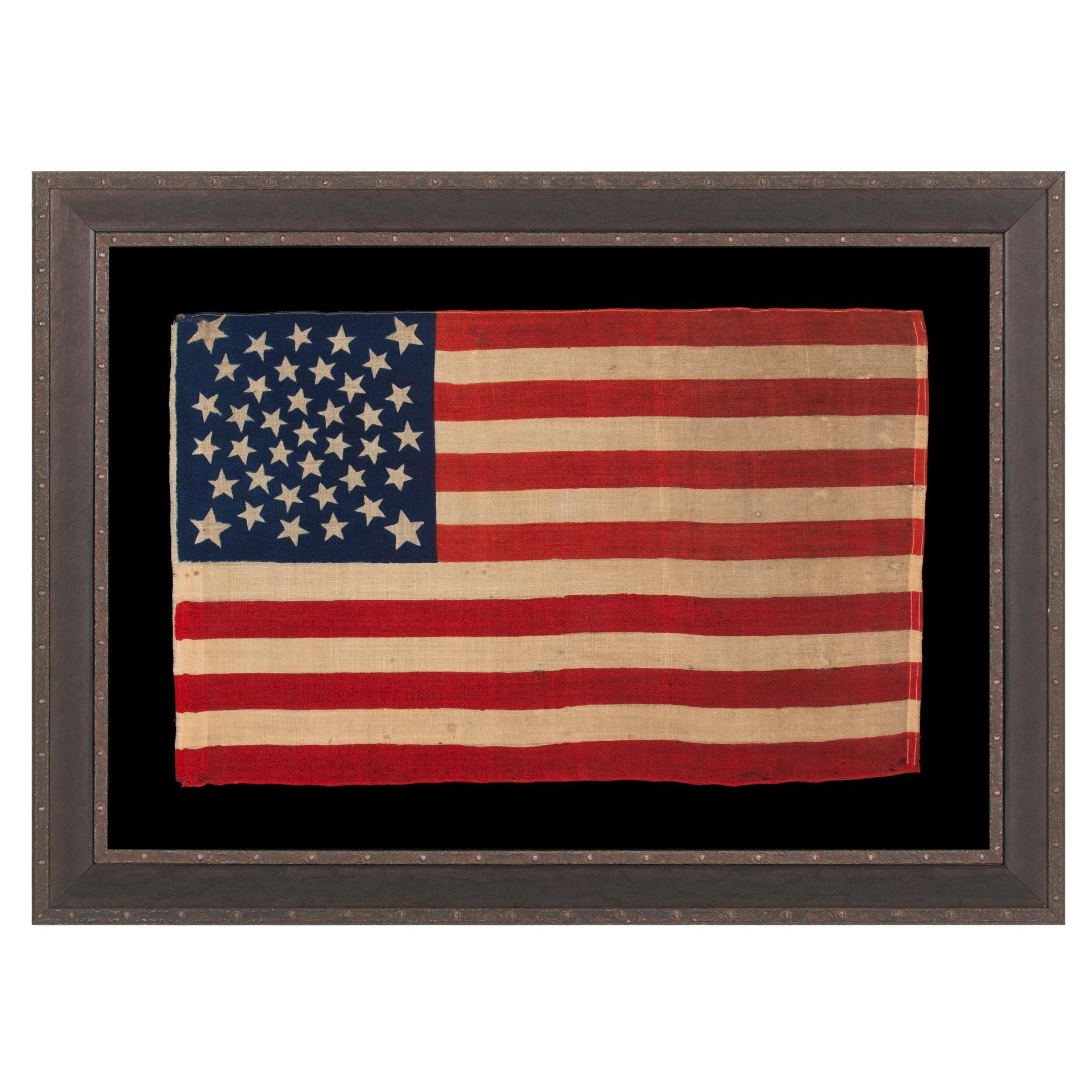
34 Star Antique American Parade Flag, Kansas Statehood, ca 1861-1863
Located in York County, PA
34 STARS IN A MEDALLION CONFIGURATION ON AN ANTIQUE AMERICAN PARADE FLAG WITH A LARGE, HALOED CENTER STAR; CIVIL WAR PERIOD, KANSAS STATEHOOD, 1861-1863
34 star American national pa...
Category
Antique 1860s American Political and Patriotic Memorabilia
Materials
Cotton
Price Upon Request
26 Star Antique American Flag, with 11 Stripes, Michigan Statehood, ca 1837-1846
Located in York County, PA
26 STAR ANTIQUE AMERICAN PARADE FLAG WITH 11 STRIPES AND IT’S CANTON RESTING ON THE “WAR STRIPE.” THE EARLIEST KNOWN STAR COUNT FOR PRINTED EXAMPLES, 1837-1846, MICHIGAN STATEHOOD
2...
Category
Antique Mid-19th Century American Political and Patriotic Memorabilia
Materials
Cotton
You May Also Like
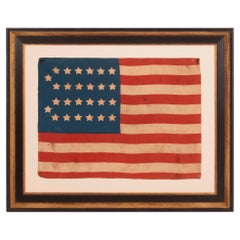
31-Star Printed American Flag, Celebrating California Statehood, Circa 1850
Located in Colorado Springs, CO
This is a rare 31-star medallion printed American flag, celebrating the addition of California to the Union. The flag is printed on silk and has a spectacular “Great Star” canton pat...
Category
Antique 1850s American Political and Patriotic Memorabilia
Materials
Silk
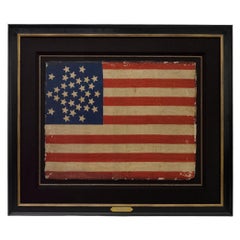
34-Star American Parade Flag, Commemorating Kansas Statehood, Circa 1861-1863
Located in Colorado Springs, CO
Offered is a spectacular 34-star American flag, produced during the Civil War. This flag features 34 printed white stars, on a blue wool blend canton. The stars are arranged in whims...
Category
Antique 1860s American American Classical Political and Patriotic Memora...
Materials
Brass
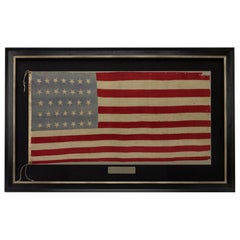
44-Star Silk American Flag, Celebrating Wyoming Statehood, Circa 1890-1896
Located in Colorado Springs, CO
Presented is a 44-star silk American flag, commemorating Wyoming statehood. The flag dates to 1890-1896. The flag has an “8-7-7-7-7-8” star configuration, with the stars whimsically ...
Category
Antique 1890s American Political and Patriotic Memorabilia
Materials
Silk
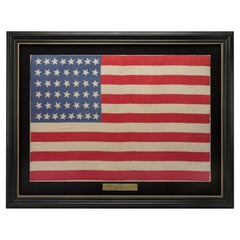
42-Star American Parade Flag, Commemorating Washington Statehood, 1889
Located in Colorado Springs, CO
This is an uncommon 42-star flag, commemorating the addition of the state of Washington to the Union. The flag dates to 1889-1890, and is printed on cotton. The canton consists of s...
Category
Antique 1880s American Political and Patriotic Memorabilia
Materials
Cotton
39-Star Printed American Flag, Commemorating North Dakota Statehood, 1889-1890
Located in Colorado Springs, CO
This is a 39-star unofficial American flag, celebrating North Dakota statehood. The printed flag dates to 1889 and showcases a “whimsical” star pattern in the canton. The flag's cant...
Category
Antique 1880s American Political and Patriotic Memorabilia
Materials
Fabric
36-Star American Printed Parade Flag, Circa 1865-1867
Located in Colorado Springs, CO
This is an antique 36-star American flag, as striking as it is scarce. The flag has a glazed cotton construction, with a blue canton printed with 36 white stars. The stars are arrang...
Category
Antique 1860s American Political and Patriotic Memorabilia
Materials
Cotton