Want more images or videos?
Request additional images or videos from the seller
1 of 6
34 Star Civil War Flag Made For Commodore Stephen Decatur
About the Item
34 star American national flag, handed down through the Decatur/Storer family, made in the period when Commodore Stephen Decatur (1815-1876) and Admiral George Washington Storer (1789-1864) were prominent, career naval officers.
A name, written in a dip pen along the hoist binding, reads "Mrs. A. P. Parsons". This would correspond to Stephen Decatur’s sister, Anna Pine Decatur, born 1812 in New Jersey. Anna married a man by the name of William H. Parsons in NY in 1854. It seems very likely that it is her name on the flag, which suggests that it belonged to Decatur. Admiral Storer retired from service in 1861, the opening year of the Civil War and the same year in which the 34th star was added, which also suggests Decatur provenance. Anna outlived all her siblings by approximately 20 years and died in 1896, which would explain how she came into possession of the flag, if she did not, in fact, produce it herself.
Stephen Decatur enlisted in the Navy in 1829. He achieved the rank of Commander in 1861, Captain in 1867, and Commodore in 1869. He was the namesake nephew of Commodore Stephen Decatur, Jr. (1779-1820), one of the most memorable figures in American Naval history. The elder Decatur is most remembered for his expedition into the harbor of Tripoli for the purpose of burning the captured U.S. frigate “Philadelphia” in the 1st Barbery Wars (1804-05), an act which earned him a Captain’s commission and a sword of honor from Congress. In the War of 1812, he captained the “United States” and gained further recognition for capturing the H.M.S. “Macedonian”. And in 1815, he launched a successful attack on the corsairs of Algiers, Tunis, and Tripoli in the Mediterranean Sea, at which time he captured the captain of the Barbary pirates, an act which brought about the end of the 2nd Barbary War with America. Andrew Jackson referred to this last act as the most recklessly daring of any so far attempted by an American Naval officer.
Note how the stars are laid out in an unusually haphazard arrangement. While the configuration may have been set forth column-by-column, it is puzzling to speculate why the maker didn’t decide to line up the first 6 groups of 5 stars both horizontally and vertically into a rectilinear pattern. Even if he/she had done so, the 4 remaining stars in what would have comprised the last column is significantly off-center. Whatever the reason may have been, ill light or poor skill, the result is at the same time peculiar and whimsical, with drunken paths of stars meandering across the navy blue canton. When combined with the fact that the stars point in various directions on their vertical axis, these features lend a nice folk quality to the flag's design.
Construction: The canton is pieced from two lengths of blue wool bunting that have been joined with treadle stitching. The red and white stripes are also made of wool bunting and are pieced in the same manner. The wool has an especially early appearance because its strands vary in width and the weave is atypically loose compared to that which is often seen in flags of the Civil War period. The stars are made of cotton and are double-appliquéd, meaning that they are sewn to both sides of the canton. These are appliquéd with treadle stitching and in a pattern that crisscrosses the body of each star. Treadle-sewn stars are unusual in this period. The sewing machine had been mass-marketed by Singer in 1855 and by the outbreak of the Civil War, just 6 years later, was used in the piecing of most stripes on American flags. But seamstresses still found it easier to hand-sew stars, not yet having mastered the skill of turning the fabric to appliqué them to the canton while pumping the treadle mechanism. There is a cotton header with two hand-sewn, whip-stitched grommets for hoisting. While all of these traits would typically suggest that the flag was made in a cottage industry setting, the Decatur family's long naval history would provide easy access to such things as wool bunting and grommets that were not otherwise readily available for private consumption.
Kansas was admitted into the Union as the 34th state on January 29th, 1861, about 2½ months before the Confederate assault on Fort Sumter that marked the beginning of the Civil War. The 34th star was officially added on July 4th of that year, but most flag makers would have added a 34th star with the addition of Kansas in January. The star count remained official until July 4th, 1863, and 34 star flags would have been produced until the addition of West Virginia in June of that year.
Mounting: The flag was hand-stitched to 100% silk organza for support on every seam and throughout the star field. It was then hand-stitched to 100% cotton twill, black in color, which was washed to reduce excess dye. An acid-free agent was added to the wash to further set the dye and the fabric was heat-treated for the same purpose. The mount was placed in a black-painted, hand-gilded and distressed Italian molding. The front is U.V. protective acrylic.
- Place of Origin:
- Period:
- Date of Manufacture:1861-1863
- Condition:See Item Description.
- Seller Location:York County, PA
- Reference Number:Seller: 34j-9191stDibs: U1203018497542
About the Seller
5.0
Recognized Seller
These prestigious sellers are industry leaders and represent the highest echelon for item quality and design.
Established in 1991
1stDibs seller since 2008
71 sales on 1stDibs
Typical response time: Several days
Authenticity Guarantee
In the unlikely event there’s an issue with an item’s authenticity, contact us within 1 year for a full refund. DetailsMoney-Back Guarantee
If your item is not as described, is damaged in transit, or does not arrive, contact us within 7 days for a full refund. Details24-Hour Cancellation
You have a 24-hour grace period in which to reconsider your purchase, with no questions asked.Vetted Professional Sellers
Our world-class sellers must adhere to strict standards for service and quality, maintaining the integrity of our listings.Price-Match Guarantee
If you find that a seller listed the same item for a lower price elsewhere, we’ll match it.Trusted Global Delivery
Our best-in-class carrier network provides specialized shipping options worldwide, including custom delivery.You May Also Like
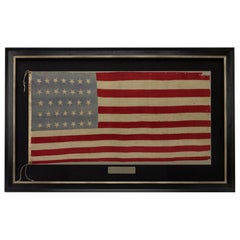
34-Star American Parade Flag, Commemorating Kansas Statehood, Circa 1861-1863
Located in Colorado Springs, CO
Offered is a spectacular 34-star American flag, produced during the Civil War. This flag features 34 printed white stars, on a blue wool blend canton. The stars are arranged in whims...
Category
Antique 1860s American American Classical Political and Patriotic Memora...
Materials
Brass
$32,500
H 37 in W 59 in D 1.75 in
13-Star Flag Waver for the Centennial Celebration
Located in Colorado Springs, CO
This small charming 13-star flag waver was made for and sold during the nation’s Centennial celebration in Philadelphia in 1876. All manner of flags were made for the official Centen...
Category
Antique 1870s American American Classical Political and Patriotic Memora...
Materials
Fabric
Large 48 Star Embroidered Flag Pillow
By American Flag
Banner Co.
Located in Los Angeles, CA
This monumental 48 star flag pillow is in great in great condition and has a red cotton linen pillow. The big pillow id down and feather fill.
Category
Mid-20th Century American Country Political and Patriotic Memorabilia
Materials
Cotton
38-Star American Parade Flag, Flown at a Reception for President Grant, 1880
Located in Colorado Springs, CO
This is a beautifully colored 38-star American parade flag, flown at a public reception for Ulysses S. Grant in October of 1880. This printed flag features a rare, triple medallion s...
Category
Antique 1880s American Political and Patriotic Memorabilia
Materials
Cotton
$15,500
H 19.5 in W 24 in D 1.25 in
Early 20thc 48 Star Flag Hand Crochet Pillow
Located in Los Angeles, CA
This fine hand crochet 48 star flag pillow is made with a blue velvet background or frame front and back.The insert is down & feather fill.
Category
Early 20th Century American Adirondack Pillows and Throws
Materials
Wool
42-Star American Parade Flag, Commemorating Washington Statehood, 1889
Located in Colorado Springs, CO
This is an uncommon 42-star flag, commemorating the addition of the state of Washington to the Union. The flag dates to 1889-1890, and is printed on cotton. The canton consists of s...
Category
Antique 1880s American Political and Patriotic Memorabilia
Materials
Cotton
$5,850
H 28.38 in W 32.88 in D 2 in
36-Star American Printed Parade Flag, Circa 1865-1867
Located in Colorado Springs, CO
This is an antique 36-star American flag, as striking as it is scarce. The flag has a glazed cotton construction, with a blue canton printed with 36 white stars. The stars are arrang...
Category
Antique 1860s American Political and Patriotic Memorabilia
Materials
Cotton
19th Century American 42 Star Flag, circa 1889
Located in Nantucket, MA
19th Century American 42 Star Flag, circa 1889, printed on linen period flag in the "Dancing Star" pattern. This was never an official U.S. flag sanctioned b y congress, but was made...
Category
Antique 1880s American Federal Political and Patriotic Memorabilia
Materials
Linen
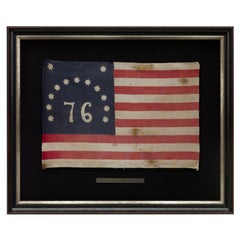
13-Star Bennington "76" Parade Flag, Early 20th Century
Located in Colorado Springs, CO
Presented here is a striking 20th century 13-star Bennington “76” style parade flag, modeled after the historic example preserved at the Bennington Museum in Vermont. This commemorat...
Category
Early 20th Century American American Colonial Political and Patriotic Me...
Materials
Fabric
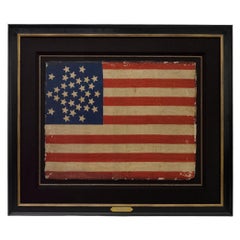
31-Star Printed American Flag, Celebrating California Statehood, Circa 1850
Located in Colorado Springs, CO
This is a rare 31-star medallion printed American flag, celebrating the addition of California to the Union. The flag is printed on silk and has a spectacular “Great Star” canton pat...
Category
Antique 1850s American Political and Patriotic Memorabilia
Materials
Silk
$38,500
H 43 in W 50.5 in D 2.5 in
More From This Seller
View All34 STAR AMERICAN FLAG, CIVIL WAR, 1861-63, KANSAS STATEHOOD, 2nd KY CAVALRY
Located in York County, PA
34 STAR ANTIQUE AMERICAN FLAG OF THE CIVIL WAR PERIOD (1861-63), IN A TINY SCALE AMONG PIECED-AND-SEWN FLAGS OF THE PERIOD, WITH A TRIPLE-WREATH CONFIGURATION, AN ELONGATED FORMAT, AND ENTIRELY HAND-SEWN; FOUND WITH A LETTER FROM JOHN W. RUDE OF THE 2ND KENTUCKY VETERAN VOLUNTEER CAVALRY (UNION):
34 star flag of the Civil War period with a variety of extremely desirable features, handed down with a letter written by John W. Rude on November 8th, 1864, while encamped with the Army’s 1st Brigade, 3rd Division, as a member of the 2nd Regiment of Veteran Volunteer Cavalry. Tiny in scale among pieced and sewn examples, the flag displays a star pattern that consists of a three consecutive wreaths, with a single star in the very center. Because it lacks a single star in each corner, outside the basic pattern—usually present in flags of this design made during the mid-late 19th century—this is something I classify as a “snowball medallion.” Entirely hand-sewn throughout, note the square format of the blue canton, with its beautiful, circular star arrangement, and how interesting this combination is when paired with the elongated format of the flag itself. The stars are double-appliqued, meaning that they are applied to both sides. These are fat in shape and inconsistent in size. Note how the lowest star in the outermost ring actually dips into the white stripe below.
Made of plain weave cotton, there is a narrow binding along the hoist, red in color, with three sets of cotton ties. Those at the top and bottom are made of fine, braided hemp or hemp and cotton cord, stitched into place, while the one in the center, looped around the binding and tied, is made of lightweight, twisted, cotton thread. Note how the 5th, 6th, and 7th red stripes are pieced from two lengths of cotton fabric, which reflects that the maker was being conscious of conserving available fabric.
In the 19th century, most flags with pieced and sewn construction were 8 feet long and larger. A six-footer was considered small. Even military battle flags, carried on foot, measured 6’ x 6.5’, which translates into approximately 7’ x 7.5’ after framing, about the size of an average quilt and larger than can comfortably fit on a wall in a house with 8-foot ceilings and average width baseboard. Flags smaller than this exist, but the smaller they get, the more unusual they are. At just 1.5’ x 3’, this is about as small as one will ever encounter in a sewn flag of the Civil War era.
The flag appears to have likely been hand-carried. I expect that it probably saw military use of some sort as a camp flag...
Category
Antique 1860s American Political and Patriotic Memorabilia
Materials
Cotton
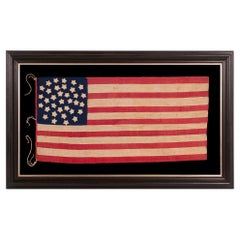
Ohio State Parade Flag with a Civil War Veterans Overprint
Located in York County, PA
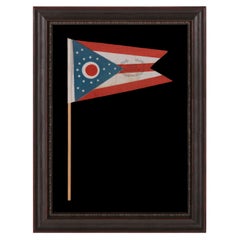
OHIO STATE FLAG WITH CIVIL WAR VETERANS' OVERPRINT FROM THE GRAND ARMY OF THE REPUBLIC POST IN COLUMBUS, MADE IN MOURNING OF THE 1925 PASSING OF NATIONAL G.A.R. COMMANDER IN CHIEF DANIEL M. HALL, WHO ALSO SERVED AS COMMANDER OF THE OHIO DEPARTMENT OF THE G.A.R., AS WELL AS THE LOCAL CHAPTER
Flag of the State of Ohio, printed on oilcloth-like cotton, affixed to its original wooden staff. Made for Civil War veteran's use, the flag bears a stamped overprint in the striped field that consists of an open wreath of laurel branches, inside which is the following text: “GAR [Grand Army of the Republic] Post, Dan Hall, Columbus, OH”.
Born on October 20th, 1842, Daniel M. Hall enlisted with the Union Army as a Private at the age of 18 on August 25th, 1861. On October 8th of that year he mustered into the Co. H of the 2nd Ohio Cavalry. Discharged for disability on June 28th, 1862, he reenlisted approximately 17 months later, on November 11th, 1863, and mustered into Co. F of the 12th Ohio Cavalry at Camp Cleveland. He was at some point promoted to the rank of Sergeant, and, on February 21st, 1864, to the rank of Corporal. He mustered out at Nashville on November 14th, 1865.
Hall mustered into the Hamlin Post of the Ohio G.A.R. on May 23rd, 1883. He would go on to serve not only as Commander of the Dept. of Ohio for the organization, but as National Commander of the entire Grand Army of the Republic.
The Grand Army of the Republic was the primary veterans association for Union Civil War soldiers. Founded in 1866, its members dressed up in Civil War uniforms, attended parades and reunions, and the organization was somewhat more fraternal in nature than today’s VFW or American Foreign Legion.
Flags overprinted for the purpose of advertising are a specialized form in American flag collecting. A flag with a basic G.A.R. overprint is the most common type. This might be accompanied by a post number and a date. More elaborate the overprints are more highly desired, such as this one, which is the only variation I know of that honors a particular person who was not the namesake of the chapter itself.
It is of interest to note that a sister variety of 48 star parade flag is known, printed on the same fabric, that bears the same overprint, accompanied by the words: “We Mourn Our Comrade." From the additional text on the 48 star variety, one can extrapolate that the flags were made to mourn the passing of this important leader of Civil War veterans on October 19th, 1925, just one day before his 83rd birthday.
The State Flag of Ohio was designed in 1901 by Cleveland architect John Eisenmann, who designed the Ohio building for the state's exhibition at the Pan American Exposition World's Fair in Buffalo, New York. It was officially adopted by the Ohio legislature on May 19th, 1902. It's elements are centered on a red disc, set against a circular white ground that forms a letter "O." This simultaneously represents a buckeye, the fruit of the state tree and an iconic Ohio symbol. The flag's 5 stripes are said to represent the state's waterways and roads, while the triangular shape of the union is said to illustrate hills and valleys. The presentation of 13 stars along the hoist end, arranged in a semi-circular medallion with two off-set stars above and below, reflects the original 13 colonies. The diamond of stars, towards the fly end. bring the overall count to 17 to reflect Ohio's admission. When the design was adopted by the state legislature, the position of these stars was changed slightly, moving them further around the circle to form a wreath.
Flag expert Whitney Smith, who coined the term Vexillology in the late 1950's (the accepted term for the study of flags), pointed out that the format of the flag itself was reminiscent of Civil War cavalry guidons, carried by Ohio regiments throughout the state. These were of swallowtail form, though with 13 stripes, all horizontal and 90 degrees to the hoist. Most often these had circular star patterns around an open center, which makes them even more similar to the Ohio flag...
Category
Vintage 1920s American Political and Patriotic Memorabilia
Materials
Cotton
Rare 13 Star Civil War Flag in the Trumbull Pattern w/ 36 Stars on the Reverse
Located in York County, PA
EXTRAORDINARY CIVIL WAR ERA FLAG, WITH 13 HAND-SEWN STARS ARRANGED IN A VARIANT OF WHAT IS KNOWN AS THE TRUMBULL PATTERN, FEATURING A HUGE, UPSIDE-DOWN CENTER STAR, AND THE EXTREMELY...
Category
Antique Mid-19th Century American Political and Patriotic Memorabilia
Materials
Cotton
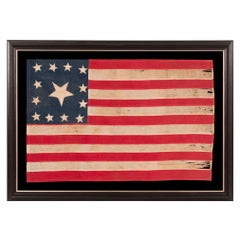
34 Stars in an Outstanding Oval Medallion Configuration, Civil War Period
Located in York County, PA
34 STARS IN AN OUTSTANDING OVAL MEDALLION CONFIGURATION, ON A NARROW CANTON THAT RESTS ON THE 6TH STRIPE, ON A HOMEMADE, ANTIQUE AMERICAN FLAG OF THE CIVIL WAR PERIOD, ENTIRELY HAND-...
Category
Antique 1860s American Political and Patriotic Memorabilia
Materials
Cotton
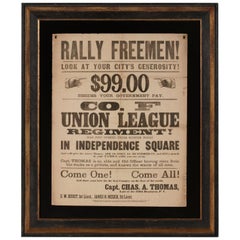
"Rally Freemen!..." Civil War Recruitment Broadside
Located in York County, PA
"RALLY FREEMEN! …COME ONE! COME ALL! AND SHOW YOUR LOVE FOR THE BEST COUNTRY ON THE FACE OF THE EARTH." A CIVIL WAR RECRUITMENT BROADSIDE FOR THE...
Category
Antique 1860s American Political and Patriotic Memorabilia
Materials
Paper
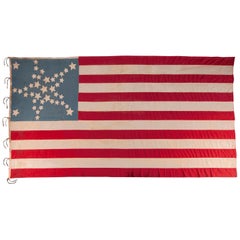
34 Star American flag, Updated to 39 Stars, with Stars in a Great Star Pattern
Located in York County, PA
34 STARS IN A WHIMSICAL RENDITION OF THE GREAT STAR PATTERN, ON A CIVIL WAR PERIOD FLAG WITH A CORNFLOWER BLUE CANTON, UPDATED TO 39 STARS IN 1876
34 star American national flag with additional stars added and one of the most stunning graphic designs I have ever seen in early flag-making. The original pattern was comprised of a circle of 5 large stars, and triangular arms made of smaller stars. These are noticeable pointy and bent like the arms of a starfish. Made of cotton, the stars are hand-sewn and double-appliquéd to a fantastic, cornflower blue canton, a color common to Civil War uniforms...
Category
Antique 1870s American Political and Patriotic Memorabilia
Materials
Cotton
Price Upon Request
Free Shipping