Want more images or videos?
Request additional images or videos from the seller
1 of 7
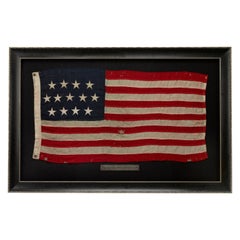
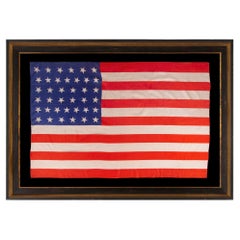
36-Star Printed American Flag, Rare Haloed Star Medallion, Circa 1865
$15,500List Price
About the Item
- Dimensions:Height: 43.5 in (110.49 cm)Width: 57 in (144.78 cm)Depth: 1.75 in (4.45 cm)
- Materials and Techniques:
- Place of Origin:
- Period:
- Date of Manufacture:1865
- Condition:Wear consistent with age and use.
- Seller Location:Colorado Springs, CO
- Reference Number:Seller: F4471stDibs: LU909737660782
About the Seller
4.9
Platinum Seller
Premium sellers with a 4.7+ rating and 24-hour response times
Established in 2010
1stDibs seller since 2011
474 sales on 1stDibs
Typical response time: 2 hours
Authenticity Guarantee
In the unlikely event there’s an issue with an item’s authenticity, contact us within 1 year for a full refund. DetailsMoney-Back Guarantee
If your item is not as described, is damaged in transit, or does not arrive, contact us within 7 days for a full refund. Details24-Hour Cancellation
You have a 24-hour grace period in which to reconsider your purchase, with no questions asked.Vetted Professional Sellers
Our world-class sellers must adhere to strict standards for service and quality, maintaining the integrity of our listings.Price-Match Guarantee
If you find that a seller listed the same item for a lower price elsewhere, we’ll match it.Trusted Global Delivery
Our best-in-class carrier network provides specialized shipping options worldwide, including custom delivery.You May Also Like
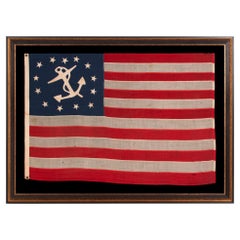
Outstanding 13 Star Hand-sewn American Private Yacht Flag, ca 1865-1885
Located in York County, PA
OUTSTANDING, 13 STAR, ANTIQUE AMERICAN PRIVATE YACHT ENSIGN WITH GREAT FOLK QUALITIES THAT INCLUDE AN UNUSUALLY WIDE ANCHOR AND A DECIDEDLY LOPSIDED RING OF 13 STARS; MADE DURING THE 2ND HALF OF THE 19TH CENTURY; ITS DEVICE HAND-SEWN AND SINGLE-APPLIQUÉD
Private yacht ensigns were approved American signals for maritime use that allowed pleasure boats to bypass customs. Though the legislation that approved them was adopted prior to 1850, almost all such flags that one will encounter were sewn by electric machine and made during the 20th century. The unusual gems among surviving examples are those that are earlier and include hand-sewn elements. Even more rare are a select few with atypical graphics. Barely any fall into both of these categories at once. Take note of the anchor on this particular flag, wide a long horizontal crossbar (stock) that contributes to uncommonly wide stance. Set within a ring of stars that is decidedly lopsided, the result is as bold as it is endearingly whimsical—two of the best qualities in American folk art, a category in which this particular example can be filed. While I have owned 13 star private yacht flags that have displayed star and canted anchor devices that were somewhat larger and/or bolder than typical, I cannot recall any that were so graphically intriguing as this one.
Brief History of Private Yacht Ensigns:
The medallion configuration, 13-star, 13-stripe flag, with a canted center anchor was entered into official use in 1848, following an act of Congress, that made it the official signal for U.S. pleasure sailing vessels. The need for such a flag arose with the popularity of boating as a pastime for well-to-do Americans, and as a competitive sport, in addition to its longstanding utilitarian role as a vehicle of trade. In early America, all boats were subject to customs searches at every port. Without modern income tax, the federal government derived its revenues mostly from tariffs, so an accounting of foreign goods on ships was a critical venture. As yachting for pleasure became more prevalent, however, more and more time was spent searching boats that had no such inventory, wasting time for both customs officials and wealthy ship owners.
John Cox Stevens, a former president of the Jockey Club and future founder of the Union League Club, became the New York Yacht Club’s Commodore upon its founding in 1845. In 1847 he approached the secretary of the treasury and suggested that something be done to streamline the customs process for non-trade vessels. In 1848, legislation passed Congress requiring registration of these boats, which could then fly the “American Yachting Signal” to bypass customs. This remained on the books until the 1980’s, when the 1848 legislation was revoked, but the use of flags in this design for decorative function continues to this day.
13 star flags have been flown throughout our nation’s history for a variety of purposes. In addition to their use on private yachts, they were hoisted at patriotic events, including Lafayette’s final visit in 1824-25, the celebration of the nation’s centennial in 1876, and the sesquicentennial in 1926. They were displayed during the Civil War, to reference past struggles for American liberty and victory over oppression, and were used by 19th century politicians while campaigning for the same reason. The U.S. Navy used the 13 star count on small boats until 1916, because it was easier to discern fewer stars at a distance on a small flag. Commercial flag-makers mirrored this practice and some private ships flew 13 star flags during the same period as the Navy.
Construction: The stars and anchor are made of cotton, hand-sewn, and single-appliquéd. This means that they were applied to one side of the canton, then the blue fabric was cut from behind each star, folded over, and under-hemmed, so that one star could be viewed on both sides of the flag. I always find single-appliquéd stars more interesting, not only because they are evidence of a more difficult level of seam-work and stitching, but also because they are more visually intriguing. The two visible rows of hand-stitching emphasize their hand-sewn construction. For these reasons, single-appliquéd stars often appeal to connoisseurs of early American textiles...
Category
Antique Mid-19th Century American Political and Patriotic Memorabilia
Materials
Wool
Price Upon Request
H 58.25 in W 78.5 in D 2.5 in
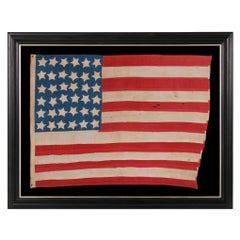
36 Star Antique American Flag, Cornflower blue Canton, circa 1864-1867, Nevada
Located in York County, PA
Antique American Flag With 36 Stars On A Cornflower Blue Canton, Civil War Era, 1864-1867, Reflects The Addition Of Nevada As The 36th State; A Great Folk Exaple With Haphazard Rows Of Starfish-like Stars:
36 star American national flag of the Civil War era with outstanding collector traits. Haphazard rows of fat, starfish-shaped stars fill most of the confines of a brilliant, cornflower blue canton. Note the crude piecing of the thirteen, red and white stripes, joined in an ill-planned manner that results in great variation in width, as well as general irregularity. The 4th red stripe actually falls slightly below the canton, and the height of each does not line up with the corresponding stripe on the reverse. This can clearly be seen at the fly end, which is is turned back and bound to repair obvious extended use in an outdoor environment. Clearly the maker lacked experience in seam work. Lining up the necessary components, so that they could be viewed on both sides, presented a challenge they may have not previously faced. This is also evident in the sewing of the stars, which do not line up on the obverse and reverse sides, as they typically would in a flag sewn by an experienced flag-maker. That said, this is just this kind of homemade charm that fuels interest in early American flags...
Category
Antique 1860s American Political and Patriotic Memorabilia
Materials
Cotton
Price Upon Request
H 50.5 in W 65 in D 2.5 in
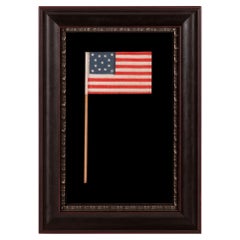
13 Star Medallion Patter Antique American Flag, ca 1910-1926
Located in York County, PA
13 STARS IN A MEDALLION PATTERN ON AN ANTIQUE AMERICAN PARADE FLAG MADE BETWEEN APPROXIMATELY 1910 AND THE 1926 SESQUICENTENNIAL OF AMERICAN INDEPENDENCE
13 star American national p...
Category
Early 20th Century American Political and Patriotic Memorabilia
Materials
Cotton
13 Star American Parade Flag with Rare Design, circa 1888 Ex Richard Pierce
Located in York County, PA
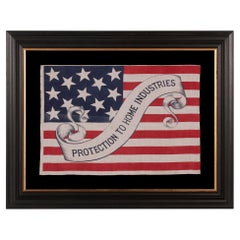
13 Star American parade flag in an extremely rare design, with “protection to home industries” slogan on a fanciful, scrolling streamer, made for the 1888 presidential campaign of Benjamin Harrison; formerly in the collection of Richard pierce.
1888 Benjamin Harrison campaign flag, printed on cotton, with 13 large stars in a 3-2-3-2-3 pattern, upon which a whimsical, scrolling streamer is superimposed that features the slogan: “Protection to Home Industries.”
There are numerous styles of both documented and undocumented, red, white, and blue bandanas and handkerchiefs, made for Harrison’s campaign in this year, as well as from the subsequent one, in 1892. Most bear variations of text to support the “Protection for American Industries” platform of the Republican Party. America was in the midst of the industrial age and there was a great deal of public interest, both in protecting growth and discouraging both imported goods and immigration. The constant stream of immigrants posed great challenges for a working families, competing for scarce jobs, in work environments that were already often far from ideal. In post-Civil War America, many of the working men were Civil War veterans.
Bandanas abound from Harrison’s Campaigns, but flags do not. This example, along with three others, were once part of an 1888 patriotic quilt that was disassembled by a dealer and sold piecemeal to collectors. I eventually acquired all four. Fifteen to twenty years ago, these were the only four known copies. A couple of others have since surfaced, but the total count known still stands closer to 5 than 10.
The use of 13 stars is seen in the flags of various candidates in the 19th century. Among these are Abraham Lincoln (1860 campaign), Henry Clay (1844 campaign), John Fremont (1856), and Benjamin Harrison’s grandfather, William Henry Harrison...
Category
Antique 1880s American Political and Patriotic Memorabilia
Materials
Cotton
Price Upon Request
H 28 in W 35.5 in D 2.5 in
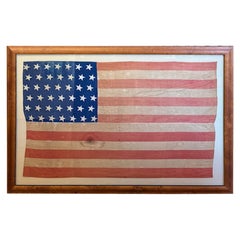
19th Century American 42 Star Flag, circa 1889
Located in Nantucket, MA
19th Century American 42 Star Flag, circa 1889, printed on linen period flag in the "Dancing Star" pattern. This was never an official U.S. flag sanctioned b y congress, but was made...
Category
Antique 1880s American Federal Political and Patriotic Memorabilia
Materials
Linen
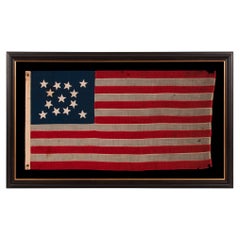
13 Star Antique American Flag , Hand-Sewn Stars in a Medallion, 1876 Centennial
Located in York County, PA
13 STAR ANTIQUE AMERICAN FLAG WITH A MEDALLION CONFIGURATION OF HAND-SEWN STARS AND A BEAUTIFUL, ELONGATED PROFILE, MADE IN THE ERA OF THE 1876 CENTENNIAL OF AMERICAN INDEPENDENCE, I...
Category
Antique 1870s Political and Patriotic Memorabilia
Materials
Wool
Price Upon Request
H 43 in W 72.25 in D 2.5 in
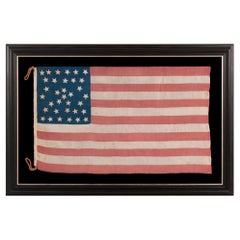
34 Star Antique American Flag with Hourglass Medallion Stars, ca 1861-1863
Located in York County, PA
EXTRAORDINARY 34 STAR ANTIQUE AMERICAN FLAG WITH AN ACCORDION OR HOURGLASS MEDALLION CONFIGURATION THAT SURROUNDS A PENTAGON OF STARS IN THE CENTER; MADE OF FINE SILK AND ENTIRELY HAND-SEWN; MADE DURING THE OPENING YEARS OF THE CIVIL WAR (1861-63), IN A TINY SIZE AMONG ITS COUNTERPARTS OF THE PERIOD; REFLECTS THE ADDITION OF KANSAS AS THE 34TH STATE
34 star flag of the Civil War period with an array of rare, beautiful, and otherwise desirable features. Extremely small among flags of this period with pieced and sewn construction, the flag displays a star pattern that is not only highly unusual, but unique to this particular example. This consists of a single star in the very center, surrounded by a pentagon of stars, flanked by angular bracket of three stars to either side. Above and below are rows of 5 stars, followed by rows of 6 that line the top and bottom of the canton. The resulting configuration is what I have termed an “accordion medallion,” though “hourglass medallion” or “standing bow tie” would be perfectly acceptable.
When rotated 90 degrees, to view the harder-to-identify, bow tie formation, students of early star patterns may note the visual similarity between this and what I call “Starburst” or “Crosshatch” medallions. The pattern, however, conspicuously lacks the crosses of St. Andrew (a saltire) and St. George (roman cross), that would allow it to be more accurately categorized as such.
Entirely hand-sewn, the canton and stripes of the flag are made of fine silk. The hemming of this was accomplished with great skill. The top and bottom edges are selvedge. These are so similar in nature as to have come from the same maker. There is a white, silk binding along the hoist, in the form of an open sleeve, through which a length of braided hemp rope was passed, expertly looped and re-braided into itself at the top and bottom for strength.
The stars are made of white, polished cotton. These were stitched to both sides (double-appliqued). Note how the edges of the fabric were not turned under, providing evidence of the fact that the maker was not especially skilled in appliqueing. This was common, as applique work was far more difficult than producing French seams.
In the 19th century, most flags with pieced and sewn construction were 8 feet long and larger. A six-footer was considered small. Even military battle flags, carried on foot, measured 6’ x 6.5’, which translates into approximately 7’ x 7.5’ after framing, about the size of an average quilt and larger than can comfortably fit on a wall in a house with 8-foot ceilings and average width baseboard. Flags smaller than this were produced both commercially and at home, but the smaller they are, the more unusual they are. At just 26.5 x 46.5 inches, this flag is extremely small for a Civil war period flag with sewn construction.
Silk was both beautiful and lightweight, which made it elegant for military unit colors and preferable for flags meant to be carried on foot. Most outdoor use flags...
Category
Antique 1860s American Political and Patriotic Memorabilia
Materials
Silk
Price Upon Request
H 38 in W 56.5 in D 2.5 in
38 Star Antique American Flag, Colorado Statehood, circa 1876-1889
Located in York County, PA
38 star antique American parade flag with scattered star orientation, made of silk, with generous scale and vivid colors, Colorado Statehood, 1876-1889
38 star American national p...
Category
Antique Late 19th Century American Political and Patriotic Memorabilia
Materials
Silk
Price Upon Request
H 43 in W 60 in D 2.5 in
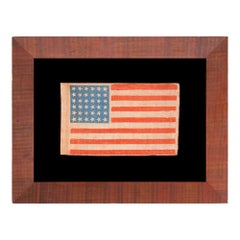
36 Star Antique American Parade Flag, with Canted Stars, ca 1864-1867
Located in York County, PA
36 STAR ANTIQUE AMERICAN PARADE FLAG WITH CANTED STARS IN DANCING ROWS, ON A BEAUTIFUL, CORNFLOWER BLUE CANTON; CIVIL WAR ERA, NEVADA STATEHOOD, 1864-1867
36 star antique American f...
Category
Antique 1860s American Political and Patriotic Memorabilia
Materials
Cotton
Price Upon Request
H 11.5 in W 14.25 in D 1.5 in
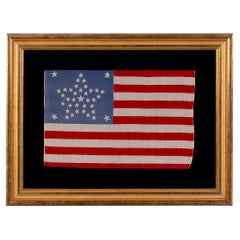
38 Star American Parade Flags with Stars in a Great Star Pattern
Located in York County, PA
38 STAR AMERICAN PARADE FLAG WITH A RARE AND BEAUTIFUL VARIATION OF THE “GREAT STAR” OR “GREAT FLOWER” PATTERN, 4 LARGE CORNER STARS, & AN ODD OUTLIER, 1876-1889, COLORADO STATEHOOD,...
Category
Antique Late 19th Century American Political and Patriotic Memorabilia
Materials
Silk
Price Upon Request
H 20.5 in W 26.75 in D 2 in
More From This Seller
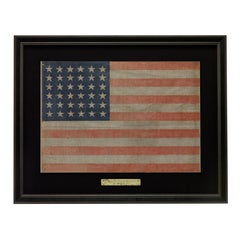
View All36-Star American Printed Parade Flag, Circa 1865-1867
Located in Colorado Springs, CO
This is an antique 36-star American flag, as striking as it is scarce. The flag has a glazed cotton construction, with a blue canton printed with 36 white stars. The stars are arrang...
Category
Antique 1860s American Political and Patriotic Memorabilia
Materials
Cotton
31-Star Printed American Flag, Celebrating California Statehood, Circa 1850
Located in Colorado Springs, CO
This is a rare 31-star medallion printed American flag, celebrating the addition of California to the Union. The flag is printed on silk and has a spectacular “Great Star” canton pat...
Category
Antique 1850s American Political and Patriotic Memorabilia
Materials
Silk
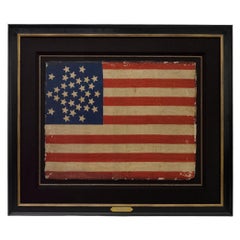
39-Star Printed American Flag, Commemorating North Dakota Statehood, 1889-1890
Located in Colorado Springs, CO
This is a 39-star unofficial American flag, celebrating North Dakota statehood. The printed flag dates to 1889 and showcases a “whimsical” star pattern in the canton. The flag's cant...
Category
Antique 1880s American Political and Patriotic Memorabilia
Materials
Fabric
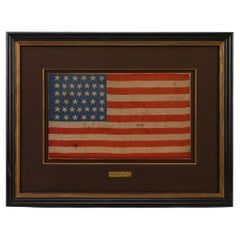
34-Star American Parade Flag, Commemorating Kansas Statehood, Circa 1861-1863
Located in Colorado Springs, CO
Offered is a spectacular 34-star American flag, produced during the Civil War. This flag features 34 printed white stars, on a blue wool blend canton. The stars are arranged in whims...
Category
Antique 1860s American American Classical Political and Patriotic Memora...
Materials
Brass
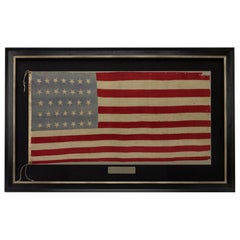
44-Star Silk American Flag, Celebrating Wyoming Statehood, Circa 1890-1896
Located in Colorado Springs, CO
Presented is a 44-star silk American flag, commemorating Wyoming statehood. The flag dates to 1890-1896. The flag has an “8-7-7-7-7-8” star configuration, with the stars whimsically ...
Category
Antique 1890s American Political and Patriotic Memorabilia
Materials
Silk
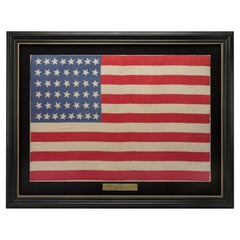
13-Star Wool American Flag, with Zig-Zag Stars, Circa 1900
Located in Colorado Springs, CO
This is a beautiful 13-star American flag, each star sewn with zig-zag stitching. The wool flag was sewn at the turn of the century, circa 1900. The flag features 13 white stars rest...
Category
Antique Early 1900s American American Classical Political and Patriotic ...
Materials
Brass