Items Similar to 38 Star American Flag, Colorado Statehood, Made by Horstmann Brothers ca 1876
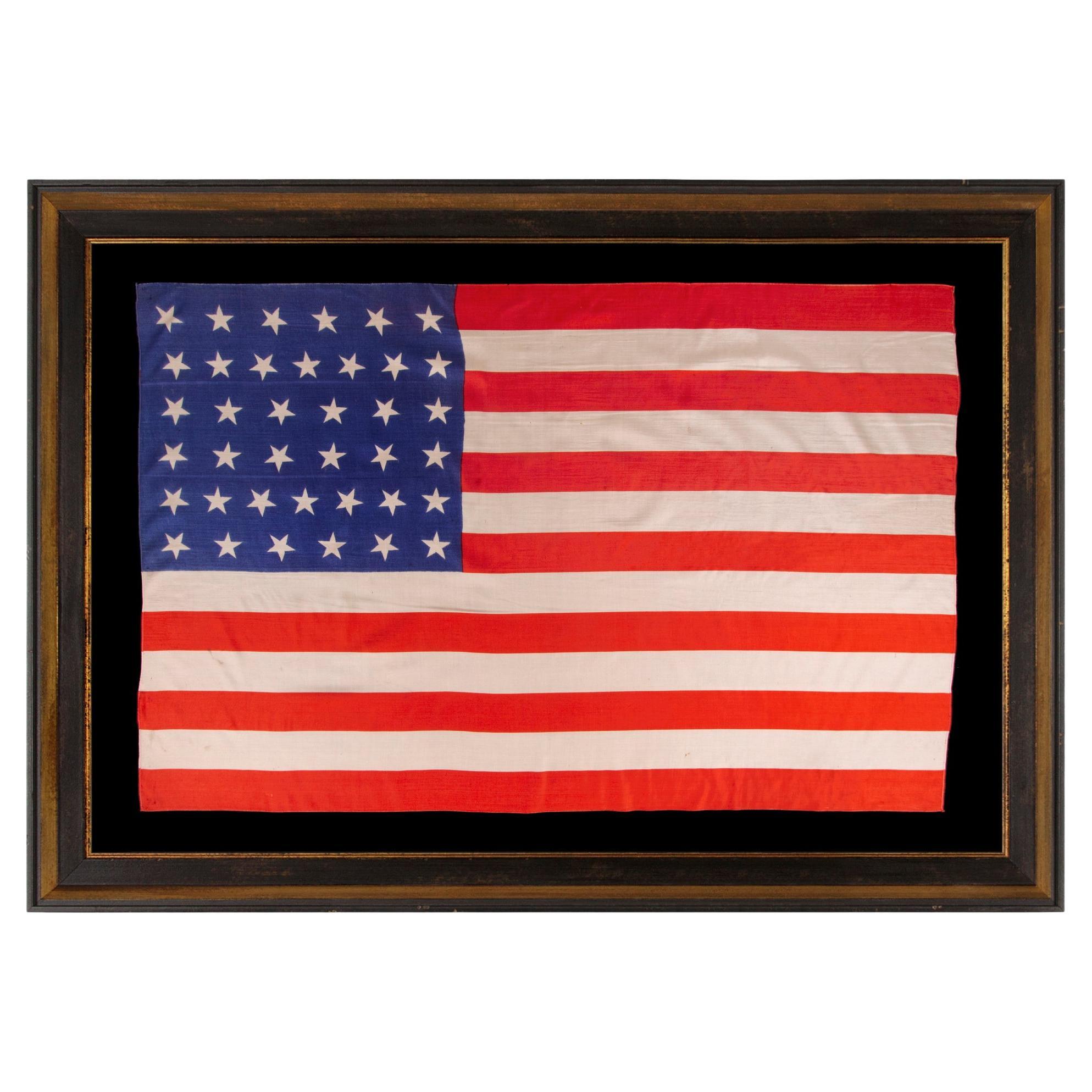
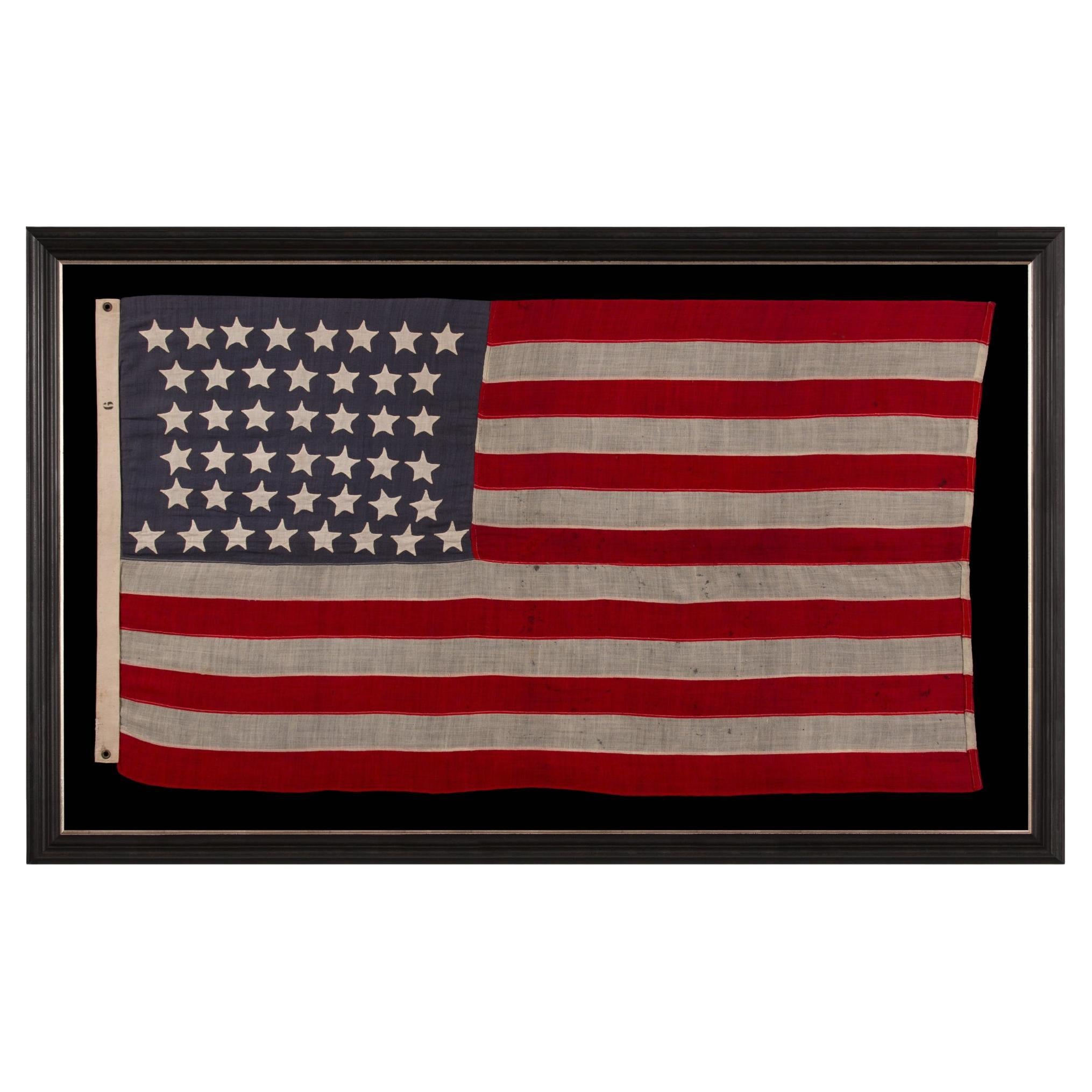
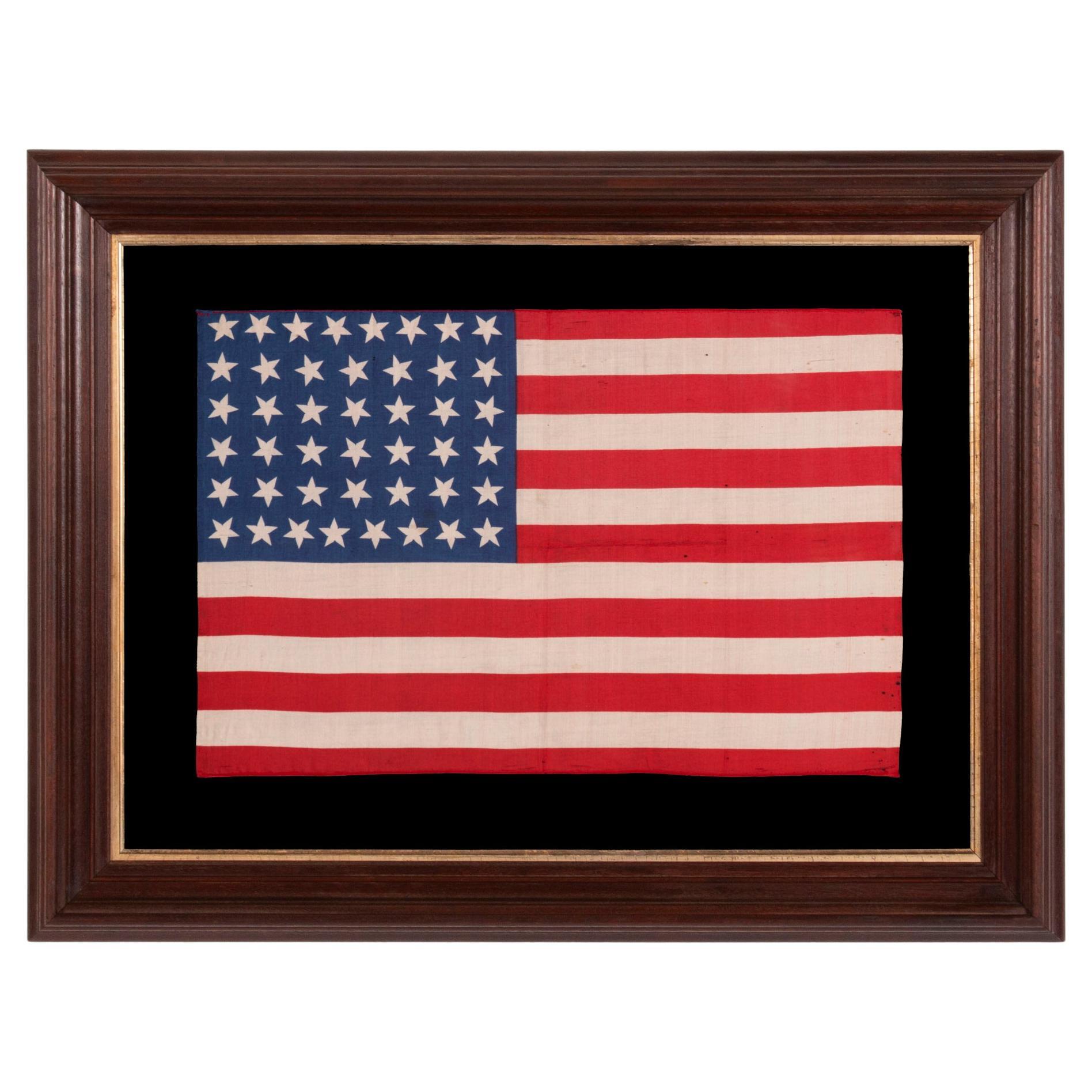
Want more images or videos?
Request additional images or videos from the seller
1 of 7
38 Star American Flag, Colorado Statehood, Made by Horstmann Brothers ca 1876
Price Upon Request
Price Upon Request
Price Upon Request
Price Upon Request
Price Upon Request
Price Upon Request
Price Upon Request
Price Upon Request
Price Upon Request
Price Upon Request
About the Item
38 STARS, COLORADO STATEHOOD, A SCARCE AND BEAUTIFUL ANTIQUE AMERICAN FLAG WITH A MEDALLION PATTERN AND 4 LARGE CORNER STARS, PRESS-DYED ON WOOL BUNTING, MADE BY HORSTMANN BROTHERS IN PHILADELPHIA FOR THE 1876 CENTENNIAL OF OUR NATION’S INDEPENDENCE
38 star American national parade flag, press-dyed on wool bunting, with an extremely unusual type of medallion star configuration. Specifically, this is triple wreath, with a small center star, surrounded by three consecutive rings of stars in the same size, with a large flanking star in each corner of the blue canton.
19th century flag-makers loved to use multiple sizes of stars in circular arrangements, often with no other purpose than to create an eye-catching, artistic presentation. In this light, the characteristic of having large corner stars is in no way uncommon, popular on wreath pattern flags. However, in the course of my 25-year obsession with fantastic star designs on early American flags this is the only instance of a wreath configuration, with larger corner stars, that lacked a star of equivalent size or greater in the center.
Many fantastic star patterns were made in the patriotism that accompanied or nation’s 100-year anniversary of independence in 1876 and this is one of the most interesting examples. Because there were no regulations concerning either star configuration or position until 1912, and many flag-makers went out of their way to catch the attention of potential buyers. The absence of a big center star makes for a visually unusual flag among its counterparts of the centennial era. Note how the somewhat crowded arrangement of the wreaths adds to its interesting appearance, as does the beautiful blue color of the square canton, that contrasts wonderfully with the scarlet red of the stripes. The combination of all the above contributes to a bold visual display.
Colorado became the 38th state on August 1st, 1876. This was the year of our nation’s 100-year anniversary of independence. Per the Third Flag Act of 1818, stars were not officially added until the 4th of July following a state's addition. For this reason, 37 was the official star count for the American flag in 1876. Flag-making was a competitive venture, however, and few flag-makers would have continued to produce 37 star flags when their competitors were making 38’s. It is for this reason that 38 and 13 stars (to represent the original 13 colonies) are more often seen at the Centennial Expo.
Some flag-makers would have been adding a star for the 38th state even before it entered the Union, in the early part of 1876 or even prior. In fact, many makers of parade flags were actually producing 39 star flags, in hopeful anticipation of the addition of two more Western Territories instead of one. The 39th state would not join the Union for another 13 years, however, when the Dakota Territory entered as two states on November 2nd, 1889. The 38 star flag became official on July 4th, 1877, and though it remained so until July 3rd, 1890, flags in this star count would have fell from use with the addition of the Dakotas.
This particular flag is of a known type, made by Made by Horstmann Brothers of Philadelphia, a major Civil War military outfitter. Horstmann produced its own press-dyed wool flags, some of which it marked with its name along the hoist. Like most 19th century flag-makers, however, it marked only tiny fraction of what it produced. This particular style of Horstmann flag is especially rare. It is of interest to note that the firm was producing press-dyed flags with other star patterns simultaneously, one of which shared the trait of having large corner stars, but lacking a large center star. That variety bore no single star at all, and was not a triple wreath, instead displaying an odd, flattened ellipse of 6 stars in the center, canted at an odd angle, surrounded by two circular wreaths. Another variant, produced in at least 3 sizes, displayed an enormous center star, surrounded by a wreath, surrounded by a square of stars. At least two other known types displayed their stars in lineal rows.
Because of its Philadelphia location, Horstmann was in a unique position to supply flags and banners to the 1876 Centennial International Exposition, our nation’s first World’s Fair, that served as the nucleus of the national celebration of America’s 100th birthday. Horstman played an integral role in decorating the enormous, six-month long event, which required flags that would last much longer than the typical cotton or silk parade flags, produced with the intent of short term use at parades, political rallies, reunions of Civil War soldiers, and the like. 225 buildings were erected to host the exhibits and accompanying necessities, most of which required extensive decoration of all types, the artistic presentation of which was simply beyond imagination. Because wool sheds water, cotton absorbs it, and silk, while elegant, was likewise not a durable fabric for exposure to the elements, press-dyed wool flags were rather ideal for the long-term display the Centennial Expo required.
All-in-all, a really terrific example for a collector or a one-time buyer, alike, with wonderful presentation.
A Brief History of the Horstmann Company:
William H. Horstmann (1785-1850) was the founder of what would become a major military outfitter in both Philadelphia and New York City. A solider and fourth generation passementier (textile weaver), Horstmann emigrated to the United States from Cassel, Germany in either 1815 or 1816, settling in the Germantown area of Philadelphia, where there was a significant concentration of textile manufacturing. Horstmann established a business of manufacturing fringe, laces, and trimmings at 50 N. Third St. and soon after married the daughter of Frederick Hoeckly, the most successful lace manufacturer in the city. In 1824 he introduced three significant tools to America, including the first jacquard loom, for weaving multicolored fabrics, the first braiding machine, and a machine for plating metal. Moving to the corner of 59th
Third, he imported technology from Germany and elsewhere and maintained regular trade with his family in Europe. The company grew exponentially in size and had many addresses over its years of operation
In 1828, the William H. Horstmann Military Store opened and in 1831 he established a New York branch. In 1843 the name was changed to the William H. Horstmann
Sons Military Store, and in 1859 it was taken over by sons Sigmund H. and William J., who operated the business as Horstmann Bros.
Co. in both New York and Philadelphia. Taking on investors in the interim, from 1845-1849 it operated in NYC as Horstmann Sons
Drucker, then Horstmann Sons
Allien. As an outfitter of Civil War regiments, the firm manufactured its own goods, including flags, swords, drums, insignia, and many other items, and subcontracted for the manufacture of these objects as well, depending on financial sensibility. There were other investors and partners along the way, such as William S. Hassall and George Evans, who broke off and became a significant competitor as “Hassall
Evans.” Brothers Sigmund
William Horstmann passed in 1870 and 1872, respectively.
In 1877, the New York branch changed its name to that of partner H.V. Allien. In 1893 the Philadelphia location changed its name to simply “Wm. H. Horstmann Co.,” operating as such until 1940. In 1927 “Horstmann Uniform Co.” was established as a separate entity, though it operated in a building within the large, Horstmann campus. In 1948, both the Philadelphia and New York branches filed for bankruptcy and closed.
Mounting: For 25 years we have maintained a specialized department for this purpose. Our lead conservator holds a master's degree in textile conservation from one of the nation’s top programs. We take great care in the mounting and preservation of flags and related textiles and have preserved thousands of examples.
The mount was placed in a The 3-part frame is constructed of wood, but has a beautiful metallic finish that presents like gunmetal and antique iron. The background is 100% cotton twill, black in color, that has been washed and treated for colorfastness. The glazing is U.V. protective acrylic (Plexiglas). Feel free to contact us for more details.
Condition: There is minor mothing throughout, accompanied by minor fabric loss at the top and bottom of the hoist-end, where the flag was once affixed to its original wooden staff. There is minor staining in limited areas and there is minor darkening from soiling in the last 1/3 of the flag, toward the fly end. Fabric of similar coloration was placed behind the flag during the mounting process, both for masking purposes and to strengthen its color against the black ground. Many of my clients prefer early flags to show their age and history of use.
Frame Size (H x L): 28.75" x 39"
Flag Size (H x L): 18" x 28.5"
- Dimensions:Height: 28.75 in (73.03 cm)Width: 39 in (99.06 cm)Depth: 2.5 in (6.35 cm)
- Materials and Techniques:
- Place of Origin:
- Period:
- Date of Manufacture:1876
- Condition:See Item Descriptio.
- Seller Location:York County, PA
- Reference Number:Seller: 38j-11541stDibs: LU849742084912
About the Seller
5.0
Recognized Seller
These prestigious sellers are industry leaders and represent the highest echelon for item quality and design.
Established in 1991
1stDibs seller since 2008
71 sales on 1stDibs
Typical response time: Several days
- ShippingRetrieving quote...Shipping from: York County, PA
- Return Policy
More From This Seller
View All38 Star Antique American Flag, Colorado Statehood, circa 1876-1889
Located in York County, PA
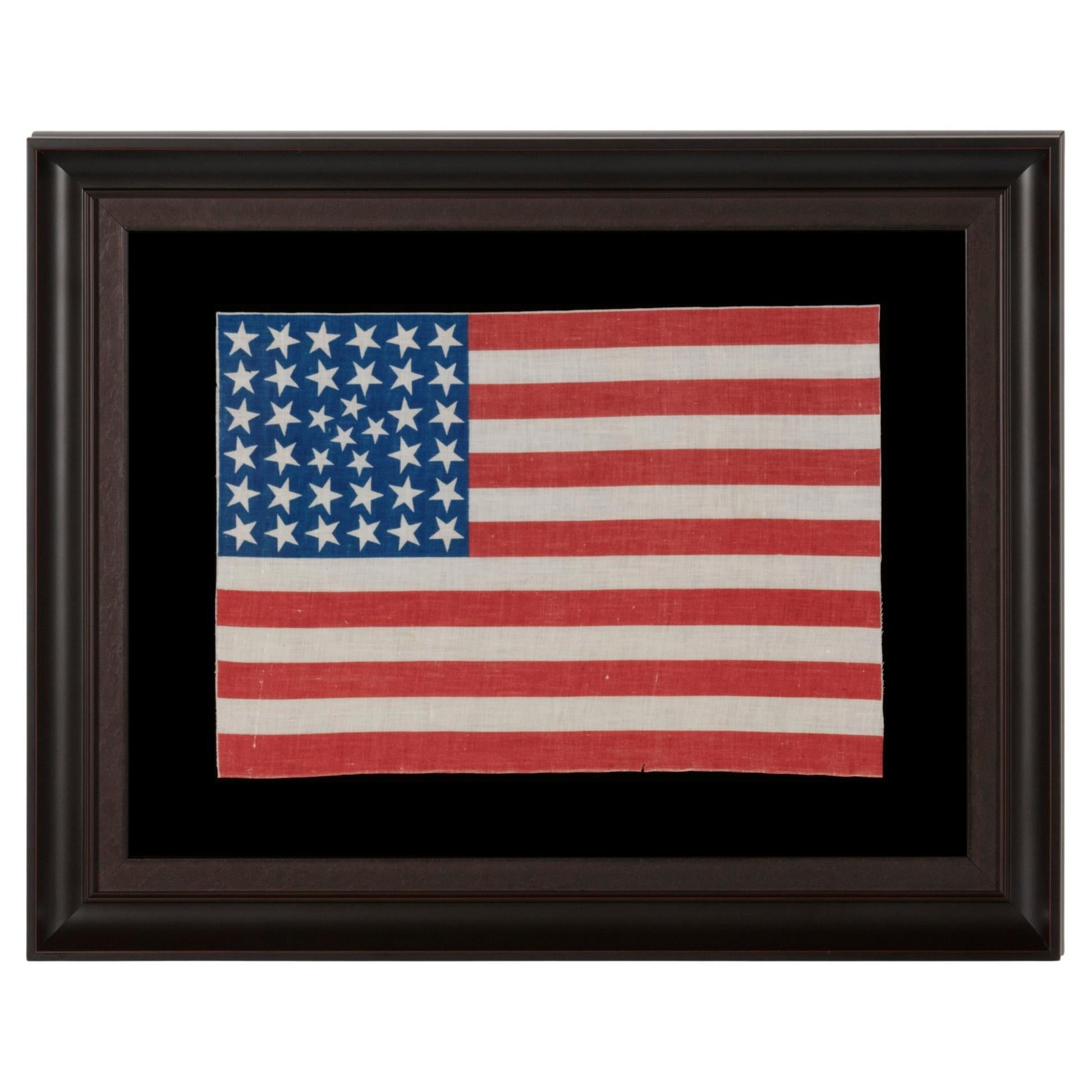
38 star antique American parade flag with scattered star orientation, made of silk, with generous scale and vivid colors, Colorado Statehood, 1876-1889
38 star American national p...
Category
Antique Late 19th Century American Political and Patriotic Memorabilia
Materials
Silk
Price Upon Request
44 Star Antique American Flag, Wyoming Statehood, ca 1890-1896
Located in York County, PA
44 STAR ANTIQUE AMERICAN FLAG WITH AN HOURGLASS ARRANGEMENT ON A DUSTY BLUE CANTON; REFLECTS THE ERA WHEN WYOMING WAS THE MOST RECENT STATE TO JOIN THE UNION, 1890-1896
Wyoming was ...
Category
Antique 1890s American Political and Patriotic Memorabilia
Materials
Wool
Price Upon Request
44 Star Silk Antique American Flag, Wyoming Statehood, ca 1890-1896
Located in York County, PA
44 STARS IN JUSTIFIED ROWS, WITH VARIED STAR POSITIONING, ON A SILK, ANTIQUE AMERICAN FLAG WITH STRIKING COLORS, REFLECTS WYOMING STATEHOOD, circa 1890-1896
44 star American parade ...
Category
Antique Late 19th Century American Political and Patriotic Memorabilia
Materials
Silk
Price Upon Request
38 Star Antique American Parade Flag, Colorado Statehood, ca 1876-1889
Located in York County, PA
38 STARS IN AN EXTREMELY UNUSUAL CONFIGURATION THAT BEARS A CLUSTER OF 6 SMALL STARS WITHIN A LINEAL PATTERN OF LARGER STARS, 1876-1889, COLORADO STATEHOOD
38 star American national parade flag, printed on cotton. This is an extremely rare example of a lineal pattern flag with a wreath or cluster of smaller stars inserted in the center. A very small number of flags in this style are known to have survived, the colors of which are typically saturated and vibrant, like this example, in scarlet red and rich, royal blue.
The particular wreath in the center of the configuration is really more of a pentagon with a single, center star. The reason for the choice of the design and 6 smaller stars seems a curious one on the surface, but its purpose was probably nothing more than to simply augment a 36 star print block to one with 38 stars. One may observe how 4 stars, that would have comprised the center of a 6 x 6 pattern, could have simply been removed and 6 smaller stars inserted in their place, in an artful fashion.
At least two other similar 38-star patterns are known that incorporate 4 small stars intermingled between rows of what most certainly were two very similar 34-star flag print blocks originally. It was easier to modify these blocks rather than create brand new ones. In these particular instances, the results are rare, quirky configurations that are highly prized by collectors.
Colorado became the 38th state on August 1st, 1876. This was the year of our nation’s 100-year anniversary of independence. Per the Third Flag Act of 1818, stars were not officially added until the 4th of July following a state's addition. For this reason, 37 was the official star count for the American flag in 1876. Flag-making was a competitive venture, however, and few flag-makers would have been continuing to produce 37 star flags when their competitors were making 38’s. It is for this reason that 38 and 13 stars (to represent the original 13 colonies) are more often seen at the Centennial International Exposition, the six-month long World’s Fair held in Philadelphia in honor of the event. Some flag-makers would have been adding a star for the 38th state even before it entered the Union, in the early part of 1876 or even prior. In fact, many makers of parade flags were actually producing 39 star flags, in hopeful anticipation of the addition of two more Western Territories instead of one. But the 39th state would not join the Union for another 13 years, when the Dakota Territory entered as two states on the same day. The 38 star flag became official on July 4th, 1877 and was generally used until the addition of the Dakotas in 1889.
Provenance: Jeff R. Bridgman Antiques to the late collector Jim Ring...
Category
Antique Late 19th Century American Political and Patriotic Memorabilia
Materials
Cotton
Price Upon Request
26 Star Antique American Flag, with 11 Stripes, Michigan Statehood, ca 1837-1846
Located in York County, PA
26 STAR ANTIQUE AMERICAN PARADE FLAG WITH 11 STRIPES AND IT’S CANTON RESTING ON THE “WAR STRIPE.” THE EARLIEST KNOWN STAR COUNT FOR PRINTED EXAMPLES, 1837-1846, MICHIGAN STATEHOOD
2...
Category
Antique Mid-19th Century American Political and Patriotic Memorabilia
Materials
Cotton
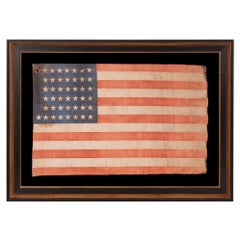
44 Star Antique American Parade Flag, Wyoming Statehood, ca 1890-1896
Located in York County, PA
44 STAR ANTIQUE AMERICAN PARADE FLAG WITH ENDEARING WEAR FROM LONG TERM USE AND WITH ITS STARS ARRANGED IN A NOTCHED PATTERN THAT LEAVES 4 SPACES OPEN FOR THE REMAINING WESTERN TERRI...
Category
Antique 1890s American Political and Patriotic Memorabilia
Materials
Cotton
Price Upon Request
You May Also Like
44-Star Silk American Flag, Celebrating Wyoming Statehood, Circa 1890-1896
Located in Colorado Springs, CO
Presented is a 44-star silk American flag, commemorating Wyoming statehood. The flag dates to 1890-1896. The flag has an “8-7-7-7-7-8” star configuration, with the stars whimsically ...
Category
Antique 1890s American Political and Patriotic Memorabilia
Materials
Silk
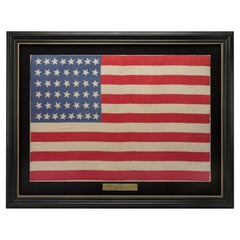
31-Star Printed American Flag, Celebrating California Statehood, Circa 1850
Located in Colorado Springs, CO
This is a rare 31-star medallion printed American flag, celebrating the addition of California to the Union. The flag is printed on silk and has a spectacular “Great Star” canton pat...
Category
Antique 1850s American Political and Patriotic Memorabilia
Materials
Silk
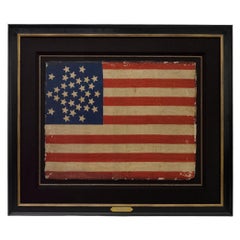
42-Star American Parade Flag, Commemorating Washington Statehood, 1889
Located in Colorado Springs, CO
This is an uncommon 42-star flag, commemorating the addition of the state of Washington to the Union. The flag dates to 1889-1890, and is printed on cotton. The canton consists of s...
Category
Antique 1880s American Political and Patriotic Memorabilia
Materials
Cotton
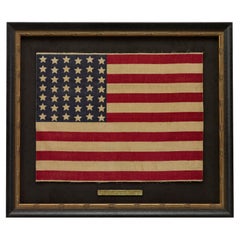
39-Star Printed American Flag, Commemorating North Dakota Statehood, 1889-1890
Located in Colorado Springs, CO
This is a 39-star unofficial American flag, celebrating North Dakota statehood. The printed flag dates to 1889 and showcases a “whimsical” star pattern in the canton. The flag's cant...
Category
Antique 1880s American Political and Patriotic Memorabilia
Materials
Fabric
34-Star American Parade Flag, Commemorating Kansas Statehood, Circa 1861-1863
Located in Colorado Springs, CO
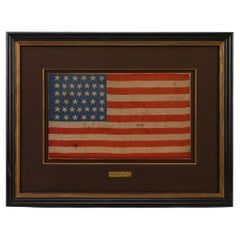
Offered is a spectacular 34-star American flag, produced during the Civil War. This flag features 34 printed white stars, on a blue wool blend canton. The stars are arranged in whims...
Category
Antique 1860s American American Classical Political and Patriotic Memora...
Materials
Brass
45-Star American Flag, Printed on Cotton, Celebrating Utah Statehood, 1896-1908
Located in Colorado Springs, CO
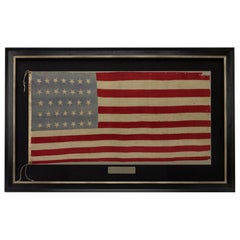
This 45-star United States flag celebrates the statehood of Utah. 45-star flags served as the official American flag from 1896-1908. This particular flag was flown as a parade flag. ...
Category
Antique 1890s American Political and Patriotic Memorabilia
Materials
Cotton