Want more images or videos?
Request additional images or videos from the seller
1 of 6
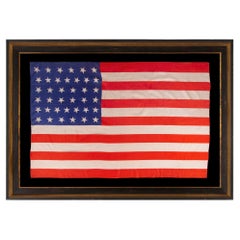
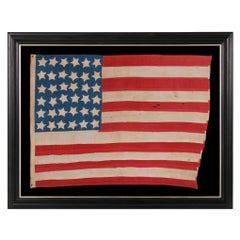
38-Star Antique American Flag with Unique Star Pattern, circa 1876
$20,500List Price
About the Item
- Dimensions:Height: 31 in (78.74 cm)Width: 40 in (101.6 cm)Depth: 2 in (5.08 cm)
- Materials and Techniques:
- Place of Origin:
- Period:
- Date of Manufacture:circa 1876
- Condition:Wear consistent with age and use. Clamp-dyed printed wool flag. Flag is in very good condition, with minimal damage. Flag has several small tears throughout and loose threads along the hoist end near canton. No hoist. Flag has machine-stitched edges.
- Seller Location:Colorado Springs, CO
- Reference Number:Seller: F1881stDibs: LU909717734671
About the Seller
4.9
Gold Seller
Premium sellers maintaining a 4.3+ rating and 24-hour response times
Established in 2010
1stDibs seller since 2011
471 sales on 1stDibs
Authenticity Guarantee
In the unlikely event there’s an issue with an item’s authenticity, contact us within 1 year for a full refund. DetailsMoney-Back Guarantee
If your item is not as described, is damaged in transit, or does not arrive, contact us within 7 days for a full refund. Details24-Hour Cancellation
You have a 24-hour grace period in which to reconsider your purchase, with no questions asked.Vetted Professional Sellers
Our world-class sellers must adhere to strict standards for service and quality, maintaining the integrity of our listings.Price-Match Guarantee
If you find that a seller listed the same item for a lower price elsewhere, we’ll match it.Trusted Global Delivery
Our best-in-class carrier network provides specialized shipping options worldwide, including custom delivery.You May Also Like
38 Star Antique American Flag, Colorado Statehood, circa 1876-1889
Located in York County, PA
38 star antique American parade flag with scattered star orientation, made of silk, with generous scale and vivid colors, Colorado Statehood, 1876-1889
38 star American national p...
Category
Antique Late 19th Century American Political and Patriotic Memorabilia
Materials
Silk
Price Upon Request
H 43 in W 60 in D 2.5 in
38 Star Antique Flag, Stars in Double Wreath Pattern, Colorado Statehood 1876-89
Located in York County, PA
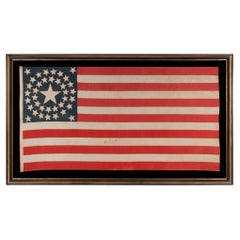
38 STAR ANTIQUE AMERICAN FLAG WITH A DOUBLE-WREATH CONFIGURATION THAT FEATURES AN ENORMOUS CENTER STAR, REFLECTS THE PERIOD OF COLORADO STATEHOOD, 1876-1889:
38 star American national flag, made entirely of plain weave cotton. The stars are arranged in a medallion configuration. This features an enormous center star, surrounded by two wreaths of much smaller stars, with a flanking star in each corner of the blue canton. The sort of disparity here, present in the scale of the large star, versus those around it, is both exceptionally unusual and graphically dynamic.
Colorado became the 38th state on August 1st, 1876. This was the year of our nation’s centennial. Per the Third Flag Act of 1818, stars were not officially added until the 4th of July following a state's addition. For this reason, 37 remained the official star count for the American flag until part way through the following year. Flag-making was a competitive venture, however, and few flag-makers would have continued to produce 37 star flags when their competitors were making 38’s. Many flag-makers added a 38th star before Colorado entered the Union, in the early part of 1876, or possibly even prior. In fact, many makers of printed flags, called parade flags or hand-wavers, were actually producing flags in the 39 star count, in hopeful anticipation of the addition of two more Western Territories instead of one.
It is for these reasons that 38, 39, and 13 stars, to representing the original 13 colonies, are most often seen on flags displayed at the Centennial International Exhibition. Hosted in Philadelphia, this enormous event was our nation’s first World’s Fair, lasted for a duration of six months, and served as the nucleus of celebrations held to honor America’s 100-year anniversary of independence. The 38 star flag became official on July 4th, 1877 and was generally used until the 39th state was added in November of 1889.
This is probably a homemade flag, though sewn by a very skilled hand, or possibly, by two different individuals. The stripes are pieced and sewn entirely by hand, with remarkable care and precision. The canton is constructed of two lengths of blue fabric, that have been joined with treadle stitching. This was joined to the striped field by hand. The stars are double-appliquéd (applied to both sides) with treadle stitching. There is a treadle-sewn, cotton binding along the hoist, with five, hand-sewn grommets.
It is extremely unusual to encounter this combination of sewing methods. Soon after the sewing machine was mass-marketed, in the mid-1850’s, flag-makers both public and private made good use of treadle machines, to join stripes, when constructing American flags. During the Civil War (1861-65), most stripes were treadle-sewn. Stars were another matter. Until the advent of electric machines...
Category
Antique Late 19th Century American Political and Patriotic Memorabilia
Materials
Cotton
Price Upon Request
H 65 in W 115.25 in D 2.5 in
38 Star Antique American Parade Flag, Colorado Statehood, ca 1876-1889
Located in York County, PA
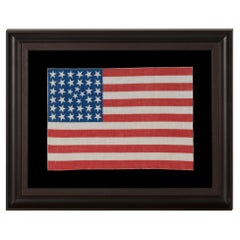
38 STARS IN AN EXTREMELY UNUSUAL CONFIGURATION THAT BEARS A CLUSTER OF 6 SMALL STARS WITHIN A LINEAL PATTERN OF LARGER STARS, 1876-1889, COLORADO STATEHOOD
38 star American national parade flag, printed on cotton. This is an extremely rare example of a lineal pattern flag with a wreath or cluster of smaller stars inserted in the center. A very small number of flags in this style are known to have survived, the colors of which are typically saturated and vibrant, like this example, in scarlet red and rich, royal blue.
The particular wreath in the center of the configuration is really more of a pentagon with a single, center star. The reason for the choice of the design and 6 smaller stars seems a curious one on the surface, but its purpose was probably nothing more than to simply augment a 36 star print block to one with 38 stars. One may observe how 4 stars, that would have comprised the center of a 6 x 6 pattern, could have simply been removed and 6 smaller stars inserted in their place, in an artful fashion.
At least two other similar 38-star patterns are known that incorporate 4 small stars intermingled between rows of what most certainly were two very similar 34-star flag print blocks originally. It was easier to modify these blocks rather than create brand new ones. In these particular instances, the results are rare, quirky configurations that are highly prized by collectors.
Colorado became the 38th state on August 1st, 1876. This was the year of our nation’s 100-year anniversary of independence. Per the Third Flag Act of 1818, stars were not officially added until the 4th of July following a state's addition. For this reason, 37 was the official star count for the American flag in 1876. Flag-making was a competitive venture, however, and few flag-makers would have been continuing to produce 37 star flags when their competitors were making 38’s. It is for this reason that 38 and 13 stars (to represent the original 13 colonies) are more often seen at the Centennial International Exposition, the six-month long World’s Fair held in Philadelphia in honor of the event. Some flag-makers would have been adding a star for the 38th state even before it entered the Union, in the early part of 1876 or even prior. In fact, many makers of parade flags were actually producing 39 star flags, in hopeful anticipation of the addition of two more Western Territories instead of one. But the 39th state would not join the Union for another 13 years, when the Dakota Territory entered as two states on the same day. The 38 star flag became official on July 4th, 1877 and was generally used until the addition of the Dakotas in 1889.
Provenance: Jeff R. Bridgman Antiques to the late collector Jim Ring...
Category
Antique Late 19th Century American Political and Patriotic Memorabilia
Materials
Cotton
Price Upon Request
H 21.5 in W 27.5 in D 2 in
34 Star American flag, Updated to 39 Stars, with Stars in a Great Star Pattern
Located in York County, PA
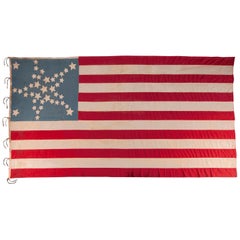
34 STARS IN A WHIMSICAL RENDITION OF THE GREAT STAR PATTERN, ON A CIVIL WAR PERIOD FLAG WITH A CORNFLOWER BLUE CANTON, UPDATED TO 39 STARS IN 1876
34 star American national flag with additional stars added and one of the most stunning graphic designs I have ever seen in early flag-making. The original pattern was comprised of a circle of 5 large stars, and triangular arms made of smaller stars. These are noticeable pointy and bent like the arms of a starfish. Made of cotton, the stars are hand-sewn and double-appliquéd to a fantastic, cornflower blue canton, a color common to Civil War uniforms...
Category
Antique 1870s American Political and Patriotic Memorabilia
Materials
Cotton
Price Upon Request
Free Shipping
H 68 in W 129 in D 1 in
36 Star Antique American Flag, Cornflower blue Canton, circa 1864-1867, Nevada
Located in York County, PA
Antique American Flag With 36 Stars On A Cornflower Blue Canton, Civil War Era, 1864-1867, Reflects The Addition Of Nevada As The 36th State; A Great Folk Exaple With Haphazard Rows Of Starfish-like Stars:
36 star American national flag of the Civil War era with outstanding collector traits. Haphazard rows of fat, starfish-shaped stars fill most of the confines of a brilliant, cornflower blue canton. Note the crude piecing of the thirteen, red and white stripes, joined in an ill-planned manner that results in great variation in width, as well as general irregularity. The 4th red stripe actually falls slightly below the canton, and the height of each does not line up with the corresponding stripe on the reverse. This can clearly be seen at the fly end, which is is turned back and bound to repair obvious extended use in an outdoor environment. Clearly the maker lacked experience in seam work. Lining up the necessary components, so that they could be viewed on both sides, presented a challenge they may have not previously faced. This is also evident in the sewing of the stars, which do not line up on the obverse and reverse sides, as they typically would in a flag sewn by an experienced flag-maker. That said, this is just this kind of homemade charm that fuels interest in early American flags...
Category
Antique 1860s American Political and Patriotic Memorabilia
Materials
Cotton
Price Upon Request
H 50.5 in W 65 in D 2.5 in
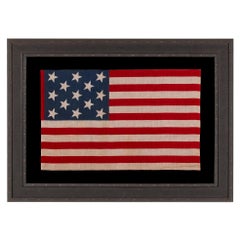
13 Star Antique American Parade Flag, ca 1876-1899
Located in York County, PA
13 STAR ANTIQUE AMERICAN PARADE FLAG, WITH A 3-2-3-2-3 CONFIGURATION OF STARS, AN EXTREMELY SCARCE AND UNUSUALLY LARGE VARIETY, MADE circa 1876-1899
13 star American national parade...
Category
Antique Late 19th Century Canadian Political and Patriotic Memorabilia
Materials
Cotton
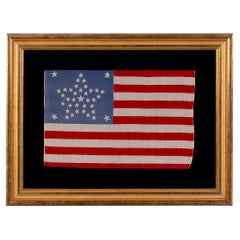
38 Star American Parade Flags with Stars in a Great Star Pattern
Located in York County, PA
38 STAR AMERICAN PARADE FLAG WITH A RARE AND BEAUTIFUL VARIATION OF THE “GREAT STAR” OR “GREAT FLOWER” PATTERN, 4 LARGE CORNER STARS, & AN ODD OUTLIER, 1876-1889, COLORADO STATEHOOD,...
Category
Antique Late 19th Century American Political and Patriotic Memorabilia
Materials
Silk
Price Upon Request
H 20.5 in W 26.75 in D 2 in
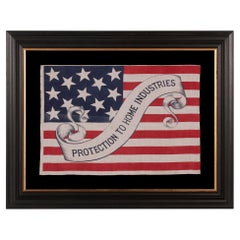
13 Star American Parade Flag with Rare Design, circa 1888 Ex Richard Pierce
Located in York County, PA
13 Star American parade flag in an extremely rare design, with “protection to home industries” slogan on a fanciful, scrolling streamer, made for the 1888 presidential campaign of Benjamin Harrison; formerly in the collection of Richard pierce.
1888 Benjamin Harrison campaign flag, printed on cotton, with 13 large stars in a 3-2-3-2-3 pattern, upon which a whimsical, scrolling streamer is superimposed that features the slogan: “Protection to Home Industries.”
There are numerous styles of both documented and undocumented, red, white, and blue bandanas and handkerchiefs, made for Harrison’s campaign in this year, as well as from the subsequent one, in 1892. Most bear variations of text to support the “Protection for American Industries” platform of the Republican Party. America was in the midst of the industrial age and there was a great deal of public interest, both in protecting growth and discouraging both imported goods and immigration. The constant stream of immigrants posed great challenges for a working families, competing for scarce jobs, in work environments that were already often far from ideal. In post-Civil War America, many of the working men were Civil War veterans.
Bandanas abound from Harrison’s Campaigns, but flags do not. This example, along with three others, were once part of an 1888 patriotic quilt that was disassembled by a dealer and sold piecemeal to collectors. I eventually acquired all four. Fifteen to twenty years ago, these were the only four known copies. A couple of others have since surfaced, but the total count known still stands closer to 5 than 10.
The use of 13 stars is seen in the flags of various candidates in the 19th century. Among these are Abraham Lincoln (1860 campaign), Henry Clay (1844 campaign), John Fremont (1856), and Benjamin Harrison’s grandfather, William Henry Harrison...
Category
Antique 1880s American Political and Patriotic Memorabilia
Materials
Cotton
Price Upon Request
H 28 in W 35.5 in D 2.5 in
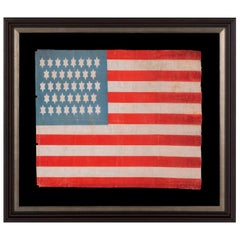
38 Star Parade Flag with Whimsical 6-Pointed Stars, Colorado Statehood
Located in York County, PA
38 WHIMSICAL STARS, WITH 6-POINTED PROFILES, SIMILAR TO THE STAR OF DAVID, ON AN ANTIQUE AMERICAN FLAG OF THE CENTENNIAL ERA; A REMARKABLE SPECIMEN, ONE-OF-A-KIND AMONG KNOWN EXAMPLE...
Category
Antique Late 19th Century American Political and Patriotic Memorabilia
Materials
Cotton
Price Upon Request
H 27 in W 23.75 in D 2.5 in
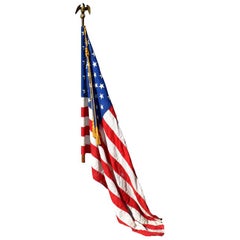
Antique Federal Eagle American 50 Star Flag with Brass Eagle Pole, 19th Century
Located in Oklahoma City, OK
Monumental 50 star American Flag with antique Federal Eagle brass and wood pole. A patriotic piece suitable for any home. This set includes both ...
Category
Antique 19th Century American Federal Political and Patriotic Memorabilia
Materials
Brass, Bronze
$4,500 Sale Price
25% Off
H 66 in W 69 in D 1.25 in
More From This Seller
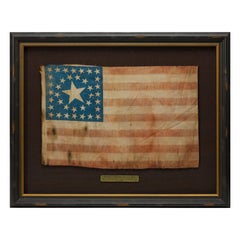
View All38-Star Antique American Flag with Unique Canton, circa 1876-1890
Located in Colorado Springs, CO
This is a striking 38-star American flag. The flag dates to 1876-1890, when Colorado (represented by the large star in the center of the flag’s canton) joined the Union as the 38th s...
Category
Antique Late 19th Century American Political and Patriotic Memorabilia
Materials
Muslin
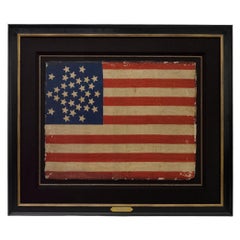
31-Star Printed American Flag, Celebrating California Statehood, Circa 1850
Located in Colorado Springs, CO
This is a rare 31-star medallion printed American flag, celebrating the addition of California to the Union. The flag is printed on silk and has a spectacular “Great Star” canton pat...
Category
Antique 1850s American Political and Patriotic Memorabilia
Materials
Silk
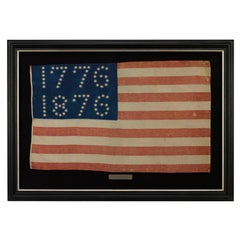
Centennial Celebration "1776-1876" American Flag Banner
Located in Colorado Springs, CO
Presented is a rare Centennial patriotic flag banner, dating to 1876. The flag’s brilliant blue canton is spectacular, with 81 five-pointed, rayed stars, arranged to read “1776” and “1876.” The flag’s design is completed with thirteen alternating red and white stripes. The flag is a three-piece, treadle-sewn sewn construction, printed on a thin wool and cotton blend. Along the edge, there is a narrow, treadle-sewn sleeve made of cotton tape.
In the lead up to the nation’s Centennial in 1876, flag makers and individuals looked to the past for designs to produce as part of the country’s many celebrations. Popular interpretation of the stars and stripes undoubtedly reached its climax of variety and originality at the time of our Nation’s first Centennial. Since no design restrictions were placed on flagmaker’s imaginations and no strict distinctions were drawn between official and unofficial star counts, it is no surprise that, on the occasion of the Centennial, creativity in flag design was not the exception, but the rule.
The cantons from this period presented an array of geometric abstractions. Great star patterns, referred to as the “starry flower of Liberty” by Oliver Wendell Holmes, that were popular from 1818 and on, resurfaced in Centennial flags...
Category
Antique 1870s American Political and Patriotic Memorabilia
Materials
Wool, Cotton
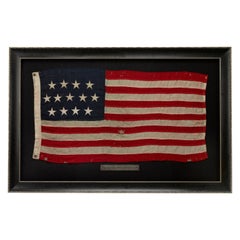
13-Star Wool American Flag, with Zig-Zag Stars, Circa 1900
Located in Colorado Springs, CO
This is a beautiful 13-star American flag, each star sewn with zig-zag stitching. The wool flag was sewn at the turn of the century, circa 1900. The flag features 13 white stars rest...
Category
Antique Early 1900s American American Classical Political and Patriotic ...
Materials
Brass
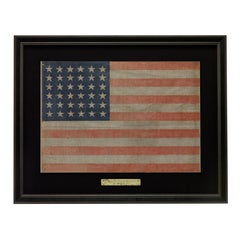
36-Star American Printed Parade Flag, Circa 1865-1867
Located in Colorado Springs, CO
This is an antique 36-star American flag, as striking as it is scarce. The flag has a glazed cotton construction, with a blue canton printed with 36 white stars. The stars are arrang...
Category
Antique 1860s American Political and Patriotic Memorabilia
Materials
Cotton
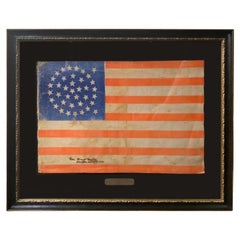
38-Star American Parade Flag, Flown at a Reception for President Grant, 1880
Located in Colorado Springs, CO
This is a beautifully colored 38-star American parade flag, flown at a public reception for Ulysses S. Grant in October of 1880. This printed flag features a rare, triple medallion s...
Category
Antique 1880s American Political and Patriotic Memorabilia
Materials
Cotton
Still Thinking About These?
All Recently ViewedMore Ways To Browse
49 Star Flag
7 Star Flag
Buermann Spurs
Catt Furniture
Eagle Of The French National Guard
J H Lynch
K Barnes
Leo Cherne
Montana Flag
North Carolina Flags
Queen Elizabeth Coin Set
South Street Antiques
Temperance Sign
Vintage 49 Star Flag
Vintage 50 Star Flag
Vintage Asafo Flags
Vintage Defiance Flag
Vintage Texas Flag