Items Similar to 45 Star Antique American Naval Jack, ca 1896-1908
Want more images or videos?
Request additional images or videos from the seller
1 of 6
45 Star Antique American Naval Jack, ca 1896-1908
Price Upon Request
Price Upon Request
Price Upon Request
Price Upon Request
Price Upon Request
Price Upon Request
Price Upon Request
Price Upon Request
Price Upon Request
Price Upon Request
About the Item
LARGE
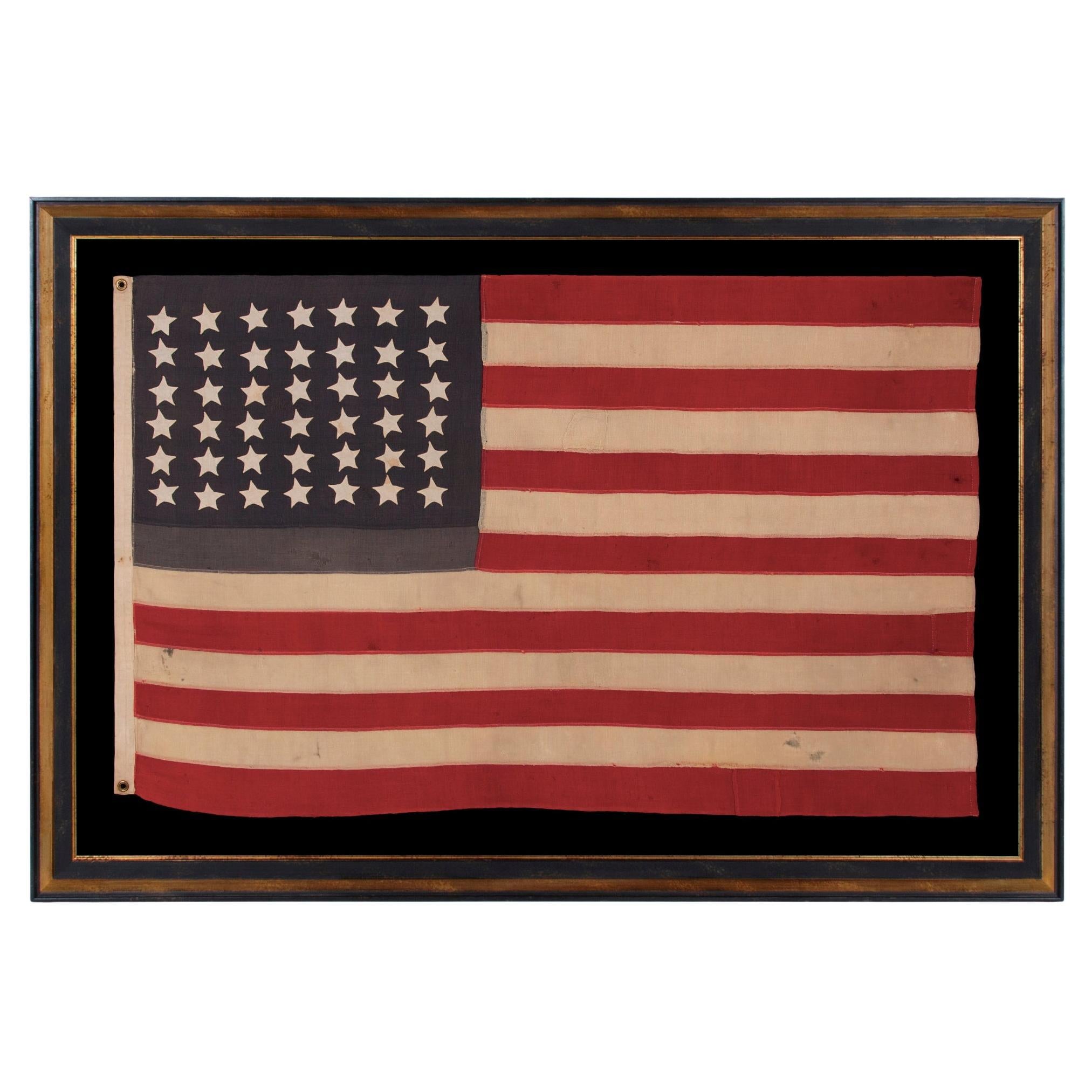
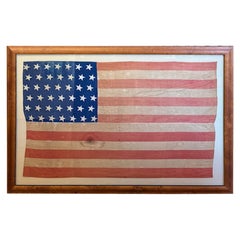
BEAUTIFULLY FADED, ANTIQUE AMERICAN JACK w/ 45 STARS ARRANGED IN A “NOTCHED” PATTERN, INTENTIONALLY LEAVING SPACE FOR THE 3 REMAINING WESTERN TERRITORIES YET TO BE ADDED; MADE IN THE PERIOD BETWEEN 1896 - 1908, WHEN UTAH WAS THE MOST RECENT STATE TO JOIN THE UNION; SPANISH-AMERICAN WAR ERA
Like the British Royal Navy, American vessels flew three flags. These included the American national flag, a Union Jack (not to be confused with the British Union Flag, often identified by this name), and a masthead or “narrow” pennant, commonly referred to today as ‘commission pennants.’
The American Navy jack, often simply referred to as the "jack," was to be comprised of a blue field with white stars. In terms of size, it was to be the mirror image of the canton of the corresponding Stars
Stripes ensign with which it was flown. When at anchor or moored, the jack is flown at the bow (front) and the national flag or "ensign" is flown at the stern (back), and the commission pennant is flown from the main mast. When under way, the jack is furled and the ensign may be kept in place or shifted to a gaff, if the ship is so equipped.
When Utah finally entered the Union as the 45th state on January 4th, 1896, it had been attempting to gain statehood for many years. It remained a territory primarily due to the fact that the Mormon Church and Utah authorities continued to be openly tolerant of polygamy. In 1890, Mormon Church President Wilford Woodruff published a manifesto that denounced the contract of “any marriages forbidden by the law of the land”. This gave way to Utah’s 1896 acceptance. The 45 star flag was generally used from that year until 1907, when Oklahoma joined the Union. Due to the Spanish-American War (1898) and Teddy Roosevelt’s famous world tour of the “White Fleet” (launched in 1907), this was an extremely patriotic period.
The stars of this particular jack are arranged in what we call a “notched” pattern. Evidence of the eagerness for new states is particular notable is this type of design, which in this case leaves three spaces open for the easy addition of Oklahoma, New Mexico, and Arizona. Earlier in the 19th century, the complement of territories, their names, borders, and potential for statehood were less certain. After the Dakota Territory entered as two separate states in 1889, the remainder of the path was easier to predict. For this reason, one will find 44 star flags with notches for 4 additional states, and 46 star flags with notches for 2, preceding the future count of 48 that was achieved in 1912. Notched arrangements appear in earlier flags, as well, but not with the correct number of spaces to reach a sum of 48 states in the continental union.
According to the Third Flag Act, passed by Congress on April 4, 1818, stars were to be added on Independence Day following a state's addition. Flag makers didn't generally care what was official, however, so while the 45 star count remained official until July 3rd, 1908, it would have generally fallen from use when Oklahoma gained statehood on November 16th, 1907.
Despite the fact that they were flown on all Navy ships, jacks with fewer than 48 stars are anything but common. Those with unusual star patterns of any sort are even less so. Surviving examples are extraordinarily scarce. At approximately 5.75 x 7 feet (plus the 1.5” hoist), this flag does not coincide with navy specifications. The navy generally made their own flags, though they did sometimes acquire commercial sources, especially during war time. The period of use of the 45 star flag did include the Spanish-American War, and sizes did vary, regardless of regulations, especially early-on. By the 45 star era, however, measurements seem to have been far more consistent and because the war last just one year, it did not necessitate the sort of prolonged demand and shortages that the Civil War or WWI and WWII required.
Because private ships often mirrored navy practice with regard to the use of signals, many senior captains being ex-navy, military ships were not the only ones flying jacks. Some flew them for practical purpose and others for show. One notable place they are recorded is in the photographs and paintings of Hudson River steamers. These were often dressed as debutants headed for a ball, with many colorful flags unfurled to impress both passengers and onlookers. They were also flown by yachtsmen. Due to the size of this flag, it would have accompanied an ensign that was probably between 19 and 22 feet in length on the fly, and so less likely to have belonged to a yacht, though not impossible.
The body of the flag is made of a wool and cotton blended fabric, identical to 100% wool bunting in its general appearance, that has been pieced and joined with machine stitching. Though I have seen this fabric before numerous times in the 1896-1908 era, it is nonetheless very unusual in this period, present in maybe 3 or so examples out of 100 of its counterparts with pieced-and sewn construction. If such flags were signed, I expect that they would all be easily identified to the same maker. Because I cannot recall having ever encountered this in a 44 star flag of any sort, nor in anything prior (43, 42, 41, 40, or 38 stars), I presume that this was an experimental fabric of the time. Inexperience with dying the blended fabric is probably what led to the bleeding of the color from this example, the consequences of which were its nonetheless beautiful presentation. Both this and the shade of indigo, leaning toward a sea-green, ocean blue, lend the impression of intentionally distressed denim. Flags such as this are few and far between. One almost couldn’t script a better look, and the best thing is that it is entirely legitimate.
The blue fabric was pieced from three lengths to achieve the desired height on the hoist. The stars of the flag are made of cotton and are double-appliqued with a lineal machine stitch. The latter is most commonly encountered in the 1890-1895 era. By 1896 most makers had transitioned to electric machines with a zigzag machine stitch to accomplish this task. There is a sailcloth binding along the hoist with two hand-sewn, whip-stitched grommets, sewn around metal rings for reinforcement. Note the single strand of blue filament, woven into the fabric by its maker, to assist with accurate trimming.
Mounting: The flag has been hand-stitched to 100% natural fabrics throughout for support. It was then hand-stitched to a background of hemp fabric, ivory in color. The mount was then placed in a black-painted and distressed Italian molding, with a wide, shaped profile, to which a rectangular molding with a textured, dark, gilded surface, was added as a liner. The glazing is U.V. protective Plexiglas.
Condition: There is significant dye loss / fading and there is some soiling. There are very minor holes throughout, accompanied by a few modest tears with associated loss, the most significant of which is a vertical area about the height of a star, near the fly end. Fabric was selected to place behind these areas during the mounting process to improve its appearance against the ivory ground. The flag had stretched a great deal along the hoist, likely due to inexperience with long-term use of the experimental fabric. I elected to strategically tuck the affected area under during the mounting process. Many of my clients prefer early flags to show their age and history of use.
Frame Size (H x L): 81.5" x 98.75"
Flag Size (H x L): 68.75" x 85.5"
- Dimensions:Height: 81.5 in (207.01 cm)Width: 98.75 in (250.83 cm)Depth: 2.5 in (6.35 cm)
- Materials and Techniques:
- Place of Origin:
- Period:
- Date of Manufacture:1896-1908
- Condition:See Item Description.
- Seller Location:York County, PA
- Reference Number:Seller: 45j-10121stDibs: LU849741177622
About the Seller
5.0
Recognized Seller
These prestigious sellers are industry leaders and represent the highest echelon for item quality and design.
Established in 1991
1stDibs seller since 2008
71 sales on 1stDibs
Typical response time: Several days
- ShippingRetrieving quote...Shipping from: York County, PA
- Return Policy
More From This Seller
View All26 Star Antique American Flag, with 11 Stripes, Michigan Statehood, ca 1837-1846
Located in York County, PA
26 STAR ANTIQUE AMERICAN PARADE FLAG WITH 11 STRIPES AND IT’S CANTON RESTING ON THE “WAR STRIPE.” THE EARLIEST KNOWN STAR COUNT FOR PRINTED EXAMPLES, 1837-1846, MICHIGAN STATEHOOD
2...
Category
Antique Mid-19th Century American Political and Patriotic Memorabilia
Materials
Cotton
36 Star Antique American Parade Flag, with Canted Stars, ca 1864-1867
Located in York County, PA
36 STAR ANTIQUE AMERICAN PARADE FLAG WITH CANTED STARS IN DANCING ROWS, ON A BEAUTIFUL, CORNFLOWER BLUE CANTON; CIVIL WAR ERA, NEVADA STATEHOOD, 1864-1867
36 star antique American f...
Category
Antique 1860s American Political and Patriotic Memorabilia
Materials
Cotton
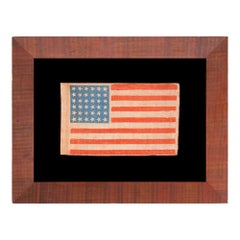
Price Upon Request
42 Hand Sewn Stars on An Antique American Flag ca 1889-1890
Located in York County, PA
42 HAND-SEWN STARS ON AN ANTIQUE AMERICAN FLAG WITH A TWO-TONE, DUSTY BLUE CANTON, REFLECTS THE ADDITION OF WASHINGTON STATE, MONTANA, AND THE DAKOTAS, NEVER AN OFFICIAL STAR COUNT, ...
Category
Antique Late 19th Century American Political and Patriotic Memorabilia
Materials
Wool
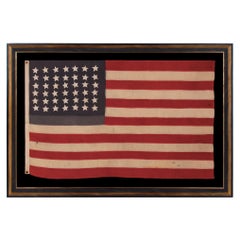
Price Upon Request
33 Star Antique American Flag with a Great Star Configuration, ca 1859-1861
Located in York County, PA
33 STARS ANTIQUE AMERICAN FLAG WITH A "GREAT STAR" CONFIGURATION ON A BRILLIANT, INDIGO BLUE CANTON, A RARE AND EXTRAORDINARY EXAMPLE, PRE-CIVIL WAR THROUGH THE WAR'S OPENING YEAR, 1...
Category
Antique Late 19th Century American Political and Patriotic Memorabilia
Materials
Silk
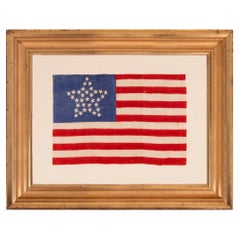
Homemade, Antique American Flag with Exceptional Folk Qualities, 1896-1908
Located in York County, PA
HOMEMADE, ANTIQUE AMERICAN FLAG WITH A TINY CANTON RESTING ON THE 6TH STRIPE AND AN EXTREMELY FOLKY PRESENTATION OF 45 STARS IN A “NOTCHED” PATTERN THAT MIGHT BE UNIQUE TO THIS EXAMP...
Category
Antique 1890s American Political and Patriotic Memorabilia
Materials
Cotton
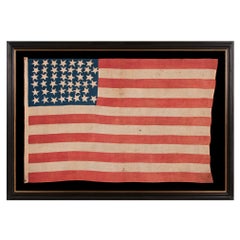
13 Star Antique American Parade Flag, ca 1876-1899
Located in York County, PA
13 STAR ANTIQUE AMERICAN PARADE FLAG, WITH A 3-2-3-2-3 CONFIGURATION OF STARS, AN EXTREMELY SCARCE AND UNUSUALLY LARGE VARIETY, MADE circa 1876-1899
13 star American national parade...
Category
Antique Late 19th Century Canadian Political and Patriotic Memorabilia
Materials
Cotton
Price Upon Request
You May Also Like
42-Star American Parade Flag, Commemorating Washington Statehood, 1889
Located in Colorado Springs, CO
This is an uncommon 42-star flag, commemorating the addition of the state of Washington to the Union. The flag dates to 1889-1890, and is printed on cotton. The canton consists of s...
Category
Antique 1880s American Political and Patriotic Memorabilia
Materials
Cotton
31-Star Printed American Flag, Celebrating California Statehood, Circa 1850
Located in Colorado Springs, CO
This is a rare 31-star medallion printed American flag, celebrating the addition of California to the Union. The flag is printed on silk and has a spectacular “Great Star” canton pat...
Category
Antique 1850s American Political and Patriotic Memorabilia
Materials
Silk
44-Star Silk American Flag, Celebrating Wyoming Statehood, Circa 1890-1896
Located in Colorado Springs, CO
Presented is a 44-star silk American flag, commemorating Wyoming statehood. The flag dates to 1890-1896. The flag has an “8-7-7-7-7-8” star configuration, with the stars whimsically ...
Category
Antique 1890s American Political and Patriotic Memorabilia
Materials
Silk
19th Century American 42 Star Flag, circa 1889
Located in Nantucket, MA
19th Century American 42 Star Flag, circa 1889, printed on linen period flag in the "Dancing Star" pattern. This was never an official U.S. flag sanctioned b y congress, but was made...
Category
Antique 1880s American Federal Political and Patriotic Memorabilia
Materials
Linen
36-Star American Printed Parade Flag, Circa 1865-1867
Located in Colorado Springs, CO
This is an antique 36-star American flag, as striking as it is scarce. The flag has a glazed cotton construction, with a blue canton printed with 36 white stars. The stars are arrang...
Category
Antique 1860s American Political and Patriotic Memorabilia
Materials
Cotton
13-Star Wool American Flag, with Zig-Zag Stars, Circa 1900
Located in Colorado Springs, CO
This is a beautiful 13-star American flag, each star sewn with zig-zag stitching. The wool flag was sewn at the turn of the century, circa 1900. The flag features 13 white stars rest...
Category
Antique Early 1900s American American Classical Political and Patriotic ...
Materials
Brass