Items Similar to Commission Pennant with 13 Stars, like for Private Vessel, Ca 1892-1910
Want more images or videos?
Request additional images or videos from the seller
1 of 6
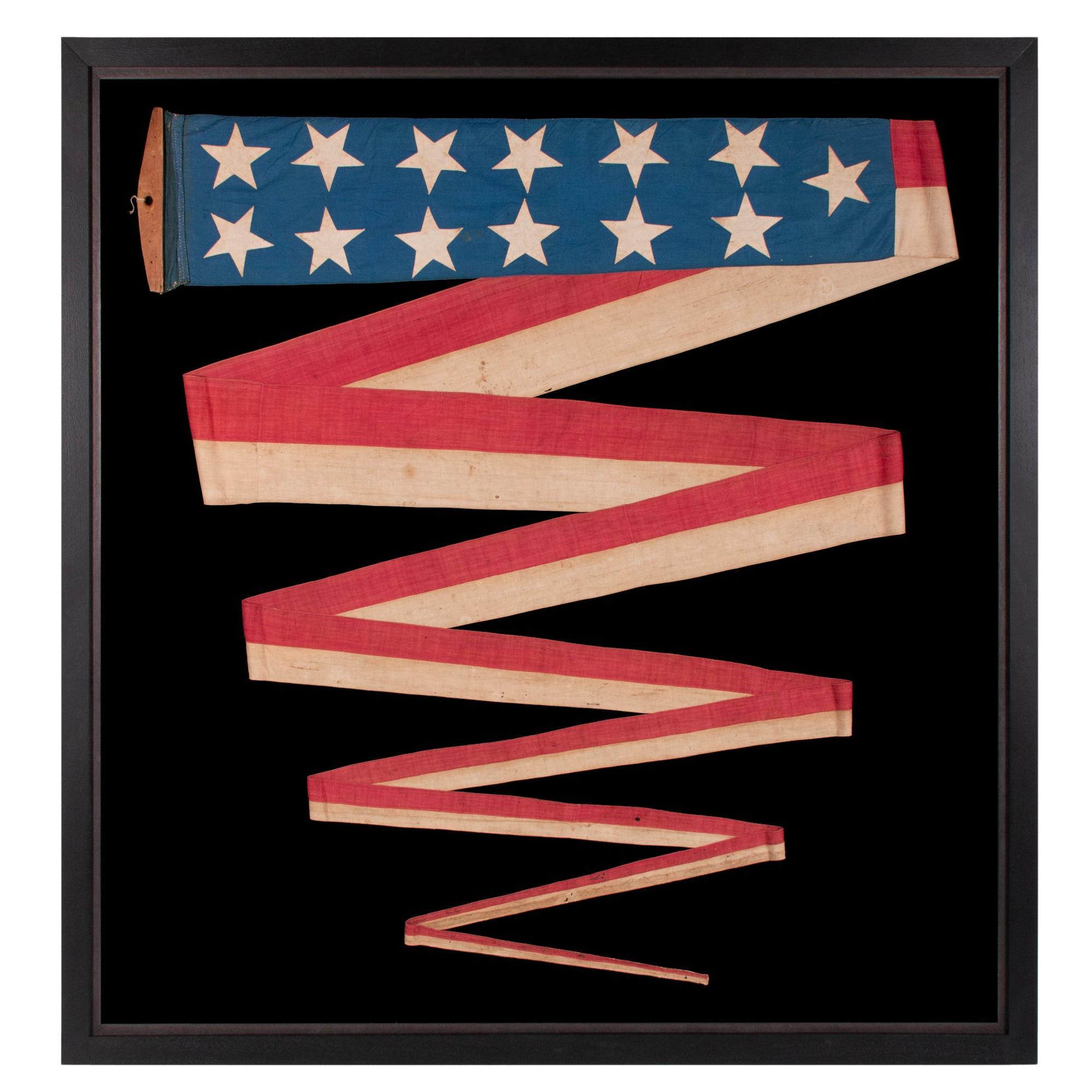
Commission Pennant with 13 Stars, like for Private Vessel, Ca 1892-1910
Price Upon Request
Price Upon Request
Price Upon Request
Price Upon Request
Price Upon Request
Price Upon Request
Price Upon Request
Price Upon Request
Price Upon Request
Price Upon Request
About the Item
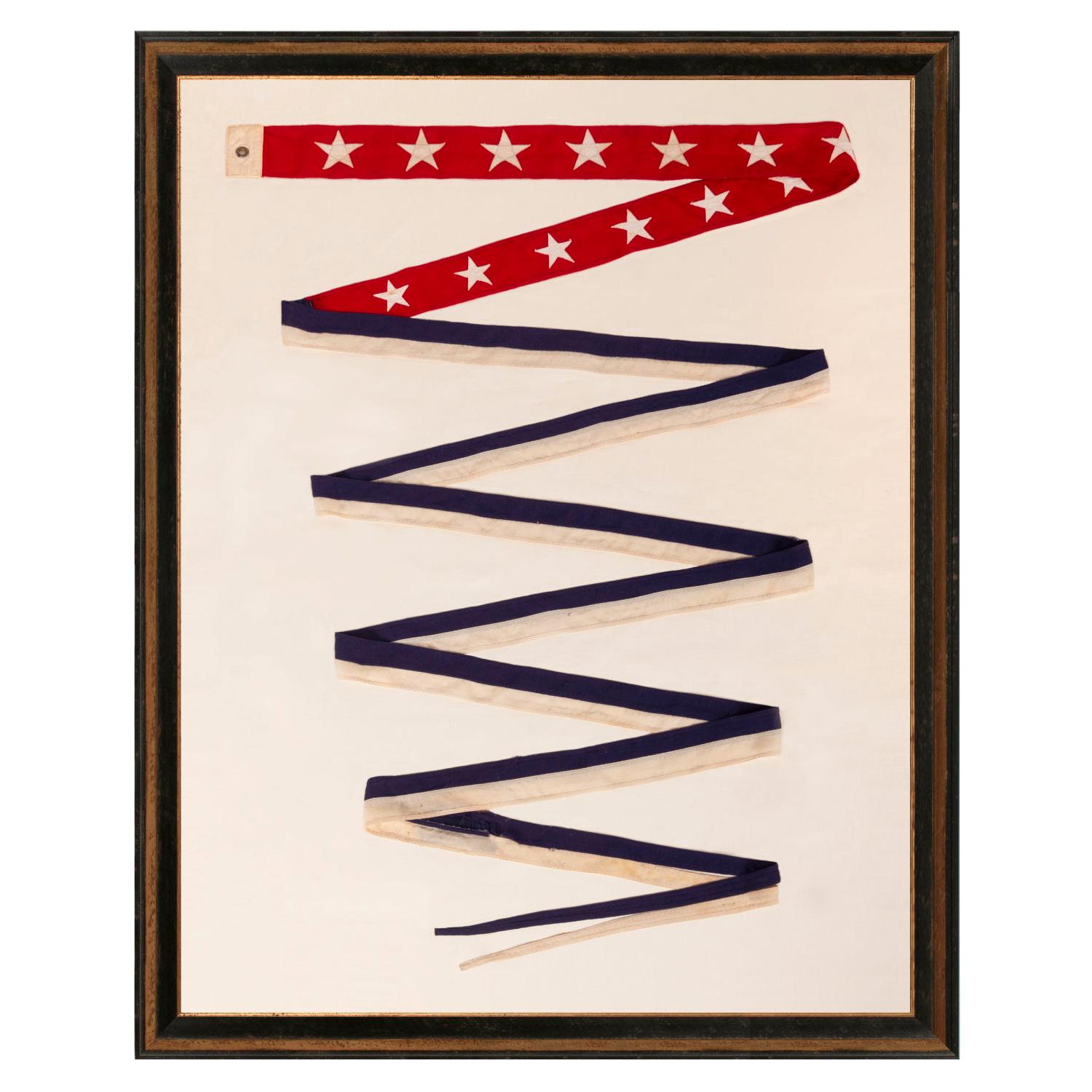
Commission pennants are the distinguishing mark of a commissioned U.S. Navy ship. Flown at the topmast, the typical American format is a long blue field, usually with a single row of white stars, although sometimes with their total divided into two rows, followed by two long stripes, red-over-white. A ship became commissioned when this pennant was hoisted. Flown during both times of peace and war, the only time the pennant is not flown is if a flag officer or civilian official was aboard and replaced it with their own flag.
Sometimes the owners of private ships mimicked the use of Navy signals. Some seafaring men would have served in the Navy and become privy to various practices in that capacity. Others flew them purely for stylistic reasons, either on a regular basis or while the boat was dressed for special occasion. Hudson River steamers regularly flew pennants of this nature, as evidenced by period photography as well as the paintings of artists such as John and James Bard. Mississippi riverboats likely flew them, as did various yachts, and other private vessels.
Probably made between roughly 1892 and 1910, more likely on the earlier end of this date window, this particular commission pennant is a commercially-produced example. It is an unusual one, however, in a scale I have not previously owned.
At 4 inches on the hoist [the maximum point] x 8 feet on the fly, the dimensions do not coincide with specified U.S. Navy regulations of the period, or of any period, for that matter. There had been 9-foot style specified in all regulations since 1854, renewed again in 1912. These had a maximum height that remained consistent at 3 inches. But there was never an 8-foot style.
Because there was a great deal of inconsistency in the exact dimension of U.S. Navy small boat ensigns, one might guess that the same might be true of commission pennants. This is difficult to know with certainty, however, because such pennants were so seldom saved, and so few have been documented that are pre-WWI (U.S. involvement 1917-1918). Too few examples survive, private or otherwise, much less with documented history, so one can’t accurately gauge just how well regulations were followed.
In the 1892-1910 era, the Navy seems to have been making most of its own flags, with much of the production of signed and dated examples occurring at the Brooklyn Navy Yard in New York. This flag was not made at that facility, nor any other U.S. Navy site that I am aware of. But we know that the Navy sometimes procured flags from flag-makers directly, when manufacture was neither convenient nor practical. When this occurred, my best, educated guess is that quartermasters did not find it important enough to quibble over having an 4” x 8’ pennant, versus one that was 3” x 9’, at least not if history is any guide. When something was readily available from the likes of Annin, Horstmann, or some alternative source, and there was ample precedence for not following specs precisely, they probably bought what was available and/or practical. As a rule, when it came to flag use, people did what made sense in the 19th century and prior, often settling for what was present and available.
What can be said is that the construction of this particular flag, while very nice, and typical of wool bunting flags of the time, is that it does not display the hallmarks of Navy-produced flags of the same period. For this reason, the intended purpose of its manufacture, regardless of the eventual function, was almost certainly for private use, on a private yacht, or on a commercial/merchant vessel.
Commissioning pennants were once very important in their role as signals and thus needed to be seen from great distance. During the 18th and 19th centuries, some reached as long as a hundred feet. Sometime around 1910, the function of commission pennants leaned away from identification and more toward ceremony and custom. By WWI (U.S. involvement 1917-18) most ranged between just four and six feet in length. Today the largest examples measure two-and-a-half inches by six feet.
Early on, commission pennants had a number of stars equal to that on the national flag. As more and more states joined the Union, however, it became impractical to use the full complement of stars, especially on smaller examples. During the mid-late 19th century, many substituted 13 stars for the full count, to reflect the original colonies. This mirrored the star count used by the Navy on most of the Stars
Stripes flags that it flew on small craft. "U.S. Navy small boat ensigns," as they are called, most often had 13 stars until 1916, when President Woodrow Wilson wrote an Executive Order that ended that practice in favor of the full star count.
Construction: The canton and stripes of the pennant are made of wool bunting that has been pieced-and-sewn by machine. The stars are made of cotton and are double-appliquéd (applied to both sides) with a zigzag, machine stitch. There is a twill cotton binding along the hoist, with two brass grommets. Some pennants of this type terminate at the fly end in a swallowtail format, while others, such as this example, have a blunt end, like this one, which is original to the flag’s construction.
Mounting: The pennant was mounted and framed within our own conservation department, which is led by expert staff. We take great care in the mounting and preservation of flags and have framed thousands of examples.
The background fabric is 100% cotton twill, black in color, that has been washed and treated for colorfastness. Three-dimensional folds were added in the stripes and a shadowbox was created to accommodate the mount. The substantial, black-painted and gilded, with its wide, shaped profile, is Italian. The glazing is U.V. protective acrylic (Plexiglas). Feel free to contact us for more details.
Condition: There is minor mothing throughout, more significant in the stripes than in the union. There are very tiny holes in some of the cotton stars, and modest to moderate areas of soiling throughout the white wool bunting. there is some separation between the blue wool bunting and the binding, with moderate fabric breakdown and loss. Many of my clients prefer early flags to show their age and history of use.
- Dimensions:Height: 32.5 in (82.55 cm)Width: 39 in (99.06 cm)Depth: 3 in (7.62 cm)
- Materials and Techniques:
- Place of Origin:
- Period:
- Date of Manufacture:1892-1910
- Condition:See Item Description.
- Seller Location:York County, PA
- Reference Number:Seller: 13j-16551stDibs: LU849729586842
About the Seller
5.0
Recognized Seller
These prestigious sellers are industry leaders and represent the highest echelon for item quality and design.
Established in 1991
1stDibs seller since 2008
71 sales on 1stDibs
Typical response time: Several days
- ShippingRetrieving quote...Shipping from: York County, PA
- Return Policy
More From This Seller
View AllU.S War Department Commissioning Pennant with 13 Stars
Located in York County, PA
EXTREMELY RARE U.S. WAR DEPARTMENT COMMISSIONING PENNANT WITH 13 STARS, A REVERSAL OF THE U.S. NAVY COLOR SCHEME, TWENTY-FOUR FEET ON THE FLY, SP...
Category
20th Century American Political and Patriotic Memorabilia
Materials
Wool
Price Upon Request
WWII Liberation Flag with 23 Silver Gilt Stars, ca 1944
Located in York County, PA
WWII LIBERATION FLAG w/ 23 SILVER GILT STARS ON A CORNFLOWER BLUE CANTON & 16 STRIPES, MADE TO WELCOME U.S. TROOPS IN FRANCE FOLLOWING LIBERATION FROM...
Category
Vintage 1940s French Political and Patriotic Memorabilia
Materials
Cotton
Price Upon Request
Exceptional American Flag, 38 Stars in 3 Sizes in a Fantastic, Unusual Medallion
Located in York County, PA
EXCEPTIONAL ANTIQUE AMERICAN FLAG WITH 38 GLAZED COTTON STARS, IN 3 DIFFERENT SIZES, ARRANGED IN A BEAUTIFULLY GRAPHIC, DOUBLE-WREATH STYLE MEDALLION, WITH TRIANGLES OF 4 STARS IN ...
Category
Antique Late 19th Century North American Political and Patriotic Memorab...
Materials
Silk
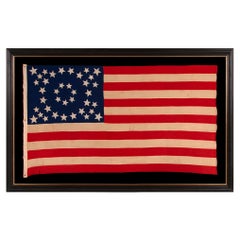
13 Star Antique American Parade Flag, ca 1876-1899
Located in York County, PA
13 STAR ANTIQUE AMERICAN PARADE FLAG, WITH A 3-2-3-2-3 CONFIGURATION OF STARS, AN EXTREMELY SCARCE AND UNUSUALLY LARGE VARIETY, MADE circa 1876-1899
13 star American national parade...
Category
Antique Late 19th Century Canadian Political and Patriotic Memorabilia
Materials
Cotton
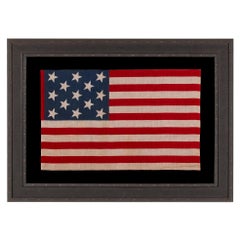
Price Upon Request
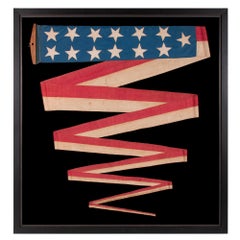
Hand-Sewn 13 Star Cornflower Blue 32 Foot Commission Pennant circa 1845-1865
Located in York County, PA
ENTIRELY HAND-SEWN, 32-FOOT, SHIP’S COMMISSION PENNANT OF THE 1845-1865 ERA, A HOMEMADE, COTTON EXAMPLE, WITH 13 STARS ON A CORNFLOWER BLUE CANTON, IN A BEAUTIFUL STATE OF PRESERVATION
Commission pennants are the distinguishing mark of a commissioned U.S. Navy ship. A ship becomes commissioned when the pennant is hoisted. Flown during both times of peace and war, the only time it is not flown is if a flag officer or civilian official is aboard and replaces it with their own flag. Flown at the topmast, this would be the first thing one would see coming over the horizon and identified the vessel as a warship.
Sometimes the owners of private ships mimicked the use of Navy signals. Some seafaring men would have served in the Navy and become privy to various practices in that capacity. Others flew them purely for stylistic reasons, either on a regular basis or while the boat was dressed for special occasion. Hudson River steamers regularly flew pennants of this nature, as evidenced by period photography as well as the paintings of artists such as John and James Bard...
Category
Antique Mid-19th Century American Political and Patriotic Memorabilia
Materials
Cotton
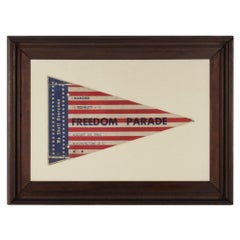
Stars
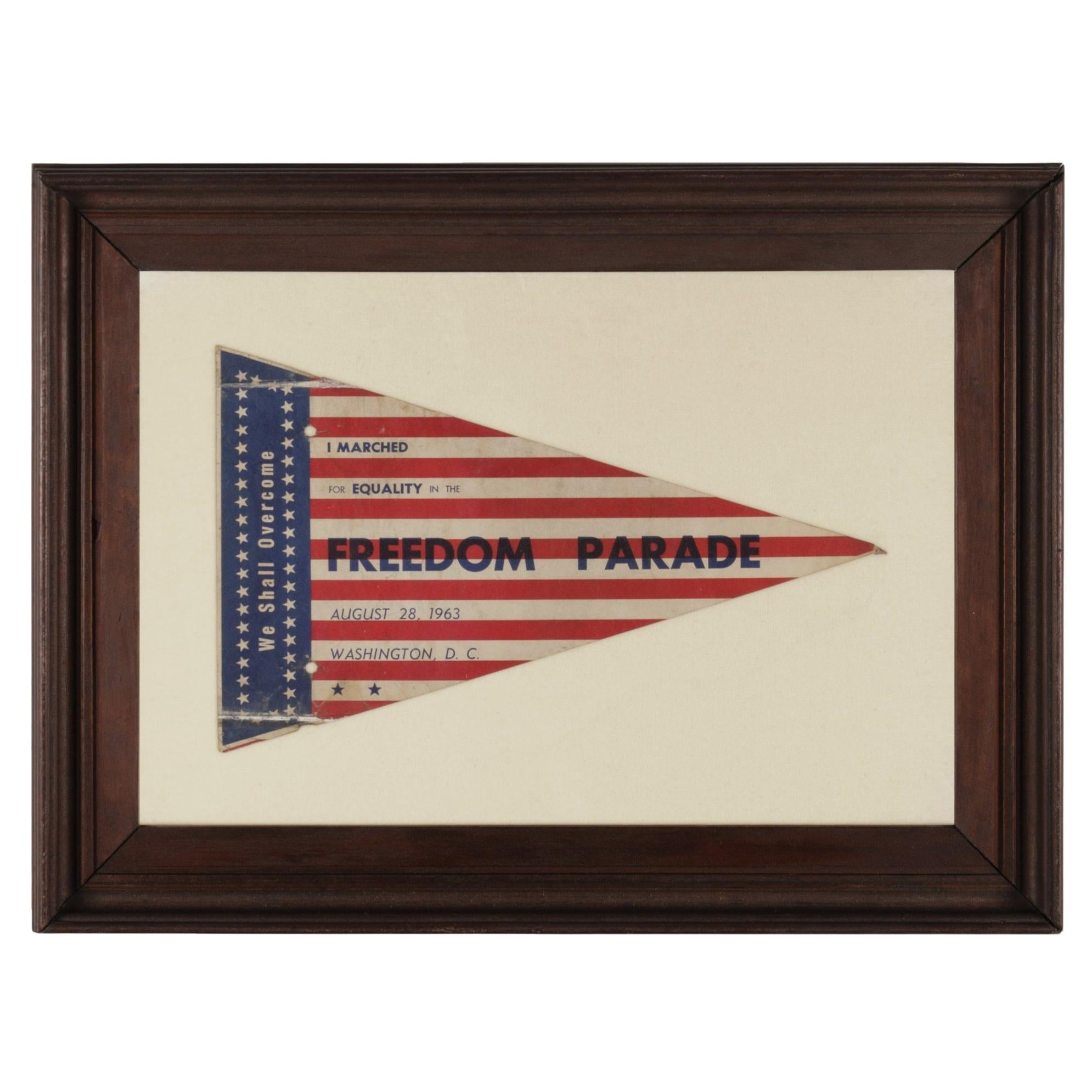
Stripe Pennant from the March on Washington, August 28, 1963
Located in York County, PA
BOLDLY GRAPHIC AND UNUSUAL STARS & STRIPES PENNANT FROM THE ‘MARCH ON WASHINGTON’ OF AUGUST 28TH, 1963, WHEN MARTIN LUTHER KING DELIVERED HIS HISTORIC "I HAVE A DREAM" SPEECH; THIS E...
Category
Vintage 1960s American Political and Patriotic Memorabilia
Materials
Paper
Price Upon Request
You May Also Like
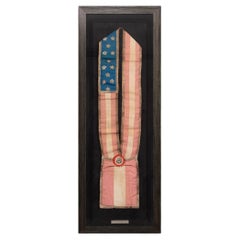
Antique 13-Star Patriotic Sash by Louis E. Stilz
Bros., Late 19th Century
Located in Colorado Springs, CO
Presented is an original patriotic sash from the late 19th century, featuring 13 stars against a bright blue field. This sash features appliqued silver stars on a blue canton, red an...
Category
Antique Late 19th Century American Historical Memorabilia
Materials
Cotton
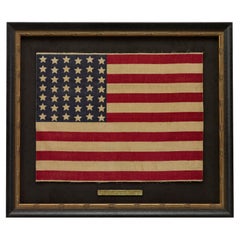
42-Star American Parade Flag, Commemorating Washington Statehood, 1889
Located in Colorado Springs, CO
This is an uncommon 42-star flag, commemorating the addition of the state of Washington to the Union. The flag dates to 1889-1890, and is printed on cotton. The canton consists of s...
Category
Antique 1880s American Political and Patriotic Memorabilia
Materials
Cotton
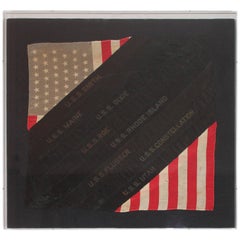
Framed Hand Sewn Patriotic Sham Made from a Flag and Ship Ribbons
Located in Los Angeles, CA
This Great framed Folk Art sham with 48star flag and ship ribbons is a great patriotic item. The top left corner as well as the bottom right corner are scraps of a 48 star linen flag and in between them are ribbons of ships names that are sewn together in a collage. The American ships span three centuries of ships ribbons, from late 19th century to present day ships. As well as the "USS Utah" which was sunk during the attack on Pearl Harbor.
This great and proud sham is not only a great American item but is a Symbol of hope and unity throughout the ages. Serves better as a hanging Folk Art...
Category
20th Century American Folk Art Political and Patriotic Memorabilia
Materials
Plexiglass
$760 Sale Price
55% Off
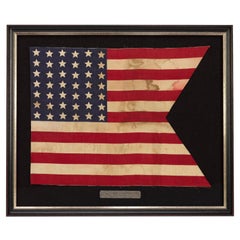
42-Star 7th Cavalry Regiment Parade Guidon, Printed "7A", Circa 1889-1890
Located in Colorado Springs, CO
Presented is 42-star 7th Cavalry Regiment parade guidon, dating to 1889-1890. The guidon is printed in cotton, and stenciled over with a “7” over crossed swords of the 7th Cavalry Re...
Category
Antique 1880s American Political and Patriotic Memorabilia
Materials
Cotton
38-Star American Parade Flag, Flown at a Reception for President Grant, 1880
Located in Colorado Springs, CO
This is a beautifully colored 38-star American parade flag, flown at a public reception for Ulysses S. Grant in October of 1880. This printed flag features a rare, triple medallion s...
Category
Antique 1880s American Political and Patriotic Memorabilia
Materials
Cotton
13-Star Flag Waver for the Centennial Celebration
Located in Colorado Springs, CO
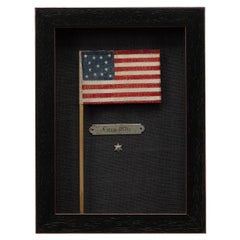
This small charming 13-star flag waver was made for and sold during the nation’s Centennial celebration in Philadelphia in 1876. All manner of flags were made for the official Centen...
Category
Antique 1870s American American Classical Political and Patriotic Memora...
Materials
Fabric
More Ways To Browse
Antique Hoist
19th Century Settle
Antique Pennants
Brooklyn Navy Yard
Wool Flag
Navy Flags
Pennant Frame
Star Mirror Antique
Commissioning Pennant
Antique Bunting Flags
American Flag 13 Stars Yacht
Antique Hoist
American Flag Cotton
4th Of July
British Flag
Antique Yachting
Antique Wash Set
Vintage Political Memorabilia