Items Similar to Homemade, Antique American Flag with Exceptional Folk Qualities, 1896-1908
Want more images or videos?
Request additional images or videos from the seller
1 of 6
Homemade, Antique American Flag with Exceptional Folk Qualities, 1896-1908
Price Upon Request
Price Upon Request
Price Upon Request
Price Upon Request
Price Upon Request
Price Upon Request
Price Upon Request
Price Upon Request
Price Upon Request
Price Upon Request
About the Item
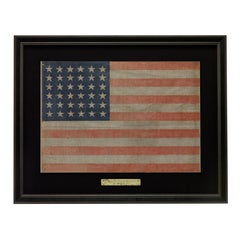
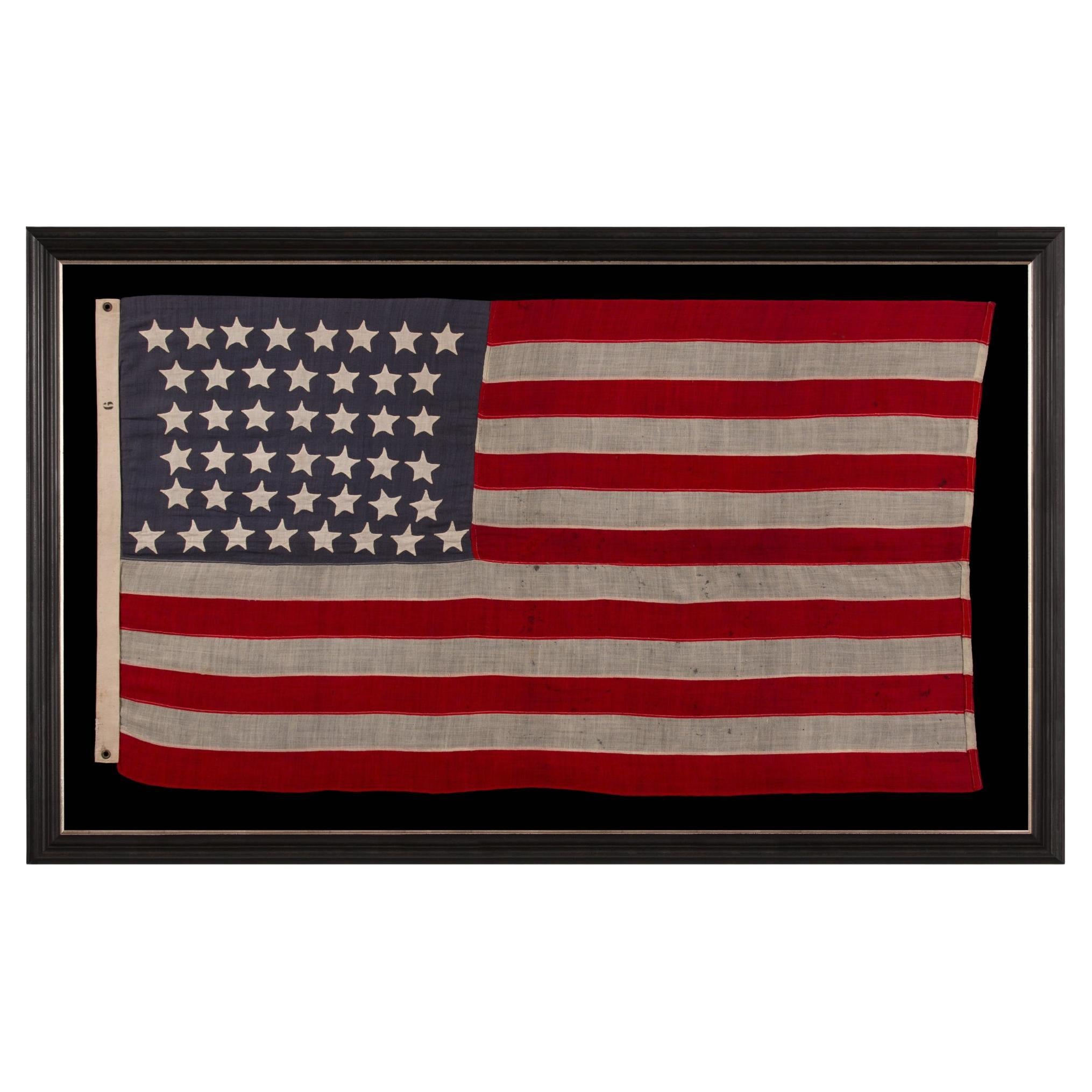
HOMEMADE, ANTIQUE AMERICAN FLAG WITH A TINY CANTON RESTING ON THE 6TH STRIPE AND AN EXTREMELY FOLKY PRESENTATION OF 45 STARS IN A “NOTCHED” PATTERN THAT MIGHT BE UNIQUE TO THIS EXAMPLE; REFLECTS THE ERA WHEN UTAH WAS THE MOST RECENT STATE TO JOIN THE UNION, 1896-1908
45 star American national flag, homemade and with a host of unusual and graphically compelling features. Chief among these are the size and placement of the blue canton against the striped field, and the especially whimsical nature of the stars within. Note how the latter present like living starfish, with arms of varying shape and size, bent this way and that, intertwined in a space too small for their number. These are arranged in haphazard rows of 7-8-7-8-7-8, in what was intended to be a “notched” pattern, that leaves three open spaces for Western Territories yet-to-be-added, only one of which is truly large enough to accomplish the task in a reasonable manner, even with an extra degree of leniency.
Note how the canton, tiny in scale, rests on the 6th stripe. Because there were no specified proportions for the American national flag until 1912, and no specified placement of the canton against the striped field, there was no right or wrong in this regard. Even so, the canton of most flags, homemade or commercially-made alike, almost always rested on the 8th stripe.
Note how the stars toward the hoist end are more evenly spread, while those toward the fly become more jumbled as they progress, so that an arm of the last star, in each of the longest rows, actually touches the edge, like swimmers in a race. The combination of all of the above results in a very beautiful flag from a folk are perspective, with elements that seem both old and modernistic.
The stars of the flag are made of plain weave cotton and are double-appliquéd, meaning that they are applied to both sides. These are hand-sewn on the obverse (front), and all except two (the first star in the 4th row, and the first star in the last row, which are hand-sewn) are appliquéd by treadle stitching on the reverse. The stripes of the flag are likewise of cotton and are treadle sewn throughout. These were joined to the canton in the same manner. There is a plain weave cotton binding along the hoist, with two whip-stitched grommets, With metal rings inserted for stability.
The canton is constructed of a single width of fabric that comprises most of its surface area, to which a small piece of the same fabric was added in the top, hoist end corner. This is not a gusset, but rather is inserted into the larger piece of fabric and joined to it by a combination of hand and treadle stitching. In spite of its location, at one of the four points in which a flag receives the most stress when flown, this actually appears to be original to the flag’s construction. It may be that the first two stars in the 1st row were removed and re-applied, so that a repair could be made, but it doesn't appear so. The canton was hemmed along the top edge with treadle stitching, and the top of the first stripe has been hemmed in the same fashion. The canton has been joined to the striped field by treadle stitching. The bottom of the last stripe has a selvedge edge.
When Utah finally entered the Union as the 45th state on January 4th, 1896, it had been attempting to gain statehood for many years. It remained a territory primarily due to the fact that the Mormon Church and Utah authorities continued to be openly tolerant of polygamy. In 1890, Mormon Church President Wilford Woodruff published a manifesto that denounced the contract of “any marriages forbidden by the law of the land”. This gave way to Utah’s 1896 acceptance. The 45 star flag was generally used from that year until 1907, when Oklahoma joined the Union. Due to the Spanish-American War (1898) and Teddy Roosevelt’s famous world tour of the “White Fleet” (launched in 1907), this was an extremely patriotic period.
Presidents who served during this period were Democrat Grover Cleveland, in his second, non-consecutive term, the two terms of Republican William McKinley (the second cut short by his 1901), and the two terms of Theodore Roosevelt, the first of these gained by ascension when McKinley passed.
Mounting: For 25 years we have maintained a specialized department for this purpose. Our lead conservator holds a master's degree in textile conservation from one of the nation’s top university programs. We take great care in the mounting and preservation of flags and related textiles and have preserved thousands of examples.
The flag has been hand-stitched to 100% silk organza throughout for support (flat-lined). The black-painted and hand-gilded molding, with its wide, serpentine profile, is Italian. The background is 100% cotton twill, black in color, that has been washed and treated for colorfastness. The glazing is U.V. protective acrylic (Plexiglas).
Condition: In addition to the aforementioned length of fabric and the upper, hoist and a corner, which appears to be original to the flags construction in spite of its appearance, there are minor to modest incidents of soiling and staining in the striped field, the most significant of which occurs in the white stripes. A series of tiny holes and associated rust marks along the binding suggests that the flag was not only tied to a wooden staff at the top and bottom, by way of the brass grommets, but affixed to it between these points with tiny metal tacks. There is a scattering of very minor holes in both the canton and the striped field. There is minor fabric loss with associated frame in the top, fly and corner. A tiny length of fabric of similar coloration was placed behind this area for masking purposes. Many of my clients prefer early flags to show their age and history of use.
Frame Size (H x L): Approx. 60.5" x 87"
Flag Size (H x L): 48.25" x 75"
- Dimensions:Height: 60.5 in (153.67 cm)Width: 87 in (220.98 cm)Depth: 2.5 in (6.35 cm)
- Materials and Techniques:
- Place of Origin:
- Period:
- Date of Manufacture:1896-1908
- Condition:See Item Description.
- Seller Location:York County, PA
- Reference Number:Seller: 45j-10091stDibs: LU849743950572
About the Seller
5.0
Recognized Seller
These prestigious sellers are industry leaders and represent the highest echelon for item quality and design.
Established in 1991
1stDibs seller since 2008
71 sales on 1stDibs
Typical response time: Several days
- ShippingRetrieving quote...Shipping from: York County, PA
- Return Policy
More From This Seller
View All44 Star Antique American Flag, Wyoming Statehood, ca 1890-1896
Located in York County, PA
44 STAR ANTIQUE AMERICAN FLAG WITH AN HOURGLASS ARRANGEMENT ON A DUSTY BLUE CANTON; REFLECTS THE ERA WHEN WYOMING WAS THE MOST RECENT STATE TO JOIN THE UNION, 1890-1896
Wyoming was ...
Category
Antique 1890s American Political and Patriotic Memorabilia
Materials
Wool
Price Upon Request
13 Star Antique American Parade Flag, ca 1876-1899
Located in York County, PA
13 STAR ANTIQUE AMERICAN PARADE FLAG, WITH A 3-2-3-2-3 CONFIGURATION OF STARS, AN EXTREMELY SCARCE AND UNUSUALLY LARGE VARIETY, MADE circa 1876-1899
13 star American national parade...
Category
Antique Late 19th Century Canadian Political and Patriotic Memorabilia
Materials
Cotton
Price Upon Request
38 Star Antique American Flag, Colorado Statehood, circa 1876-1889
Located in York County, PA
38 star antique American parade flag with scattered star orientation, made of silk, with generous scale and vivid colors, Colorado Statehood, 1876-1889
38 star American national p...
Category
Antique Late 19th Century American Political and Patriotic Memorabilia
Materials
Silk
Price Upon Request
26 Star Antique American Flag, with 11 Stripes, Michigan Statehood, ca 1837-1846
Located in York County, PA
26 STAR ANTIQUE AMERICAN PARADE FLAG WITH 11 STRIPES AND IT’S CANTON RESTING ON THE “WAR STRIPE.” THE EARLIEST KNOWN STAR COUNT FOR PRINTED EXAMPLES, 1837-1846, MICHIGAN STATEHOOD
2...
Category
Antique Mid-19th Century American Political and Patriotic Memorabilia
Materials
Cotton
44 Star Silk Antique American Flag, Wyoming Statehood, ca 1890-1896
Located in York County, PA
44 STARS IN JUSTIFIED ROWS, WITH VARIED STAR POSITIONING, ON A SILK, ANTIQUE AMERICAN FLAG WITH STRIKING COLORS, REFLECTS WYOMING STATEHOOD, circa 1890-1896
44 star American parade ...
Category
Antique Late 19th Century American Political and Patriotic Memorabilia
Materials
Silk
Price Upon Request
44 Star Antique American Parade Flag, Wyoming Statehood, ca 1890-1896
Located in York County, PA
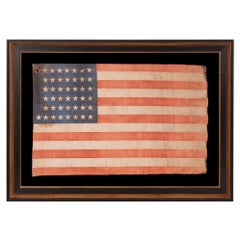
44 STAR ANTIQUE AMERICAN PARADE FLAG WITH ENDEARING WEAR FROM LONG TERM USE AND WITH ITS STARS ARRANGED IN A NOTCHED PATTERN THAT LEAVES 4 SPACES OPEN FOR THE REMAINING WESTERN TERRI...
Category
Antique 1890s American Political and Patriotic Memorabilia
Materials
Cotton
Price Upon Request
You May Also Like
42-Star American Parade Flag, Commemorating Washington Statehood, 1889
Located in Colorado Springs, CO
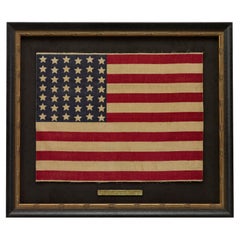
This is an uncommon 42-star flag, commemorating the addition of the state of Washington to the Union. The flag dates to 1889-1890, and is printed on cotton. The canton consists of s...
Category
Antique 1880s American Political and Patriotic Memorabilia
Materials
Cotton
31-Star Printed American Flag, Celebrating California Statehood, Circa 1850
Located in Colorado Springs, CO
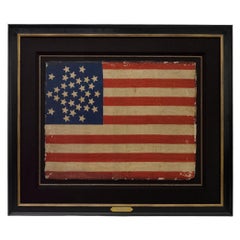
This is a rare 31-star medallion printed American flag, celebrating the addition of California to the Union. The flag is printed on silk and has a spectacular “Great Star” canton pat...
Category
Antique 1850s American Political and Patriotic Memorabilia
Materials
Silk
Rare Antique 45-Star American Flag Hand-Painted on Cotton, Spanish-American War
Located in Doha, QA
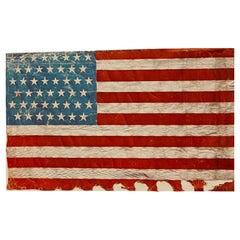
This exceptional and exceedingly scarce 45-star American flag, commemorating Utah’s admission as the 45th state in 1896, represents one of the earliest surviving examples of a hand-p...
Category
Antique Late 19th Century American Folk Art Historical Memorabilia
Materials
Cotton, Glass, Wood, Paint
Centennial Celebration "1776-1876" American Flag Banner
Located in Colorado Springs, CO
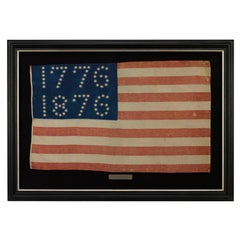
Presented is a rare Centennial patriotic flag banner, dating to 1876. The flag’s brilliant blue canton is spectacular, with 81 five-pointed, rayed stars, arranged to read “1776” and “1876.” The flag’s design is completed with thirteen alternating red and white stripes. The flag is a three-piece, treadle-sewn sewn construction, printed on a thin wool and cotton blend. Along the edge, there is a narrow, treadle-sewn sleeve made of cotton tape.
In the lead up to the nation’s Centennial in 1876, flag makers and individuals looked to the past for designs to produce as part of the country’s many celebrations. Popular interpretation of the stars and stripes undoubtedly reached its climax of variety and originality at the time of our Nation’s first Centennial. Since no design restrictions were placed on flagmaker’s imaginations and no strict distinctions were drawn between official and unofficial star counts, it is no surprise that, on the occasion of the Centennial, creativity in flag design was not the exception, but the rule.
The cantons from this period presented an array of geometric abstractions. Great star patterns, referred to as the “starry flower of Liberty” by Oliver Wendell Holmes, that were popular from 1818 and on, resurfaced in Centennial flags...
Category
Antique 1870s American Political and Patriotic Memorabilia
Materials
Wool, Cotton
44-Star Silk American Flag, Celebrating Wyoming Statehood, Circa 1890-1896
Located in Colorado Springs, CO
Presented is a 44-star silk American flag, commemorating Wyoming statehood. The flag dates to 1890-1896. The flag has an “8-7-7-7-7-8” star configuration, with the stars whimsically ...
Category
Antique 1890s American Political and Patriotic Memorabilia
Materials
Silk
36-Star American Printed Parade Flag, Circa 1865-1867
Located in Colorado Springs, CO
This is an antique 36-star American flag, as striking as it is scarce. The flag has a glazed cotton construction, with a blue canton printed with 36 white stars. The stars are arrang...
Category
Antique 1860s American Political and Patriotic Memorabilia
Materials
Cotton