Items Similar to Ohio State Parade Flag with a Civil War Veterans Overprint
Want more images or videos?
Request additional images or videos from the seller
1 of 8
Ohio State Parade Flag with a Civil War Veterans Overprint
$1,450
£1,105.96
€1,259.42
CA$2,037.69
A$2,222.39
CHF 1,177.27
MX$26,643.30
NOK 14,993.21
SEK 13,710.18
DKK 9,409.10
About the Item
OHIO STATE FLAG WITH CIVIL WAR VETERANS' OVERPRINT FROM THE GRAND ARMY OF THE REPUBLIC POST IN COLUMBUS, MADE IN MOURNING OF THE 1925 PASSING OF NATIONAL G.A.R. COMMANDER IN CHIEF DANIEL M. HALL, WHO ALSO SERVED AS COMMANDER OF THE OHIO DEPARTMENT OF THE G.A.R., AS WELL AS THE LOCAL CHAPTER
Flag of the State of Ohio, printed on oilcloth-like cotton, affixed to its original wooden staff. Made for Civil War veteran's use, the flag bears a stamped overprint in the striped field that consists of an open wreath of laurel branches, inside which is the following text: “GAR [Grand Army of the Republic] Post, Dan Hall, Columbus, OH”.
Born on October 20th, 1842, Daniel M. Hall enlisted with the Union Army as a Private at the age of 18 on August 25th, 1861. On October 8th of that year he mustered into the Co. H of the 2nd Ohio Cavalry. Discharged for disability on June 28th, 1862, he reenlisted approximately 17 months later, on November 11th, 1863, and mustered into Co. F of the 12th Ohio Cavalry at Camp Cleveland. He was at some point promoted to the rank of Sergeant, and, on February 21st, 1864, to the rank of Corporal. He mustered out at Nashville on November 14th, 1865.
Hall mustered into the Hamlin Post of the Ohio G.A.R. on May 23rd, 1883. He would go on to serve not only as Commander of the Dept. of Ohio for the organization, but as National Commander of the entire Grand Army of the Republic.
The Grand Army of the Republic was the primary veterans association for Union Civil War soldiers. Founded in 1866, its members dressed up in Civil War uniforms, attended parades and reunions, and the organization was somewhat more fraternal in nature than today’s VFW or American Foreign Legion.
Flags overprinted for the purpose of advertising are a specialized form in American flag collecting. A flag with a basic G.A.R. overprint is the most common type. This might be accompanied by a post number and a date. More elaborate the overprints are more highly desired, such as this one, which is the only variation I know of that honors a particular person who was not the namesake of the chapter itself.
It is of interest to note that a sister variety of 48 star parade flag is known, printed on the same fabric, that bears the same overprint, accompanied by the words: “We Mourn Our Comrade." From the additional text on the 48 star variety, one can extrapolate that the flags were made to mourn the passing of this important leader of Civil War veterans on October 19th, 1925, just one day before his 83rd birthday.
The State Flag of Ohio was designed in 1901 by Cleveland architect John Eisenmann, who designed the Ohio building for the state's exhibition at the Pan American Exposition World's Fair in Buffalo, New York. It was officially adopted by the Ohio legislature on May 19th, 1902. It's elements are centered on a red disc, set against a circular white ground that forms a letter "O." This simultaneously represents a buckeye, the fruit of the state tree and an iconic Ohio symbol. The flag's 5 stripes are said to represent the state's waterways and roads, while the triangular shape of the union is said to illustrate hills and valleys. The presentation of 13 stars along the hoist end, arranged in a semi-circular medallion with two off-set stars above and below, reflects the original 13 colonies. The diamond of stars, towards the fly end. bring the overall count to 17 to reflect Ohio's admission. When the design was adopted by the state legislature, the position of these stars was changed slightly, moving them further around the circle to form a wreath.
Flag expert Whitney Smith, who coined the term Vexillology in the late 1950's (the accepted term for the study of flags), pointed out that the format of the flag itself was reminiscent of Civil War cavalry guidons, carried by Ohio regiments throughout the state. These were of swallowtail form, though with 13 stripes, all horizontal and 90 degrees to the hoist. Most often these had circular star patterns around an open center, which makes them even more similar to the Ohio flag. Although these were carried everywhere throughout the North, the flags are certainly similar. The Ohio flag, however, is in the shape of a ship's burgee rather than that of a U.S. Cavalry guidon. This is especially appropriate due to the importance of the Ohio River, as well as Lake Erie. For thousands upon thousands of American settlers, the Ohio River, largest of the Mississippi's tributaries, was the gateway to the American West. Its own tributaries provided transport throughout the state itself, while Lake Erie opened passage to Michigan and beyond. All were the lifeblood of industry and trade.
Brief History of the 2nd Ohio Cavalry and the 12th Ohio Cavalry during Daniel M. Hall's tenure with the units:
2nd Ohio Cavalry:
Second Cavalry. - Cols., Charles Doubleday, August V. Kautz, Bayard Nettleton, Dudley Seward; Lieut.-Cols., Robert W. Ratliff, George A. Purington, David E. Welch; Majs., Henry F. Willson, George G. Miner, Henry L. Burnett, Albert Barnitz, Hyman N. Easton, Rynd E. Lawder.
The 2nd cavalry was recruited and organized under the supervision of Hon. B. F. Wade and Hon. John Hutchins, in the summer and fall of 1861, to serve for three years, and rendezvoused at Camp Wade. Early in Jan., 1862, under orders from the war department, the regiment proceeded by rail via Cincinnati, St. Louis and St. Joseph to Platte City, Mo. In February a scouting party of 120 men of the regiment was attacked in the streets of Independence by an equal force under the command of the subsequently noted Quan- trill, but as the results of the regiment's "first fight," Quantrill was routed in 15 minutes, losing 5 killed, 4 wounded and 5 captured, the Ohioans losing 1 killed and 3 wounded. (Source: The Union Army: A History of Military Affairs in the Loyal States, 1861-65…, Vol. 2).
At this point, Hall was discharged for disability.
12th Ohio Cavalry:
Col., Robert W. Ratliff; ; Lieut.-Cols., Robert H. Bentley, John F. Herrick; Majs., Miles J. Collier, Erastus C. Moderwell.
This regiment, from the state at large, was organized at Camp Cleveland from Aug. 7 to Nov. 24, 1863, to serve for a term of three years. On Nov. 29 it moved to Louisville, then to Lexington and Mt. Sterling, and at the latter place was closely engaged with the Confederates in the following June, behaving with great gallantry and being especially complimented by Gen. Burbridge. It overtook Morgan [Morgan's Raiders] at Cynthiana and fought with him, scattering his forces in every direction. In October it was engaged for half a day in hard fighting at Saltville, finally charging up a hill and driving the enemy from his works. It did its full share of duty under Gen. Stoneman, at Bristol, Abingdon and Marion; thence as support to Gen. Gillem in his pursuit of Vaughn; then back again to Marion, where Stoneman engaged Breckenridge for 40 hours, and finally defeated him. In December Saltville was captured and the forces returned to Kentucky, regimental headquarters being established at Richmond. In the spring of 1865 it again formed part of a raiding expedition under Gen. Stoneman, during which Salisbury, with its stores and the Federal prisoners con-fined there, fell into Union hands. The regiment was mustered out on Nov. 14, 1865, at Nashville, Tenn., in accordance with orders from the war department. (Source: The Union Army: A History of Military Affairs in the Loyal States, 1861-65…, Vol. 2)
Mounting: The flag was mounted and framed within our own conservation department, which is led by expert staff. We take great care in the mounting and presentation of flags and have preserved thousands of examples.
The black molding has a scooped profile, with red undertones and highlights. To this a rippled profile molding, black with gold highlights, was added as a liner. The background is 100% cotton twill, black in color. Spacers keep the textile away from the glass, which is U.V. protective.
Condition: Excellent.
Frame size (H x L): Approx. 14.5" x 10.25"
Flag size (H x L): 4" x 6" on a 10" staff.
- Dimensions:Height: 14.5 in (36.83 cm)Width: 10.25 in (26.04 cm)Depth: 2 in (5.08 cm)
- Materials and Techniques:
- Place of Origin:
- Period:
- Date of Manufacture:1925
- Condition:See Item Description.
- Seller Location:York County, PA
- Reference Number:Seller: ofj-9401stDibs: LU849715099031
About the Seller
5.0
Recognized Seller
These prestigious sellers are industry leaders and represent the highest echelon for item quality and design.
Established in 1991
1stDibs seller since 2008
70 sales on 1stDibs
Typical response time: Several days
- ShippingRetrieving quote...Shipping from: York County, PA
- Return Policy
More From This Seller
View All34 Star Antique American Parade Flag, Kansas Statehood, ca 1861-1863
Located in York County, PA
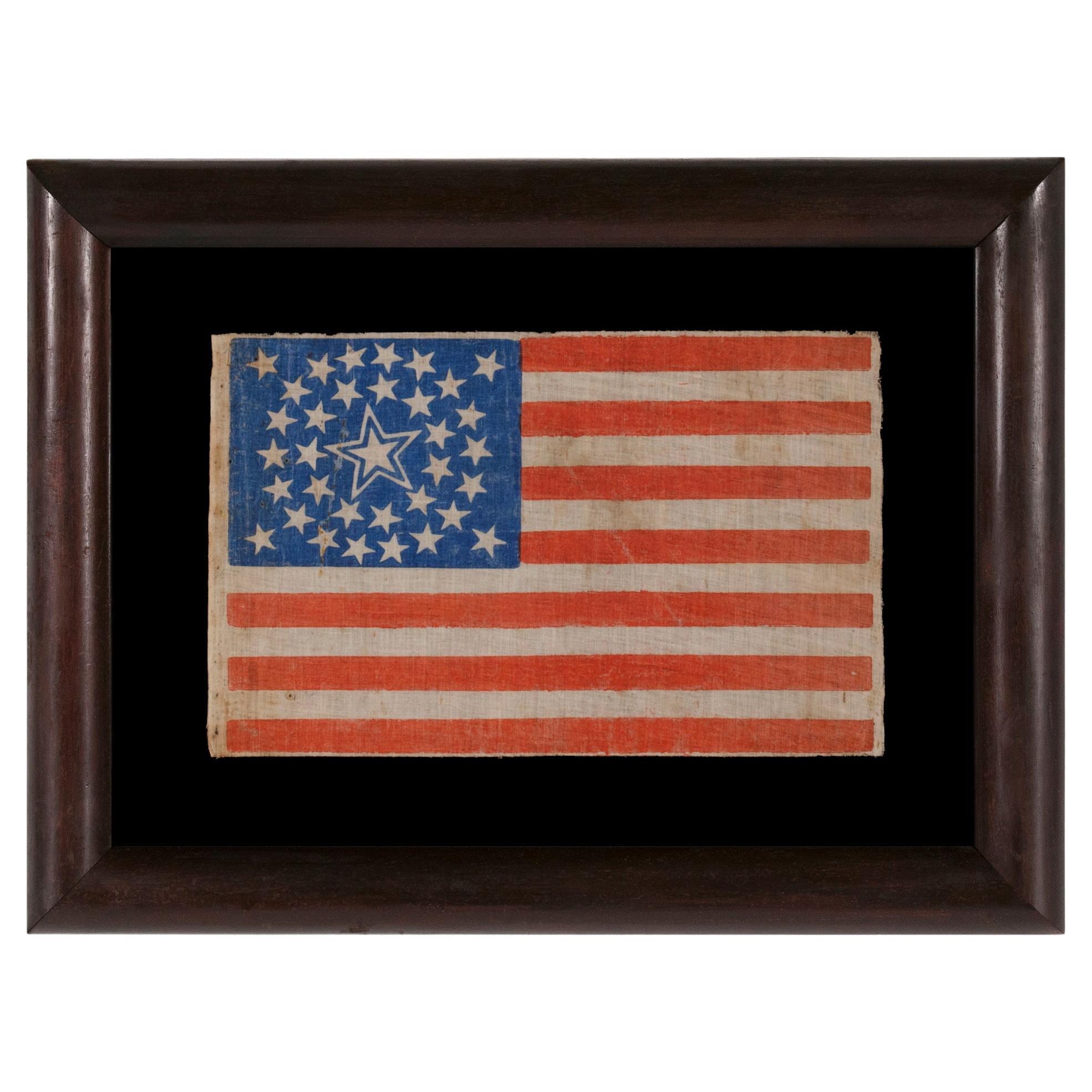
34 STARS IN A MEDALLION CONFIGURATION ON AN ANTIQUE AMERICAN PARADE FLAG WITH A LARGE, HALOED CENTER STAR; CIVIL WAR PERIOD, KANSAS STATEHOOD, 1861-1863
34 star American national pa...
Category
Antique 1860s American Political and Patriotic Memorabilia
Materials
Cotton
Price Upon Request
13 Star Antique American Parade Flag, ca 1876-1899
Located in York County, PA
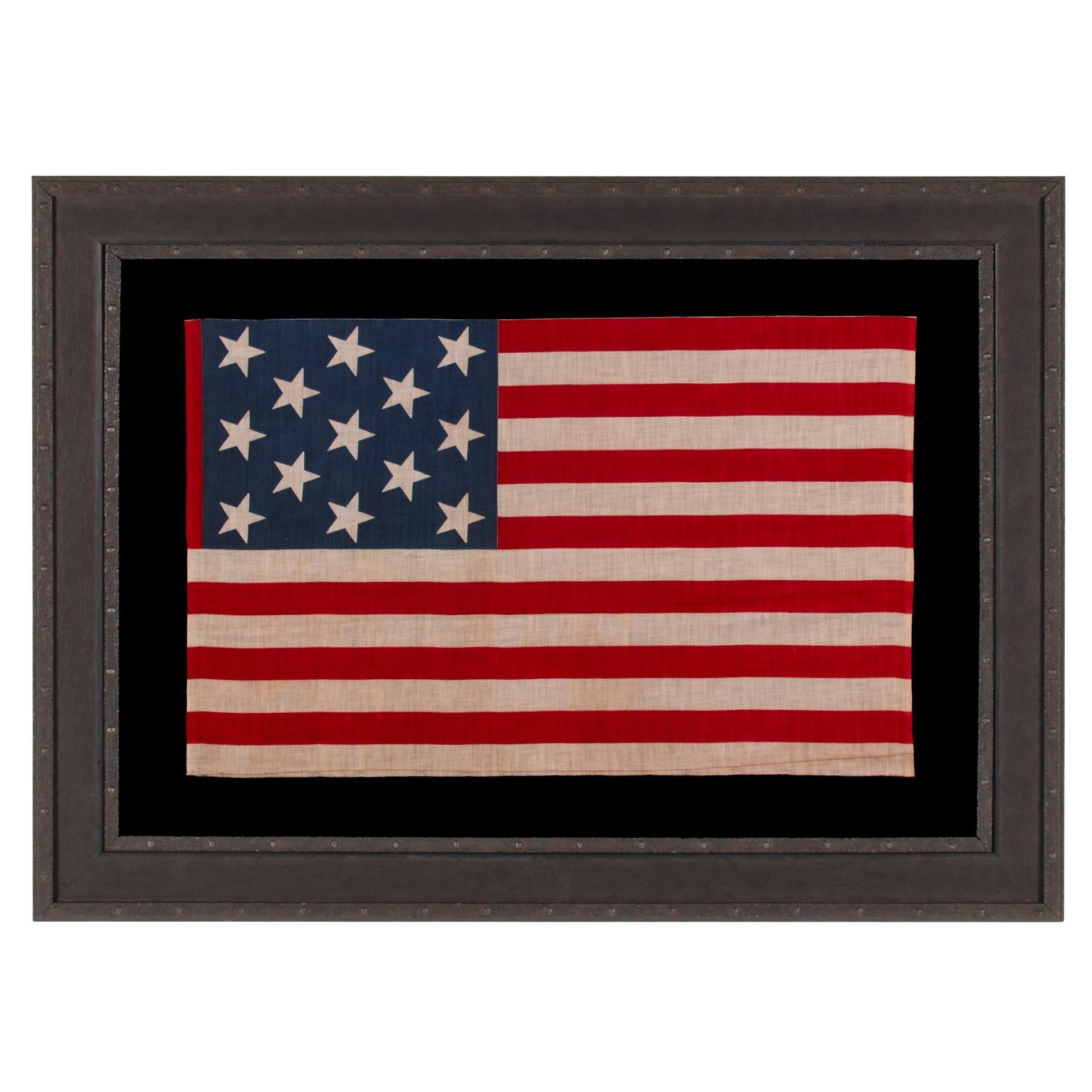
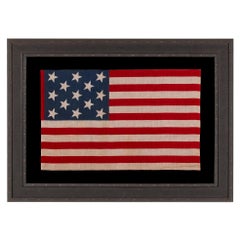
13 STAR ANTIQUE AMERICAN PARADE FLAG, WITH A 3-2-3-2-3 CONFIGURATION OF STARS, AN EXTREMELY SCARCE AND UNUSUALLY LARGE VARIETY, MADE circa 1876-1899
13 star American national parade...
Category
Antique Late 19th Century Canadian Political and Patriotic Memorabilia
Materials
Cotton
Price Upon Request
30 Star Antique American Parade Flag, Wisconsin Statehood, ca 1848-1850
Located in York County, PA
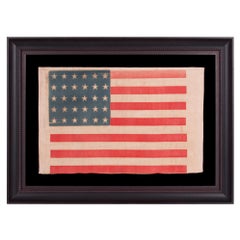
ANTIQUE AMERICAN PARADE FLAG WITH 30 STARS, THE ONLY KNOWN EXAMPLE IN THIS SIMPLE BUT EXTRAORDINARY STYLE, PRE-CIVIL WAR, OFFICIAL FOR JUST TWO YEARS, REFLECTS THE ADDITION OF WISCON...
Category
Antique Mid-19th Century American Political and Patriotic Memorabilia
Materials
Cotton
Price Upon Request
34 Star Antique American Parade Flag, Kansas Statehood, ca 1861-1863
Located in York County, PA
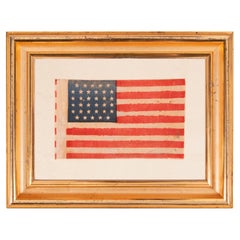
34 STAR ANTIQUE AMERICAN FLAG WITH A LINEAL ARRANGEMENT THAT I HAVE TERMED "GLOBAL ROWS, WITH EXCEPTIONAL COLOR AND CRUDE YET BEAUTIFUL FEATURES, OPENING TWO YEARS OF THE CIVIL WAR, ...
Category
Antique 1860s American Political and Patriotic Memorabilia
Materials
Cotton
Price Upon Request
38 Star Antique American Parade Flag, Colorado Statehood, ca 1876-1889
Located in York County, PA
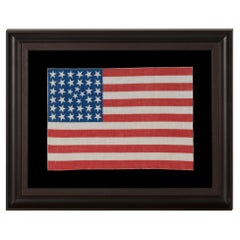
38 STARS IN AN EXTREMELY UNUSUAL CONFIGURATION THAT BEARS A CLUSTER OF 6 SMALL STARS WITHIN A LINEAL PATTERN OF LARGER STARS, 1876-1889, COLORADO STATEHOOD
38 star American national parade flag, printed on cotton. This is an extremely rare example of a lineal pattern flag with a wreath or cluster of smaller stars inserted in the center. A very small number of flags in this style are known to have survived, the colors of which are typically saturated and vibrant, like this example, in scarlet red and rich, royal blue.
The particular wreath in the center of the configuration is really more of a pentagon with a single, center star. The reason for the choice of the design and 6 smaller stars seems a curious one on the surface, but its purpose was probably nothing more than to simply augment a 36 star print block to one with 38 stars. One may observe how 4 stars, that would have comprised the center of a 6 x 6 pattern, could have simply been removed and 6 smaller stars inserted in their place, in an artful fashion.
At least two other similar 38-star patterns are known that incorporate 4 small stars intermingled between rows of what most certainly were two very similar 34-star flag print blocks originally. It was easier to modify these blocks rather than create brand new ones. In these particular instances, the results are rare, quirky configurations that are highly prized by collectors.
Colorado became the 38th state on August 1st, 1876. This was the year of our nation’s 100-year anniversary of independence. Per the Third Flag Act of 1818, stars were not officially added until the 4th of July following a state's addition. For this reason, 37 was the official star count for the American flag in 1876. Flag-making was a competitive venture, however, and few flag-makers would have been continuing to produce 37 star flags when their competitors were making 38’s. It is for this reason that 38 and 13 stars (to represent the original 13 colonies) are more often seen at the Centennial International Exposition, the six-month long World’s Fair held in Philadelphia in honor of the event. Some flag-makers would have been adding a star for the 38th state even before it entered the Union, in the early part of 1876 or even prior. In fact, many makers of parade flags were actually producing 39 star flags, in hopeful anticipation of the addition of two more Western Territories instead of one. But the 39th state would not join the Union for another 13 years, when the Dakota Territory entered as two states on the same day. The 38 star flag became official on July 4th, 1877 and was generally used until the addition of the Dakotas in 1889.
Provenance: Jeff R. Bridgman Antiques to the late collector Jim Ring...
Category
Antique Late 19th Century American Political and Patriotic Memorabilia
Materials
Cotton
Price Upon Request
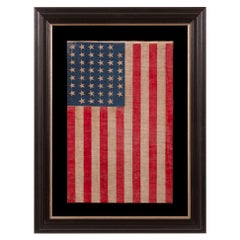
45 Stars Antique American Parade Flag, Utah Statehood, ca 1896-1908
Located in York County, PA
45 STAR ANTIQUE AMERICAN PARADE FLAG WITH ITS STARS ARRANGED IN A NOTCHED PATTERN, 1896-1908, UTAH STATEHOOD:
45 star American national flag, printed on coarse, glazed cotton. Evide...
Category
Antique 1890s American Political and Patriotic Memorabilia
Materials
Cotton
Price Upon Request
You May Also Like
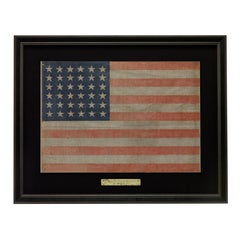
36-Star American Printed Parade Flag, Circa 1865-1867
Located in Colorado Springs, CO
This is an antique 36-star American flag, as striking as it is scarce. The flag has a glazed cotton construction, with a blue canton printed with 36 white stars. The stars are arrang...
Category
Antique 1860s American Political and Patriotic Memorabilia
Materials
Cotton
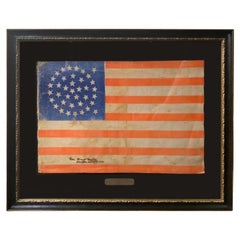
38-Star American Parade Flag, Flown at a Reception for President Grant, 1880
Located in Colorado Springs, CO
This is a beautifully colored 38-star American parade flag, flown at a public reception for Ulysses S. Grant in October of 1880. This printed flag features a rare, triple medallion s...
Category
Antique 1880s American Political and Patriotic Memorabilia
Materials
Cotton
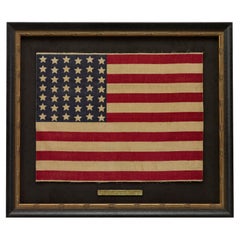
42-Star American Parade Flag, Commemorating Washington Statehood, 1889
Located in Colorado Springs, CO
This is an uncommon 42-star flag, commemorating the addition of the state of Washington to the Union. The flag dates to 1889-1890, and is printed on cotton. The canton consists of s...
Category
Antique 1880s American Political and Patriotic Memorabilia
Materials
Cotton
Centennial Celebration "1776-1876" American Flag Banner
Located in Colorado Springs, CO
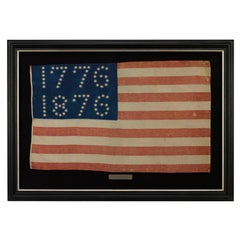
Presented is a rare Centennial patriotic flag banner, dating to 1876. The flag’s brilliant blue canton is spectacular, with 81 five-pointed, rayed stars, arranged to read “1776” and “1876.” The flag’s design is completed with thirteen alternating red and white stripes. The flag is a three-piece, treadle-sewn sewn construction, printed on a thin wool and cotton blend. Along the edge, there is a narrow, treadle-sewn sleeve made of cotton tape.
In the lead up to the nation’s Centennial in 1876, flag makers and individuals looked to the past for designs to produce as part of the country’s many celebrations. Popular interpretation of the stars and stripes undoubtedly reached its climax of variety and originality at the time of our Nation’s first Centennial. Since no design restrictions were placed on flagmaker’s imaginations and no strict distinctions were drawn between official and unofficial star counts, it is no surprise that, on the occasion of the Centennial, creativity in flag design was not the exception, but the rule.
The cantons from this period presented an array of geometric abstractions. Great star patterns, referred to as the “starry flower of Liberty” by Oliver Wendell Holmes, that were popular from 1818 and on, resurfaced in Centennial flags...
Category
Antique 1870s American Political and Patriotic Memorabilia
Materials
Wool, Cotton
34-Star American Parade Flag, Commemorating Kansas Statehood, Circa 1861-1863
Located in Colorado Springs, CO
Offered is a spectacular 34-star American flag, produced during the Civil War. This flag features 34 printed white stars, on a blue wool blend canton. The stars are arranged in whims...
Category
Antique 1860s American American Classical Political and Patriotic Memora...
Materials
Brass
31-Star Printed American Flag, Celebrating California Statehood, Circa 1850
Located in Colorado Springs, CO
This is a rare 31-star medallion printed American flag, celebrating the addition of California to the Union. The flag is printed on silk and has a spectacular “Great Star” canton pat...
Category
Antique 1850s American Political and Patriotic Memorabilia
Materials
Silk