Mid-19th Century Political and Patriotic Memorabilia
to
1
27
27
1
1
7
92
102
3
39
46
10
5
9
3
5
7
3
4
4
3
1
21
15
4
3
2
26
25
27
27
27
Period: Mid-19th Century
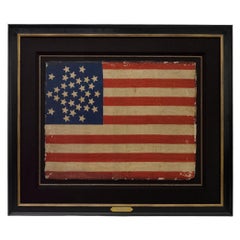
31-Star Printed American Flag, Celebrating California Statehood, Circa 1850
Located in Colorado Springs, CO
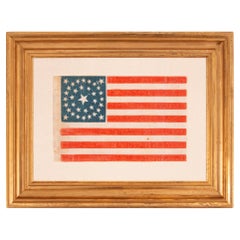
This is a rare 31-star medallion printed American flag, celebrating the addition of California to the Union. The flag is printed on silk and has a spectacular “Great Star” canton pat...
Category
American Antique Mid-19th Century Political and Patriotic Memorabilia
Materials
Silk
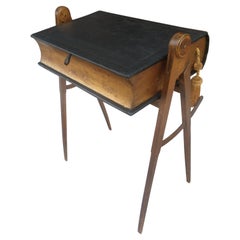
19th Century Masonic Table with Leather Bible Compartment Flip Lid Compass Legs
Located in Port Jervis, NY
Rare and fabulous 19th century faux book with compass legs as legs. Mustard paint on the legs with Gilt on the pages of the leather bound book. Looks to be original tassle.. Possibly...
Category
American Folk Art Antique Mid-19th Century Political and Patriotic Memorabilia
Materials
Leather, Hardwood, Paint
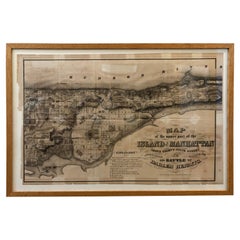
1868 Map of the Upper Part of the Island of Manhattan Above 86th Street
Located in San Francisco, CA
This wonderful piece of New York City history is over 150 years old. It depicts 86th street and above. It was lithographed by WC Rogers and company. It was made to show what was the Battle of Harlem during the Revolutionary war...
Category
American American Colonial Antique Mid-19th Century Political and Patriotic Memorabilia
Materials
Paper
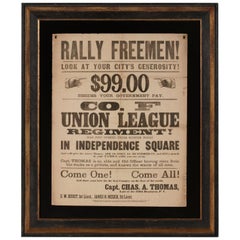
"Rally Freemen!..." Civil War Recruitment Broadside
Located in York County, PA
"RALLY FREEMEN! …COME ONE! COME ALL! AND SHOW YOUR LOVE FOR THE BEST COUNTRY ON THE FACE OF THE EARTH." A CIVIL WAR RECRUITMENT BROADSIDE FOR THE...
Category
American Antique Mid-19th Century Political and Patriotic Memorabilia
Materials
Paper
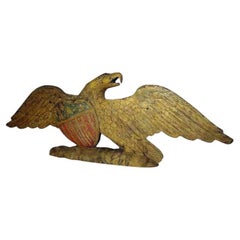
Carved and Painted Wooden Eagle with Shield Attributed to John Haley Bellamy
Located in Savannah, GA
In all original untouched condition including weathered paint, this wonderful Folk Art wall plaque speaks for itself. Substantial size. It looks to be made to be mounted on a ledge, ...
Category
American Federal Antique Mid-19th Century Political and Patriotic Memorabilia
Materials
Wood

$9,713 Sale Price
24% Off
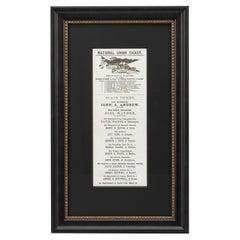
1864 Lincoln
Johnson Boston Union Presidential Ticket
Located in Colorado Springs, CO
Presented is an original Massachusetts Union Presidential ticket for the November 8, 1864 election. The paper ticket is printed in black, headed by a large spreadwing eagle carrying ...
Category
Antique Mid-19th Century Political and Patriotic Memorabilia
Materials
Paper
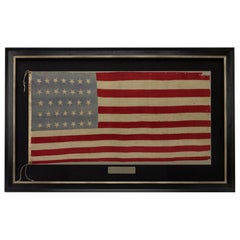
34-Star American Parade Flag, Commemorating Kansas Statehood, Circa 1861-1863
Located in Colorado Springs, CO
Offered is a spectacular 34-star American flag, produced during the Civil War. This flag features 34 printed white stars, on a blue wool blend canton. The stars are arranged in whims...
Category
American American Classical Antique Mid-19th Century Political and Patriotic Memorabilia
Materials
Brass
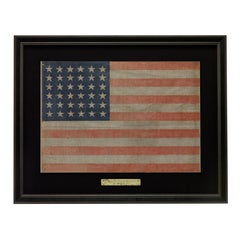
36-Star American Printed Parade Flag, Circa 1865-1867
Located in Colorado Springs, CO
This is an antique 36-star American flag, as striking as it is scarce. The flag has a glazed cotton construction, with a blue canton printed with 36 white stars. The stars are arrang...
Category
American Antique Mid-19th Century Political and Patriotic Memorabilia
Materials
Cotton
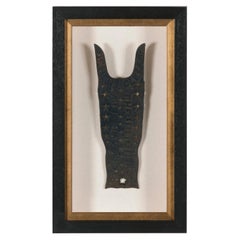
Cast Iron Boot Jack Made for 1864 Presidential Campaign of George McClellan
Located in York County, PA
CAST IRON BOOT JACK, MADE FOR THE 1864 PRESIDENTIAL CAMPAIGN OF GENERAL GEORGE B. MC CLELLAN, WITH A FANTASTIC SLOGAN THAT READS "THE UNION AT ALL HAZZARDS"
Made for the 1864 presidential run of George B. McClellan, this cast iron bootjack is both rare and graphically exceptional. Displaying the original black-painted surface, with attractive and desirable patina, the stylized profile has a wonderful folk art quality. Molded block letters that wrap around the heel clasp read simply "Gen. Mc Clellan. These are accompanied by a prominent Civil War-associated slogan: "The Union at all Hazards." The text is intermingled with 34 stars, which was equivalent to the number of states during the opening two years of the war, but was one star short by mid-1863 and two stars short by the time of the actual election in 1864. It's not unusual to encounter this feature in civil war campaign parade flags as well as all manner of flag-related ephemera.
The iron was reportedly cast by G. & D. Cross of Morrisville, New York, though it is unsigned and I have not yet verified the attribution. I have seen two other examples, one of which had a broken and repaired tine on the U-shaped horns and newly painted surface, while the other appeared to have broken lifters and inferior, rusted patina. This is, hands-down, the best of the identified examples.
Brief History of the 1864 Campaign:
President Abraham Lincoln had a checkered relationship with his 1864 opponent, who he had formerly chosen as General-in-Chief of the entire Union Army. The career officer repeatedly knocked heads with his Commander-in-Chief. Having raised a well-trained and organized military force, McClellan often seemed reluctant to use it. By 1862, after losses in Virginia during the Peninsula Campaign, Lincoln grew frustrated with McClellan and the progression of the war and removed him from command.
By the early part of 1864 the American people shared some of the same frustrations and Lincoln was no longer the clear choice for the White House. The nation was tired of war and the remains of the Democratic Party...
Category
American Antique Mid-19th Century Political and Patriotic Memorabilia
Materials
Iron
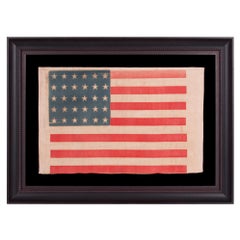
30 Star Antique American Parade Flag, Wisconsin Statehood, ca 1848-1850
Located in York County, PA
ANTIQUE AMERICAN PARADE FLAG WITH 30 STARS, THE ONLY KNOWN EXAMPLE IN THIS SIMPLE BUT EXTRAORDINARY STYLE, PRE-CIVIL WAR, OFFICIAL FOR JUST TWO YEARS, REFLECTS THE ADDITION OF WISCON...
Category
American Antique Mid-19th Century Political and Patriotic Memorabilia
Materials
Cotton
Price Upon Request
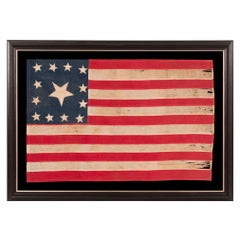
Rare 13 Star Civil War Flag in the Trumbull Pattern w/ 36 Stars on the Reverse
Located in York County, PA
EXTRAORDINARY CIVIL WAR ERA FLAG, WITH 13 HAND-SEWN STARS ARRANGED IN A VARIANT OF WHAT IS KNOWN AS THE TRUMBULL PATTERN, FEATURING A HUGE, UPSIDE-DOWN CENTER STAR, AND THE EXTREMELY...
Category
American Antique Mid-19th Century Political and Patriotic Memorabilia
Materials
Cotton
Roller-Printed Yard Good, Made to Memorialize George Washington, ca 1824-1832
Located in York County, PA
ROLLER-PRINTED YARD GOODS TEXTILE, MADE TO MEMORIALIZE GEORGE WASHINGTON SOMETIME BETWEEN LAFAYETTE’S FINAL VISIT & GRAND TOUR OF AMERICA, FROM 1824-25, AND THE 1832 CELEBRATION OF G...
Category
American Antique Mid-19th Century Political and Patriotic Memorabilia
Materials
Cotton

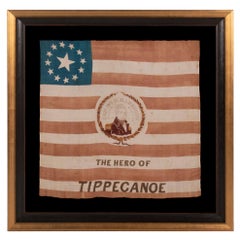
13 Stars on a flag Made for the 1840 Presidential Campaign of W.H. Harrison
Located in York County, PA
13 STARS ON A FLAG MADE FOR THE 1840 PRESIDENTIAL CAMPAIGN OF WILLIAM HENRY HARRISON, WITH THE INCLUSION OF A THREE-COLOR PORTRAIT MEDALLION, IN VIOLET , GOLD, AND BLACK; AMONG THE E...
Category
American Antique Mid-19th Century Political and Patriotic Memorabilia
Materials
Silk
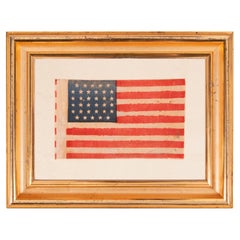
34 Star Antique American Parade Flag, Kansas Statehood, ca 1861-1863
Located in York County, PA
34 STAR ANTIQUE AMERICAN FLAG WITH A LINEAL ARRANGEMENT THAT I HAVE TERMED "GLOBAL ROWS, WITH EXCEPTIONAL COLOR AND CRUDE YET BEAUTIFUL FEATURES, OPENING TWO YEARS OF THE CIVIL WAR, ...
Category
American Antique Mid-19th Century Political and Patriotic Memorabilia
Materials
Cotton
Price Upon Request
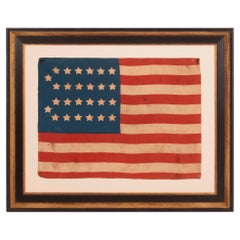
26 Star Antique American Flag, with 11 Stripes, Michigan Statehood, ca 1837-1846
Located in York County, PA
26 STAR ANTIQUE AMERICAN PARADE FLAG WITH 11 STRIPES AND IT’S CANTON RESTING ON THE “WAR STRIPE.” THE EARLIEST KNOWN STAR COUNT FOR PRINTED EXAMPLES, 1837-1846, MICHIGAN STATEHOOD
2...
Category
American Antique Mid-19th Century Political and Patriotic Memorabilia
Materials
Cotton
34 Star Antique American Flag with Hourglass Medallion Stars, ca 1861-1863
Located in York County, PA
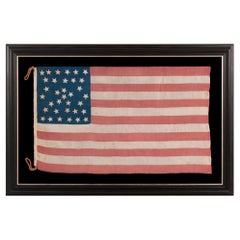
EXTRAORDINARY 34 STAR ANTIQUE AMERICAN FLAG WITH AN ACCORDION OR HOURGLASS MEDALLION CONFIGURATION THAT SURROUNDS A PENTAGON OF STARS IN THE CENTER; MADE OF FINE SILK AND ENTIRELY HAND-SEWN; MADE DURING THE OPENING YEARS OF THE CIVIL WAR (1861-63), IN A TINY SIZE AMONG ITS COUNTERPARTS OF THE PERIOD; REFLECTS THE ADDITION OF KANSAS AS THE 34TH STATE
34 star flag of the Civil War period with an array of rare, beautiful, and otherwise desirable features. Extremely small among flags of this period with pieced and sewn construction, the flag displays a star pattern that is not only highly unusual, but unique to this particular example. This consists of a single star in the very center, surrounded by a pentagon of stars, flanked by angular bracket of three stars to either side. Above and below are rows of 5 stars, followed by rows of 6 that line the top and bottom of the canton. The resulting configuration is what I have termed an “accordion medallion,” though “hourglass medallion” or “standing bow tie” would be perfectly acceptable.
When rotated 90 degrees, to view the harder-to-identify, bow tie formation, students of early star patterns may note the visual similarity between this and what I call “Starburst” or “Crosshatch” medallions. The pattern, however, conspicuously lacks the crosses of St. Andrew (a saltire) and St. George (roman cross), that would allow it to be more accurately categorized as such.
Entirely hand-sewn, the canton and stripes of the flag are made of fine silk. The hemming of this was accomplished with great skill. The top and bottom edges are selvedge. These are so similar in nature as to have come from the same maker. There is a white, silk binding along the hoist, in the form of an open sleeve, through which a length of braided hemp rope was passed, expertly looped and re-braided into itself at the top and bottom for strength.
The stars are made of white, polished cotton. These were stitched to both sides (double-appliqued). Note how the edges of the fabric were not turned under, providing evidence of the fact that the maker was not especially skilled in appliqueing. This was common, as applique work was far more difficult than producing French seams.
In the 19th century, most flags with pieced and sewn construction were 8 feet long and larger. A six-footer was considered small. Even military battle flags, carried on foot, measured 6’ x 6.5’, which translates into approximately 7’ x 7.5’ after framing, about the size of an average quilt and larger than can comfortably fit on a wall in a house with 8-foot ceilings and average width baseboard. Flags smaller than this were produced both commercially and at home, but the smaller they are, the more unusual they are. At just 26.5 x 46.5 inches, this flag is extremely small for a Civil war period flag with sewn construction.
Silk was both beautiful and lightweight, which made it elegant for military unit colors and preferable for flags meant to be carried on foot. Most outdoor use flags...
Category
American Antique Mid-19th Century Political and Patriotic Memorabilia
Materials
Silk
33 Star Flag with Stars in a "Great Star" Pattern, Oregon State, ca 1859-1861
Located in York County, PA
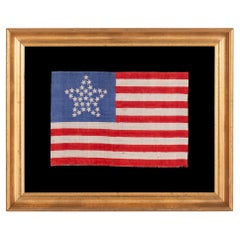
33 STARS IN A "GREAT STAR" PATTER ON A BRILLIANT, ROYAL BLUE CANTON, A RARE AND EXTRAORDINARY EXAMPLE, PRE-CIVIL WAR THROUGH THE WAR'S OPENING YEAR, 1859-1861, OREGON STATEHOOD
33 s...
Category
American Antique Mid-19th Century Political and Patriotic Memorabilia
Materials
Silk
34 Star Antique American Parade Flag, Kansas Statehood, ca 1861-1863
Located in York County, PA
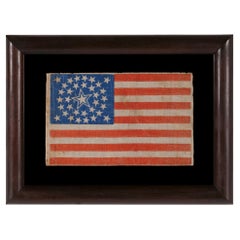
34 STARS IN A MEDALLION CONFIGURATION ON AN ANTIQUE AMERICAN PARADE FLAG WITH A LARGE, HALOED CENTER STAR; CIVIL WAR PERIOD, KANSAS STATEHOOD, 1861-1863
34 star American national pa...
Category
American Antique Mid-19th Century Political and Patriotic Memorabilia
Materials
Cotton
Price Upon Request
Outstanding 13 Star Hand-sewn American Private Yacht Flag, ca 1865-1885
Located in York County, PA
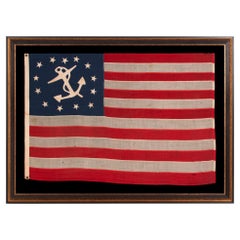
OUTSTANDING, 13 STAR, ANTIQUE AMERICAN PRIVATE YACHT ENSIGN WITH GREAT FOLK QUALITIES THAT INCLUDE AN UNUSUALLY WIDE ANCHOR AND A DECIDEDLY LOPSIDED RING OF 13 STARS; MADE DURING THE 2ND HALF OF THE 19TH CENTURY; ITS DEVICE HAND-SEWN AND SINGLE-APPLIQUÉD
Private yacht ensigns were approved American signals for maritime use that allowed pleasure boats to bypass customs. Though the legislation that approved them was adopted prior to 1850, almost all such flags that one will encounter were sewn by electric machine and made during the 20th century. The unusual gems among surviving examples are those that are earlier and include hand-sewn elements. Even more rare are a select few with atypical graphics. Barely any fall into both of these categories at once. Take note of the anchor on this particular flag, wide a long horizontal crossbar (stock) that contributes to uncommonly wide stance. Set within a ring of stars that is decidedly lopsided, the result is as bold as it is endearingly whimsical—two of the best qualities in American folk art, a category in which this particular example can be filed. While I have owned 13 star private yacht flags that have displayed star and canted anchor devices that were somewhat larger and/or bolder than typical, I cannot recall any that were so graphically intriguing as this one.
Brief History of Private Yacht Ensigns:
The medallion configuration, 13-star, 13-stripe flag, with a canted center anchor was entered into official use in 1848, following an act of Congress, that made it the official signal for U.S. pleasure sailing vessels. The need for such a flag arose with the popularity of boating as a pastime for well-to-do Americans, and as a competitive sport, in addition to its longstanding utilitarian role as a vehicle of trade. In early America, all boats were subject to customs searches at every port. Without modern income tax, the federal government derived its revenues mostly from tariffs, so an accounting of foreign goods on ships was a critical venture. As yachting for pleasure became more prevalent, however, more and more time was spent searching boats that had no such inventory, wasting time for both customs officials and wealthy ship owners.
John Cox Stevens, a former president of the Jockey Club and future founder of the Union League Club, became the New York Yacht Club’s Commodore upon its founding in 1845. In 1847 he approached the secretary of the treasury and suggested that something be done to streamline the customs process for non-trade vessels. In 1848, legislation passed Congress requiring registration of these boats, which could then fly the “American Yachting Signal” to bypass customs. This remained on the books until the 1980’s, when the 1848 legislation was revoked, but the use of flags in this design for decorative function continues to this day.
13 star flags have been flown throughout our nation’s history for a variety of purposes. In addition to their use on private yachts, they were hoisted at patriotic events, including Lafayette’s final visit in 1824-25, the celebration of the nation’s centennial in 1876, and the sesquicentennial in 1926. They were displayed during the Civil War, to reference past struggles for American liberty and victory over oppression, and were used by 19th century politicians while campaigning for the same reason. The U.S. Navy used the 13 star count on small boats until 1916, because it was easier to discern fewer stars at a distance on a small flag. Commercial flag-makers mirrored this practice and some private ships flew 13 star flags during the same period as the Navy.
Construction: The stars and anchor are made of cotton, hand-sewn, and single-appliquéd. This means that they were applied to one side of the canton, then the blue fabric was cut from behind each star, folded over, and under-hemmed, so that one star could be viewed on both sides of the flag. I always find single-appliquéd stars more interesting, not only because they are evidence of a more difficult level of seam-work and stitching, but also because they are more visually intriguing. The two visible rows of hand-stitching emphasize their hand-sewn construction. For these reasons, single-appliquéd stars often appeal to connoisseurs of early American textiles...
Category
American Antique Mid-19th Century Political and Patriotic Memorabilia
Materials
Wool
Price Upon Request
34 STAR AMERICAN FLAG, CIVIL WAR, 1861-63, KANSAS STATEHOOD, 2nd KY CAVALRY
Located in York County, PA
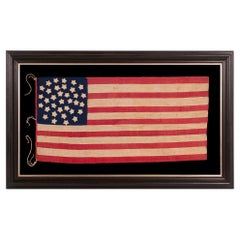
34 STAR ANTIQUE AMERICAN FLAG OF THE CIVIL WAR PERIOD (1861-63), IN A TINY SCALE AMONG PIECED-AND-SEWN FLAGS OF THE PERIOD, WITH A TRIPLE-WREATH CONFIGURATION, AN ELONGATED FORMAT, AND ENTIRELY HAND-SEWN; FOUND WITH A LETTER FROM JOHN W. RUDE OF THE 2ND KENTUCKY VETERAN VOLUNTEER CAVALRY (UNION):
34 star flag of the Civil War period with a variety of extremely desirable features, handed down with a letter written by John W. Rude on November 8th, 1864, while encamped with the Army’s 1st Brigade, 3rd Division, as a member of the 2nd Regiment of Veteran Volunteer Cavalry. Tiny in scale among pieced and sewn examples, the flag displays a star pattern that consists of a three consecutive wreaths, with a single star in the very center. Because it lacks a single star in each corner, outside the basic pattern—usually present in flags of this design made during the mid-late 19th century—this is something I classify as a “snowball medallion.” Entirely hand-sewn throughout, note the square format of the blue canton, with its beautiful, circular star arrangement, and how interesting this combination is when paired with the elongated format of the flag itself. The stars are double-appliqued, meaning that they are applied to both sides. These are fat in shape and inconsistent in size. Note how the lowest star in the outermost ring actually dips into the white stripe below.
Made of plain weave cotton, there is a narrow binding along the hoist, red in color, with three sets of cotton ties. Those at the top and bottom are made of fine, braided hemp or hemp and cotton cord, stitched into place, while the one in the center, looped around the binding and tied, is made of lightweight, twisted, cotton thread. Note how the 5th, 6th, and 7th red stripes are pieced from two lengths of cotton fabric, which reflects that the maker was being conscious of conserving available fabric.
In the 19th century, most flags with pieced and sewn construction were 8 feet long and larger. A six-footer was considered small. Even military battle flags, carried on foot, measured 6’ x 6.5’, which translates into approximately 7’ x 7.5’ after framing, about the size of an average quilt and larger than can comfortably fit on a wall in a house with 8-foot ceilings and average width baseboard. Flags smaller than this exist, but the smaller they get, the more unusual they are. At just 1.5’ x 3’, this is about as small as one will ever encounter in a sewn flag of the Civil War era.
The flag appears to have likely been hand-carried. I expect that it probably saw military use of some sort as a camp flag...
Category
American Antique Mid-19th Century Political and Patriotic Memorabilia
Materials
Cotton
36 Star Antique American Parade Flag, with Canted Stars, ca 1864-1867
Located in York County, PA
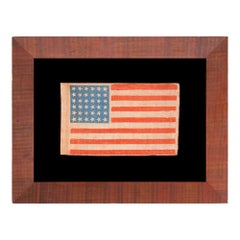
36 STAR ANTIQUE AMERICAN PARADE FLAG WITH CANTED STARS IN DANCING ROWS, ON A BEAUTIFUL, CORNFLOWER BLUE CANTON; CIVIL WAR ERA, NEVADA STATEHOOD, 1864-1867
36 star antique American f...
Category
American Antique Mid-19th Century Political and Patriotic Memorabilia
Materials
Cotton
Price Upon Request
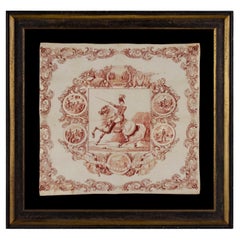
1840 Campaign Kerchief of William Henry Harrison on Horseback
Located in York County, PA
1840 campaign kerchief featuring an image of William Henry Harrison on horseback in military garb, one of the first known campaign textiles in e...
Category
American Antique Mid-19th Century Political and Patriotic Memorabilia
Materials
Cotton
Price Upon Request
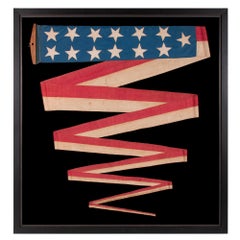
Hand-Sewn 13 Star Cornflower Blue 32 Foot Commission Pennant circa 1845-1865
Located in York County, PA
ENTIRELY HAND-SEWN, 32-FOOT, SHIP’S COMMISSION PENNANT OF THE 1845-1865 ERA, A HOMEMADE, COTTON EXAMPLE, WITH 13 STARS ON A CORNFLOWER BLUE CANTON, IN A BEAUTIFUL STATE OF PRESERVATION
Commission pennants are the distinguishing mark of a commissioned U.S. Navy ship. A ship becomes commissioned when the pennant is hoisted. Flown during both times of peace and war, the only time it is not flown is if a flag officer or civilian official is aboard and replaces it with their own flag. Flown at the topmast, this would be the first thing one would see coming over the horizon and identified the vessel as a warship.
Sometimes the owners of private ships mimicked the use of Navy signals. Some seafaring men would have served in the Navy and become privy to various practices in that capacity. Others flew them purely for stylistic reasons, either on a regular basis or while the boat was dressed for special occasion. Hudson River steamers regularly flew pennants of this nature, as evidenced by period photography as well as the paintings of artists such as John and James Bard...
Category
American Antique Mid-19th Century Political and Patriotic Memorabilia
Materials
Cotton
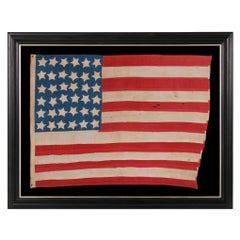
36 Star Antique American Flag, Cornflower blue Canton, circa 1864-1867, Nevada
Located in York County, PA
Antique American Flag With 36 Stars On A Cornflower Blue Canton, Civil War Era, 1864-1867, Reflects The Addition Of Nevada As The 36th State; A Great Folk Exaple With Haphazard Rows Of Starfish-like Stars:
36 star American national flag of the Civil War era with outstanding collector traits. Haphazard rows of fat, starfish-shaped stars fill most of the confines of a brilliant, cornflower blue canton. Note the crude piecing of the thirteen, red and white stripes, joined in an ill-planned manner that results in great variation in width, as well as general irregularity. The 4th red stripe actually falls slightly below the canton, and the height of each does not line up with the corresponding stripe on the reverse. This can clearly be seen at the fly end, which is is turned back and bound to repair obvious extended use in an outdoor environment. Clearly the maker lacked experience in seam work. Lining up the necessary components, so that they could be viewed on both sides, presented a challenge they may have not previously faced. This is also evident in the sewing of the stars, which do not line up on the obverse and reverse sides, as they typically would in a flag sewn by an experienced flag-maker. That said, this is just this kind of homemade charm that fuels interest in early American flags...
Category
American Antique Mid-19th Century Political and Patriotic Memorabilia
Materials
Cotton
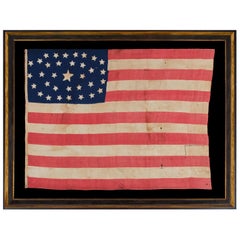
34 Stars in an Outstanding Oval Medallion Configuration, Civil War Period
Located in York County, PA
34 STARS IN AN OUTSTANDING OVAL MEDALLION CONFIGURATION, ON A NARROW CANTON THAT RESTS ON THE 6TH STRIPE, ON A HOMEMADE, ANTIQUE AMERICAN FLAG OF THE CIVIL WAR PERIOD, ENTIRELY HAND-...
Category
American Antique Mid-19th Century Political and Patriotic Memorabilia
Materials
Cotton
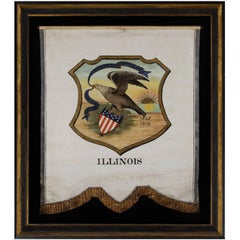
Hand-Painted 19th Century Banner with the 1867 Proposed Seal of Illinois
Located in York County, PA
HAND-PAINTED 19TH CENTURY BANNER WITH AN 1867 VERSION OF THE SEAL OF THE STATE OF ILLINOIS, PROPOSED IN THAT YEAR BY THE SECRETARY OF STATE, BUT IN A VARIATION NEVER FORMALLY ADOPTED
Banner with the Illinois State Seal, in a rare variation of the design, never adopted. In 1867 Illinois Secretary of State Sharon Tyndale proposed that the phrases in the state motto be reversed. In the wake of the Civil War, (which ended in 1865,) Tyndale suggested that the verbiage be changed from "State Sovereignty--National Union" to "National Union--State Sovereignty,” which made sense given the recent secession of the Southern States, which placed their own interests first. Illinois' own Abraham Lincoln had worked hard to preserve national interests, echoed here in the altering of the language. Though Tyndale’s suggestion was rejected, he was nonetheless charged with creating a new design, which he did and was soon adopted. This displayed the dates of "1818," when Illinois became a state, and "1868," when the seal was officially changed. Interestingly enough, Tyndale did manage to send a message in the new version by turning the word “sovereignty” upside-down , with the surmised explanation that this fit accordingly with the orientation / position of the streamer.
The banner is beautifully hand-painted on muslin and retains its original staff. The shape is beautifully scalloped at the bottom edge, which is painted to look as if there is an applied fringe. Most of the elements are congruent with the 1868 version, but there are various differences. Set within a shield-shaped medallion—usually circular—is the expected eagle in a side view, spread wing pose with beak uplifted. The eagle is supposed to be perched upon a rock with one talon, while gripping a Federal shield in the other. Here there is no rock and both talons grip the shield, which displays 13 stars. Note the date of "1867" and Tyndale's preferred order of the wording on the billowing ribbon in the eagle's beak. The foreground of the official design is all grass. Here there are olive branches—a peacetime reference appropriate for a country recovering from war—on a grassy area, set upon a sandy shore before Lake Michigan, with a rising sun on the horizon.
Mounting: The banner was mounted and framed within our own conservation department, which is led by masters degree trained staff. We take great care in the mounting and presentation of flags and have preserved thousands of examples; more than anyone worldwide.
The background is 100% cotton twill, black in color. The mount was placed in a black-painted, hand-gilded and distressed Italian molding. A shadowbox was created to accommodate the staff. The glazing is U.V. protective plexiglass. Feel free to contact us for more details.
Banner - 49" x 56.5"
Frame - 67.75" x 59.25"
About Jeff R. Bridgman Antiques, Inc.:
As an advisor to top museums and collectors alike, Jeff Bridgman is the world's leading expert and source for antique American flags and political textiles...
Category
American Antique Mid-19th Century Political and Patriotic Memorabilia
Materials
Cotton
Price Upon Request
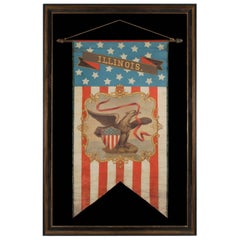
Hand-Painted Patriotic Banner With The Seal of the State of Illinois
Located in York County, PA
HAND-PAINTED PATRIOTIC BANNER WITH THE SEAL OF THE STATE OF ILLINOIS AND GREAT FOLK QUALITIES PROBABLY MADE FOR THE 1868 DEMOCRAT NATIONAL CONVENTION...
Category
North American Antique Mid-19th Century Political and Patriotic Memorabilia
Materials
Canvas
Price Upon Request
Related Items
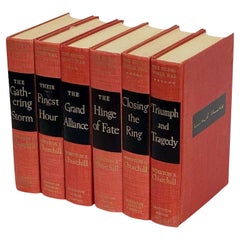
"The Second World War, " by Winston Churchill
Located in Austin, TX
The Second World War by Winston Churchill from Houghton-Mifflin Company, Boston.
A vintage edition of Winston Churchill's six-volume memoir, The Second World War, for which he was a...
Category
American Modern Mid-19th Century Political and Patriotic Memorabilia
Materials
Paper
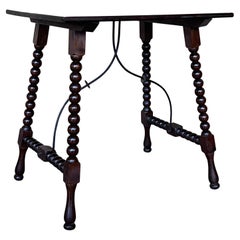
19th Spanish Side Table with Cared Turned Legs and Iron Stretcher
Located in Miami, FL
19th Spanish side table with turned legs and iron stretcher.
The top has a beautiful grain and patina.
Category
Spanish Baroque Antique Mid-19th Century Political and Patriotic Memorabilia
Materials
Iron
$1,475
H 20.08 in W 19.49 in D 15.56 in
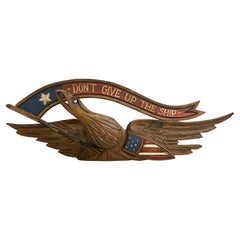
Bellamy Style Carved Wooden Eagle w/ Banner
Shield, Don’t Give Up The Ship
Located in Milford, NH
A fine polychrome wooden eagle hand carved in the style of John Haley Bellamy (1836-1914) with nice carved feather detail, a banner which reads “Don’t Give Up The Ship” , and a Liber...
Category
American Folk Art Mid-19th Century Political and Patriotic Memorabilia
Materials
Wood
$1,980
H 10.13 in W 28 in D 4 in
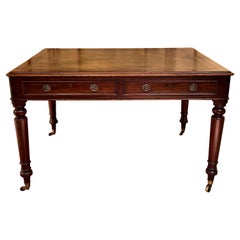
19th Century Victorian English Partner Desk Column Shaped Legs Writing Table
Located in Berlin, DE
19th century Victorian English partner desk column shaped legs writing table
Column shaped table legs. Desk with 2 drawers, slightly protruding tabletop. Writing surface with exce...
Category
English Victorian Antique Mid-19th Century Political and Patriotic Memorabilia
Materials
Leather, Mahogany
$5,387
H 29.53 in W 47.64 in D 35.44 in
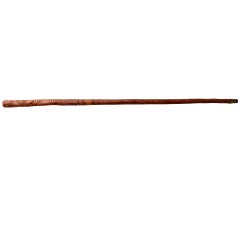
Thomas Jefferson Crannock Carved Cane
Located in Darnestown, MD
Unique carved cane that chronicles the life and achievements of Thomas Jefferson. Among the carved words are "Thos. Jefferson of Va Born Apr 2,1743 Wa...
Category
American Country Antique Mid-19th Century Political and Patriotic Memorabilia
Materials
Wood
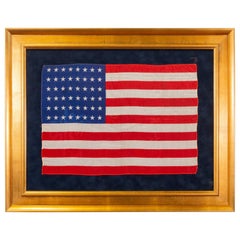
Vintage 1912 Arizona and New Mexico Statehood Flag
Located in Coeur d
Alene, ID
25th Design Patriotic American silk flag with 48 stars. Arizona Statehood Feb 14, 1912; New Mexico Statehood Jan 6, 1912
Period: 1912
Origin: United States
Size: 12" x 17".
Family ...
Category
American Vintage Mid-19th Century Political and Patriotic Memorabilia
Materials
Silk
English 19th Century Mahogany Table with Compartment, Drawer and Reeded Legs
Located in Atlanta, GA
An English mahogany table from the 19th century, with single drawer, small compartment and reeded legs. Created in England during the 19th century, this mahogany table features a rectangular top with rounded corners and small compartment, sitting above a single drawer fitted with round beaded pulls. Raised on four reeded legs mounted on casters, this 19th century English mahogany table...
Category
English Antique Mid-19th Century Political and Patriotic Memorabilia
Materials
Brass
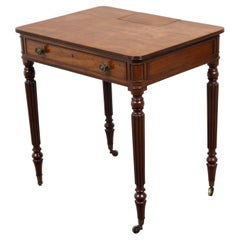
$6,550
H 29 in W 28 in D 20.75 in
19th Century Louis XV French Desk with Cabriolet Legs, 1890s
Located in Miami, FL
19th century Louis XV style French walnut writing desk with three drawers and cabriolet legs. Created in France during the 19th century, th...
Category
French Louis XV Antique Mid-19th Century Political and Patriotic Memorabilia
Materials
Bronze
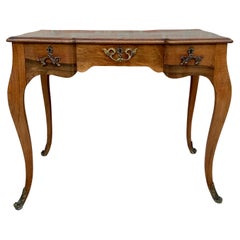
Mid-Century Table with Wheels, Italy, 19th Century
Located in Roma, IT
Mid-century table with wheels realized by italian manufactory in the mid-20th Century.
Central drawer.
Good condition.
Category
Italian Antique Mid-19th Century Political and Patriotic Memorabilia
Materials
Metal

$386 Sale Price
30% Off
H 31.89 in W 22.05 in D 33.86 in
19th Spanish Side Table with Cared Turned Legs and Iron Stretcher
Located in Miami, FL
19th Spanish side table with cared Solomonic turned legs and iron stretcher.
The top has a carved edges and a beautiful grain and patina.
Category
Spanish Baroque Antique Mid-19th Century Political and Patriotic Memorabilia
Materials
Iron
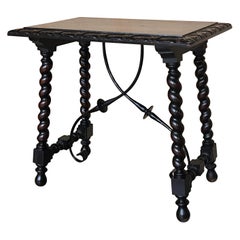
$2,975
H 27.56 in W 29.53 in D 18.51 in
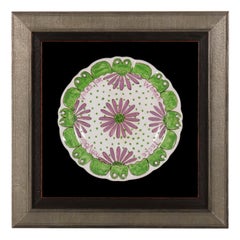
Suffragette Plate, "Deeds Not Words"
"Votes for Women", The Only Known Example
Located in York County, PA
ENGLISH PORCELAIN SUFFRAGETTE PLATE WITH "DEEDS, NOT WORDS" AND "VOTES FOR WOMEN" SLOGANS, ONE-OF-A-KIND AMONG KNOWN EXAMPLES, CA 1905-1918
English porcelain plate, made for the Women's Suffrage movement in the U.K. One-of-a-kind among presently known examples, this wonderful Arts & Crafts design features a green, frog-like pattern around the border, surrounding violet and green or daisies, on a polka dot green background. Interspersed between the flowers are the words "Votes for Women" and, in Latin, the phrase "Facta non Verba...
Category
English Mid-19th Century Political and Patriotic Memorabilia
Materials
Porcelain
$4,900
H 10 in W 10 in D 3 in
13 Star Medallion Patter Antique American Flag, ca 1910-1926
Located in York County, PA
13 STARS IN A MEDALLION PATTERN ON AN ANTIQUE AMERICAN PARADE FLAG MADE BETWEEN APPROXIMATELY 1910 AND THE 1926 SESQUICENTENNIAL OF AMERICAN INDEPENDENCE
13 star American national p...
Category
American Mid-19th Century Political and Patriotic Memorabilia
Materials
Cotton
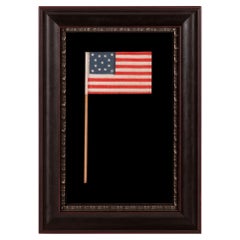
Previously Available Items
33 Star Antique American Parade Flag, Oregon Statehood, ca 1859-1861
Located in York County, PA
33 STARS IN A MEDALLION CONFIGURATION ON A LARGE SCALE ANTIQUE AMERICAN PARADE FLAG, AN EXTREMELY RARE EXAMPLE, OREGON STATEHOOD, 1859-1861
This 33 star American parade flag, printe...
Category
American Antique Mid-19th Century Political and Patriotic Memorabilia
Materials
Cotton
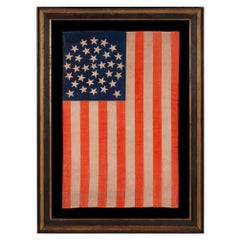
1864 Lincoln
Johnson Ohio Union Presidential Ticket
Located in Colorado Springs, CO
Presented is an original Ohio Union Presidential ticket for the November 8, 1864 election. The paper ticket is printed in orange-red and blue. The front of the ticket reads, "A Vigor...
Category
American Antique Mid-19th Century Political and Patriotic Memorabilia
Materials
Paper
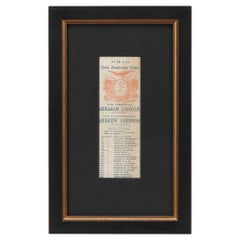
32 Star Antique American Flag, Minnesota Statehood, Extremely Rare, 1858-1859
Located in York County, PA
32 STAR ANTIQUE AMERICAN FLAG OF A TYPE KNOWN TO HAVE LIKELY SEEN MILITARY USE, REFLECTS THE ADDITION OF MINNESOTA TO THE UNION IN 1858, AN EXTREMELY RARE FLAG, ACCURATE FOR JUST 9 MONTHS AND OFFICIAL FOR ONLY ONE YEAR
32 star American flags are rare. This is largely because they were only official for one year (1858-59), but it is also a result of the fact that this time frame occurred prior to the Civil War, in an era when use of the Stars & Stripes on land in the private sector was very slim. Flags were becoming popular in political campaigning, but their use had yet to become widespread in the display of general patriotism.
Minnesota joined the Union as the 32nd state on May 11th, 1858. Following the Flag Act of 1818, stars were officially added to the American flag on the 4th of July following a state's addition, for any states that entered during the previous “flag year.” The 32 star flag...
Category
American Antique Mid-19th Century Political and Patriotic Memorabilia
Materials
Cotton
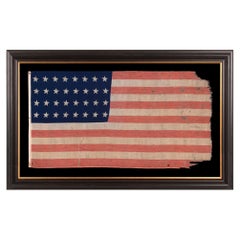
H 36 in W 55.5 in D 2.5 in
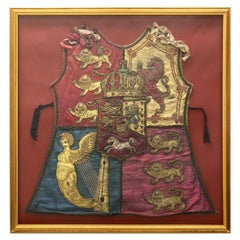
Framed George IV Royal Herald At Arms Tunic
Located in Kent, Dover
An historic piece of Royal history: a Herald at Arms tabard dating to the reign of George IV in silks and gold bullion threads. Displaying the Arms of the House of Hanover, which rul...
Category
English George IV Antique Mid-19th Century Political and Patriotic Memorabilia
Materials
Gold
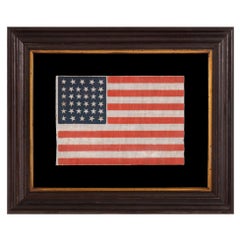
34 Star Antique American Parade Flag, Kansas Statehood, ca 1861-1863
Located in York County, PA
34 STARS, WITH SCATTERED POSITIONING, ON AN ANTIQUE AMERICAN PARADE FLAG MADE DURING THE OPENING TWO YEARS OF THE CIVIL WAR, 1861-63, KANSAS STATEHOOD
34 star American national flag...
Category
American Antique Mid-19th Century Political and Patriotic Memorabilia
Materials
Cotton
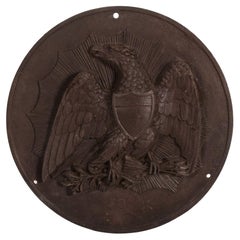
Pre-Civil War Cast Iron Medallion with the Federal Eagle Dated 1857
Located in York County, PA
AMERICAN, PRE-CIVIL WAR, CAST IRON MEDALLION / PLAQUE WITH A FEDERAL EAGLE SUPERIMPOSED ON A SUNBURST, DATED 1857
Cast iron medallion / plaque of generous scale, approximately 18" i...
Category
American Antique Mid-19th Century Political and Patriotic Memorabilia
Materials
Wrought Iron
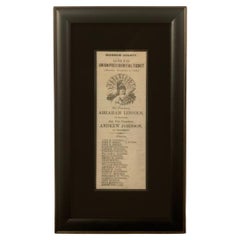
1864 Abraham Lincoln Presidential Election Soldier
s Ballot
Located in Colorado Springs, CO
Presented is an original soldier’s ballot for the 1864 American presidential election. The ballot is from Binton County, Ohio. The paper ticket is printed with an allegorical represe...
Category
American Antique Mid-19th Century Political and Patriotic Memorabilia
Materials
Paper
35 Star Antique American Parade Flag, West Virginia Statehood, ca 1863-1865
Located in York County, PA
35 STAR ANTIQUE AMERICAN PARADE FLAG WITH A DOUBLE-WREATH STYLE MEDALLION CONFIGURATION OF STARS, PERHAPS THE BEST SURVIVING EXAMPLE IN THIS RARE FORM, CIVIL WAR PERIOD, WEST VIRGINI...
Category
American Antique Mid-19th Century Political and Patriotic Memorabilia
Materials
Cotton
H 14.5 in W 18.25 in D 2 in
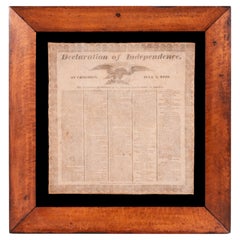
Declaration of Independence on Cloth, Printed in Boston 1832
Located in York County, PA
COPY OF THE DECLARATION OF INDEPENDENCE ON CLOTH, PRINTED IN BOSTON IN 1832 TO MEMORIALIZE THE PASSING OF THE LAST SURVIVING SIGNER, CHARLES CARROLL OF MARYLAND, IN THE YEAR THAT COI...
Category
American Antique Mid-19th Century Political and Patriotic Memorabilia
Materials
Cotton
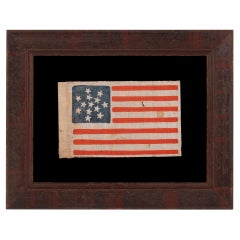
13 Star Antique American Parade Flag with Star in Snowflake Pattern, ca 1861-65
Located in York County, PA
13 STAR ANTIQUE AMERICAN PARADE FLAG, DATING TO THE CIVIL WAR PERIOD (1861-1865), OR PERHAPS PRIOR, WITH AN EXCEPTIONALLY RARE & BEAUTIFUL SNOWFLAKE MEDALLION CONFIGURATION
13 star ...
Category
American Antique Mid-19th Century Political and Patriotic Memorabilia
Materials
Cotton
H 10.25 in W 12.75 in D 2 in
13-Star American Parade Flag, 1860
Located in Colorado Springs, CO
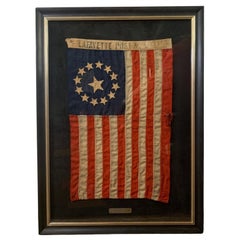
Presented is a stunning 13-star American parade flag, dating to 1860. The wool flag has 13 hand-sewn cotton stars with truncated tips. The stars are configured in the “Third Maryland” or “Cowpens” pattern, consisting of a 12-star wreath surrounding a large central star. The flag design is completed with 13 red and white alternating stripes and a white cotton hoist. The flag’s hoist has “Lafayette Post 140” stenciled in selvage.
The “Third Maryland” star pattern of a 12-star wreath surrounding a central star is associated with an early 13-star flag that was long thought to have been carried by William Batchelor of the 3rd Maryland Regiment at the Battle of Cowpens during the American Revolution. The flag, now in the collection of the Maryland State Archives, was later discovered by Smithosian experts to date to the mid-19th century. But this particular star pattern is forever linked to that particular 13-star flag and the wreath and central star configuration is still referred to as a “Third Maryland” or “Cowpens” style among dealers and collectors. Thirteen star flags with the “Third Maryland” pattern are among the scarcest and most desired by collectors of early American flag...
Category
American Federal Antique Mid-19th Century Political and Patriotic Memorabilia
Materials
Wool, Cotton
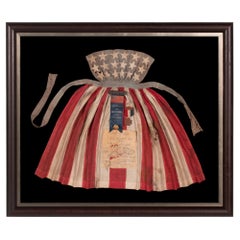
Civil War Apron, Made In Cambridge, OH by Laura, Hynes, ca 1861
Located in York County, PA
CIVIL WAR PERIOD APRON, MADE IN CAMBRIDGE, OHIO IN 1861 BY 12-YEAR-OLD LAURA HAYNES, WORN BY HER AT BENEFITS FOR THE U.S. SANITARY COMMISSION, PREDECESSOR OF THE RED CROSS, THAT STAFFED, FUNDED, AND MODERNIZED CIVIL WAR HOSPITALS
Laura Haynes was born on the 17th of June, 1847 to Vincent and Sarah (Dillon) Haynes of Westland, Ohio (southeast of Columbus and due south of Zanesville). Vincent was listed as a physician in the 1850 U.S. Census, then as a lawyer in 1860, apparently having pursued both fields. It stands to reason that that during the Civil War (1861-1865), the Haynes family, being of means and with Vincent involved in the medical profession, might become involved in philanthropy to benefit Civil War hospitals.
Made of plain weave cotton, this patriotic apron features 18 white, appliquéd, hand-sewn stars on a blue ground, cinched at the waist, with a blue belt incorporated below, followed by 13 vertical stripes, alternating red and white, likewise cinched, so that top and bottom have opposing triangular profiles. Aprons of this period did not generally have a loop or tie that went about the neck, to keep the breast portion up, but were rather pinned in place. All of the construction was accomplished by hand-stitching. One can see in the more crude stitching of the stars, how much more difficult it was to perform appliqué work than it was to hem fabric, especially for a 12-year-old girl.
While the count of 18 stars may have had no purpose other than to fill the available space, to create a patriotic display, it may just as likely have been selected to reflect the number of states that were felt to be loyal to the Union at the time. Until July 4th, 1861, there were officially 33 stars on the American national flag. This, less the entire complement of 15 Slave States, would arrive at a count of 18. President Abraham Lincoln urged the nation not to do this, desiring not to give credence to secession, with his goal of keeping the Union together. But there were no flag police and people did as they wished, creating versions of the Stars & Stripes in both the North and the South that removed those the respective maker(s) deemed loyal to the opposition. Although rare, a number of American flags of the Civil War era are known that display 18 stars, likely to reflect the removal of 15 Southern States.
In the upper center of the striped portion of the apron is a fraternal ribbon, made of blue satin silk, with a white metal brooch at the top and a gold button with an eagle below. This is decorated with a printed 13 star flag ribbon (applied), and with gilded text that reads: “The Women and Girl Workers of the Civil War; ’61-’65.” Next to this is the membership badge of the Women’s Relief Corp, which served as the women’s auxiliary of the Grand Army of the Republic, the primary organization for Civil War veterans. Below these, a hand-lettered exhibition tag was adhered, that reads as follows: “Made in 1861 at Cambridge Ohio by Laura Haynes; Age 12 Years; and Worn at Benefits for the Sanitary Commission [The Red Cross of 1861-5],” Followed by “Laura H. Green; Hotel St Mark; Oakland Calf.” Along the bottom of the tag is a brief title: “Flag-Apron of 1861-5,” with a circled item number “27.”
The Sanitary Commission was founded in the Spring of 1861 by private citizens in New York City, who were appalled by the Army’s lack of medical supplies and sanitary conditions in the care of Civil War soldiers. Officially sanctioned by the War Department on June 9th of that year, and approved by Abraham Lincoln on June 13th, the chief planner and organizer was Boston-born writer and Harvard-educated clergyman, Henry Whitney Bellows of New York (b. 1814, d. 1882). Bellows modeled the organization after the work of Florence Nightingale in the British Sanitary Commission of the 1850’s, and brought with him a force of volunteers belonging to an organization he led called the Woman’s Central Association of Relief of New York. In 1863, Bellows would become one of the four founders of the Union League Club of New York, with fellow Sanitary Commission leaders Frederick Law Olmsted (the designer of Central Park, considered to be the father of modern landscape architecture,) plus George Templeton Strong (American composer, painter, lawyer, and prolific diarist), and Oliver Wolcott Gibbs (Harvard professor, chemist, and physician). The goal of the Union League Club was to join like-minded and influential, moneyed men with the cause of both the Commission and the Union in general. In 1881, Sanitary Commission nurse Clara Barton would carry the torch forward, expanding upon the concept to form the Red Cross.
Sanitary Fairs—large, fundraising events held to benefit the Commission—were held in New York, Philadelphia, Baltimore, Chicago, St. Louis, and elsewhere. The Northern Ohio Sanitary Fair was almost certainly attended by Laura Haynes, 16 years old by that time, who is likely to have worn the apron there. Held in Cleveland from Feb. 22nd – Mar. 10th, 1864, the fair was opened by Major General James Garfield, future President of the United States, who, it is said, was extremely well received.
About 3 years later, on June 11th, 1868, Laura married Robert M. Green of Cambridge, Ohio (northeast of Westland), who shared her June 17th birthday. Born 2 years prior to Laura, in 1846, Robert enlisted as a Corporal with “A” company of the 85th Ohio Infantry, a 3-month unit, on May 27th, 1862. Mustering in on June 10th, I Columbus, at Camp Chase, the 85th was assigned to guard Confederate prisoners at the garrison. He mustered out on the 23rd of September.
By 1880, Robert & Laura Green had relocated to Oroville, California (Butte County...
Category
American Antique Mid-19th Century Political and Patriotic Memorabilia
Materials
Cotton
Still Thinking About These?
All Recently ViewedMore Ways To Browse
Battle Of Gettysburg
Patriotic Banners
Political Campaign Memorabilia
34 Star American Flag
48 Star American Flag Vintage
Antique 48 Star Flag
Colorado Flag
Presidential Memorabilia
39 Star American Flag
Antique Furniture Oklahoma
Colonial Dress
Commissioning Pennant
Patriotic Shield
Rough Rider
42 Star Flag
46 Star Flag
John Bellamy
Mexican Flag