Items Similar to Rare 13 Star Civil War Flag in the Trumbull Pattern w/ 36 Stars on the Reverse
Want more images or videos?
Request additional images or videos from the seller
1 of 13
Rare 13 Star Civil War Flag in the Trumbull Pattern w/ 36 Stars on the Reverse
Price Upon Request
Price Upon Request
Price Upon Request
Price Upon Request
Price Upon Request
Price Upon Request
Price Upon Request
Price Upon Request
Price Upon Request
Price Upon Request
About the Item
EXTRAORDINARY CIVIL WAR ERA FLAG, WITH 13 HAND-SEWN STARS ARRANGED IN A VARIANT OF WHAT IS KNOWN AS THE TRUMBULL PATTERN, FEATURING A HUGE, UPSIDE-DOWN CENTER STAR, AND THE EXTREMELY RARE TRAIT OF HAVING A DIFFERENT STAR COUNT ON THE REVERSE, WHICH DISPLAYS 36 STARS; HANDED DOWN THROUGH THE FAMILY OF GROVE H. "STOWE" DUDLEY OF THE 100th INDIANA, circa 1864-67:
Antique American flag of the Civil War era, made entirely of plain weave cotton. The stars are arranged in a rectangular box with a single star in the center. This rare and highly coveted design is what's referred to among flag aficionados as the "Trumbull" pattern, named after the artist John Trumbull (b. 1743, d. 1853), who for a brief time in 1776 served as George Washington's aide-de-camp, as well as within the staff of General Horatio Gates.
Even though ground forces weren't formally authorized to carry the Stars
Stripes until well into the 19th century, Washington, at least, is thought to have perhaps done so. Trumbull included American flags with his former commander, with stars arranged in a boxed medallion, in several versions of his most notable works. Because Trumbull left the army before the Act of Congress that created the American national flag was passed (June 14th, 1777), and because all of his views that included the flag were painted post-war, there is some question regarding whether or not the Stars
Stripes was actually present. Whatever the case may be, it can reasonably be assumed that the Trumbull pattern was being displayed somewhere during the Revolution.
Note the enormous size of the center star in this particular example, irregular in shape and visually impactful. With two points directed upward, instead of one, contrary to modern expectations of how a 5-pointed star should appear, one may likewise note the irregularity present in the alignment of the stars around the perimeter.
Also unlike modern flags, note how the profile of the canton is relatively near-to-square square, actually being a bit taller than it is wide. In this respect it bears similarity to many military battle flags, which displayed similar proportions. Because there was no specific requirement for this aspect of the American national flag until 1912, nor specific placement of the canton against the striped field, official shades of red and blue, number of points on the stars, star size, etc., most of the characteristics of the design of the Stars
Stripes, not only during the 18th and 19th centuries, but into the 20th, were left to the liberties of the maker. Note how the combination of the features thus far mentioned adds exceptional folk qualities to the flag’s design.
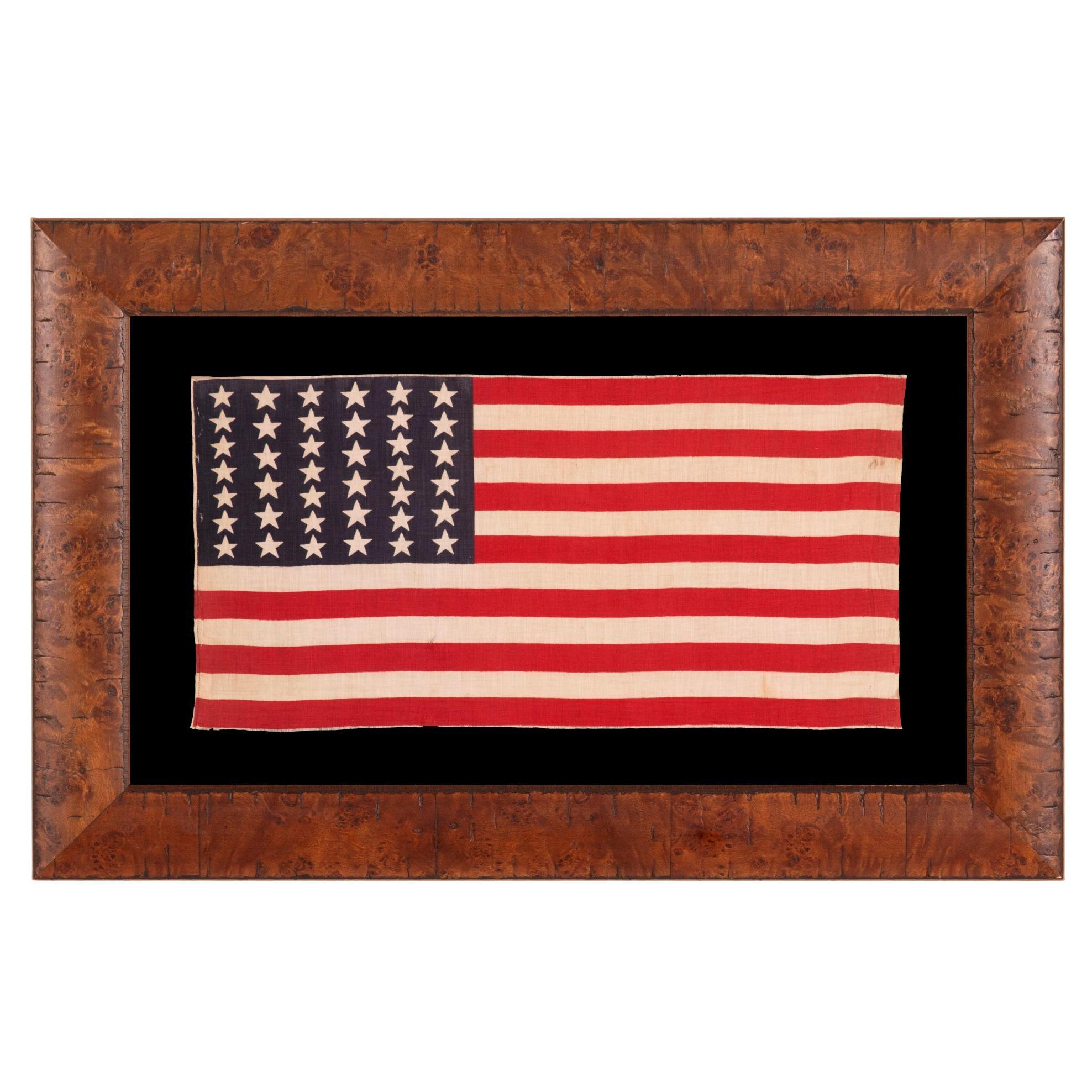
One of the flag’s most interesting elements is the use of a different star count on the reverse, which instead displays a compliment of 36 stars, arranged in 6 rows of 6. This is an extraordinary and very desirable feature. The selection of 13 stars, on one side, draws a parallel between the struggle for liberty during the American Revolution, and the one set before it once again at the time of the flag’s making, sometime between 1864-1867, toward the close of the Civil War. Due to Nevada’s wealth in silver, combined with increased support of the Republican, anti-slavery ticket, Lincoln escorted the territory to statehood on October 31st (Halloween), 1864, just 8 days before the November election.
Following the 3rd Flag Act (1818), stars were to be officially added each year on Independence Day, for all states that had entered over the course of the previous “flag year” (July 4th - July 3rd). Though the 36th star would thus not be officially added until July 4th, 1864, following the war’s end, few seem to have cared or perhaps been aware of the associated legislation. The thrust to new star counts instead stemmed from a combination of the notion of Manifest Destiny, from personal interest in the forthcoming state(s) for motivations political, patriotic, or otherwise, as well as from simple matter of practicality. Why, for example, make a flag with 35 stars when the addition of the 36th star was inevitable? Also at work was an element of American capitalism, motivated by the desire of commercial flag-makers to have a reason to sell new flags. In fact, almost all makers of flags, both commercial and at home, including those producing for both military and government function, added stars as soon as a new state was in, if not well beforehand in hopeful anticipation. The clearest example of this in the Civil War era surrounded the addition of Kansas as the 34th state. Though its admission had occurred on January 29th, 1861, when Confederates attacked Ft. Sumter approximately 3 months later, on April 12th, floating above the battlements was a 33 star flag. Officially there were still 33 stars and though that count would not officially change until July 4th of that year, almost all flags produced with the raising of volunteer regiments, from April – July, bore 34 stars. To do otherwise would have meant that all flags would need to be subsequently updated, which was highly impractical. In addition, the inclusion of Kansas, a Border State, as a newly formed Free State, over which the possibility of slavery’s expansion was heavily debated and fought both politically and physically (i.e., “Bloody Kansas”), was a Union victory, worthy of an additional ‘badge,’ so-to-speak.
Because 34 and 35 star flags were made and kept in significant supply by the War Department, as well as the Navy, flags with 36 stars are virtually non-existent among regulation Civil War battle flags. In the private sector, however, 36 star flags begin to appear as early as April of 1864, roughly 7 months before Nevada gained statehood.
It is of interest to note that, while flags with 36 stars would have theoretically fallen from production around March 1st, 1867, when Nebraska followed as the 37th state, I have seen at least one 37 star flag that could be positively dated, made in 1860, prior to the addition of the 34th, 35th, and 36th states, let alone number 37. Though jumping the gun to such a degree appears to have been highly unordinary, another 37 star example is documented as having been presented by General Benjamin Butler, future politician and Presidential candidate, to President Abraham Lincoln, a few days prior to his April, 1865 assassination. I presently own a 3rd which is a mate to the Butler-presented flag, and I could present nearly countless examples in other star counts. This is a fairly good illustration of the American expansionist mindset during the mid-latter 19th century, at least in regard to the production of American flags.
While cotton was a poor fabric for flags made for long-term outdoor use, as it absorbed water, became heavy, and was thus subject to tearing and rot, it was nonetheless the fabric of choice for homemade flags, such as this one. Unlike wool bunting, an open weave fabric used exclusively for the commercial manufacture of flags and banners, and silk, which was fairly delicate and costly, cotton was both inexpensive and widely available.
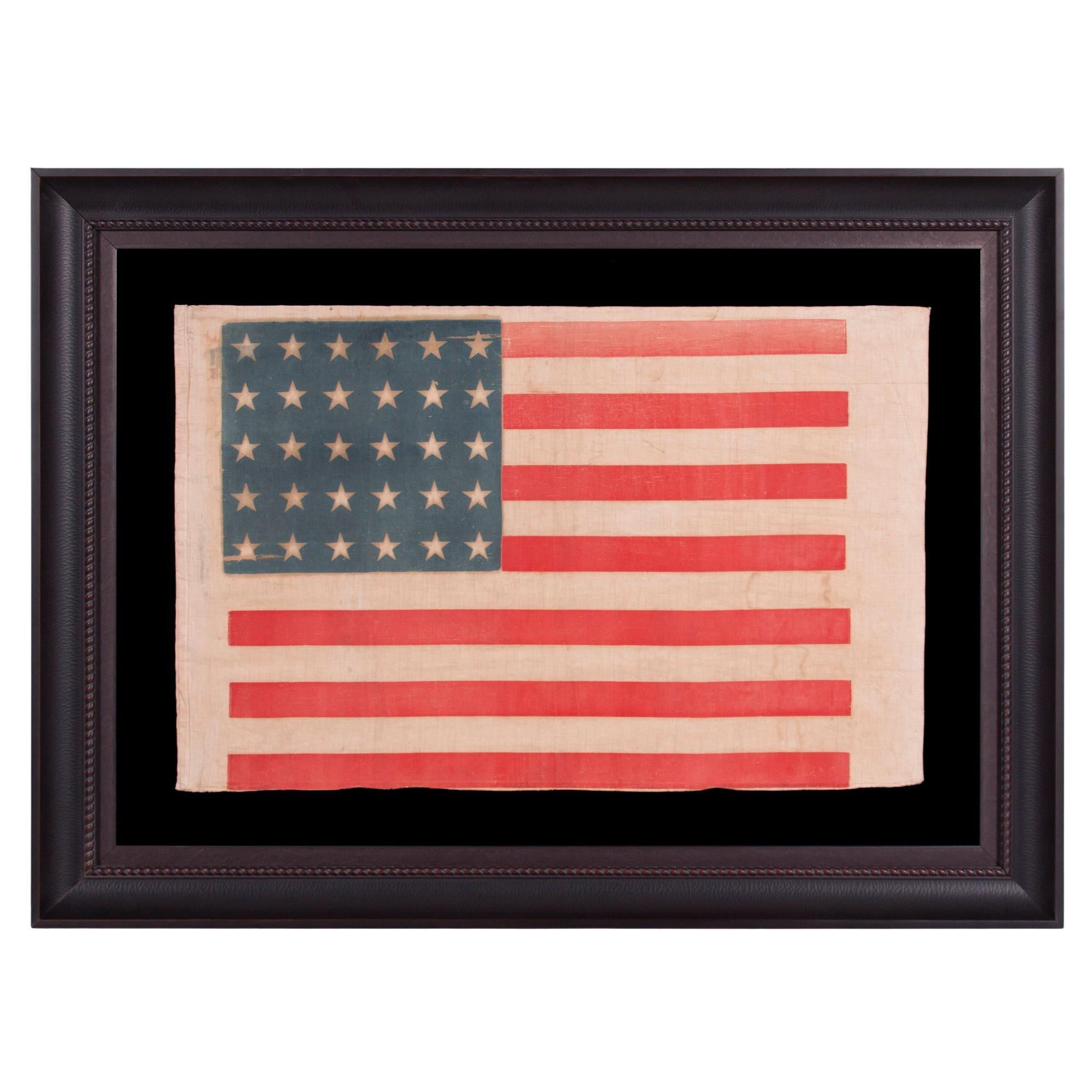
Because the stitching of each star does not line up with a opposing star on the other side of the canton, as it typically would on a flag devoid of bi-star-count feature, many of the stitches can be viewed on the reverse. This results in an interesting visual element. Like the 13 stars on the obverse (front), the 36 on the reverse are made of cotton, expertly appliquéd and entirely hand-sewn, exhibiting the same wonderful elements in their varied shapes and scattered orientation. While the level of workmanship in their application suggests someone regularly employed in flag manufacture, the assembly of the striped field suggests it was sewn independently by someone who was not. Though a capable seamstress, the manner of hemming in the red and white stripes resulted in an atypical overlap of the two colors. This did not allow for the canton to be neatly fit within them, or for the assembled field to line up accordingly when turned back and hemmed along the fly. The joining of the canton to the stripes, the seaming of the stripes, and all associated hemming was accomplished by treadle stitching. The combination of hand-sewn stars and treadle-sewn stripes is extremely prevalent during the Civil War period (1861-65), where approximately 60-70 percent of American flags exhibit at least some treadle stitching.
The flag was handed down through the family of a Civil War soldier by the name of Grover Hall Dudley. Identified as “Grove” in newspapers and military records, as well as on his headstone and obituary, he was known within his own family as “Stowe.” Born September 10th, 1838 at Orland, Indiana (Steuben County), along the Michigan border, Stowe is reported to have been the only one of his siblings born in the Hoosier State. His parents, Stephen M.
Lucy (Conger) Dudley, relocated from the village of Hannibal, New York (Oswego County), northwest of Syracuse, along Lake Ontario. As a young boy, he attended some of the earliest, pioneer, Indiana schools, before successful application to a teacher’s school called the North Eastern Literary Institute at Orland (a.k.a., the Northeastern Indiana Institute, est. 1850). Upon graduation, Stowe Dudley taught public school, in addition to farming.
Listing his residence at York Centre, Indiana, Grove (Stowe) Dudley enlisted as a Private with in the 100th Indiana Volunteer Infantry on August 15th, 1862. Mustering in at Fort Wayne, Indiana on the same day, he was assigned to “B” Company and served throughout the balance of the war.
Absorbing two companies of the 88th Indiana, the 100th left for Memphis on Nov. 1st, 1862 and upon its arrival there was assigned to the 2nd Brigade, 1st Division, Army of the Tennessee. Employed in the initial operations against Vicksburg – a fortress city and the last remaining Confederate stronghold on the Mississippi – it was repelled by the rebel capture of the Union supply depot at Holly Springs on December 20th, 1862, where 3,500 Confederate Cavalry, under Maj. Gen. Earl Van Dorn, seized a staggering $1.5 million of supplies slated for Grant’s Army.
Assigned to garrison and railroad guard duty at Collierville, Tennessee, in June, 1863, the 100th joined Grant at Vicksburg, took part in the siege, before moving against Jackson, Mississippi, where it was constantly engaged until the evacuation.
In camp at Big Black River Bridge, the 100th IN sailed to Memphis on Sept. 28th, 1863, then to Stephenson, Alabama, and on to Bridgeport, AL, a railroad and water transportation hub, on the Tennessee River. It was part of the force under Union General John C. Hooker that turned Gen. Bragg’s left flank at the Battle of Lookout Mountain, Tennessee on Nov. 24th, 1863. Defeating Bragg again at the Battle of Missionary Ridge, where he was stubbornly urged on by Maj. Gen. John C. Breckinridge, former 1860 Southern Democrat candidate against Lincoln), the 100th , following substantial losses at that engagement, took part in the chase of Bragg to Graysville, Georgia, then returned to Knoxville under Union Gen. William T. Sherman, in aid of Gen. Burnside in the defense of that city, then under siege by a portion of Lee’s Army of Northern Virginia under the command of Gen. James Longstreet, Lee’s principle subordinate.
Heading south again, the 100th IN reached Scottsboro, Alabama on the day after Christmas, 1863. On May 1, 1864, it joined Sherman’s Atlanta Campaign and March to the Sea, participating in at least 13 engagements, including Dalton, Snake Creek Gap, Resaca, Dallas, New Hope Church, Big Shanty, Kennesaw Mountain, Nickajack Creek, Cedar Bluffs, Chattahoochee River, Decatur, Jonesboro, and Lovejoy's Station.
Chasing Hood to the Tennessee River, it turned back and moved on to Savannah, Georgia with Sherman, where it partook in heavy engagement at Griswoldville. Moving by steamship to Beaufort, SC, it took part in Sherman’s Carolina Campaign, helping to seize Branchville, Columbia, Georgetown, and Cheraw, then was engaged at Bentonville, NC.
On its return north, the 100th IN participated in the occupation of Goldsboro, NC, then Raleigh, NC. It was present for the surrender of Joe Johnston’s army to General Sherman at Bennett’s House, VA on April 26th, 1865, then proceeded to Richmond, VA and on to Washington, DC, where it appeared in the Grand Review. Grove H. (Stowe) Dudley mustered out with his unit out at Washington on June 8th, 1865. After the war he returned to teaching and to farming. He wed Mary A. Clossen in 1866, became the father of 8, 4 of whom preceded him to death. He passed at the age of 83 on March 16th, 1922 and is interred at Greenlawn Cemetery, Orland, IN. In his obituary, Stowe was described as having been “a man of sterling integrity and his loyalty to his home and family was shown by his untiring efforts to give his children every possible advantage."
The flag passed through the Dudley family until one of Stowe’s great-grandchildren inherited it as part of the Michigan estate of one of Stowe’s children (grandfather of the inheritor). The history of the flag, being “long on family lore, but short on hard documentation,” is presently not known. Of the homemade sort one might expect to find gifted to a Civil War unit within a rural community, it was constructed in such a way that a rope could be inserted along the hoist, so that it could be readily and securely affixed to a staff. Definitely flown for an extended period, the flag exhibits precisely the sort of wear, with associated loss, that one would expect in a Civil War era example carried on foot.
Because there is no known specific history, and it is unknown whether or not someone within the Dudley family, or perhaps among the young students whom he taught before enlisting, may have made the flag and somehow secured its transport to him and/or the regiment in the field, mid-late war, one cannot be certain of its precise use or origin. Both of these things are possible. Because Dudley likely arrived home shortly before July 4th, 1865, it could be that the flag was presented to him for both the celebration of his return and/or that of the 100th, as well as the impending holiday, thereafter, to be displayed outside at the school where he would once again teach. Extended display there may alternatively explain the wear. Because he was married in 1866, when the 36 star count was still official, perhaps the flag was a gift from Stowe’s wife, Mary. Whatever the case may be, both beautiful and graphically unusual, the losses and overall state of preservation actually do more to benefit the flag’s presentation than they in any way detract from it.
More about John Trumbull
John Trumbull (1746-1853), Harvard graduate and son of the Governor of Connecticut, joined the Colonial Army in 1775, where among other appointments, he served as George Washington's aide-de-camp, as well as within the staff of General Horatio Gates.
Resigning in 1777, following a disagreement over the date of his military commission, Trumbull traveled to England to study art. Here he was introduced by Benjamin Franklin to American painter Benjamin West, the most celebrated artist in the world at the time, now living abroad. While training under West, Trumbull was imprisoned for treason against the crown. This occurred when a scapegoat was sought, after a British officer, of similar military rank to Trumbull’s former appointment, was captured and hung in America. Six months later he was released to the States. After the war, Trumbull returned to England, where he was encouraged by West to paint significant American historical figures and American military scenes. He commenced doing so in 1785 and was especially prolific, producing more than 250 works within this genre.
Trumbull included American flags with his former commander in several versions of his most notable views. In three of these he depicted a configuration of 13 stars that consisted of a single center star, set within a rectangular box of 12. These include:
The Death of General Mercer at the Battle of Princeton
In the collection of the Yale University Art Gallery, painted sometime between 1789 and 1831.
Depicts the events of January 3rd, 1777.
The Surrender of General Burgoyne at Saratoga, New York
Installed in the United States Capitol Rotunda in 1821, painted in 1821.
Depicts the events of October 17th, 1777.
The Surrender of Lord Cornwallis at Yorktown, Virginia
Installed in the United States Capitol Rotunda in 1820, painted between 1820 and 1821 (one of at least 4 versions illustrating 4 different flags).
Depicts the events of October 19th, 1781.
In his landmark book, Standards
Colors of the American Revolution, noted flag historian Edward Richardson describes Trumbull as "meticulous to the accuracy of uniforms and accoutrements; therefore, the flags depicted in [his] paintings should be considered as accurate versions of the time.” One extremely good argument against this assertation, is that the Battle of Princeton occurred more than 6 months before the First Flag Act was passed by Continental Congress, on June 14th, 1777. At that time, given present knowledge, the Stars
Stripes didn't exist.
Though Washington may have displayed the Stars
Stripes, ground forces weren't formally authorized to carry it until well into the 19th century. The practice was not officially authorized until 1834 (artillery), 1841 (infantry), and 1862 (cavalry). Due to the above facts, and other supporting documentation—or lack thereof—some vexillologists have surmised that the American national flag was included by Trumbull, simply because the American public somehow expected it to be there, in a way not so very different from the modern perception today. One of several explanations for this phenomenon is that, with such inconsistency across both the flags of colonial regiments, and their uniforms, it was important to include some sort of common device that the viewer could identify as American. Whatever the case may be, the box medallion pattern in three of Trumbull's works led to a permanent association between this exceedingly scarce design with the Trumbull name. Whatever the case may be, his inclusion of the Stars
Stripes on the battlefield, be it fact or fiction, illustrates the appropriateness of its presence in the American consciousness from very early on.
It could also be argued that Trumbull’s inclusion of the flag, prior to June 14th, 1777, may suggest that there is reason to speculate as to whether the 13-star, 13-stripe American flag was actually being displayed prior to that time. If so, it might explain why the language used in the legislation to make it official was so brief. Perhaps it was already familiar to those involved.
Some Notes about 13 Star Flags
13 star flags have been continuously produced throughout our nation’s history for purposes both patriotic and utilitarian. Because this was the original number of stars on the American flag, representing the original 13 colonies, it was appropriate for any flag made in conjunction with celebrations of American independence. 13 star flags were hoisted at patriotic events, including Lafayette’s visit in 1824-25, the celebration of the nation’s centennial in 1876, and the sesquicentennial in 1926. They were displayed during the Civil War, to reference past struggles for American liberty, and were used by 19th century politicians while campaigning for the same reason.
13 star flags were flown by American ships both private and federal. The U.S. Navy used 13 stars on the ensigns made for small boats, because they wished the stars to be easily discerned at a distance. As the number of stars grew with the addition of new states, it became more and more difficult to fit stars on a small flag so that they may be viewed from afar as individual objects. Because any star count that has previously been official remains so today according to the Congressional flag acts, all 13 star flags in an otherwise appropriate design remain official flags of the United States.
Mounting: For 25 years we have maintained a specialized department for this purpose. Our lead conservator holds a master's degree in textile conservation from one of the nation’s top university programs. We take great care in the mounting and preservation of flags and related textiles and have preserved thousands of examples.
The background fabric is 100% cotton twill, black in color, that has been washed and treated for colorfastness. The substantial, black-painted and gilded molding, with its wide, shaped profile, is Italian. The glazing is U.V. protective acrylic (Plexiglas). Feel free to contact us for more details.
Condition: There is minor soiling in the white stars, accompanied by minor to moderate of the same throughout the white stripes, the latter being most significant below and to the fly end of the canton, and adjacent to the fly end. There is minor to modest fading of the red and blue fabrics. There are tears and associated losses, from obvious, extended use, in the top and bottom corners of the hoist end (minor), as well as the striped field, The most significant of which occurs adjacent to the fly end, and within the first and last white stripes, where there are extended lateral tears. Many of my clients prefer early flags to show their age in history of use. The flag presents beautifully.
Frame Size (H x L): 46.25" x 65"
Flag Size (H x L): 34.5" x 53.25"
- Dimensions:Height: 46.25 in (117.48 cm)Width: 65 in (165.1 cm)Depth: 2.5 in (6.35 cm)
- Materials and Techniques:
- Place of Origin:
- Period:
- Date of Manufacture:1864-67
- Condition:See Item Description.
- Seller Location:York County, PA
- Reference Number:Seller: 13j-17081stDibs: LU849743197652
About the Seller
5.0
Recognized Seller
These prestigious sellers are industry leaders and represent the highest echelon for item quality and design.
Established in 1991
1stDibs seller since 2008
71 sales on 1stDibs
Typical response time: Several days
- ShippingRetrieving quote...Shipping from: York County, PA
- Return Policy
More From This Seller
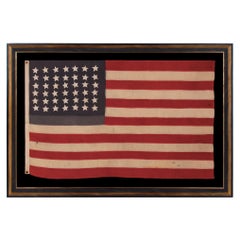
View All39 Star Antique American Parade Flag with Stars in Two Sizes, Ca 1876
Located in York County, PA
39 STARS IN TWO SIZES, ALTERNATING FROM ONE COLUMN TO THE NEXT, ON AN ANTIQUE AMERICAN PARADE FLAG WITH AN UNUSUALLY ELONGATED PROFILE, DATING TO THE 1876 CENTENNIAL, NEVER AN OFFICI...
Category
Antique 1870s American Political and Patriotic Memorabilia
Materials
Cotton
42 Hand Sewn Stars on An Antique American Flag ca 1889-1890
Located in York County, PA
42 HAND-SEWN STARS ON AN ANTIQUE AMERICAN FLAG WITH A TWO-TONE, DUSTY BLUE CANTON, REFLECTS THE ADDITION OF WASHINGTON STATE, MONTANA, AND THE DAKOTAS, NEVER AN OFFICIAL STAR COUNT, ...
Category
Antique Late 19th Century American Political and Patriotic Memorabilia
Materials
Wool
Price Upon Request
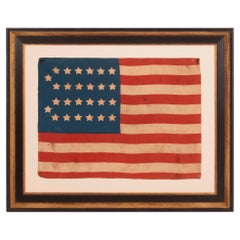
26 Star Antique American Flag, with 11 Stripes, Michigan Statehood, ca 1837-1846
Located in York County, PA
26 STAR ANTIQUE AMERICAN PARADE FLAG WITH 11 STRIPES AND IT’S CANTON RESTING ON THE “WAR STRIPE.” THE EARLIEST KNOWN STAR COUNT FOR PRINTED EXAMPLES, 1837-1846, MICHIGAN STATEHOOD
2...
Category
Antique Mid-19th Century American Political and Patriotic Memorabilia
Materials
Cotton
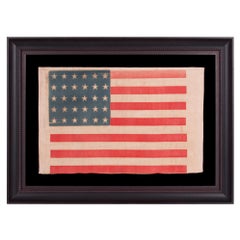
30 Star Antique American Parade Flag, Wisconsin Statehood, ca 1848-1850
Located in York County, PA
ANTIQUE AMERICAN PARADE FLAG WITH 30 STARS, THE ONLY KNOWN EXAMPLE IN THIS SIMPLE BUT EXTRAORDINARY STYLE, PRE-CIVIL WAR, OFFICIAL FOR JUST TWO YEARS, REFLECTS THE ADDITION OF WISCON...
Category
Antique Mid-19th Century American Political and Patriotic Memorabilia
Materials
Cotton
Price Upon Request
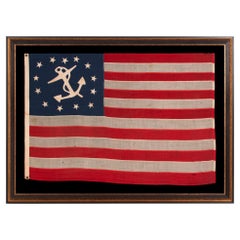
Outstanding 13 Star Hand-sewn American Private Yacht Flag, ca 1865-1885
Located in York County, PA
OUTSTANDING, 13 STAR, ANTIQUE AMERICAN PRIVATE YACHT ENSIGN WITH GREAT FOLK QUALITIES THAT INCLUDE AN UNUSUALLY WIDE ANCHOR AND A DECIDEDLY LOPSIDED RING OF 13 STARS; MADE DURING THE 2ND HALF OF THE 19TH CENTURY; ITS DEVICE HAND-SEWN AND SINGLE-APPLIQUÉD
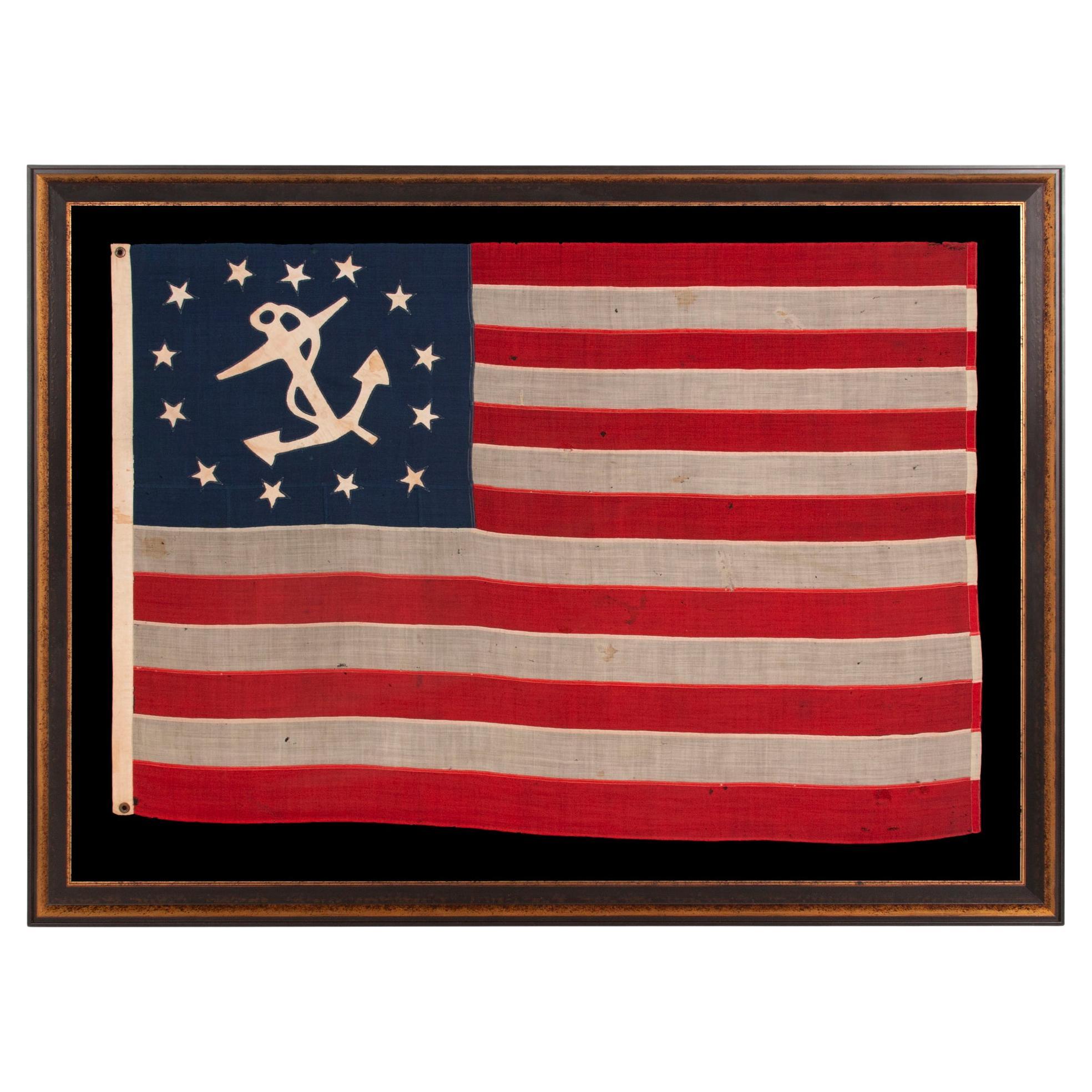
Private yacht ensigns were approved American signals for maritime use that allowed pleasure boats to bypass customs. Though the legislation that approved them was adopted prior to 1850, almost all such flags that one will encounter were sewn by electric machine and made during the 20th century. The unusual gems among surviving examples are those that are earlier and include hand-sewn elements. Even more rare are a select few with atypical graphics. Barely any fall into both of these categories at once. Take note of the anchor on this particular flag, wide a long horizontal crossbar (stock) that contributes to uncommonly wide stance. Set within a ring of stars that is decidedly lopsided, the result is as bold as it is endearingly whimsical—two of the best qualities in American folk art, a category in which this particular example can be filed. While I have owned 13 star private yacht flags that have displayed star and canted anchor devices that were somewhat larger and/or bolder than typical, I cannot recall any that were so graphically intriguing as this one.
Brief History of Private Yacht Ensigns:
The medallion configuration, 13-star, 13-stripe flag, with a canted center anchor was entered into official use in 1848, following an act of Congress, that made it the official signal for U.S. pleasure sailing vessels. The need for such a flag arose with the popularity of boating as a pastime for well-to-do Americans, and as a competitive sport, in addition to its longstanding utilitarian role as a vehicle of trade. In early America, all boats were subject to customs searches at every port. Without modern income tax, the federal government derived its revenues mostly from tariffs, so an accounting of foreign goods on ships was a critical venture. As yachting for pleasure became more prevalent, however, more and more time was spent searching boats that had no such inventory, wasting time for both customs officials and wealthy ship owners.
John Cox Stevens, a former president of the Jockey Club and future founder of the Union League Club, became the New York Yacht Club’s Commodore upon its founding in 1845. In 1847 he approached the secretary of the treasury and suggested that something be done to streamline the customs process for non-trade vessels. In 1848, legislation passed Congress requiring registration of these boats, which could then fly the “American Yachting Signal” to bypass customs. This remained on the books until the 1980’s, when the 1848 legislation was revoked, but the use of flags in this design for decorative function continues to this day.
13 star flags have been flown throughout our nation’s history for a variety of purposes. In addition to their use on private yachts, they were hoisted at patriotic events, including Lafayette’s final visit in 1824-25, the celebration of the nation’s centennial in 1876, and the sesquicentennial in 1926. They were displayed during the Civil War, to reference past struggles for American liberty and victory over oppression, and were used by 19th century politicians while campaigning for the same reason. The U.S. Navy used the 13 star count on small boats until 1916, because it was easier to discern fewer stars at a distance on a small flag. Commercial flag-makers mirrored this practice and some private ships flew 13 star flags during the same period as the Navy.
Construction: The stars and anchor are made of cotton, hand-sewn, and single-appliquéd. This means that they were applied to one side of the canton, then the blue fabric was cut from behind each star, folded over, and under-hemmed, so that one star could be viewed on both sides of the flag. I always find single-appliquéd stars more interesting, not only because they are evidence of a more difficult level of seam-work and stitching, but also because they are more visually intriguing. The two visible rows of hand-stitching emphasize their hand-sewn construction. For these reasons, single-appliquéd stars often appeal to connoisseurs of early American textiles...
Category
Antique Mid-19th Century American Political and Patriotic Memorabilia
Materials
Wool
Price Upon Request
13 Star Antique American Parade Flag, ca 1876-1899
Located in York County, PA
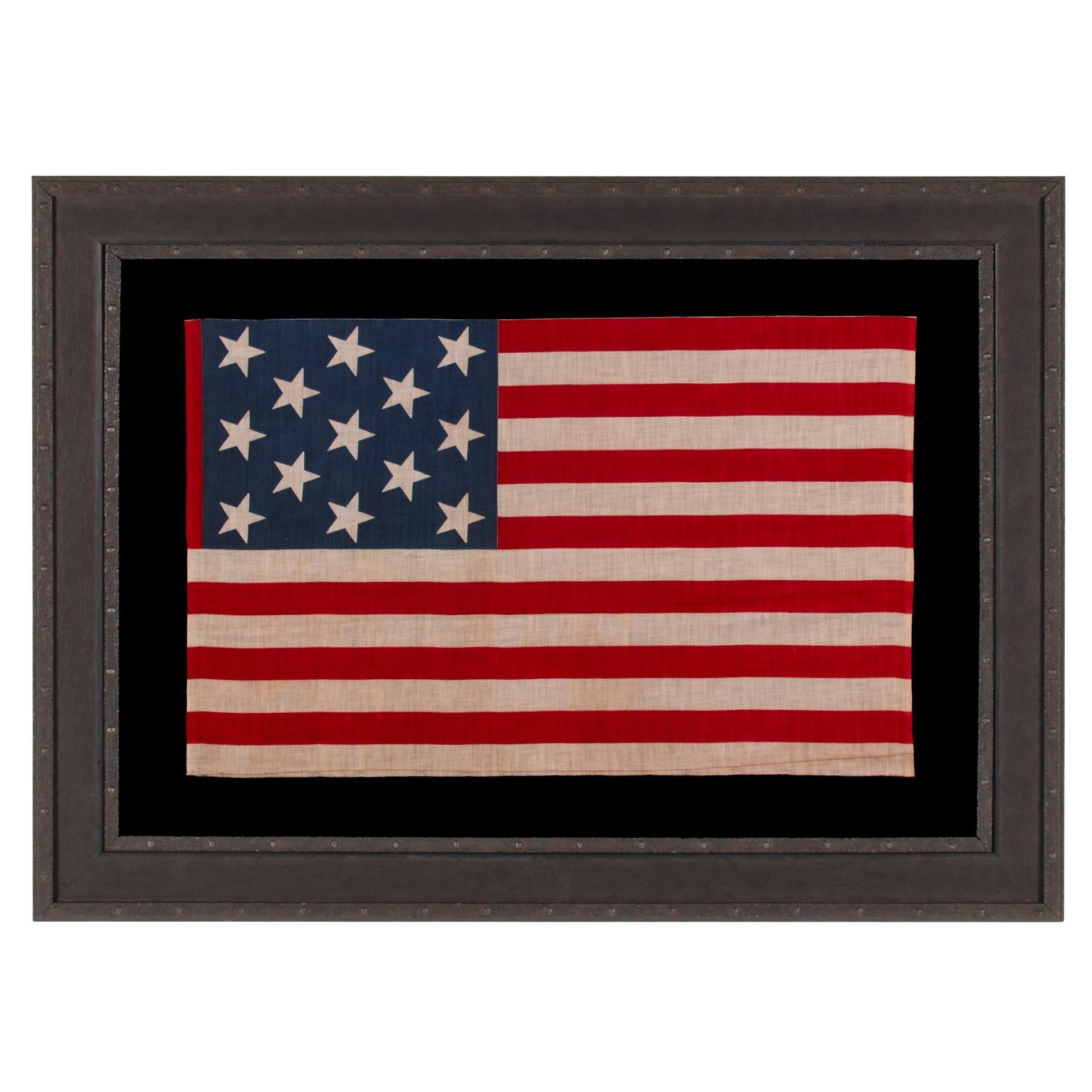
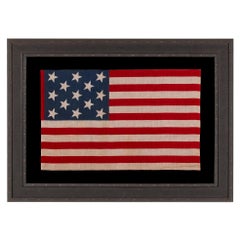
13 STAR ANTIQUE AMERICAN PARADE FLAG, WITH A 3-2-3-2-3 CONFIGURATION OF STARS, AN EXTREMELY SCARCE AND UNUSUALLY LARGE VARIETY, MADE circa 1876-1899
13 star American national parade...
Category
Antique Late 19th Century Canadian Political and Patriotic Memorabilia
Materials
Cotton
Price Upon Request
You May Also Like
42-Star American Parade Flag, Commemorating Washington Statehood, 1889
Located in Colorado Springs, CO
This is an uncommon 42-star flag, commemorating the addition of the state of Washington to the Union. The flag dates to 1889-1890, and is printed on cotton. The canton consists of s...
Category
Antique 1880s American Political and Patriotic Memorabilia
Materials
Cotton
44-Star Silk American Flag, Celebrating Wyoming Statehood, Circa 1890-1896
Located in Colorado Springs, CO
Presented is a 44-star silk American flag, commemorating Wyoming statehood. The flag dates to 1890-1896. The flag has an “8-7-7-7-7-8” star configuration, with the stars whimsically ...
Category
Antique 1890s American Political and Patriotic Memorabilia
Materials
Silk
13-Star Wool American Flag, with Zig-Zag Stars, Circa 1900
Located in Colorado Springs, CO
This is a beautiful 13-star American flag, each star sewn with zig-zag stitching. The wool flag was sewn at the turn of the century, circa 1900. The flag features 13 white stars rest...
Category
Antique Early 1900s American American Classical Political and Patriotic ...
Materials
Brass
13-Star Bennington "76" Parade Flag, Early 20th Century
Located in Colorado Springs, CO
Presented here is a striking 20th century 13-star Bennington “76” style parade flag, modeled after the historic example preserved at the Bennington Museum in Vermont. This commemorat...
Category
Early 20th Century American American Colonial Political and Patriotic Me...
Materials
Fabric
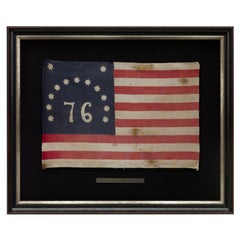
31-Star Printed American Flag, Celebrating California Statehood, Circa 1850
Located in Colorado Springs, CO
This is a rare 31-star medallion printed American flag, celebrating the addition of California to the Union. The flag is printed on silk and has a spectacular “Great Star” canton pat...
Category
Antique 1850s American Political and Patriotic Memorabilia
Materials
Silk
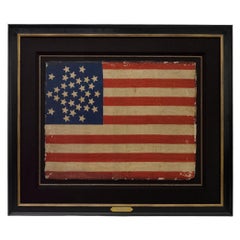
36-Star American Printed Parade Flag, Circa 1865-1867
Located in Colorado Springs, CO
This is an antique 36-star American flag, as striking as it is scarce. The flag has a glazed cotton construction, with a blue canton printed with 36 white stars. The stars are arrang...
Category
Antique 1860s American Political and Patriotic Memorabilia
Materials
Cotton